High Speed Two Lite
Posts that relate to Rishi Sunak’s cut-back High Speed Two will be tagged with High Speed Two Lite.
These are the current list of posts.
Could High Speed Two Finish At Lichfield?
Could Manchester Airport Be Accessed From The West By A Tunnel Under The M56?
High Speed Two To Barrow-in-Furness
High Speed Two To Stoke-on-Trent
Is Six Platforms Enough At Euston For High Speed Two?
Will High Speed Two Lite Make Stafford An Important Station?
UK’s First Battery-Powered Trains Hit The Tracks
The title of this post, is the same as that of this article on the BBC.
This is the sub-heading.
The UK’s first battery-powered passenger trains have started running on Merseyside.
These two paragraphs outline the article.
The trains, which are part of the Liverpool City Region’s £500m publicly owned fleet, will run from the new £80m Headbolt Lane station in Kirkby.
Metro Mayor Steve Rotheram said the move helps to pave the way “for cleaner and greener” transport.
I particularly liked this paragraph.
The battery technology – which removes the need for a live third rail – could see the Merseyrail network running to previously inaccessible places, including Manchester, Wrexham, Warrington, Preston and Runcorn, according to a Liverpool City Region Combined Authority spokesperson.
After the trouble, I had on Tuesday, when I tried to get from Manchester to Saint Helens, Manchester is also a city that’s difficult to leave.
High Speed Two To Stoke-on-Trent
Some of you out there might be a bit worried after Rishi Sunak’s speech today, when he announced he’d cancelled High Speed Two, as you might be losing a future high speed service.
Currently, Stoke-on-Trent is served by two trains per hour (tph), that run between London and Manchester Piccadilly.
- One train calls at Milton Keynes Central, Rugby, Macclesfield and Stockport, and takes about 1:33 to Stoke and 2:12 to Manchester Piccadilly.
- The other calls at Nuneaton and Stockport, and takes about 1:30 to Stoke and 2:06 to Manchester Piccadilly.
- Trains are both 9-car and 11-car Class 390 trains or Pendolinos.
- All trains go via Colwich.
This map shows the Colwich, Stafford and Stoke-on-Trent.
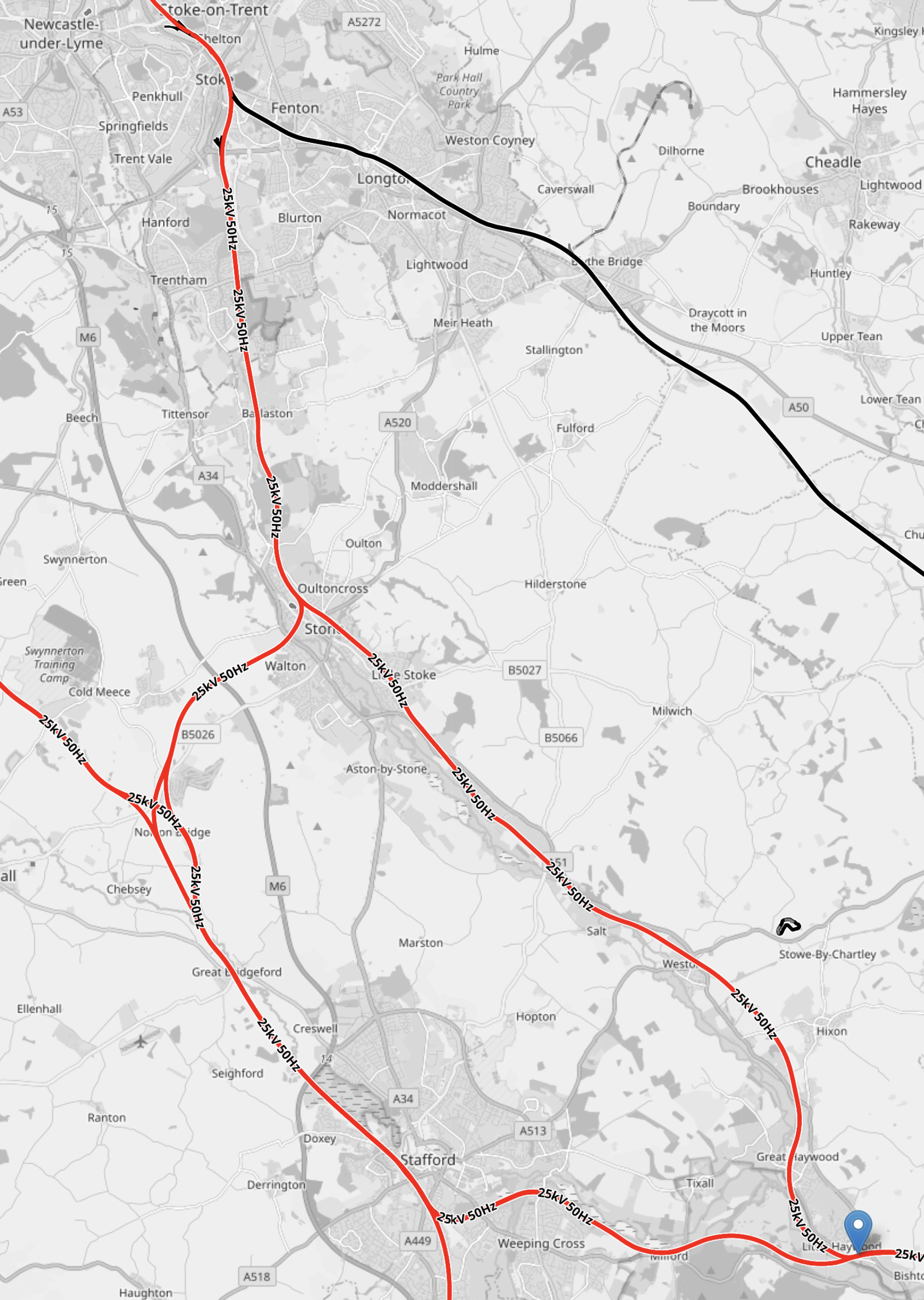
Note.
- Electrified lines are shown in red.
- The line across the South-West corner of the map is the West Coast Main Line.
- Stafford is the Northern end of the Trent Valley Line, which runs East along the bottom of the map.
- The Trent Valley Line, which is a by-pass of the West Coast Main Line, rejoins that line at Rugby.
- Stoke-on-Trent is in the North-West corner of the map.
- Colwich is in the South-East corner of the map and is marked by a blue arrow.
- There are two routes between Stone-on-Trent and Colwich; the more-direct Northern route and a Southern route via Stafford.
The current services between London and Stoke-on-Trent use the more-direct Northern route, although they can take the Southern route via Stafford.
This must mean that as Stoke-on-Trent services take the Northern route, there are more paths through Stafford for West Coast Main Line services to and from Liverpool, Manchester and Scotland.
This graphic shows High Speed Two services after Phase 2b is completed.
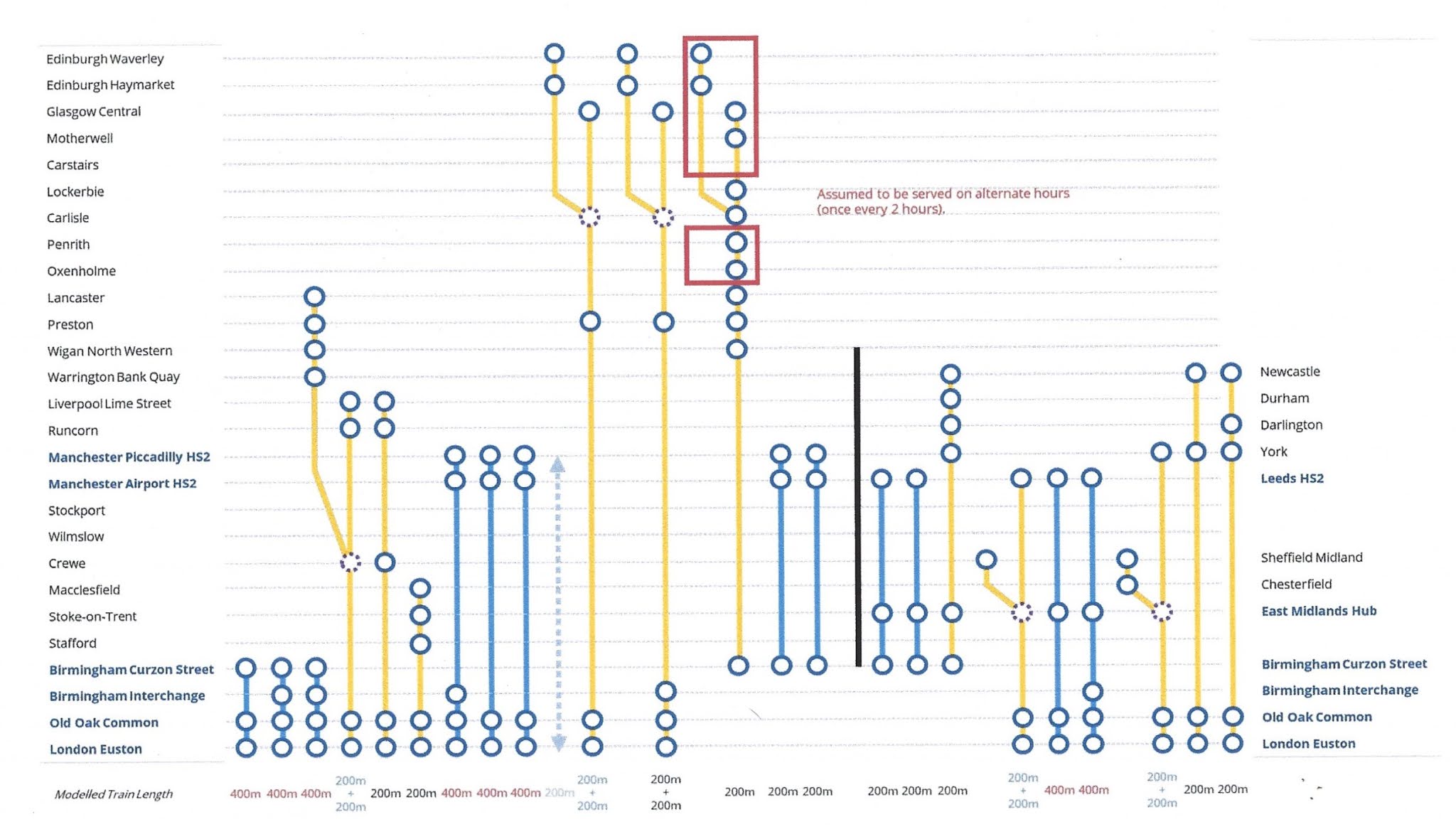
Note.
- Services shown in blue are run by High Speed Two Full Size trains.
- Services shown in yellow are run by High Speed Two Classic-Compatible trains.
- Each of these trains will have a frequency of one tph.
The third High Speed Two Classic-Compatible train from the left is a London and Macclesfield service, which will stop at Stafford and Stoke-on-Trent, has the following timings from London.
- Stafford – 0:55 – 22 minutes faster
- Stoke-on-Trent – 1:10 – 14 minutes faster
- Macclesfield – 1:30 – 11 minutes faster
I have a few thoughts and questions.
How Does This High Speed Two Service Get To And From London?
The service goes through Stafford and then takes the Trent Valley Line to the South.
This map clipped from the HS2 site, shows the original layout of HS2 to the North and East of Lichfield.

Note.
- High Speed Two runs North-South across the map.
- After the Junction by Fradley South, the now-scrapped High Speed Two to Crewe and the North, is the branch to the East.
- The other branch connects to the Trent Valley Line, which can be picked out North of Lichfield, where it passes through Lichfield Trent Valley station.
- The Trent Valley Line goes North-West through Colwich to Stafford, where the line rejoins the West Coast Main Line.
As the Eastern branch North from the junction has been scrapped, all trains between London and North would go via this link between High Speed Two at Lichfield and Trent Valley Line through Stafford.
Can The Current Trains and the High Speed Two Classic-Compatible Trains Share Tracks?
The answer will be yes, as the High Speed Two Classic-Compatible trains have been designed to share tracks with existing trains.
Full digital signalling may be needed to enable 140 mph running and more paths on the classic lines.
Will There Be A Second High Speed Two Service To Stoke-On-Trent And Stafford?
One of the problems with High Speed Two is that it won’t call at stations in the Midlands that are currently served by Avanti West Coast.
- Currently, stations with an Avanti call are Milton Keynes Central, Nuneaton and Rugby.
- Avanti’s second Liverpool service will call at Tamworth and Lichfield Trent Valley.
- In the June 2023 Edition of Modern Railways, Avanti’s Managing Director; Andy Mellors talks about the benefits the company accrues from stopping in the Midlands.
I believe that after High Speed Two opens, that a semi-fast service could run between London and Manchester.
- It would be run by a Class 390 train or Pendolino.
- It would use the route currently used by Manchester services via Stoke-on-Trent.
- At the Southern end, it would terminate in London Euston.
- It could call at Watford Junction, Milton Keynes Central, Rugby, Nuneaton, Lichfield Trent Valley, Stoke-on-Trent, Macclesfield and Stockport.
- ,Station stops would be arranged as to need.
- A one stop service to London takes 90 minutes from Stoke-on-Trent, with a two-stopper taking 93 minutes, so does each stop with a Pendolino add three minutes to the journey time?
Such a service could be developed to give stations like Stoke-on-Trent a second service to London.
The Lines Around Stafford
This map from OpenRailwayMap shows the lines around Stafford.
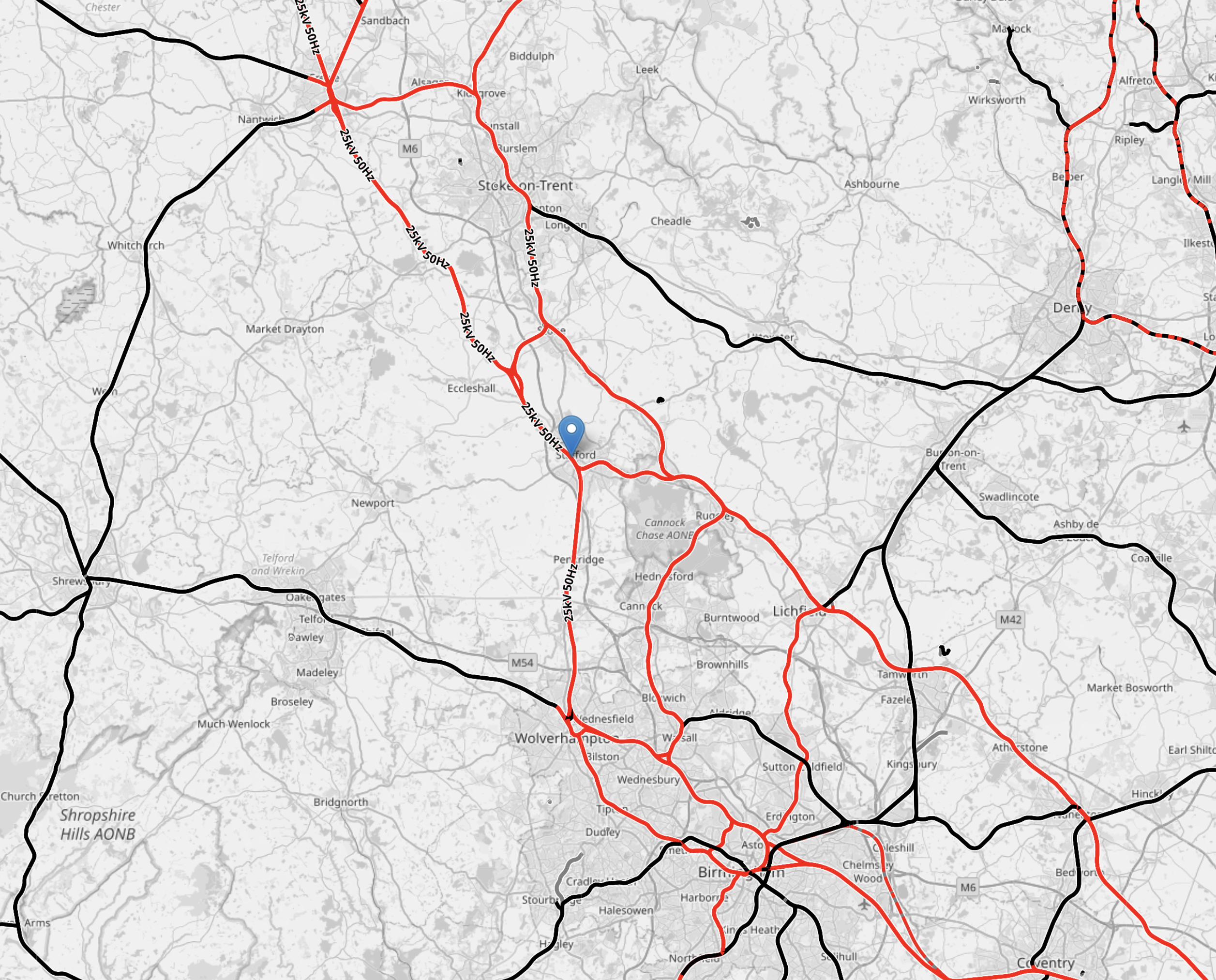
Note.
- Red lines are electrified.
- Black Lines are not.
- Stafford is marked by the blue arrow.
Selective electrification could probably improve connectivity by a large margin.
This Google map shows Stafford station.
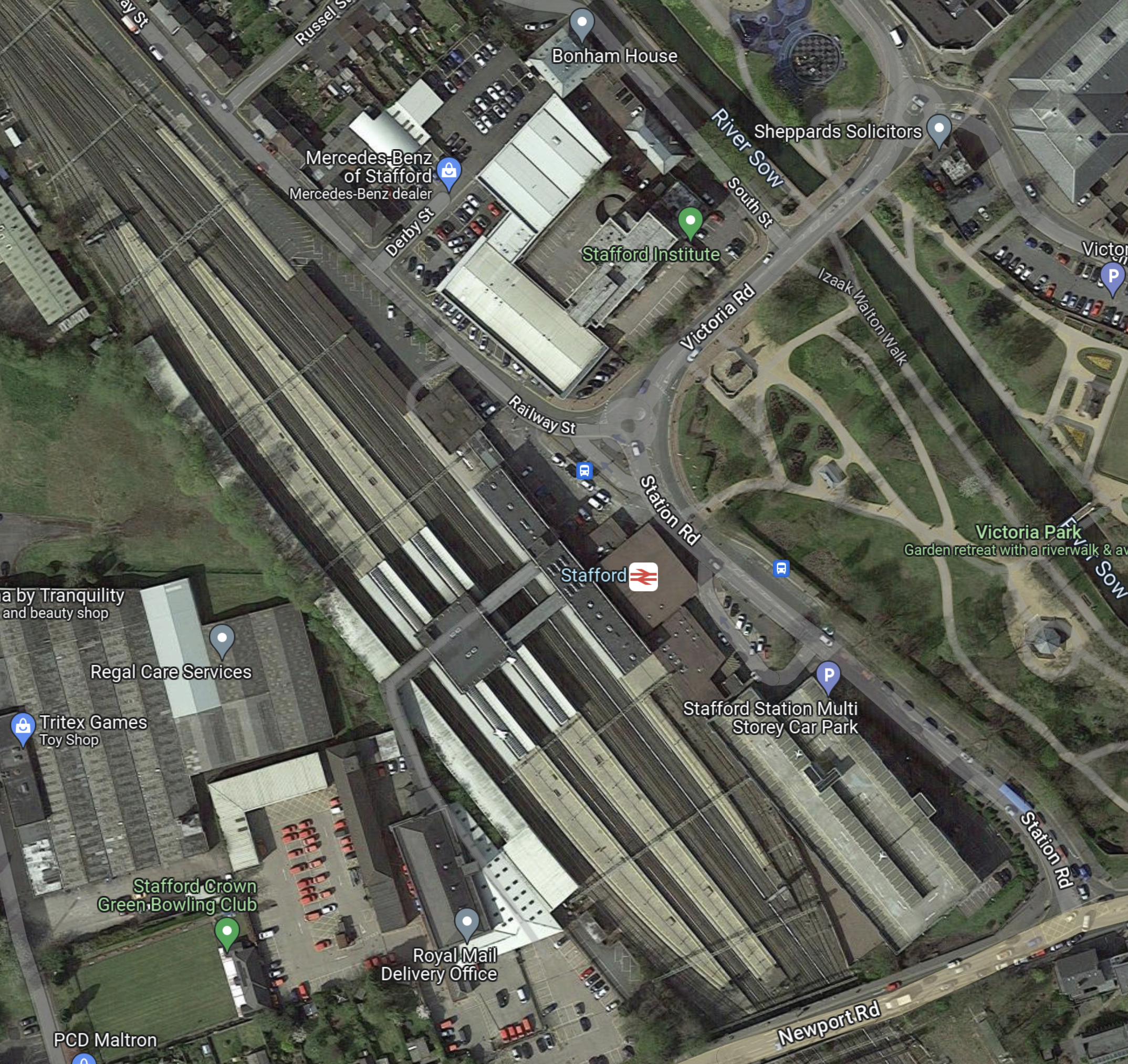
I feel that Stafford station could be developed into a major interchange between High Speed Two and local services.
Conclusion
It looks to me that Stoke-on-Trent will be well-served by High Speed Two.
See Also
Could High Speed Two Finish At Lichfield?
INEOS Inovyn Becomes Europe’s First Green Hydrogen ISCC PLUS Fully Certificated Producer
The title of this post, is the same as that of this press release from INEOS.
These two bullet points, act as sub-headings.
- INEOS Inovyn’s Antwerp hydrogen production, has been certified under the ISCC (International Sustainability & Carbon Certification) PLUS scheme.
- We become the first European company to have our renewable hydrogen fully audited with greenhouse gas data certification.
This paragraph describes how the hydrogen is produced.
Our Antwerp site produces hydrogen through Chlor-Alkali electrolysis – the electrolysis of brine producing chlorine, caustic soda/potash, sodium hypochlorite and hydrogen. The electricity used to produce this hydrogen comes directly from wind turbines off Belgium’s North Coast.
The Castner-Kellner process, that I worked on at ICI in the 1960s produced similar products.
 The Anonymous Widower