GWR Trialling Transformative Ultra-Rapid Charging Train Battery
The title of this post is the same as that of this article on Rail Technology Magazine.
This is the sub-heading.
Great Western Railway (GWR) has begun trialling a potentially groundbreaking battery innovation called FastCharge. If the trial is successful, it is hoped that the technology could transform branch line services and accelerate the decarbonisation of the network.
This is the first paragraph.
This innovative system, which has been developed over three years, eliminates the need for diesel trains on branch lines by powering battery-operated units with ultra-rapid charging. The system boasts an impressive 2,000kW charging capacity, eight times more powerful than a Tesla Supercharger, allowing trains to fully recharge in just 3.5 minutes at West Ealing station, the trial’s first real-world location.
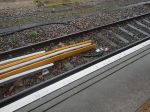
I took these pictures of the trial installation at West Ealing station, this morning.


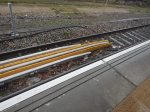

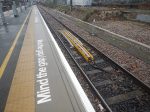
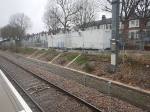
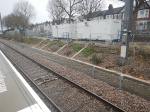
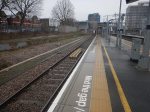
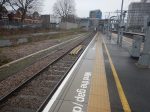
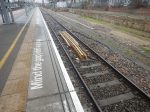
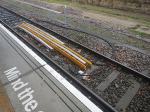
Note.
- Platform 5 is used by the trains to and from Greenford station.
- Two sets of charging rails have been installed between the rails, in Platform 5.
- The rails in the charging rails could be aluminium. This would not be surprising, as it is a good electrical conductor.
- The two shorter outside charging rails could be connected together.
- The yellow parts of the charging rails are plastic, so are probably for warning purposes.
- Two white containers have been installed alongside the track.
In Great Western Railway Updates EHRT On Its Upcoming Operational Trial Of Fast Charge Tech, I described the components of the Fast Charge system in this paragraph.
The Fast Charge system consists of three key components: retractable charging shoe gear, which is mounted to the underframe of the train; short (4m) charging rails mounted between the underframe of the train; and the Fast Charge Battery Bank (FCBB) installed beside the track, acting as an energy buffer between the train and the grid.
The charging rails are clearly visible in my images and the Fast Charge Battery Bank is probably in the white containers.
These are my thoughts.
The Engineering Is Of A High Quality
Or it certainly appears so from the platform and in the pictures, that I took.
How Much Energy Will Be Taken On Board at Each Charge At West Ealing?
According to the Rail Technology Magazine article, the Fast Charge Battery Bank will have to supply 2,000 KW for 3.5 minutes to fully-charge the train at West Ealing station.
This is 7,000 KW-minutes or 117 KWh.
In D-Train Order For Marston Vale Confirmed, this is said about the batteries on a Class 230 train.
- The train has four battery rafts, each with a capacity of 106 kWh
- Range is up to fifty miles with a ten minute charge at each end of the journey.
- Range will increase as battery technology improves.
I wonder if the Class 230 train, that will run between West Ealing and Greenford, will only have one 106 kWh battery.
- This will be less weight and therefor better acceleration.
- 117 kWh in the Fast Charge Battery Bank will be sufficient to fully-charge the single battery.
- The route is only five miles for a round trip.
I can see costs dropping.
What Batteries Will Be Used In The Fast Charge Battery Bank?
I think there are four main possibilities.
- New lithium-ion batteries
- Refurbished second-hand electric vehicle batteries
- New lead-acid batteries.
- It might be possible to use supercapacitors
Note.
- Lead-acid batteries can lose charge in cold weather.
- Supercapacitors don’t care about the weather.
- The weight of lead-acid batteries would not be a problem in a stationary application.
If there is only one battery on the train, I can see the supercapacitors handling it.
What Voltage Is Used In The Charging Rails?
Consider.
- The Vivarail Class 230 trains are built from redundant London Underground D78 Stock trains.
- The D78 Stock trains were built to run on London Underground lines, when that had voltages of 0 and 630 VDC.
- So I wouldn’t be surprised if the trains were designed around this voltage.
- If the charging rails worked at 630 VDC, then to have a 2,000kW charger, this would mean a charging current of 3175 Amps.
This would explain the fat cables connecting the charging rails to the Fast Charge Battery Bank.
An alternative voltage to use could be 3,000 VDC, as some trains are built to this voltage and therefor the electronics and transformers must be available. This would reduce the charging current to 667 Amps, which might be able to use smaller cables.
It may come down to what is convenient for the output voltage of the batteries.
Why Are There Two Sets Of Charging Rails?
They are both shown in this image.
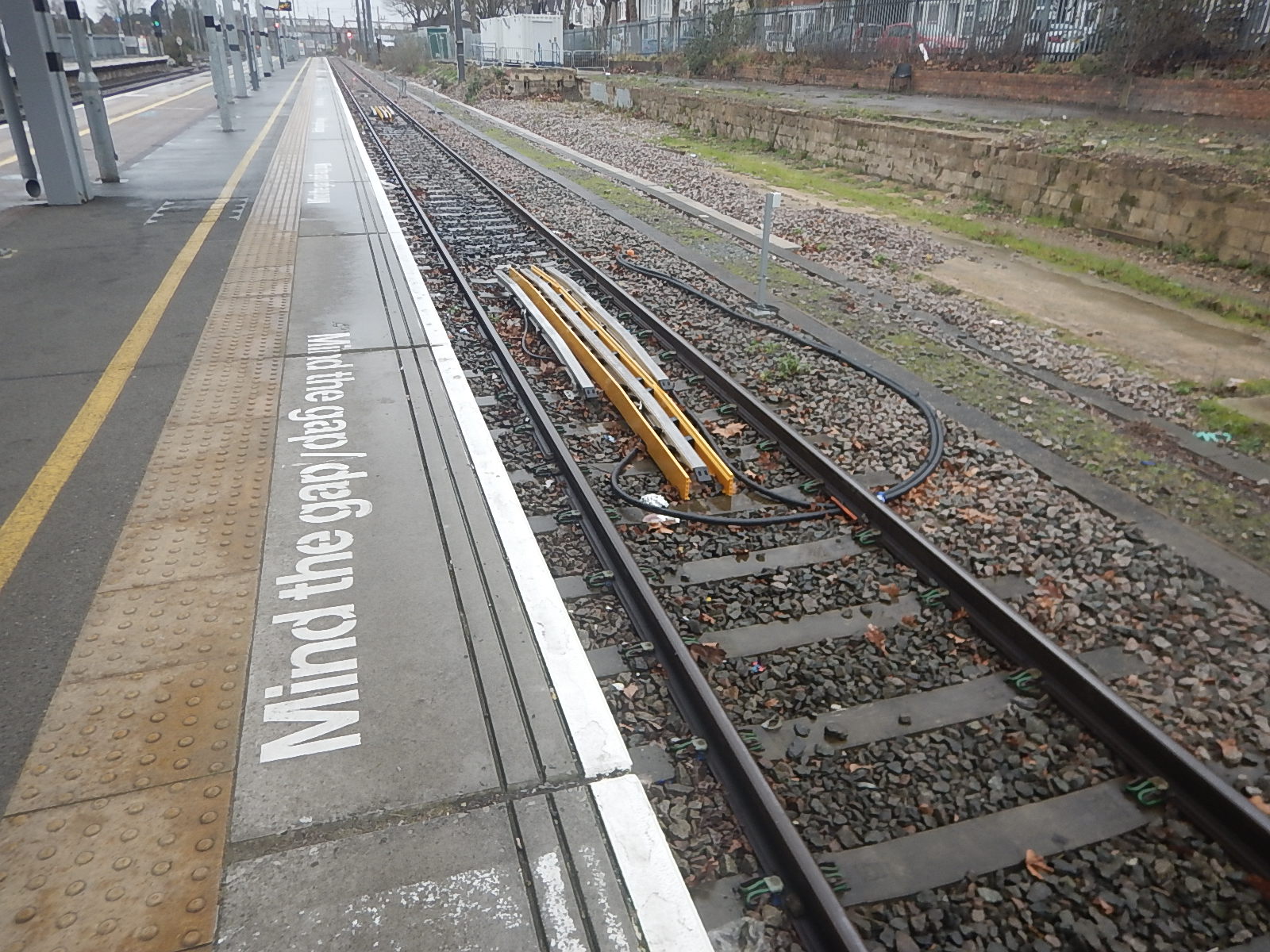
Note.
- The two sets of charging rails are about forty metres apart.
- The Fast Charge Battery Banks are another twenty metres further on.
It’s not the layout you’d expect for running a single two-car train running every half hour.
But could it be that two separate sets of charging rails can operate a more frequent service with this layout of charging rails?
Does The Elizabeth Line Need More Frequent Trains In The Central Section?
Currently, the Off Peak service on the Elizabeth Line is at follows.
- Reading and Abbey Wood – 2 tph
- Maidenhead and Abbey Wood – 2 tph
- Heathrow Terminal 4 and Abbey Wood – 4 tph
- Heathrow Terminal 5 and Shenfield – 2 tph
- Paddington and Shenfield – 6 tph
Note.
- tph is trains per hour.
- There are eight tph to Abbey Wood and Shenfield.
- There are six tph to Heathrow Airport.
But there are only 16 tph through the Central Tunnel between Paddington and Whitechapel stations.
These are typical Off Peak frequencies on other Underground and rail services across London.
- Bakerloo Line – 16 tph – Queen’s Park and Elephant & Castle – 20 tph in the Peak.
- Central Line – 24 tph – White City and Leytonstone – 35 tph in the Peak.
- Jubilee Line – 24 tph – Stratford and West Hampstead.
- Northern Line – 16-20 tph – All routes except Kennington and Battersea Power Station.
- Piccadilly Line – 21 tph – Arnos Grove and Acton Town.
- Thameslink – 16 tph – St. Pancras and Blackfriars.
- Victoria Line – 33 tph – Seven Sisters and Brixton – 36 tph in the Peak.
From these figures, it appears that the Elizabeth Line’s 16 tph is on the low side, when compared to the Central, Jubilee and Victoria Line.
This morning about 11:00, I went between Moorgate and West Ealing stations.
- I went to see FirstGroup’s fast-charge system for battery-electric trains.
- The trains were full both ways.
- There was only the odd seat available.
I know it’s Half Term, but I do think that more services need to run on the Elizabeth Line.
 The Anonymous Widower