Treasures Found On HS2 Route Stored In Secret Warehouse
The title of this post is the same as that of this article on the BBC.
This is the sub-heading.
Treasures unearthed by hundreds of archaeologists during the ongoing construction of the controversial HS2 train line have been shown exclusively to the BBC.
These three paragraphs add detail to the story.
The 450,000 objects, which are being held in a secret warehouse, include a possible Roman gladiator’s tag, a hand axe that may be more than 40,000 years old and 19th Century gold dentures.
It is an “unprecedented” amount and array of items, which will yield new insights into Britain’s past, says the Centre for British Archaeology.
Major building developments in the UK need land to be assessed by archaeologists as part of the planning process, to protect heritage sites.
Crossrail also collected a lot of artefacts in an archaeology programme, that I wrote about in Bison to Bedlam or How To Make Friends.
Typing “TransPennine Route Archaeology” into Google AI gave this answer.
AI Overview
Archaeological investigations for the Trans-Pennine upgrades are split into two major, parallel projects: the A66 Northern Trans-Pennine road project and the Transpennine Route Upgrade (TRU) rail project. Both have revealed significant historical, archaeological, and industrial remains.
A66 Northern Trans-Pennine Upgrade (Road)
As part of the A66 upgrade between Penrith and Scotch Corner, Oxford Cotswold Archaeology (OCA) is conducting extensive excavations.
Key Finds: Archaeologists have identified prehistoric settlements, Neolithic stone axes, and evidence of a 60-meter-wide posthole structure.
Roman Discovery: A major Roman vicus (settlement) and the original Roman road have been uncovered, revealing a “grid of Roman field systems and ditches” near Brough.
Locations: Key sites include Brougham, Brough, Kirkby Thore, and Crackenthorpe.
Significance: These findings illustrate the area’s long-distance connection, trade, and culture from prehistoric through Roman times.
Transpennine Route Upgrade (Rail)
This project, involving Network Rail and ASWYAS (Archaeological Services WYAS), is upgrading the railway between Manchester, Huddersfield, Leeds, and York.
172-Year-Old Railway Siding: A mid-19th-century railway siding was uncovered at Hillhouse Sidings in Huddersfield, revealing two turntables and brick-built engine sheds.
Roman Settlement (Ravensthorpe): Excavations at Ravensthorpe (for a new station) uncovered a large, hexagonal-shaped feature thought to be an Iron Age or Roman-British enclosure, featuring ceramics, glass, and animal bones.
Mirfield Viaduct: An investigation of the Grade II-listed Mirfield Viaduct (built 1836-1839) was conducted to record its structure before upgrade works.It could be a very large exhibition in the North, if High Speed Two and the two Transpennine Route Upgrades were combined in a single exhibition.
I asked Google AI, what is the largest exhibition centre in Yorkshire and received this answer.
The largest exhibition sites in Yorkshire are concentrated in Harrogate, anchored by the Great Yorkshire Event Centre and the Harrogate Convention Centre. These venues offer a combined total of over 10,000 square meters of exhibition space, accommodating major national events, conferences, and large-scale outdoor exhibitions.
I suspect Leeds, Manchester and Sheffield could have other ideas.
Man Finds Prehistoric Handaxe On His Tea Break
The title of this post, is the same as that of this article on the BBC.
This is the sub-heading.
A man discovered a prehistoric handaxe while he was “kicking his feet” on the ground during a tea break.
These are the first three paragraphs, which add some detail to the story.
Colin Cooley, 57, from Otley, Suffolk, works as a dumper driver on the Sizewell C excavation site.
Toward the end of a tea break, he noticed a piece of rock that he believed looked like a handaxe.
“All hell broke loose” when it was confirmed to be between 36,000 and 59,000 years old, and Hadley Sharman, an archaeologist working on the site, added it was a “blinder” of a find.
I suppose that the Nimbies will use the find to stop the power station getting built!
On the other hand Crossrail has used archaeology to make friends with the public, as I pointed out in Bison To Bedlam Or How To Make Friends.
Mystery LNER Train Found In Belgium
The title of this post, is the same as that of this article on RAILUK.
These four paragraphs detail what is known about the wagon.
More than 400 miles from LNER’s current home in York, an LNER train has been unearthed by archaeologists in Antwerp in Belgium.
The modern-day operator of trains on the East Coast Mainline has been in touch with the team who dug up the wagon to try and find out more about the curious discovery.
It appears that the find is a wooden removals truck, used to carry people’s belongings when they moved house. It’s thought to be almost a hundred years old.
It’s a mystery as to how the carriage came to be in Antwerp, and unfortunately there’s very little left of the relic as it disintegrated while being excavated.
It’s a story to go with London Bus Found On The Moon, that was published in the Daily Sport.
Stonehenge Is Unique
Stonehenge is unique and at the age of ten, I was able to walk amongst the stones in a party from my Primary School.
That was much better than the limited access you get now.
But then in the mid-1950s, Stonehenge didn’t get the visitors it does now.
In The Times today, there are reports of an Almighty row about how traffic is hidden from the monument.
This article on the BBC, which is entitled Stonehenge tunnel ‘should be longer’, puts forward a shorter view of the arguments in The Times.
The real problem with the traffic around Stonehenge, is that something should have been done about it years ago. As with so many problems, successive governments have just ignored the unique site.
I think that any solution to the future of Stonehenge should do the following.
- Remove all passing traffic as far away as is practical.
- All visitors to the monument should probably come by electric bus from the a nearby railway station or Park-and-Ride.
- Improve the rail service on the South Western Main Line, which is not electrified and needs more capacity.
I also feel that modern technology could be used to provide a better view of the stones.
Certainly, what we have at present is totally unacceptable to both road traffic passing the site and visitors.
There is even a proposal for a Wilton Parkway station, which would be on the Wessex Main Line and linked to Stonehenge by bus, that I wrote about in A Station For Stonehenge?
This would provide a Tourist Route from Bristol to Portsmouth via Bath Spa, Stomnehenge, Salisbury and Southampton.
Between Bank And Cannon Street Station
The City of London is creating a new walking route between Bank and Cannon Street stations, along Walbrook.
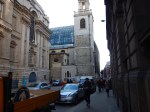
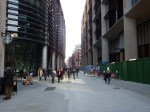

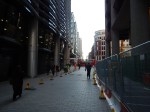
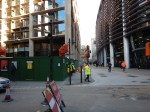
It doesn’t reach to the Thames yet, as there is some 1980s development and the dual-carriageway of Upper Thames Street in the way, but I suspect it will, at some point in the future.
On the Western side of the walk is Walbrook Square being developed by Bloomberg, which underneath which are both the London Mithraeum and the new step-free entrance to the Waterloo and City Line and Bank station.
On the Eastern side is the historic church of |St. Stephen Walbrook, where I once met Chad Varah; the founder of The Samaritans, who for personal and wider reasons, I nominated at Man of the Noughties.
This Google Map shows the area.
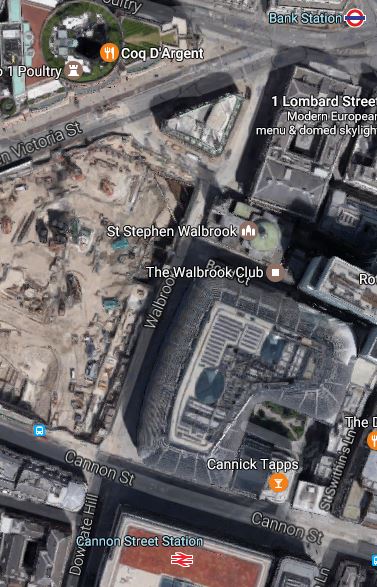
It looks like this walking and cycling route will come with a prestigious office development, an important Roman site and a transport interchange.
I have a feeling there’s a deep agenda in pedestrianising Walbrook in this way.
Commuters arriving in the City at Cannon Street station or the Waterloo and City Line will be able to come out of the stations onto the spacious thoroughfare of Walbrook , from where they could walk to their place of work. A pedestrianised Bank Junction would give a traffic free route for commuters to the East side of the junction.
Could we see other routes around Bank Junction also given over to pedestrians and cyclists? Roads like.
- Cannon |Street
- Cornhill
- Dowgate Hill
- King William Street
- Lombard Street
- Lothbury
- Old Jewry
- Prince’s Street
- St. Swithin’s Lane
and a few others, must all be being considered for full or partial pedestrianisation.
In addition, there will be beloe-ground routes through Bank station.
Archaeology In Dresden
There is a lot of rebuilding going on in Dresden, and I came across this site that was being investigated for archaeological purposes.
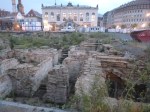
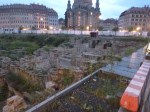
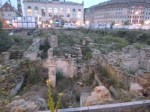
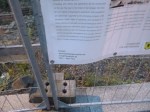
In a couple of places across Germany, I’ve recently come across examples of developers doing the sort of PR you see in London, to passify those affected by large developments.
Perhaps, everybody is watching Crossrail, who have used archaeology virtually as a PR weapon to fight off protesters and bad press!
Archaeology At Liverpool Street
Liverpool Street, just outside the station of the same name, is home to a large archaeology project.
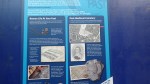
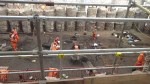
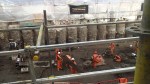
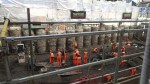
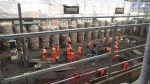
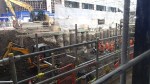


The pictures of the actual dig was taken from a publicly accessible walkway on the South side of the Street.
Crossrail In The New Yorker
According to Wikipedia, the New Yorker is an American magazine of reportage, commentary, criticism, essays, fiction, satire, cartoons, and poetry.
This serious article from the magazine, which discusses the archaeology around the new rail line, is well worth a read.
An Historical Side-Effect Of The London Gateway
This story from the Southend Echo, tells about the excavation of HMS London. They say this.
A PHOTOGRAPHIC exhibition detailing the excavation of a shipwreck off Southend pier has opened to the public.
HMS London was first rediscovered in 2005 during works to build the London Gateway superport.
Mary Rose it is not, but HMS London would appear that it is starting to give up its secrets.
I shall certainly go to the exhibition of photos at the Beecroft Gallery in the town.
DAM – German Architectural Museum
The Deutsches Architektur Museum was recommended in my guide book.
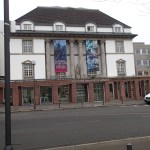
It cost me nine euros to enter to see a presentation of photographs of the main modern buildings of Frankfurt with descriptions.
There is no directly similar museum in London, although Crossrail have recently put on some excellent free displays of both their archaeology and architecture.
I wouldn’t return to this museum, unless I was travelling with an architect, who thought it a must-see!
 The Anonymous Widower