December 6, 2020 8:42 am
This article on Railway Gazette International is entitled ADIF AV Agrees EIB Loan As Extremadura High Speed Link Makes Progress.
This sentence in the first paragraph gives details of the route.
The loan will support completion of the 282 km high speed line between Talayuela, Plasencia Cáceres, Mérida and Badajoz.
It will carry both passengers and freight and eventually link Madrid and Lisbon.
The article shows a spectacular bridge under construction.
So I got out my helicopter and decided to go and look for the bridge.
These are some sections and stations along the line.
The Railway Gazette article says this about the route to the East of Plasencia.
East of Plasencia however, land acquisition and preparatory works have proceeded more slowly. On this section, broad gauge tracks are to be laid as far as Talavera de la Reina, where there would be a junction with the conventional network and a gauge-changer. Passenger trains would then continue over 1 435 mm gauge tracks to join the existing Toledo – Madrid high speed line south of the capital.
Note.
As the Spanish do gauge-change well, I suspect they know what they’re doing, even if I don’t!
Two Routes From Madrid
Consider.
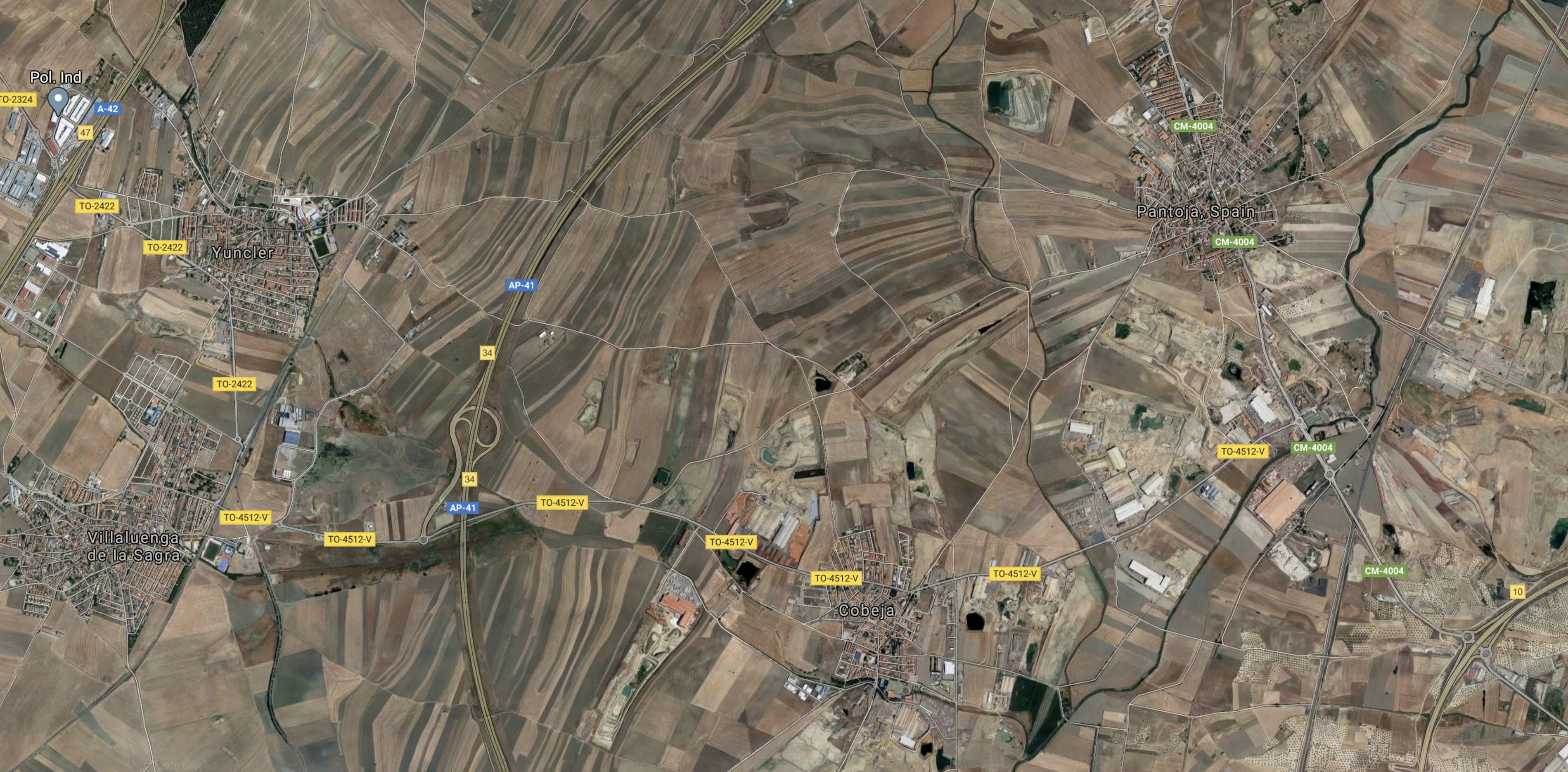
This Google Map shows the area between Msdrid and Toledo.
Note.
Looking at the map, I don’t think it would be impossible to create a link between the two lines.
The Area Is Mainly Agricultural
This Google Map shows the mainly agricultural nature of the land.

Between Madrid and Talavera de la Reina, it also appears to not be very challenging and there doesn’t appear to be a major river, that would need to be crossed.
This should make construction easier!
Talavera de la Reina
This Google Map shows the railway station at the city of Talavera de la Reina.

Note.
I can’t find any work here concerned with building the new high speed tracks.
Oropesa de Toledo
This Google Map shows the railway station in the town of Oropesa de Toledo.
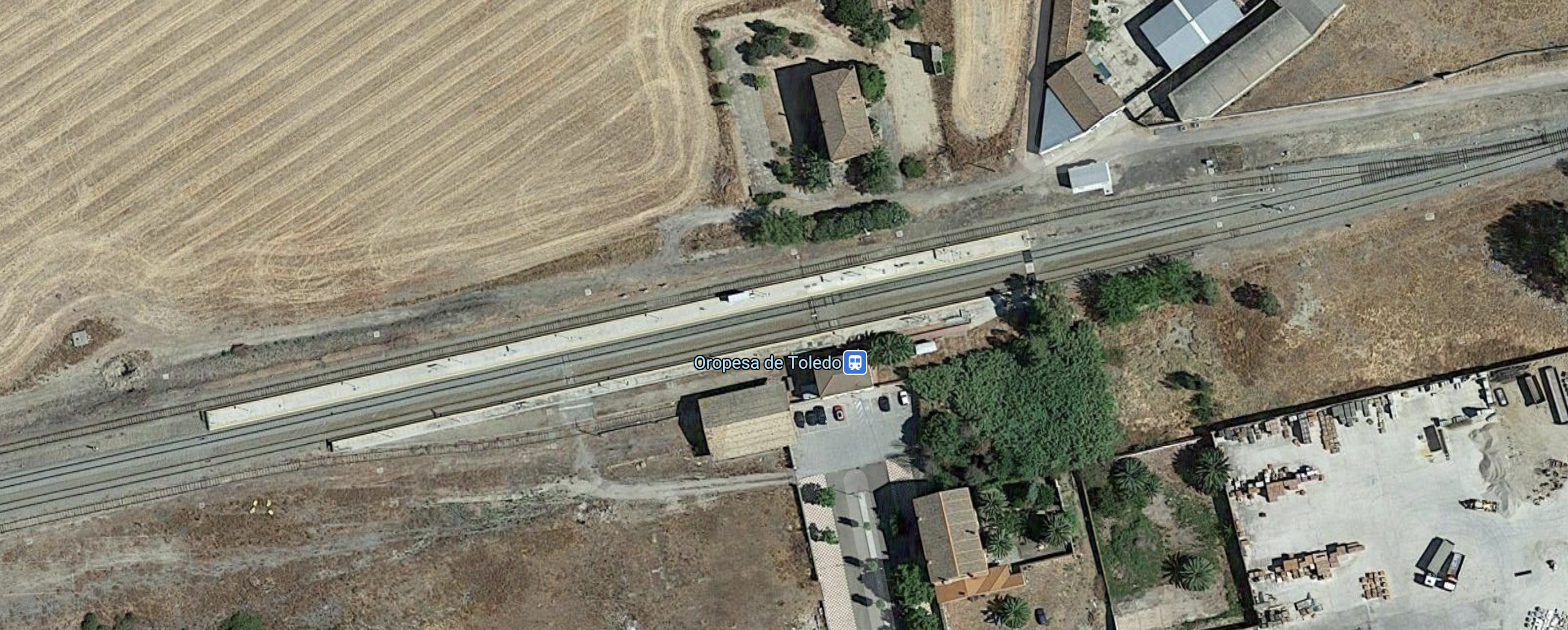
There is no sign of the high speed line.
Note.
No clues as to the gauge of the high speed lines.
Navalmoral de la Mata
The current line goes through the municipality of Navalmoral de la Mata.
This Google Map shows the station.

There appeared to be no sign of the new high speed line. On one of my maps it is shown to the North.
The Eastern End Of The High Speed Line
The first sight of the new high speed line was at the border of Extremadura.

Note.
No clues as to the gauge of the high speed lines.
Casatejada
This Google Map shows the municipality of Casatejada.
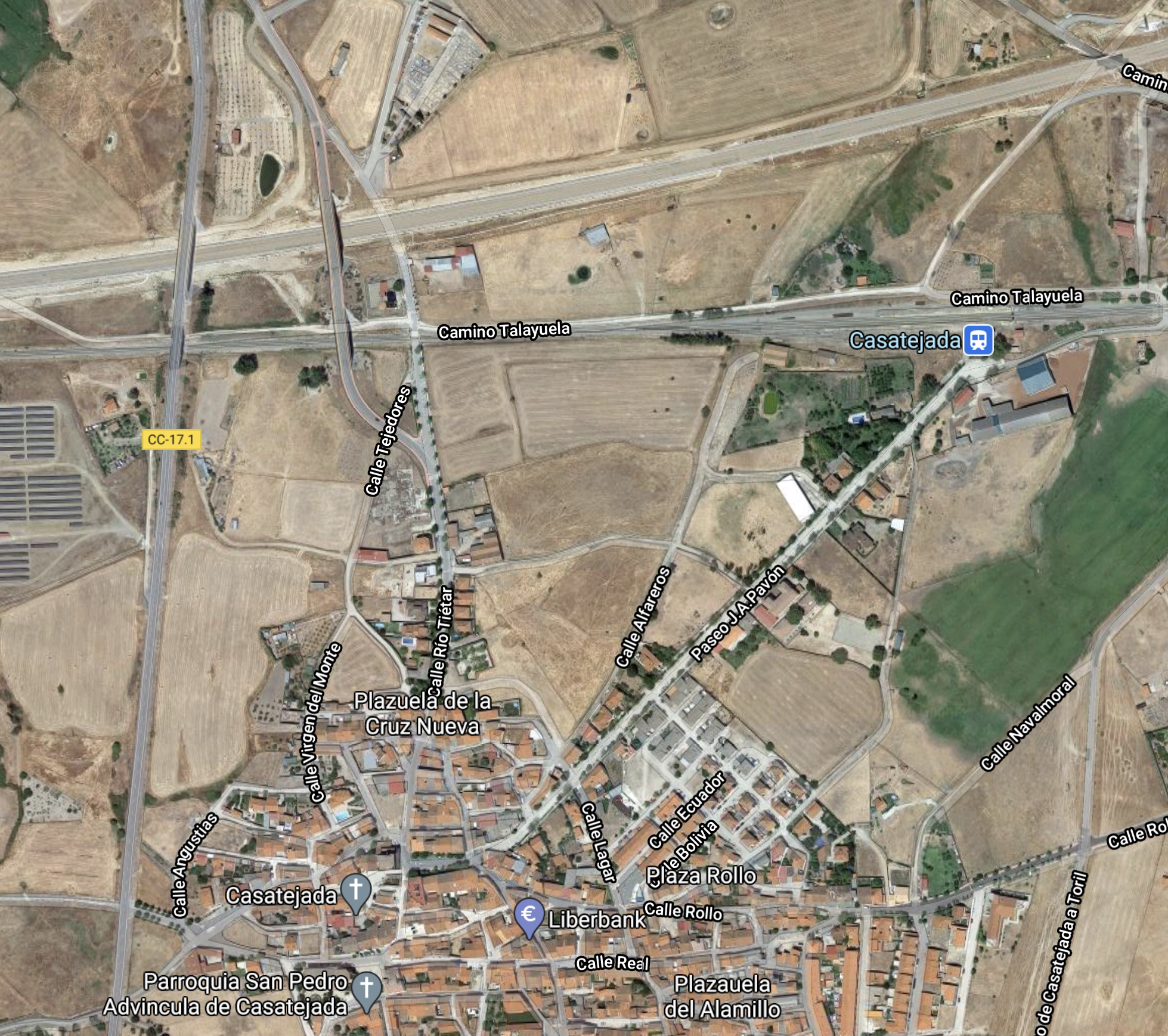
Note.
It may have a station, but it doesn’t have too many trains.
The section of the high speed line ends just to the West of Casatejada, as this Google Map shows.
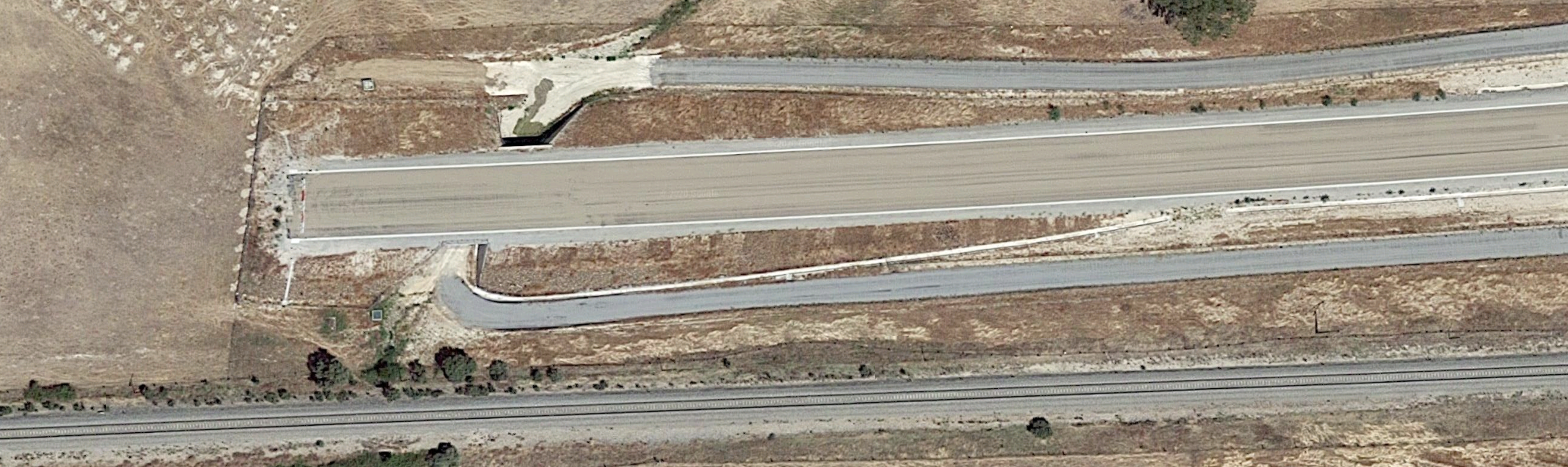
This section of the high speed line would seem to go all the way to the Eastern edge of Extremadura, which I showed in a previous section.
La Bazagona
This Google Map, shows the area of La Bazagona.
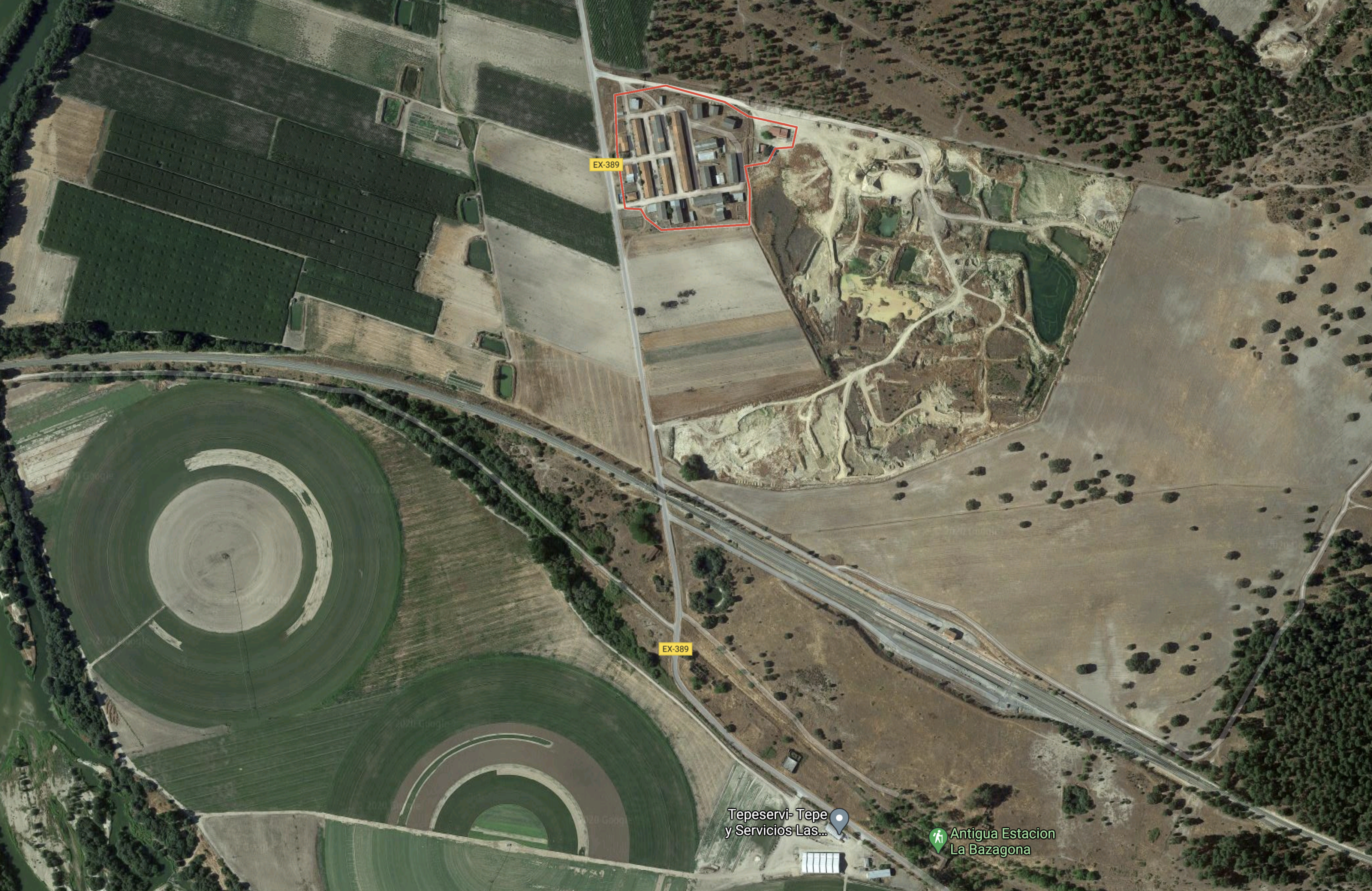
Note.
It certainly looks like a new station is being built to serve the area.
West Of La Bazagona
Consider.
This Google Map shows the area to the West of La Bazagona.
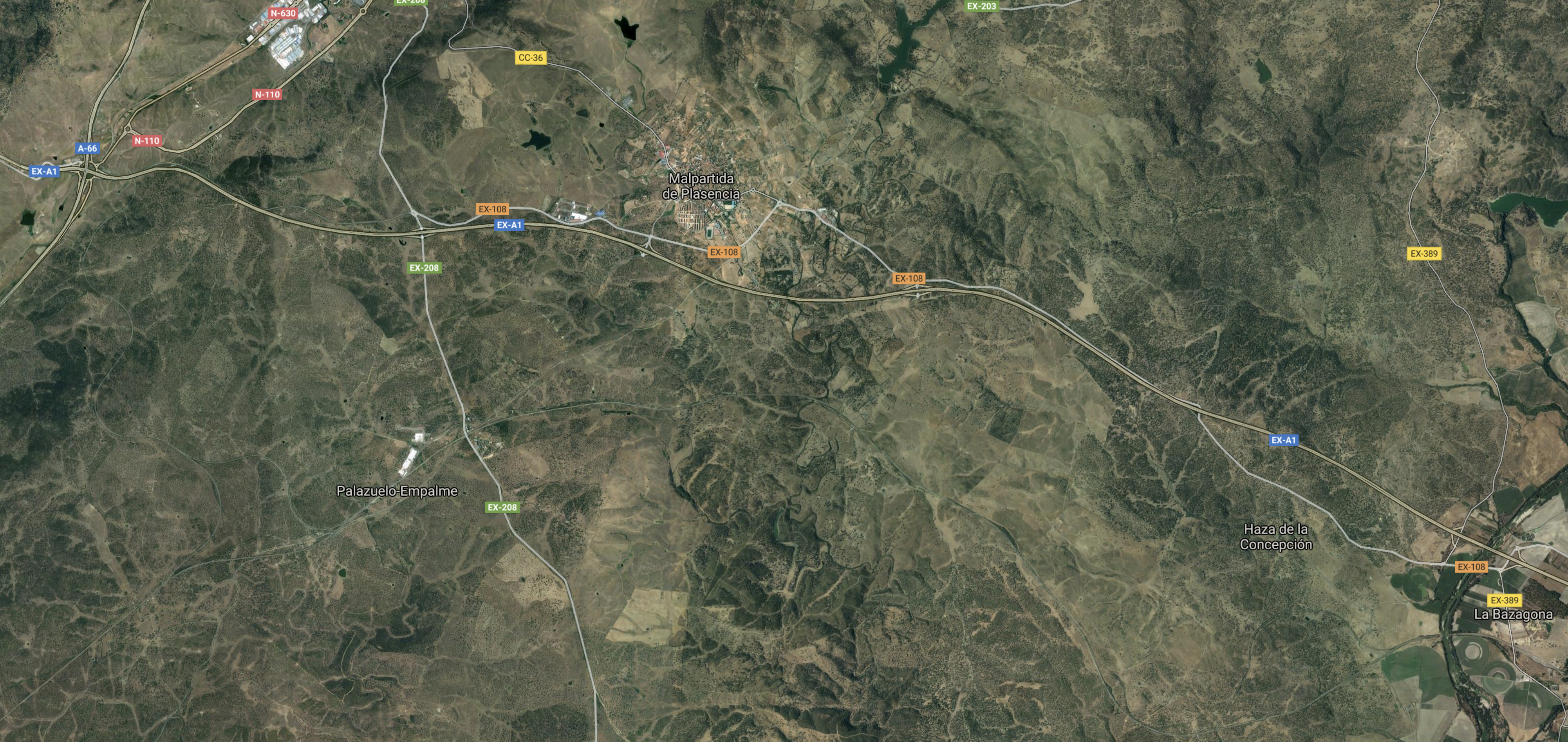
Note.
The current railway runs East West between La Bazagone and Monfrague.
Monfrague
This Google Map shows that except for a tobacco factory, there’s not much near Monfrague station.
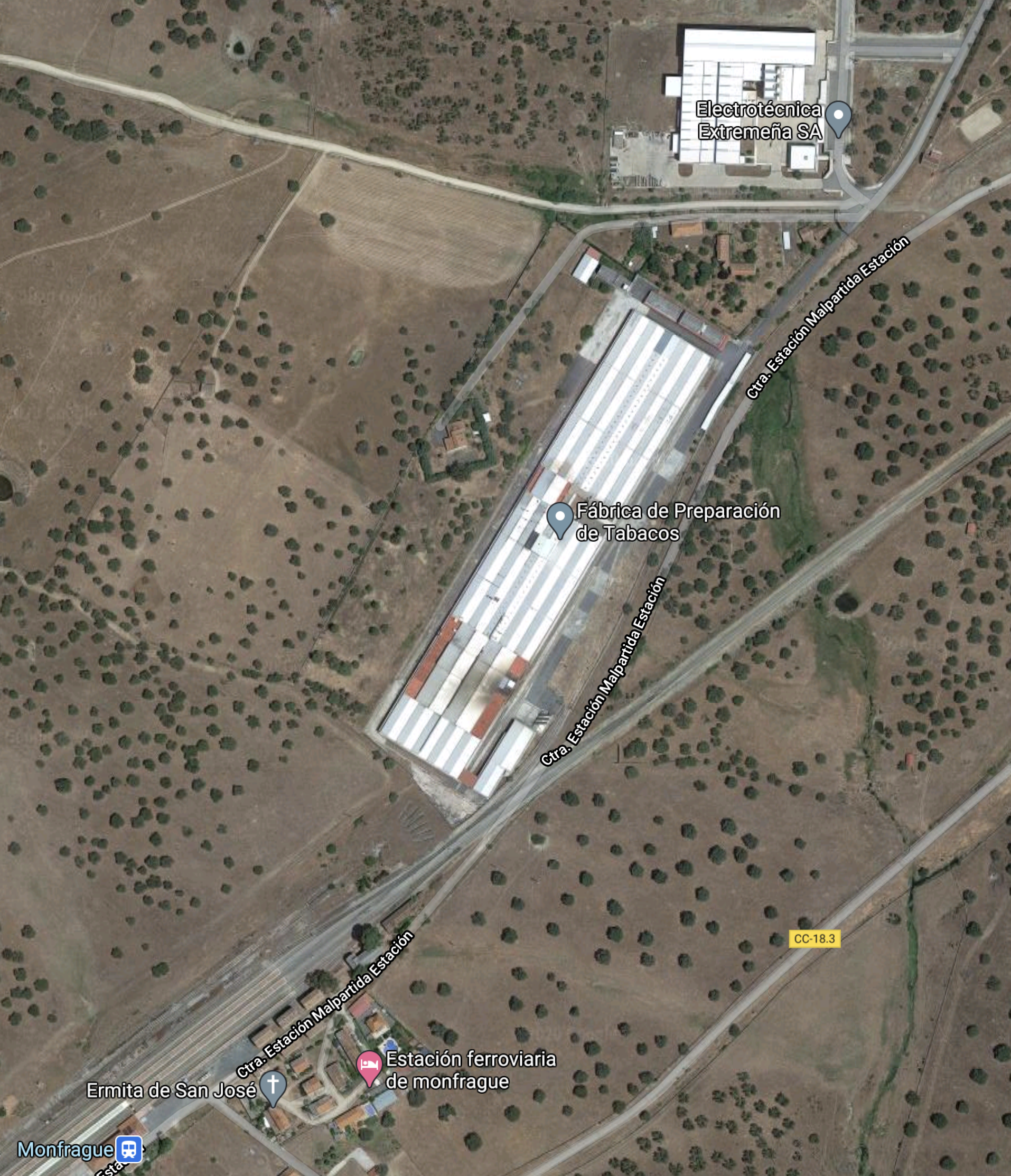
On other maps, where it is to a smaller scale, the station and the surrounding buildings appear as a dash and a dot.
It appears the station only has one train per day. But it was December, when I checked.
Mirabel
Mirabel is a municipality on the current line, that is shown in this Google Map.

From Wikipedia it appears to be worth a visit.
A Diversion of the Current Route
Between Mirabel and Cañaveral, the old route takes a diversion to the East.
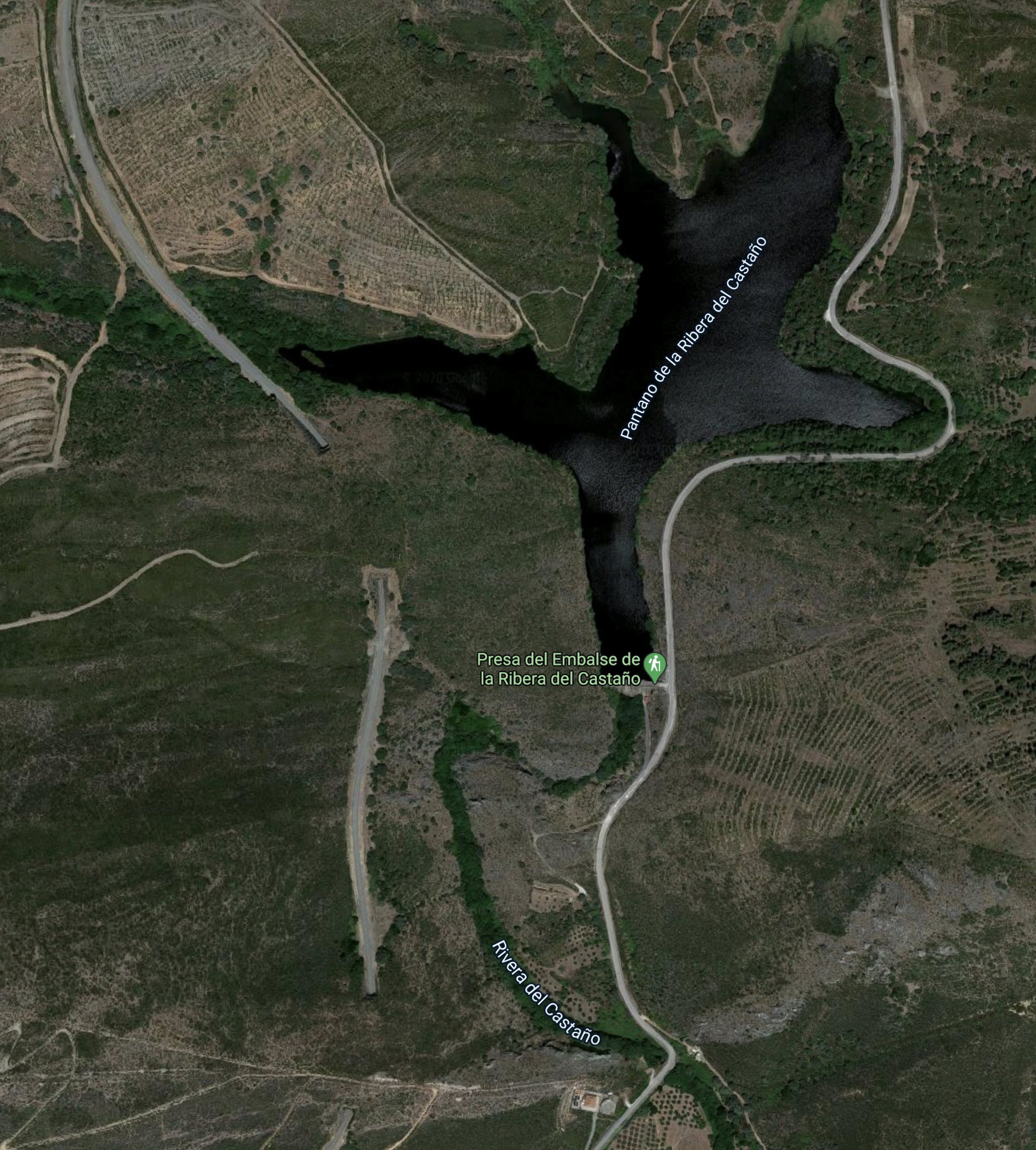
The railway goes to the West of the lake.
The green label indicates, it’s a hiking area.
The High Speed Line Becomes Visible Again
Since La Bazagona, I have followed the current route, but this Google Map shows where construction starts again for the new high speed line.
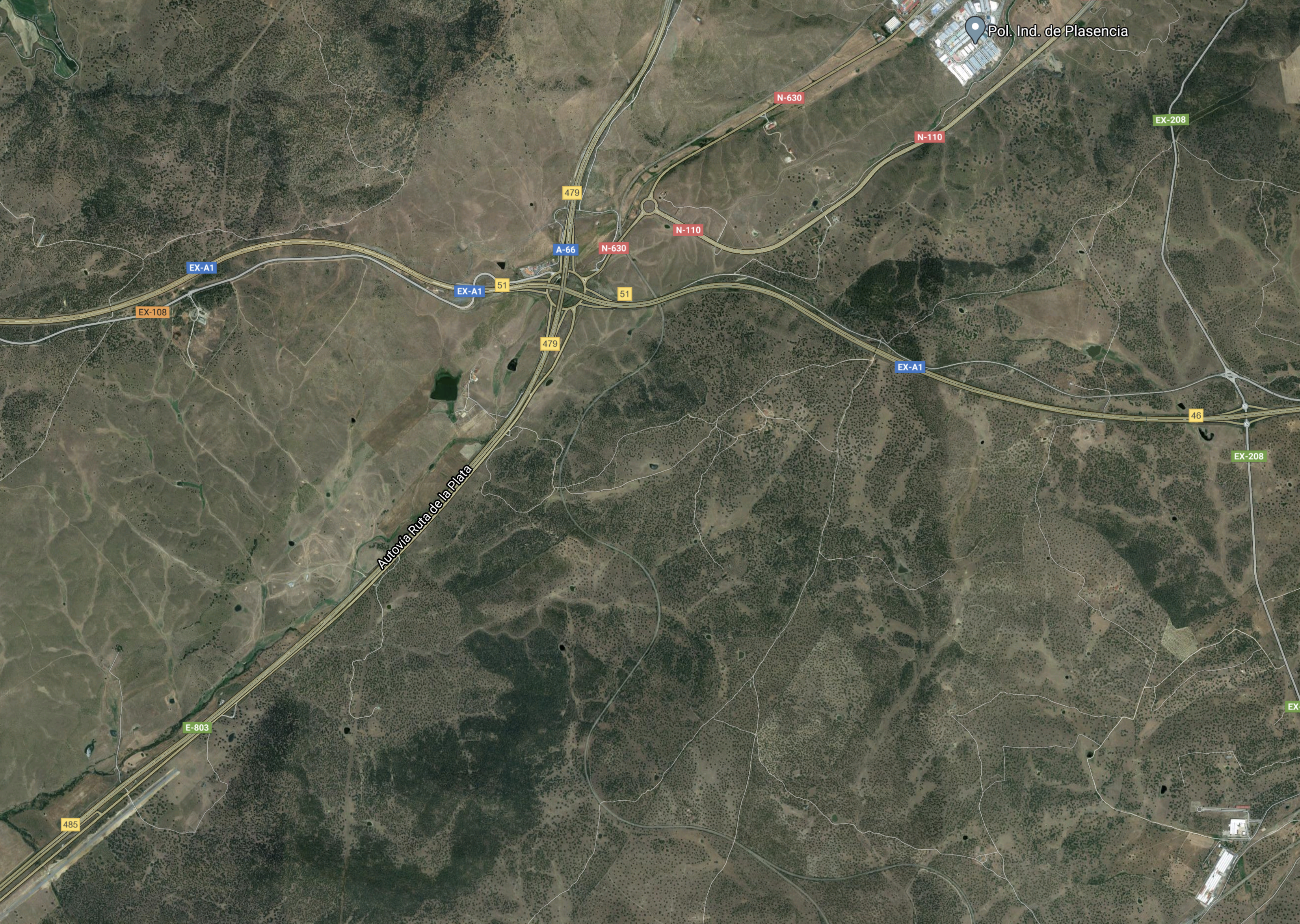
Note,
This is an enlargement of the South-West corner of the map.

Note the new high speed line, which stops abruptly.
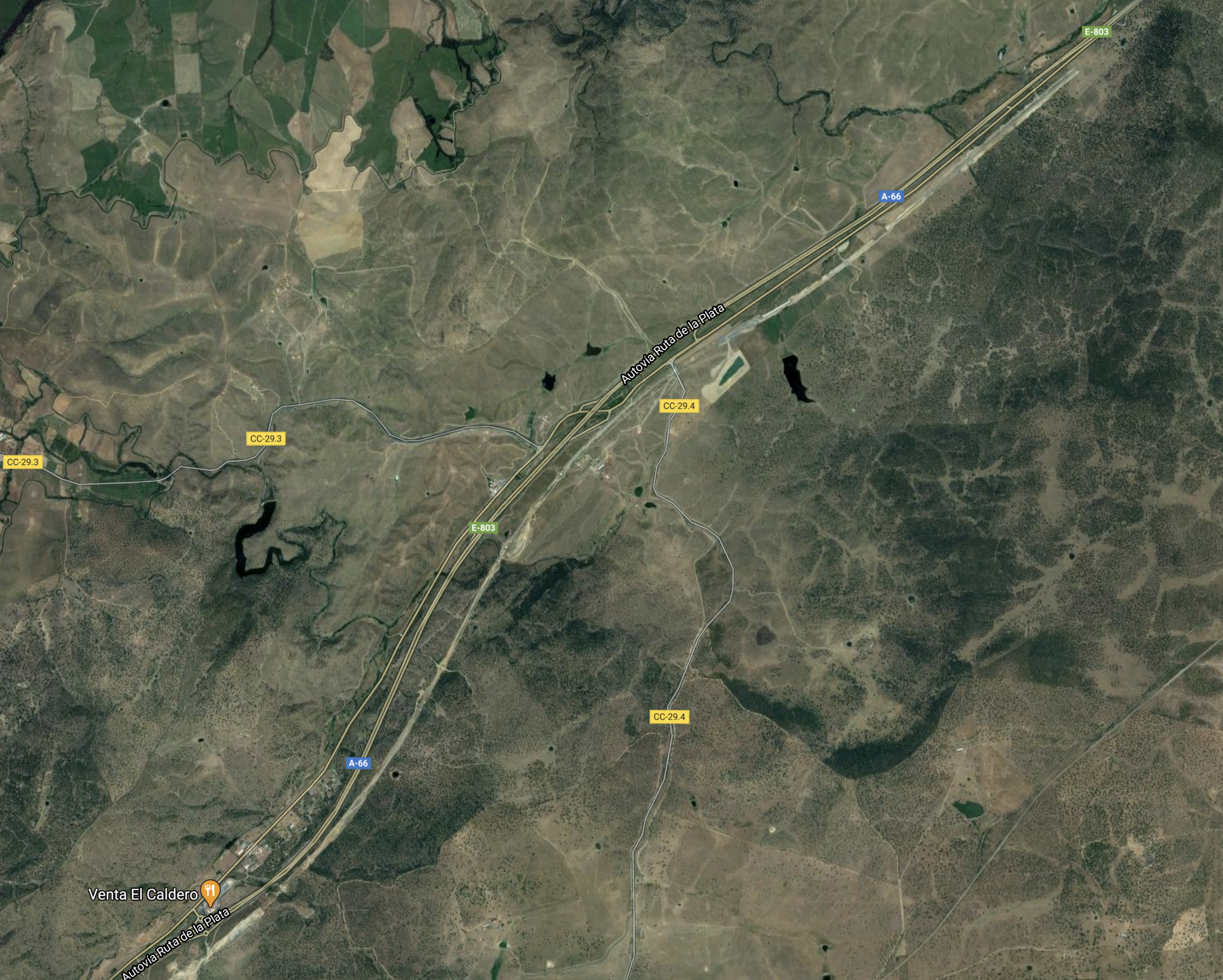
North and South Of Venta El Caldero
This map shows the construction to the North of Venta El Caldero.
And this map shows the construction to the South of Venta El Caldero.
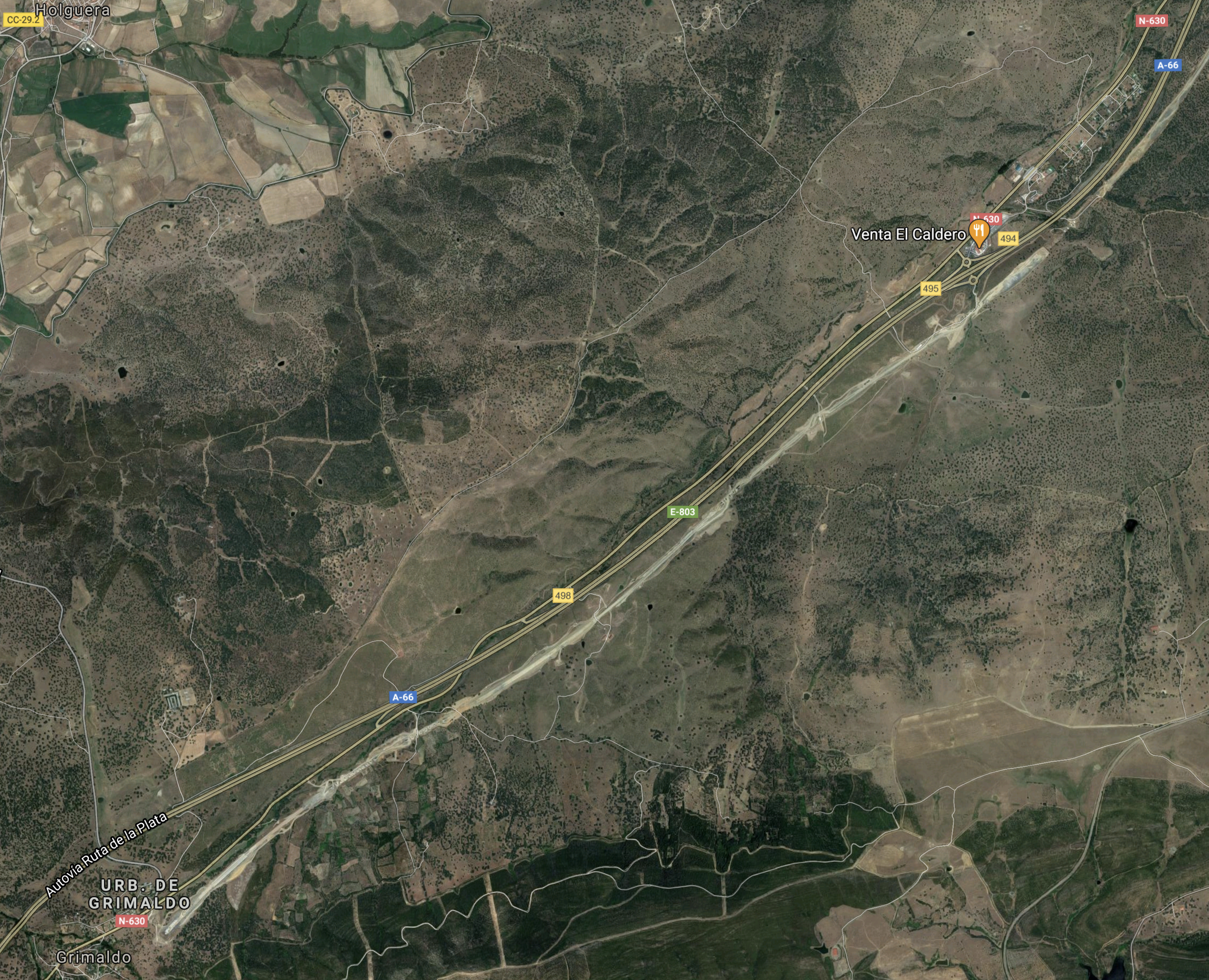
Note.
Grimaldo is in the South-West corner of the map.
Grimaldo To Cañaveral
This Google Map shows the route of the high speed line from Grimaldo to Cañaveral.
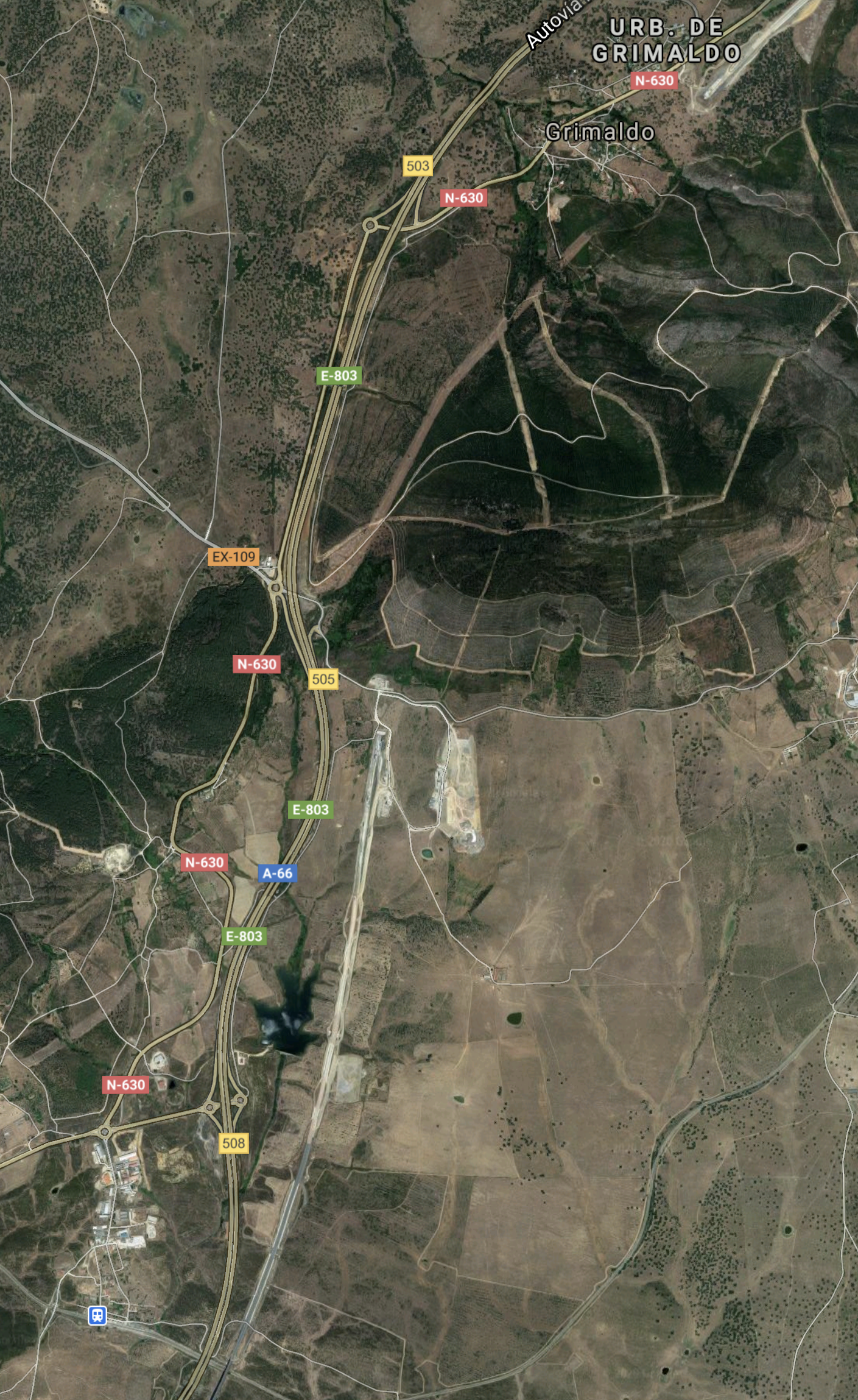
Note how the scar of the railway construction is to the East of the A66 Motorway.
Cañaveral
This Google Map shows Cañaveral station on the current line and the track of the new high speed line.
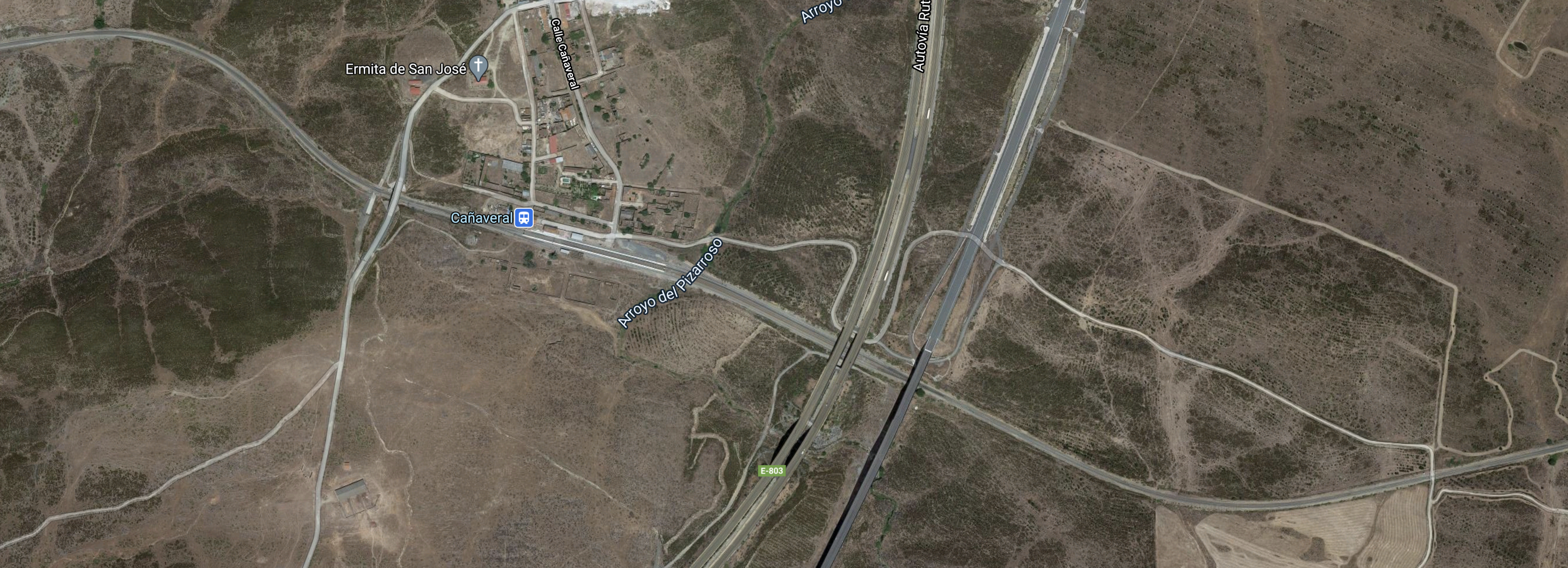
This map illustrates how the new high speed line is so much more direct, which in itself will save time.
From Cañaveral To The Tagus
This map shows the scar of the construction of the high speed line from Cañaveral to the Tagus.
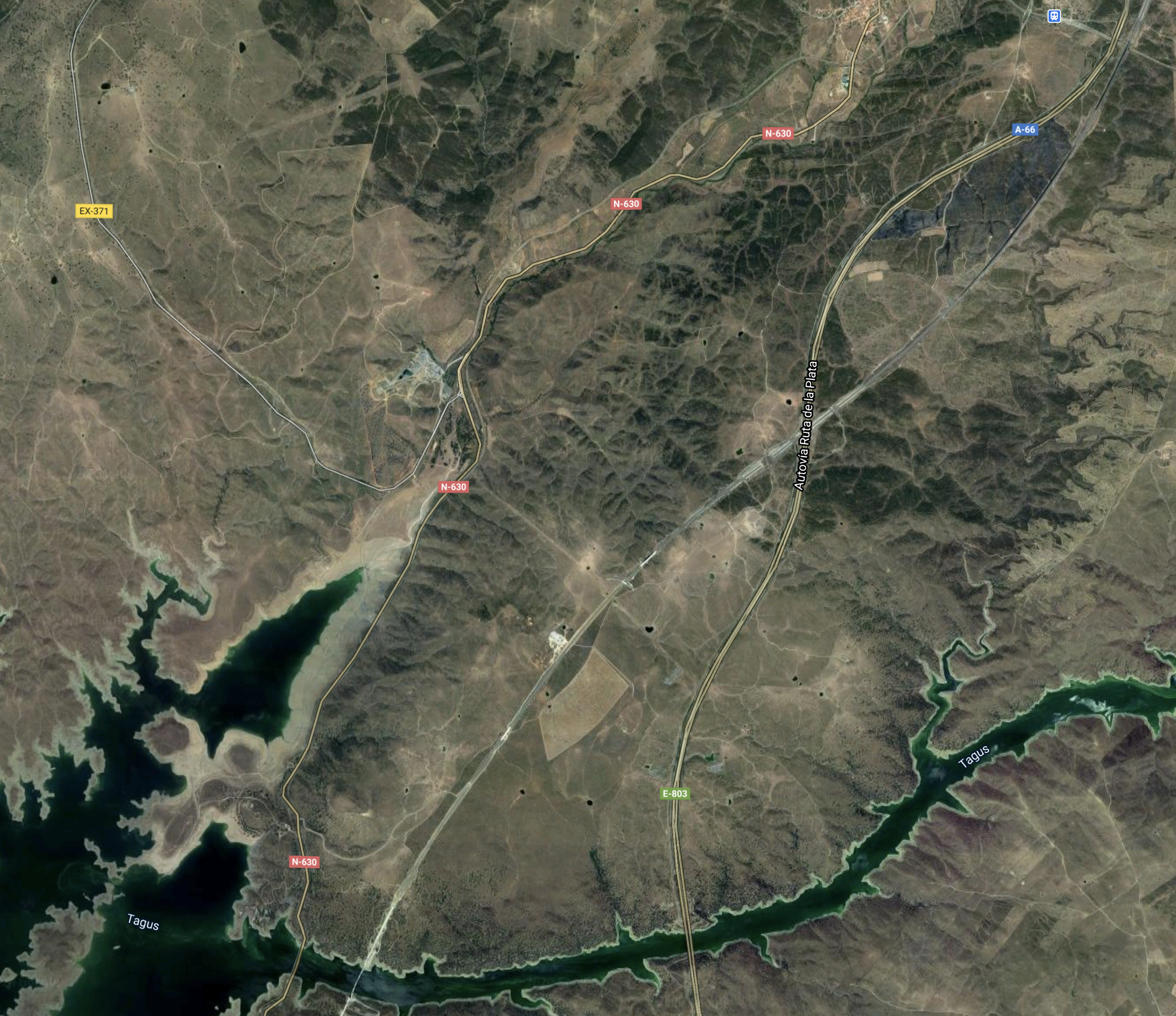
Note.
A lot of the features, as the railway crosses the River Tagus, will come clearer in the next section.
Crossing The Tagus
This Google Map shows where the railway crosses the River Tagus.
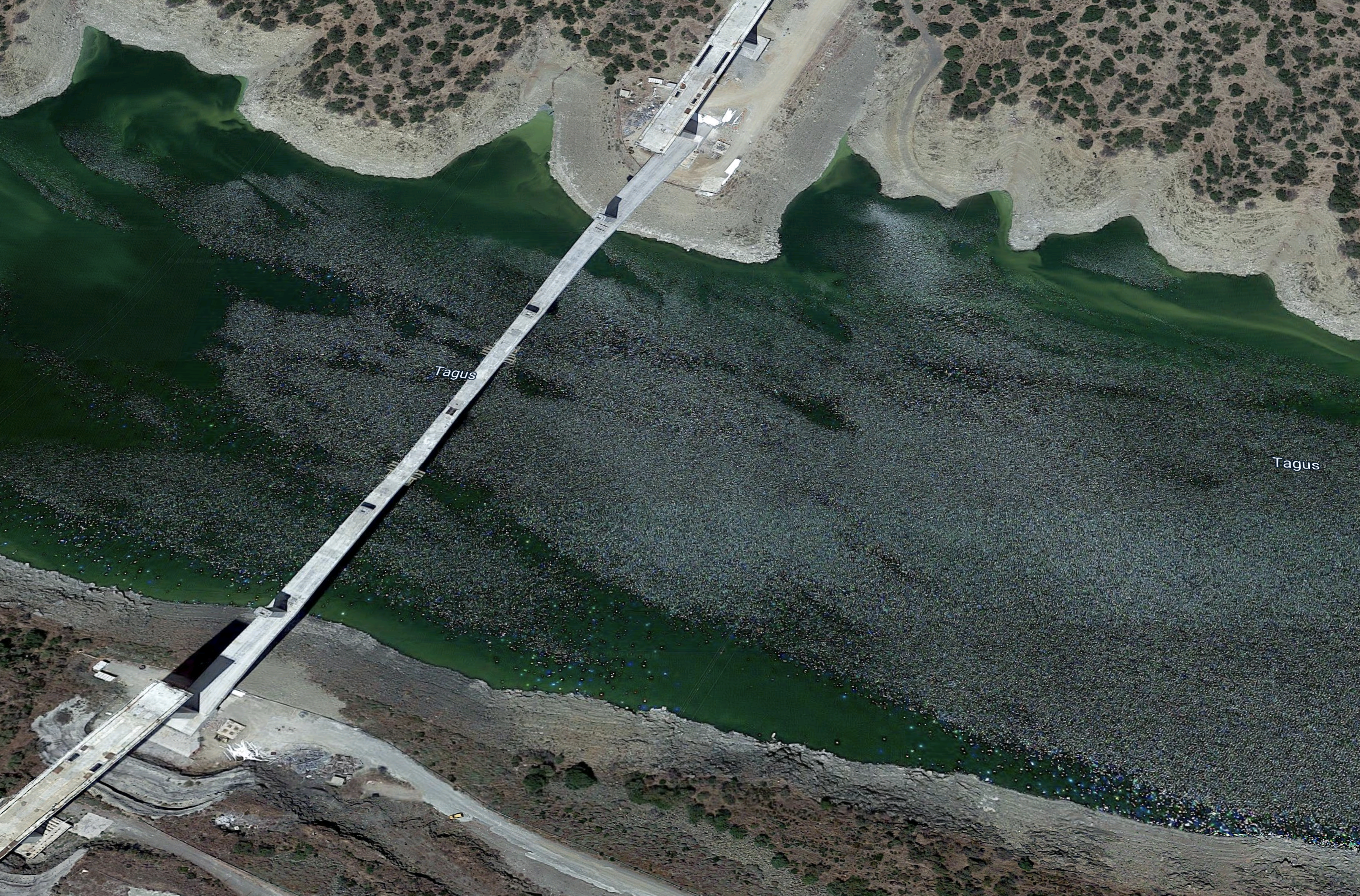
This second map shows the Northern end of the bridge on a larger scale.
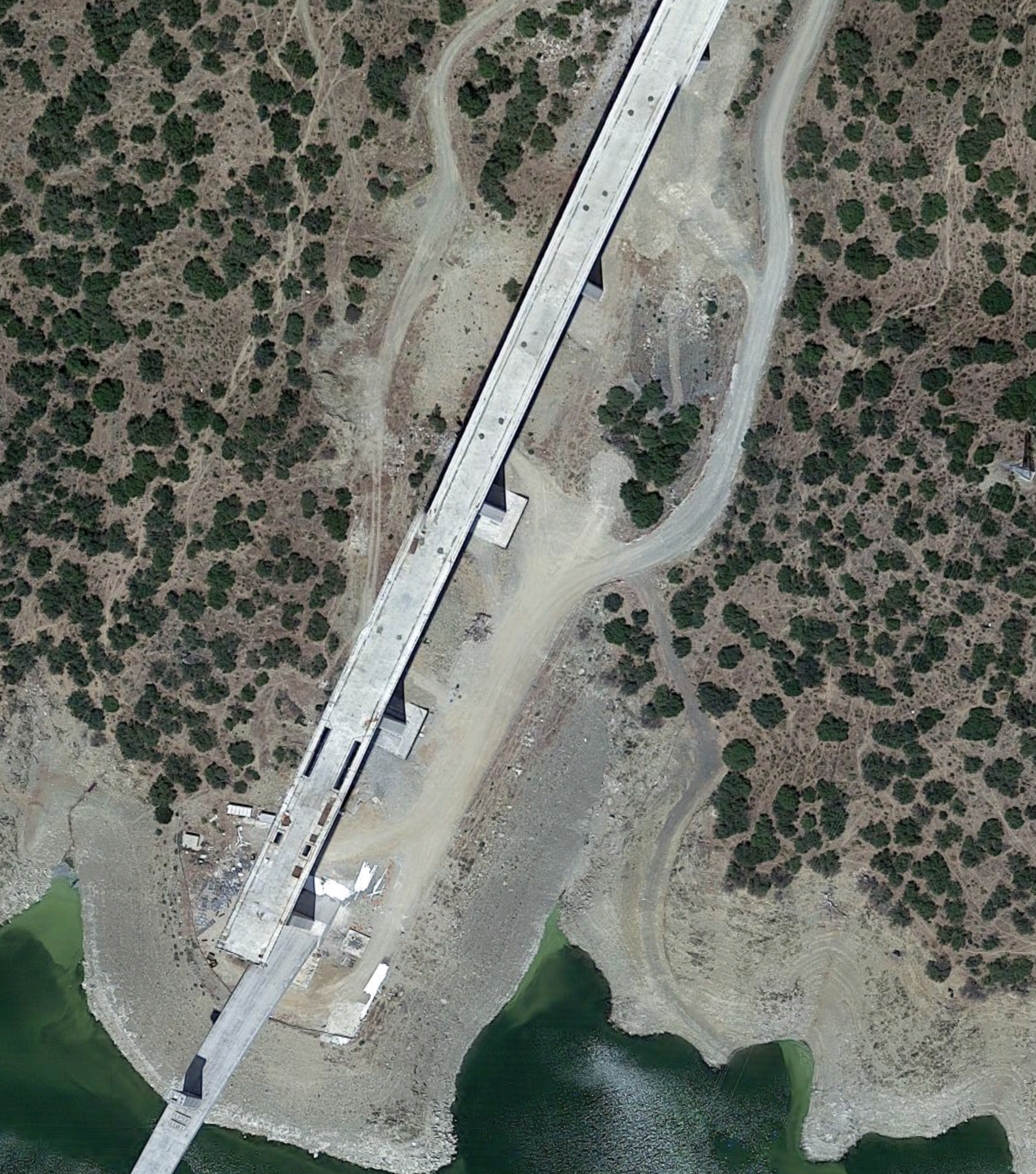
Is this bridge a double deck bridge with a road underneath a rail track?
Almonte River Railway Viaduct
This Google Map shows the viaduct over the Almonte river.
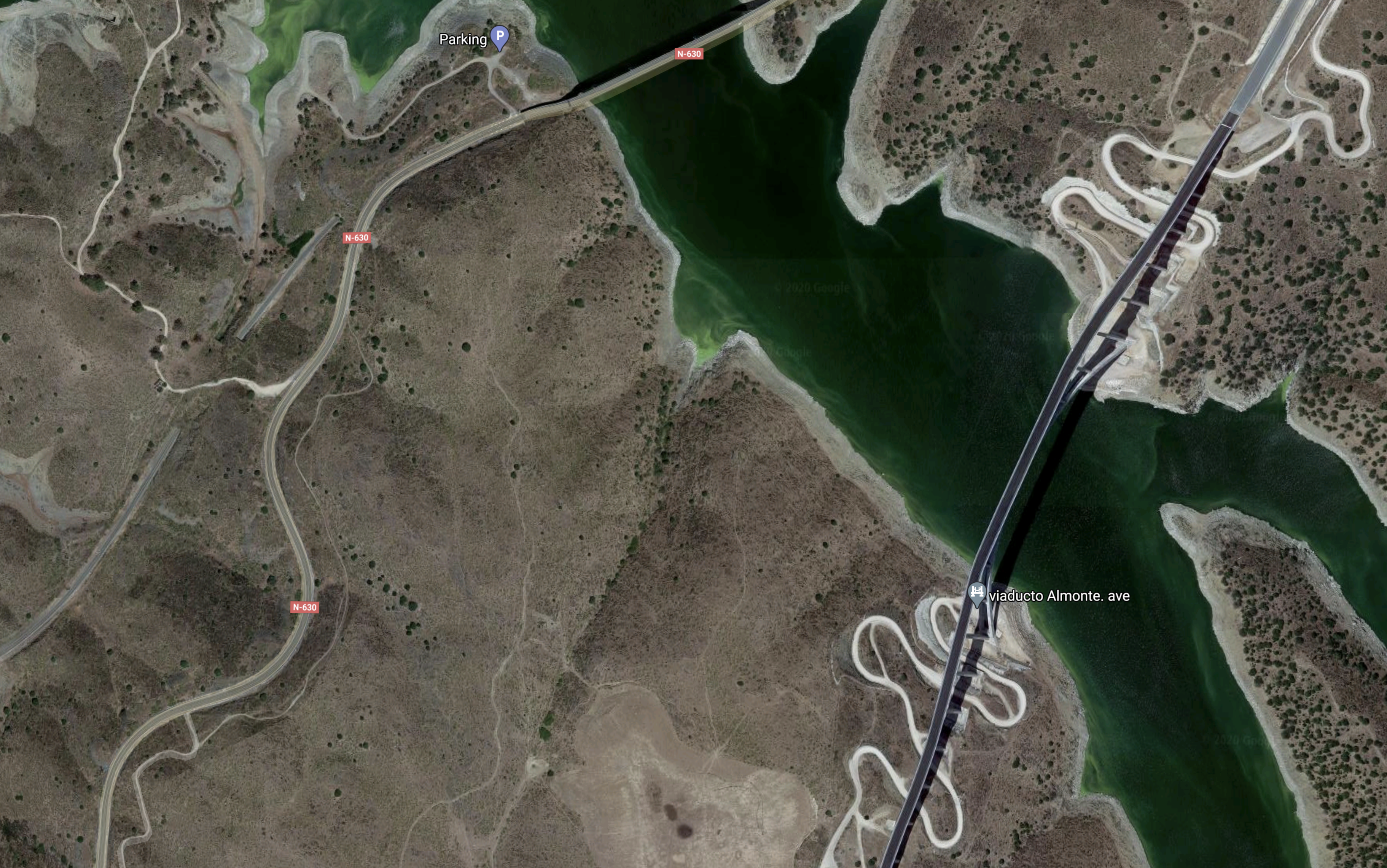
Note.
The other bridge to the West is shown in this Google Map.
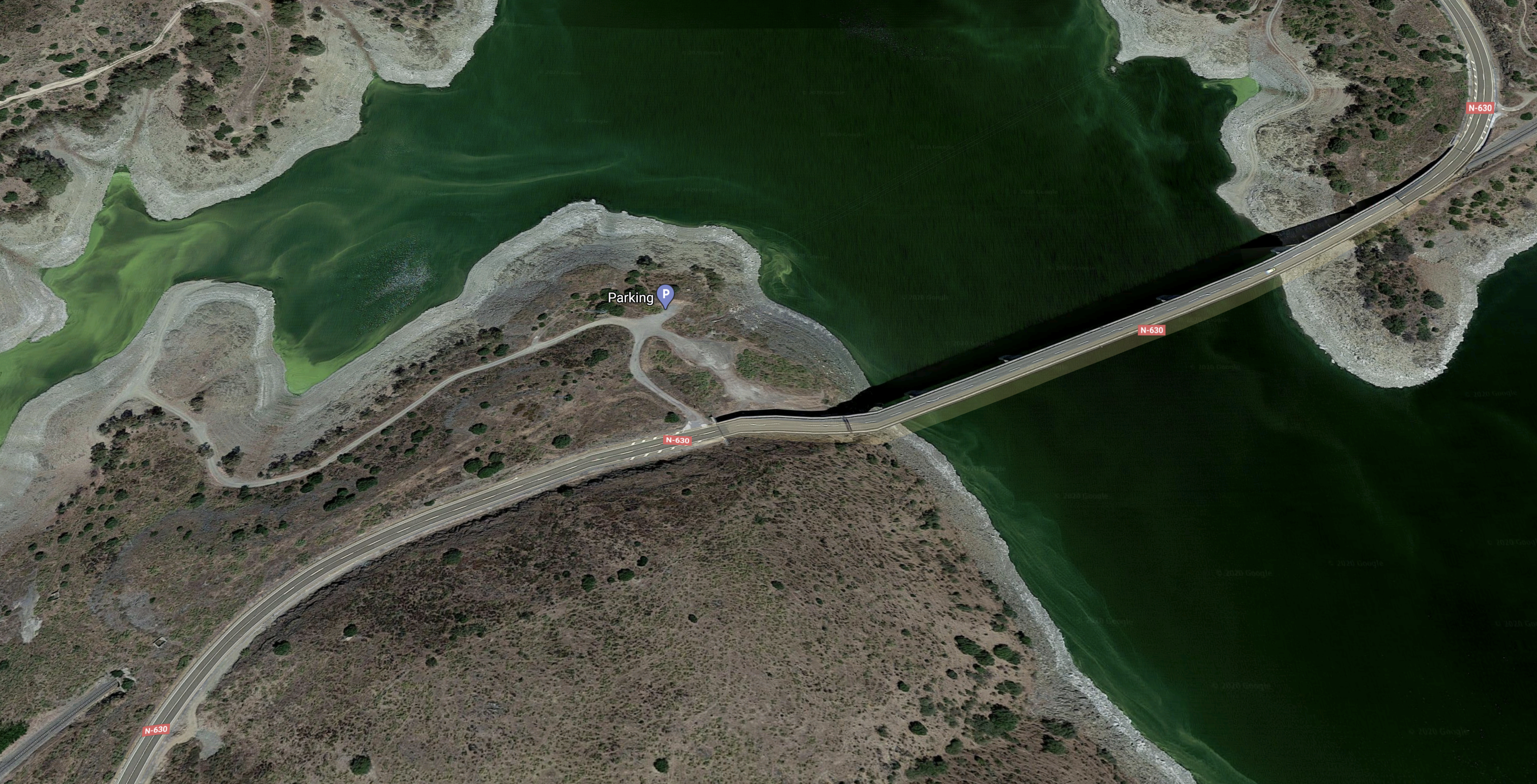
It appears to be a double-deck bridge, with a road on top of as single track railway.
This third Google Map clearly shows the arch.
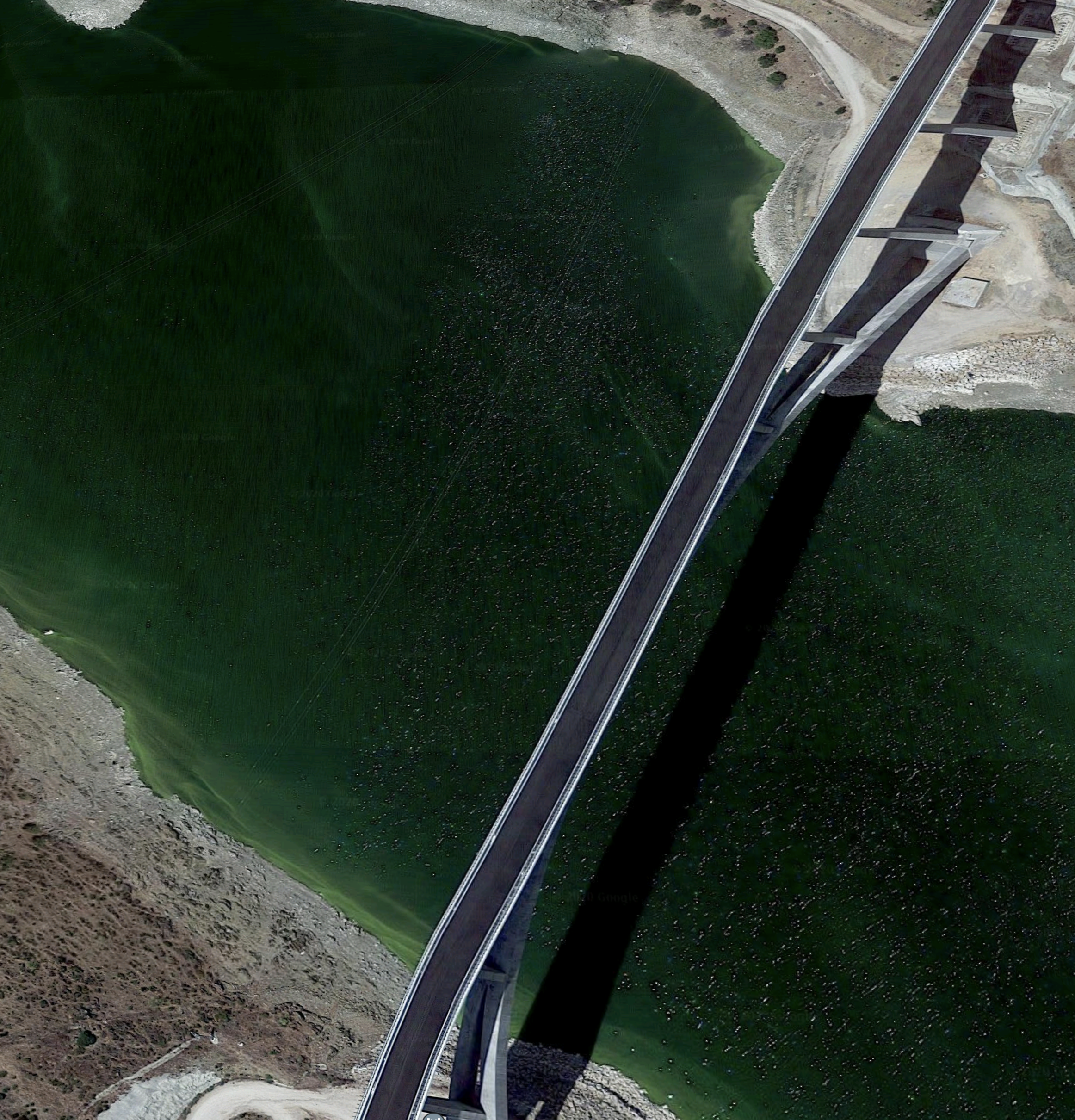
It certainly is a bridge I want to experience.
The Old And New South Of The Almonte
I had to include this Google Map.

Note.
There would appear to be a viewpoint and parking to explore the area.
Cáceres
This Google Map shows the joining of the old and new lines to the Nothe of the Cáceres
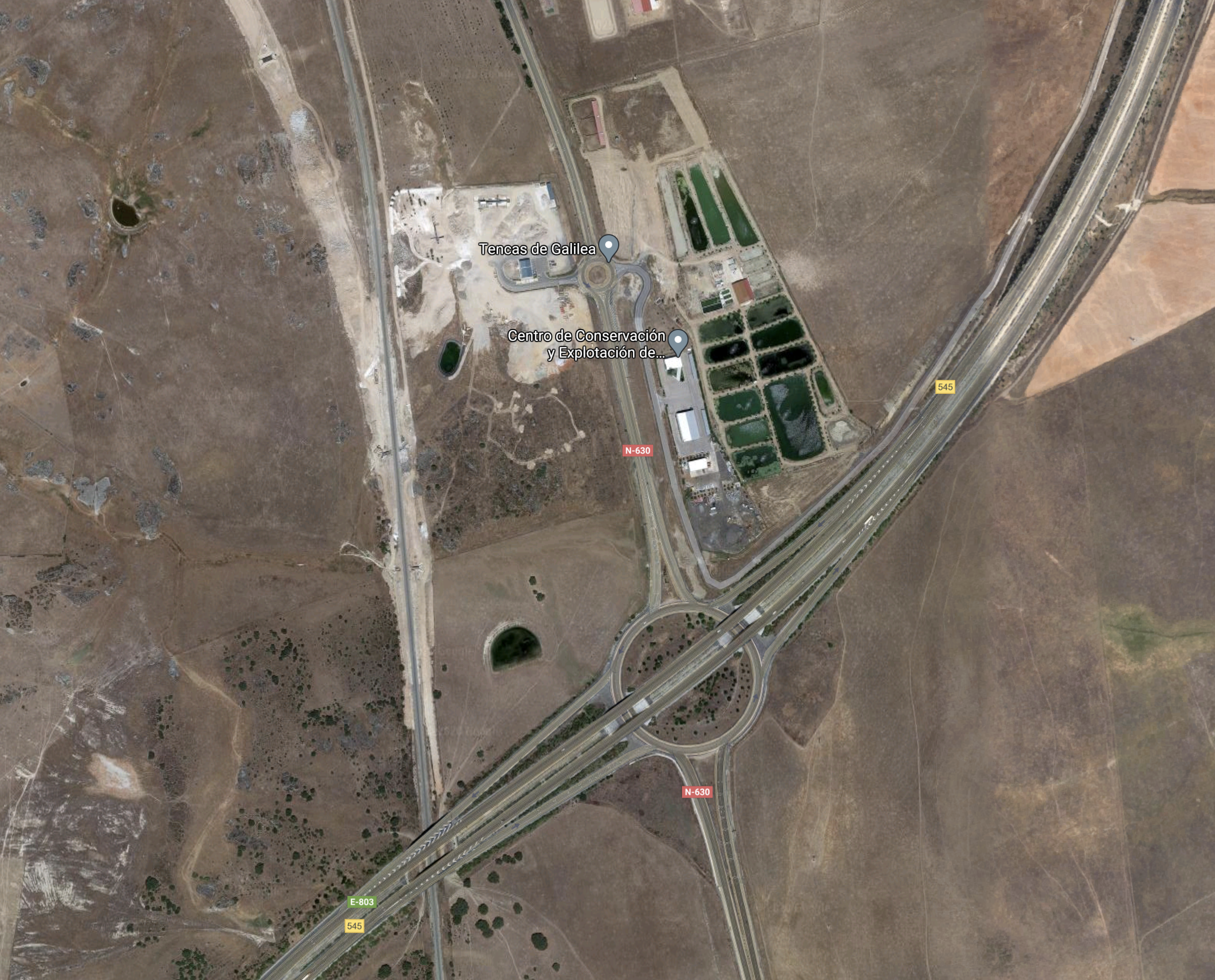
Note.
The lines would appear to join to go through Cáceres. This must surely mean, they are the same gauge.
This second map shows the station in the city of Cáceres.
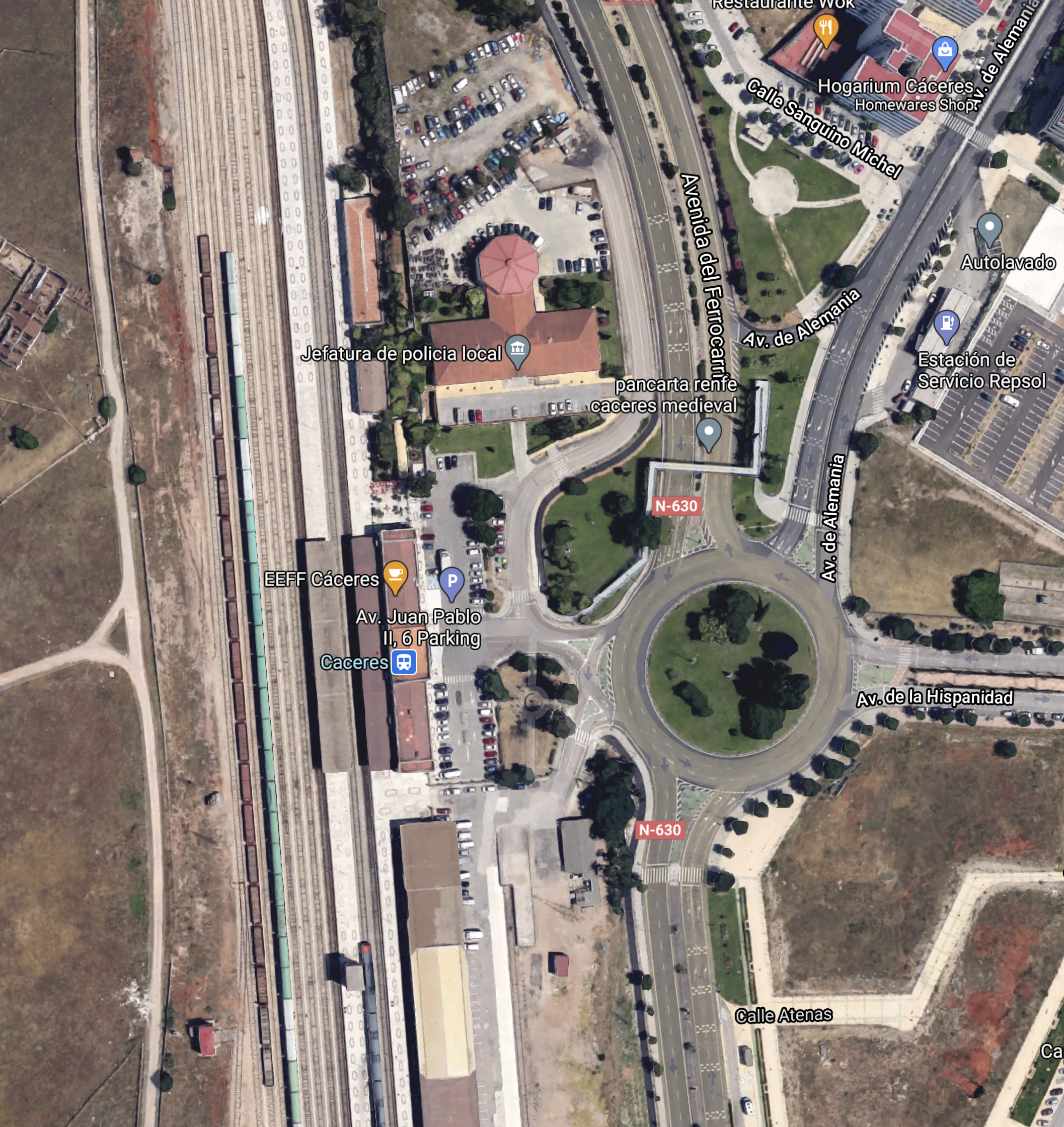
Reading Wikipedia, it looks to be the sort of place for an overnight stop or more.
Building The New Line South Of Cáceres
A new double-track High Speed Line is being built alongside the existing single track, as this Google Map shows.
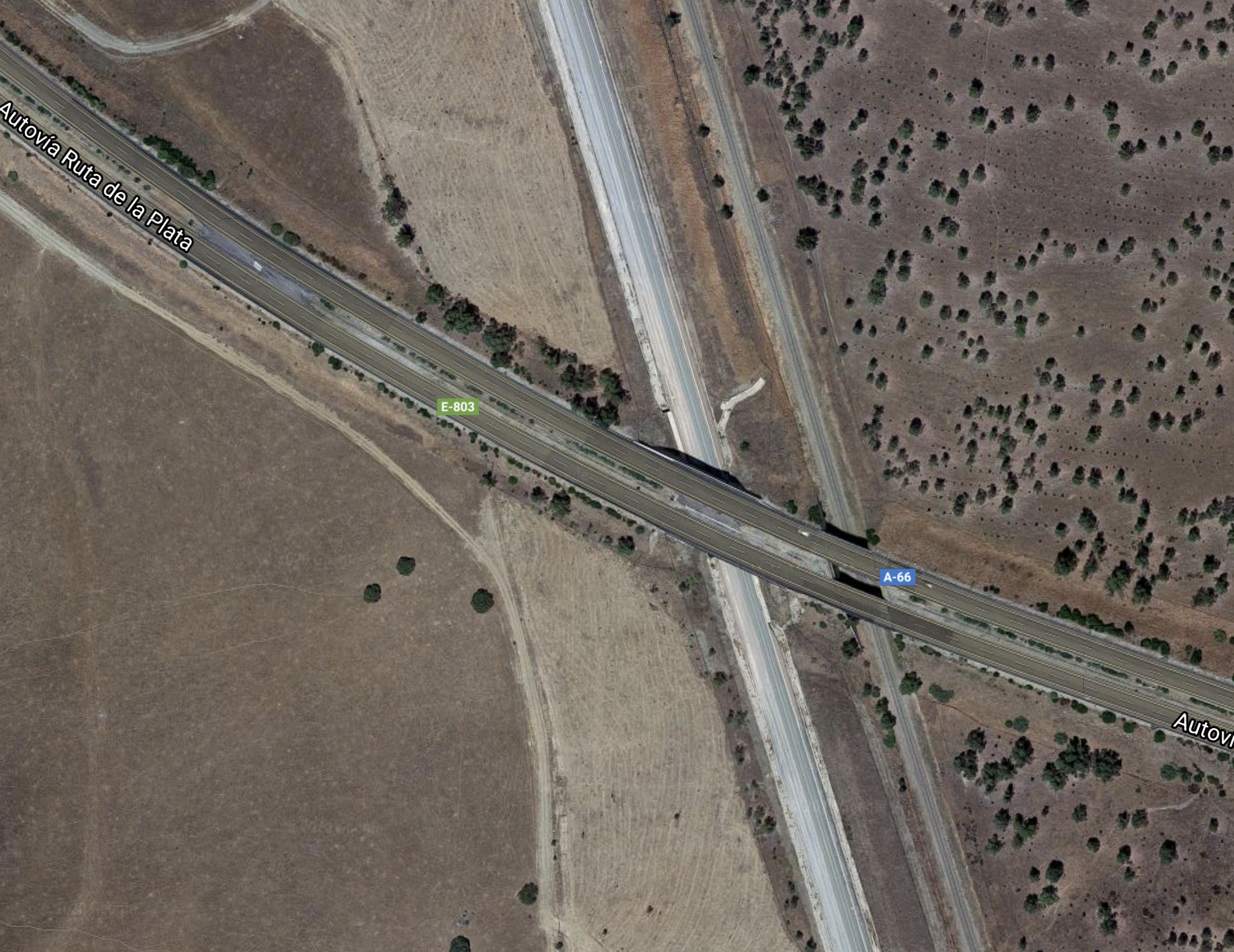
Note.
This second map, taken in the same area, appears to show rail and railway being constructed along the same route.

The third map shows a tunnel on the route.
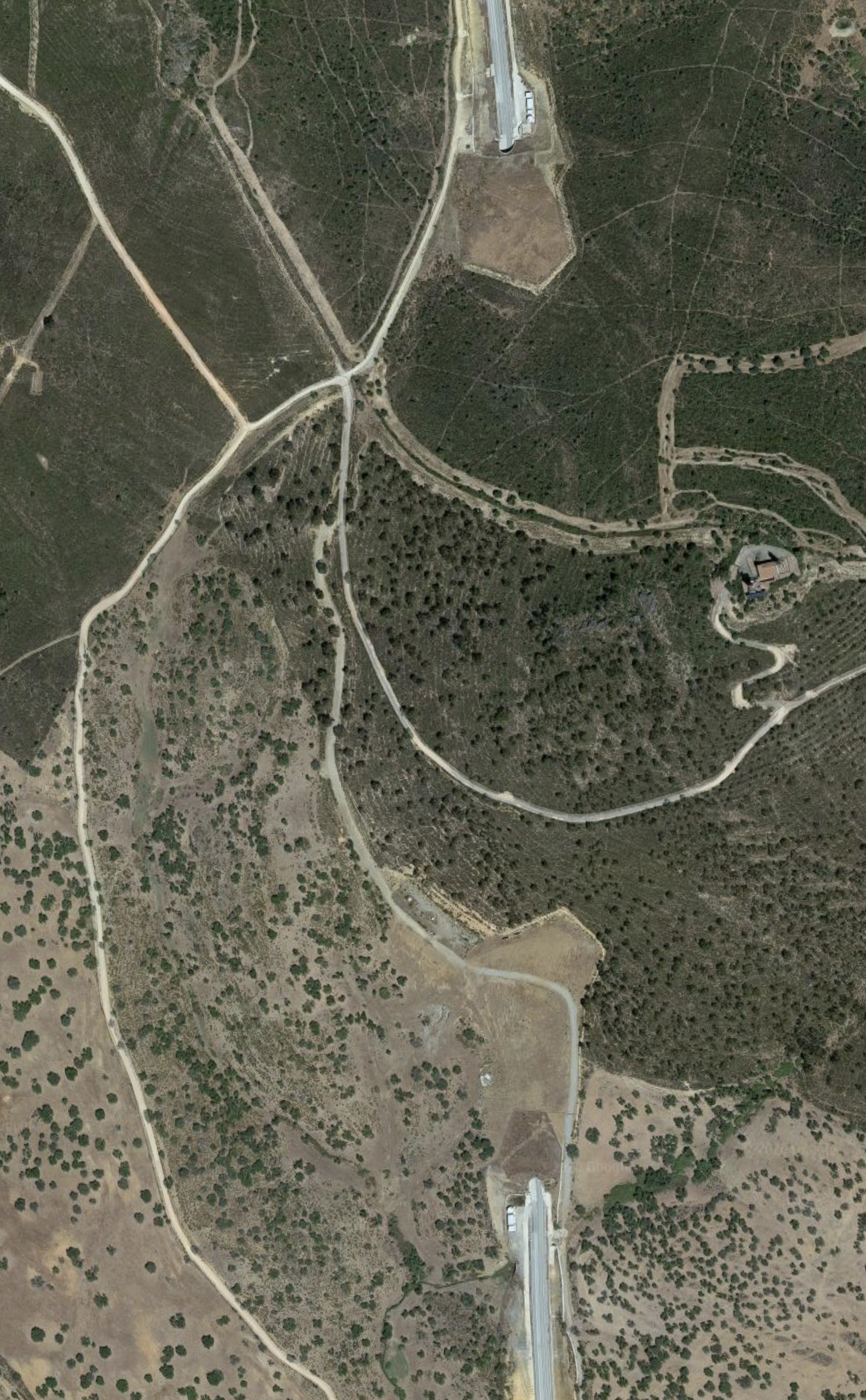
It goes straight through a range of mountains.
Aljucén
This Google Map shows the track layout at Aljucén.
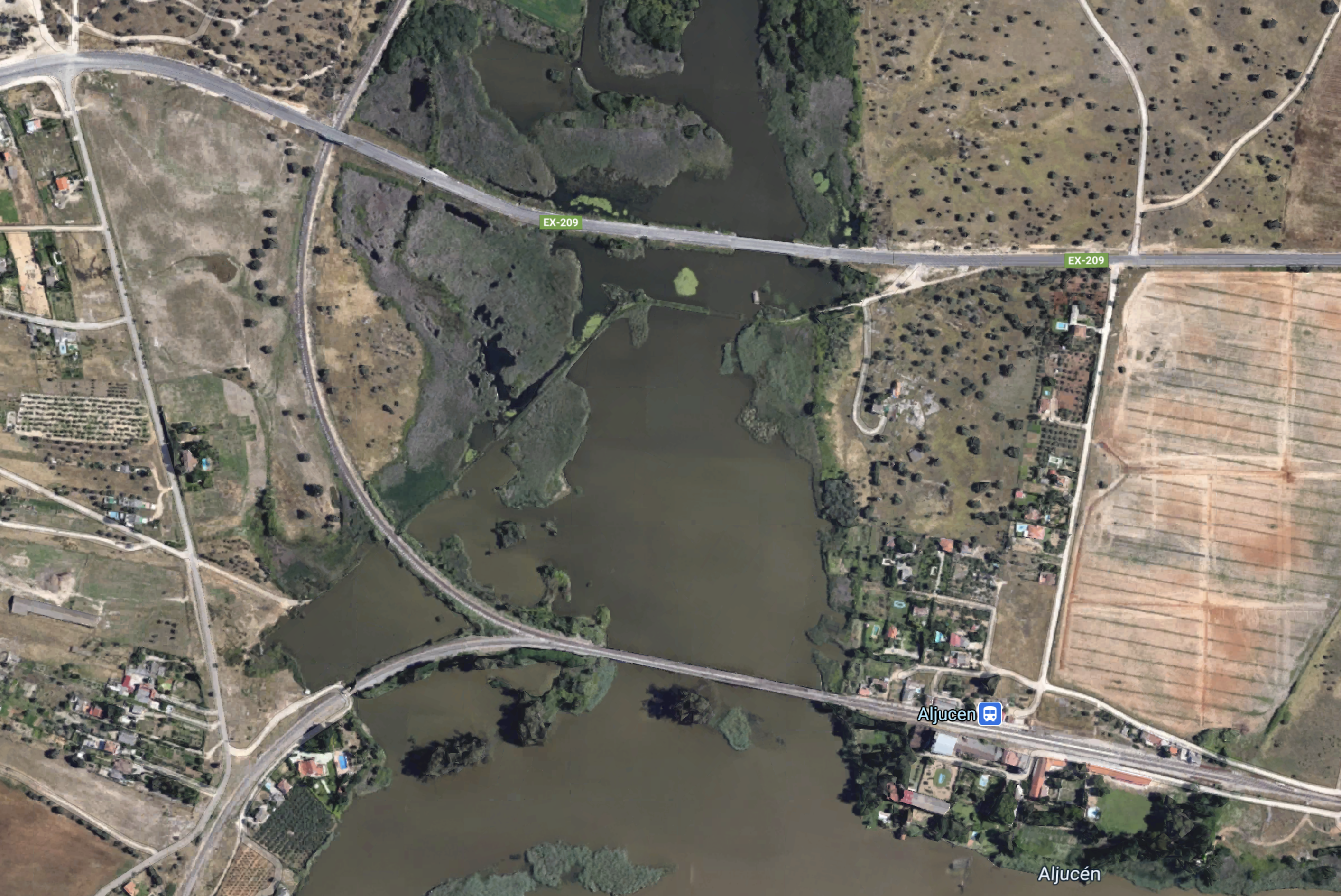
Note.
Trains between Caceres and Badajoz, may go East to Mérida to reverse.
Mérida
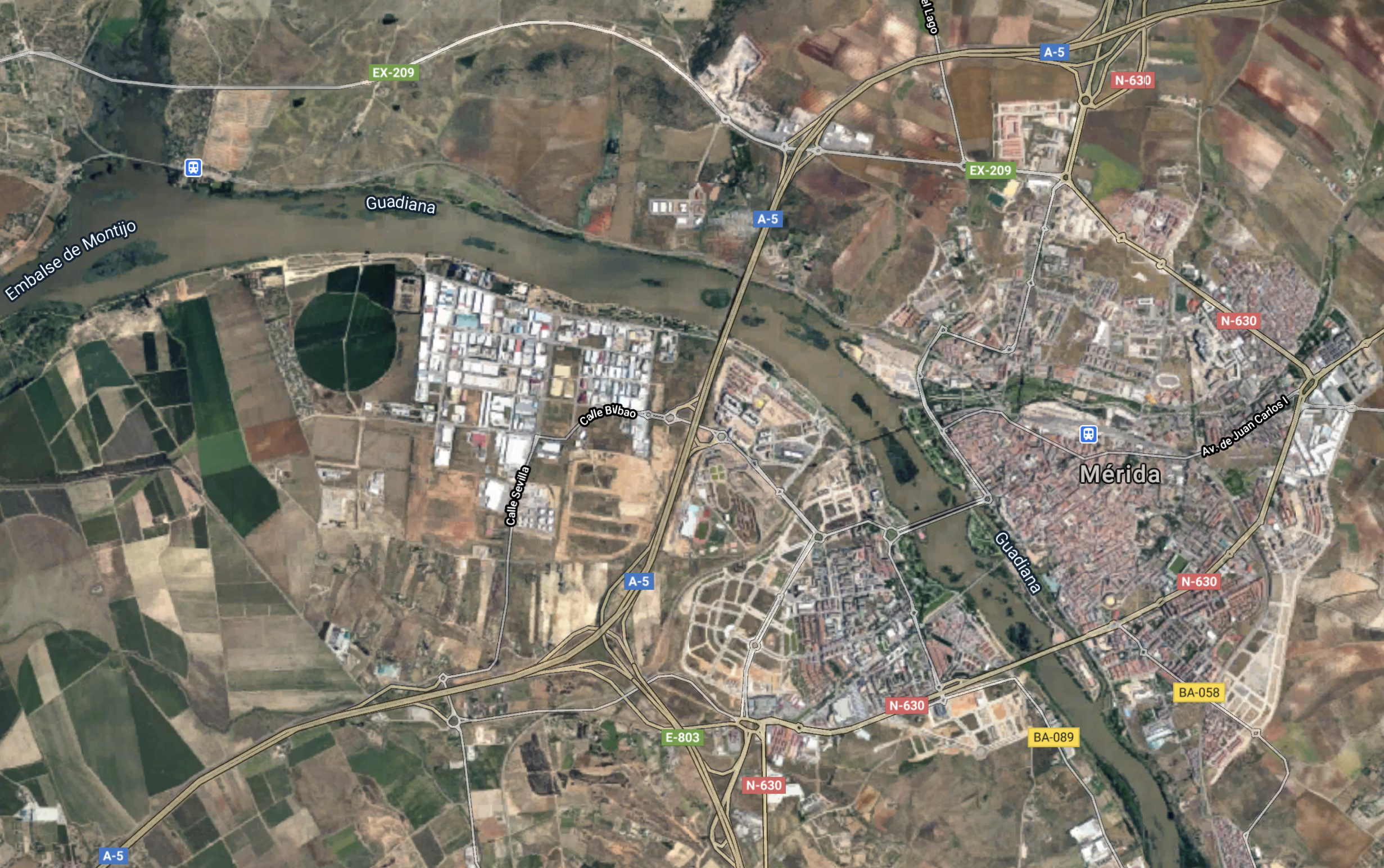
As I said, the city of Mérida is to the East of Aljucén.
This Google Map shows the area between Aljucén and Mérida .
This second map, shows the large railway yard and the station at Mérida .
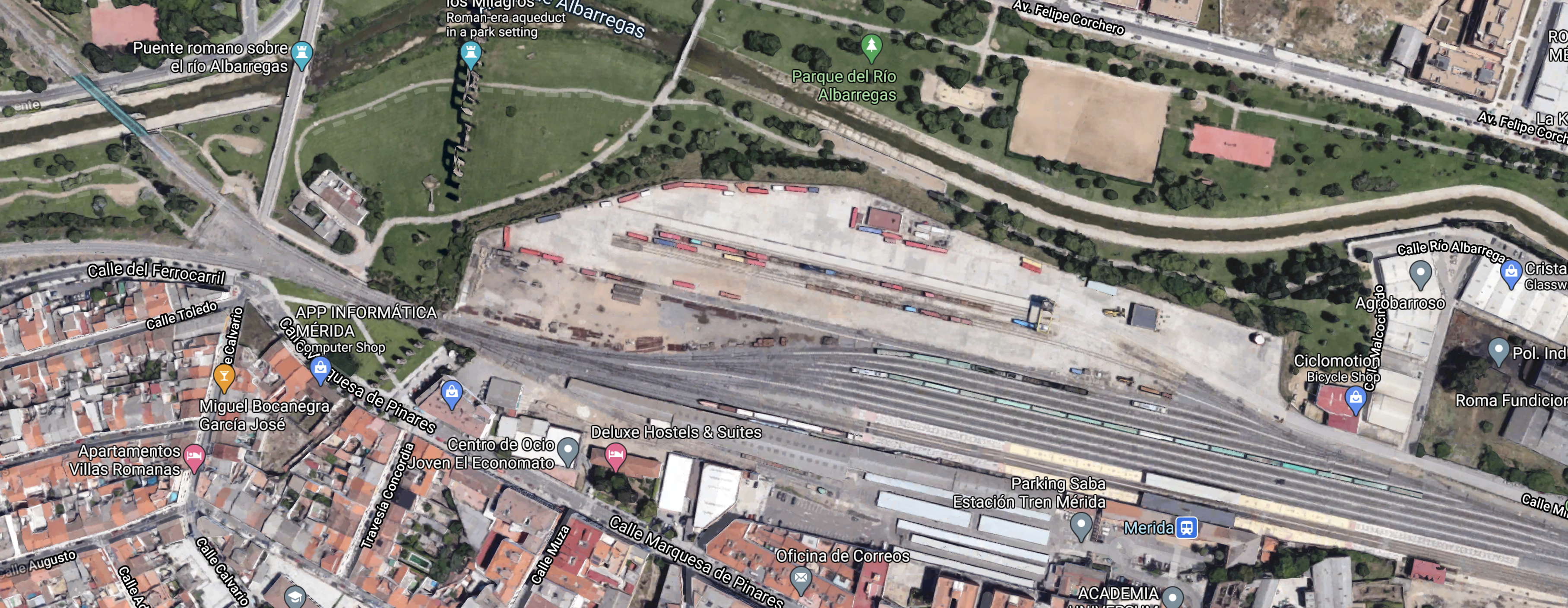
Note how the railway splits into two at the West of the station. One line takes the North side of the river and the other the South.
Onward To Badajoz
The Railway Gazette article says this about the section of the railway between Cáceres and Badajoz.
By late November, the 58∙8 km of double track between Plasencia and Cáceres was complete, while a single track has been built over the 80 km between Cáceres, Mérida and Badajoz. At Montijo, between Mérida and Badajoz, a junction is to be built to link the high speed line and the adjacent conventional line, which is to be electrified as part of work to modernise the east-west route across Extremadura between Badajoz and Puertollano.
Puertollano is to the East.
It looks to me, that if I was going to Badajoz, I’d fly to Seville and take the train, with a change at Puertollano.
Guardiana del Caudillo
This Google Map around Guadina del Caudillo station is typical of much of the route between Aljucén and Badajoz.
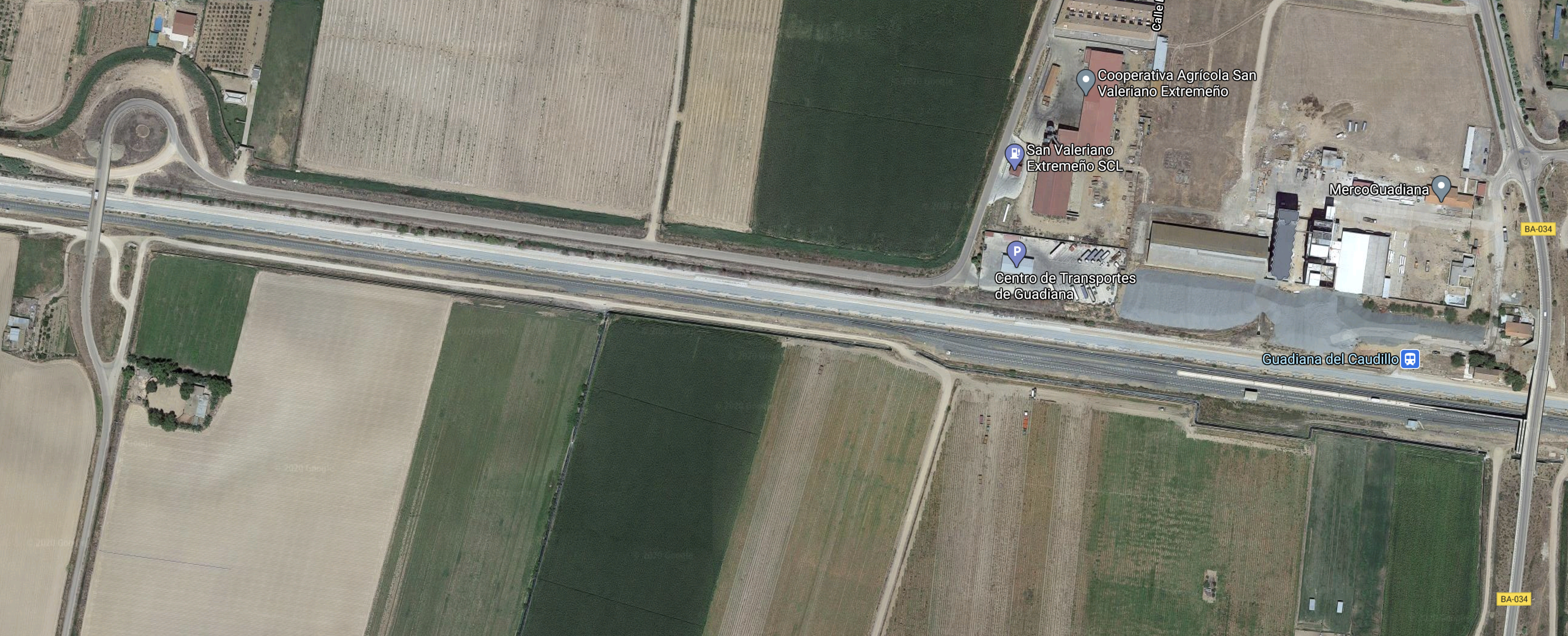
It appears that a double-track high speed railway is being built alongside the current single track.
Badajoz
This Google Map shows the current single-track railway passing North-West South-East through the city of Badajoz.
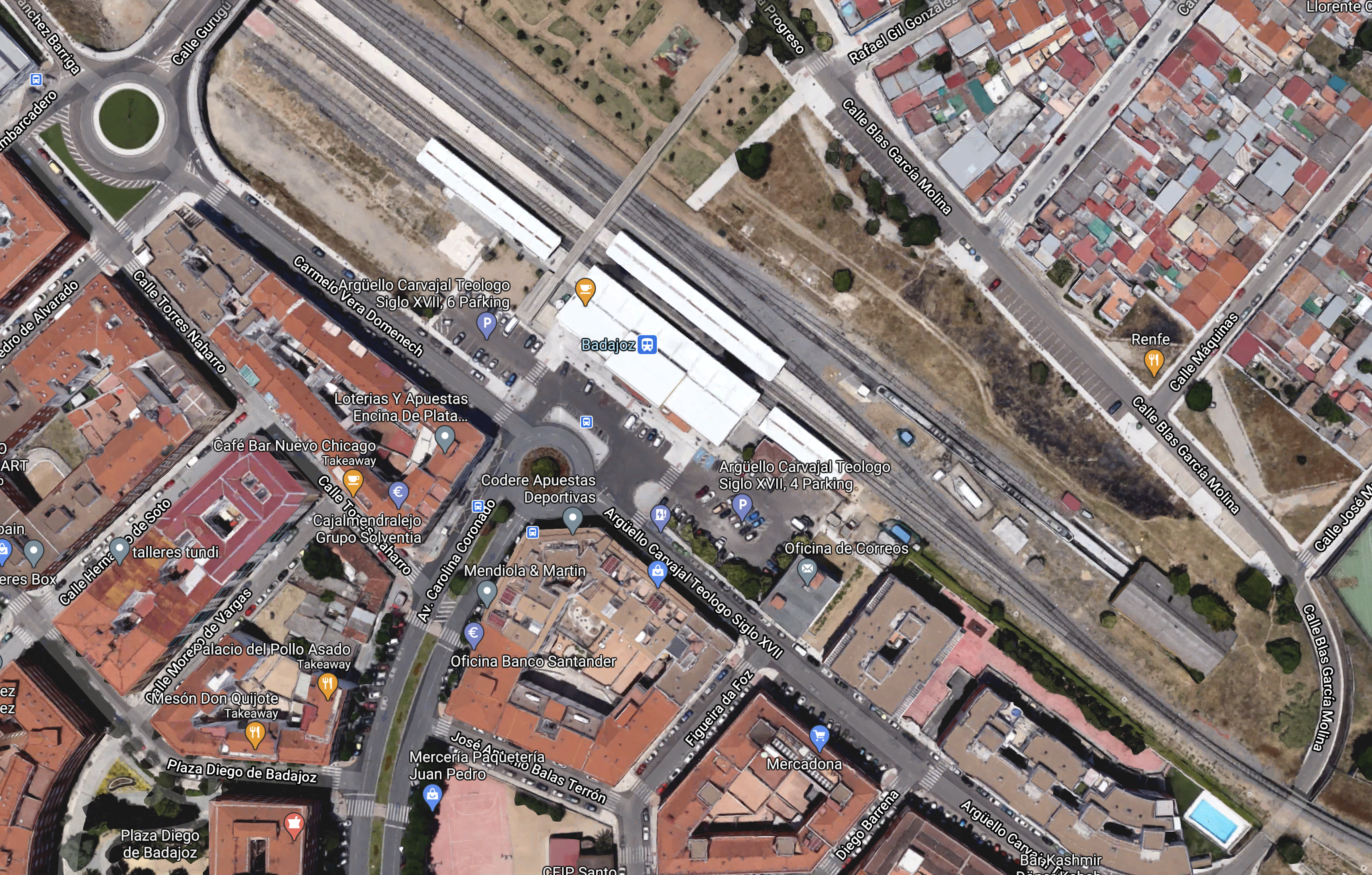
Note.
This second map shows the border.

Note.
Given the closeness of Badejoz to the border, the Spanish city could be a good place to break a journey.
Conclusion
This high speed line would appear to be easier to build than High Speed Two in some ways.
On the other hand, there are some tunnels and hills and some substantial river crossings.
Writing, this has made me want to visit, this part of Spain, where I’ve never been.
I would fly to Lisbon and gradually work my way back, stopping in places like Badajoz, Caceres and Toledo, before taking a train back to London.
Could The Madrid And Lisbon High Speed Line Become Iconic?
I think it could, as it will be a line with beautiful scenery between two of Europe’s must-visit capitals.
Posted by AnonW
Categories: Transport/Travel
Tags: Construction, Extremadura, High Speed Rail, Madrid And Lisbon High Speed Line, Portugal, Spain, Trains
Mobile Site | Full Site
Get a free blog at WordPress.com Theme: WordPress Mobile Edition by Alex King.
there’s more detail on the line in the Spanish Wikipedia page https://es.wikipedia.org/wiki/L%C3%ADnea_de_alta_velocidad_Madrid_-_Extremadura and the line of the Plasencia-Merida route is on OSM and hence shown on https://www.openrailwaymap.org/?lang=null&lat=39.79007200971702&lon=-5.9896087646484375&zoom=10&style=standard
This project is a bit complicated, as the Plasencia-Merida line currently being built is a ‘Línea de Altas Prestaciones’, higher spec than conventional with max speed of 200kmh but not ‘high-speed’ as per the Spanish definition. I suppose this is a bit like ECML/WCML, which are high-speed by British standards, but not by HS2 standards. This section will be Iberian gauge with ‘polivalente’ sleepers, so with provision for conversion to Euro gauge when the link from Toledo is complete (no funding for this atm AIUI).
Openrailwaymap also shows the line of the new single-track Evora-Elvas railway on the Portuguese side, scheduled for completion in 2022 https://pt.wikipedia.org/wiki/Nova_Linha_de_%C3%89vora https://www.infraestruturasdeportugal.pt/pt-pt/ferrovia-2020/corredor-internacional-sul/nova-linha-de-evora-evora-norte-elvascaia The sleepers on this line are also ‘polyvalente’, so they’ll also be Iberian gauge initially, with the option of converting to Euro gauge later. The connection to the border is also being upgraded. The Portuguese seem more interested in freight connections on this line than passenger. The originally planned high-speed line to Lisbon is not in the 2020 rail plan https://www.infraestruturasdeportugal.pt/pt-pt/ferrovia-2020/corredor-internacional-sul which only plans upgrades to the ports of Sines and Setubal to cater for longer freight trains.
By Peter Robins on December 6, 2020 at 10:20 am
PS I’ve just been looking at Adif’s page http://www.adifaltavelocidad.es/es_ES/infraestructuras/lineas_de_alta_velocidad/madrid_extremadura_fronteraportuguesa/madrid_extremadura_fronteraportuguesa.shtml and it looks to me as though there’s an error. This talks of upgrades to Talayuela-Casatejada, but the current line doesn’t go through Talayuela. OpenRailwayMap shows a new line between Navalmoral and Casatejada, so I have to assume that’s what’s meant here.
By Peter Robins on December 6, 2020 at 11:11 am
It looks like ‘Talayuela’ is referring to the admin area of Talayuela, not the town. Contracts have been awarded for extending E from Plasencia/Monfrague to Arroyo de Sta Maria some 7km E of Navalmoral. The Extremadura/Castilla La Mancha border is just to the E of this, so presumably there’ll be separate contracts issued for the CLA section on to Toledo, probably somewhere around 120km.
I see OpenRailwayMap has just added a layer for gauge – quite useful for Spain.
By Peter Robins on July 21, 2022 at 9:13 am
Adif’s page on this is now at https://www.adifaltavelocidad.es/w/adif-pone-en-servicio-la-primera-fase-del-corredor-de-alta-velocidad-de-extremadura (Spanish only)
By Peter Robins on July 21, 2022 at 9:18 am
correction: there is an English page at https://www.adifaltavelocidad.es/l%c3%adnea-madrid-extremadura-frontera-portuguesa
By Peter Robins on July 21, 2022 at 9:21 am
The Railway Gazette article talks of slow progress. I suspect that some of the route isn’t finalised.
Google Maps seems to be reliable.
By AnonW on December 6, 2020 at 11:19 am
Was in Badajoz last month. The old fortifications are truly a sight to behold. Recommended!
By Matthew on December 11, 2020 at 8:52 am
Thanks! As soon as a vaccine, releases the Chinese hands from my neck, I’ll go!
By AnonW on December 11, 2020 at 9:05 am
The Plasencia-Badajoz section has now opened, with full electrification next year https://www.railwaygazette.com/high-speed/extremadura-high-speed-line-inaugurated/62142.article
By Peter Robins on July 21, 2022 at 9:05 am
The Portuguese have just announced a new €4.5bn high-speed line Lisboa-Porto, together with a link on to the Galician border at Valenca, though that is dependent on developments on the Spanish side. https://www.infraestruturasdeportugal.pt/sites/default/files/inline-files/ApresentacaoProjetoAV_28Set2022.pdf (in Portuguese, but should be reasonably self-explanatory). Broad gauge, as is the Vigo-Corunna HS line in Galicia. Split into several phases 2024-early 2030s. A loop is also planned via Porto airport.
By Peter Robins on October 3, 2022 at 2:17 pm
I’m currently in Badajoz, having arrived this afternoon from Portugal in an ancient 1-carriage DMU through a very remote and little known part of P. At one point we slowed to a crawl, as there were cows on the line. There’s a lot of new track W of B, mainly for the new Amazon centre (not in use yet).
Off to Merida tomorrow, but they’re working on the line, so I shall probably take the bus.
By Peter Robins on February 5, 2023 at 5:57 pm
If you’re still thinking of going to that area, I’d suggest holding off for a while, as there’s still a long way to go before the line’s anywhere near complete.
I did go to Merida the following day from my last comment, and was able to go on a local train (which runs next to the high-speed track). The work they were doing was final touches to the electrification of the new track from Plasencia, which should be operational shortly. They can then use bi-modes. It won’t however be high speed (i.e. 300kph) until they upgrade to ERTMS, which AIUI should happen later this year (the trains are of course already able to handle that).
The following day I took the Alvia from Merida to Madrid. There was excellent wifi, and I followed our progress on OpenRailwayMap all the way. Most Spanish trains these days include speed on the in-carriage display, and I don’t think we went above 155kph the whole way. Much of the old line is still unwelded single track, with the old-style ker-clunk ker-clunk.
As you note from the satellite images, a lot of foundation work has been done on the new line E from Plasencia, though there’s still a lot to do (such as bridges), and they’ve not got around to laying any track as yet. This work comes to a halt at the Extremadura border, and I don’t think they’ve even decided on an exact route for the Castille section yet.
I forgot to mention in my previous comment that wires have been put up from Badajoz W to Elvas on the Portuguese side, though I’m not sure why, as there aren’t currently any through trains, and I can’t see there being much demand unless/until it’s extended through to Lisbon (Elvas population 16,000, compared to Badajoz 150,000). Badajoz station has been completely rebuilt.
By Peter Robins on February 13, 2023 at 10:00 pm
And just as a follow-up to this, Adif have now announced they’ve completed electrification of Plasencia-Badajoz including the spur to Merida (and the section to the Portuguese border) https://www.adif.es/documents/34745/2621689/Dic2023+Dossier+LAV+Extremadura.pdf/5d180cce-b62a-bd5a-2ddf-4de6fe8b24b6?t=1702556311845 (I think this is only available in Spanish). They say they’ve added ERTMS level 2 infrastructure to enable 300kph running, and just need to roll out and test the software. They don’t give a completion date for this. They say they’ve also completed 2 of the subsections of the line E from Plasencia, and are working on a further 5. The final stage on to Madrid is still very much in the planning stage.
By Peter Robins on December 21, 2023 at 12:59 pm
There’s an interesting ‘in depth’ look at the new Evora-Elvas connection at https://www.railwaygazette.com/in-depth/portugal-south-international-corridor-nears-completion/66312.article which discusses the various options once this comes into operation, supposedly next year. Looks like a greatly-improved Lisbon-Madrid connection could be in operation before too long.
Electrification of the (primarily freight) line Merida-Puertollano has now started, currently scheduled for 2027.
By Peter Robins on April 19, 2024 at 1:32 pm