West London Orbital: Line Could Be Reused For Passengers
The title of this post is the same as that of this article on the BBC.
This is the sub-heading.
A railway line that stopped serving passengers in 1902 could be brought back into use as a route called the West London Orbital.
These are the first three paragraphs.
The Dudding Hill loop runs from Acton to Cricklewood and currently only takes freight trains.
Transport for London (TfL) published a strategic document in 2021 saying it would be “a catalyst for relieving road congestion in west London”.
It is estimated by TfL more than 11 million people a year would use it.
This is also said.
Sharma Tatler, the deputy leader of Brent Council, called the plan “a no-brainer”.
I agree with that.
These are my thoughts.
Finding The Money
Money will be needed for the following.
- To build and update the stations on the route.
- To acquire the new trains needed.
- To bring the track and signalling up to the required standard.
Note.
- It appears that around a dozen freight trains use the route on a typical day.
- Hopefully, Network Rail can come up with an affordable plan for the track and signalling, as the route is used by freight trains at the present time.
- I would envisage that the trains used would be a version of the current Class 710 trains used on the Overground. These could probably be leased.
I wouldn’t be surprised that the cost of the stations, will be the major part of the building of the line.
Building the stations is probably, the easiest place to bring in private finance. Especially, if stations incorporated housing or other developments.
On a train going to the North a few years ago, I met two infrastructure funders from L & G (in Standard Class), who were going to lend a company 50 billion to develop a large residential housing site. We got talking and I asked them if they would develop a mythical branch line with a good station site at the end. (Think Felixstowe!) I asked if they’d fund housing and possibly the trains. They said yes!
So I suspect that the West London Orbital could also be funded in the same way, as there are a few stations to build and upgrade. Much needed housing could be built on top or nearby.
I would also deck-over Neasden Depot and build housing in town blocks on top.
I believe that the West London Orbital could be funded.
Electrification
The Wikipedia entry for the West London Orbital describes the route like this.
The route would run for approximately 11 miles (17 km) from West Hampstead and Hendon at the northern end to Hounslow at the western end via Brent Cross West, Neasden, Harlesden, Old Oak Common, South Acton and Brentford.
Note.
- There is 25 KVAC overhead electrification at the Northern end of the route between West Hampstead Thameslink and Hendon stations.
- The Dudding Hill Line between the Midland Main Line and Acton Wells Junction is not electrified.
- The North London Line between Acton Wells Junction and Acton Central station is electrified with 25 KVAC overhead wires.
South of Acton Central station, the electrification gets complicated as this OpenRailwayMap shows.
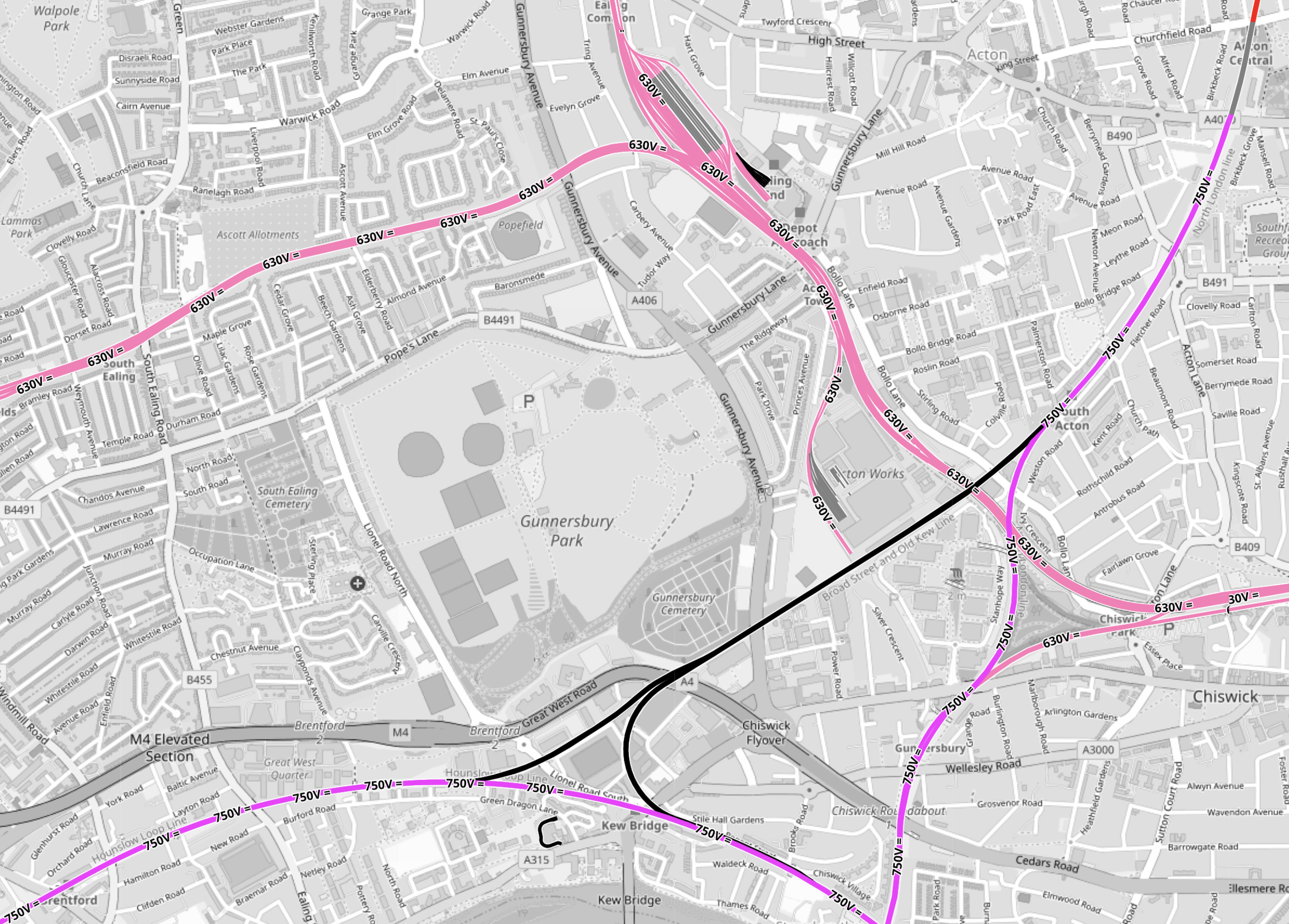
Note.
- Acton Central station is in the North-East corner of the map.
- Brentford station is in the South-West corner of the map.
- The red track is electrified with 25 KVAC overhead and it is used North of Acton Central station.
- Mauve track is electrified with British Rail third rail.
- Ptnk track is electrified with London Underground third rail.
- Black track is not electrified.
- West London Orbital trains between West Hampstead Thameslink and Hounslow will use the direct route between Acton Central and Brentford.
- West London Orbital trains between Hendon and Kew Bridge terminate at the South-Eastern point of the triangular junction.
It seems that trains will be needed that can use both types of electrification and none.
New Trains
Because of the requirement of the trains to be able to use both types of electrification and be self-powered, the trains will either have hydrogen or battery power to augment electric traction.
Hendon and Hounslow is 11.3 miles and this will be longer than any service distances, so I suspect that a battery-electric train could handle the route.
In this article in Global Rail News from 2011, which is entitled Bombardier’s AVENTRA – A new era in train performance, gives some details of the Aventra’s electrical systems. This is said.
AVENTRA can run on both 25kV AC and 750V DC power – the high-efficiency transformers being another area where a heavier component was chosen because, in the long term, it’s cheaper to run. Pairs of cars will run off a common power bus with a converter on one car powering both. The other car can be fitted with power storage devices such as super-capacitors or Lithium-ion batteries if required. The intention is that every car will be powered although trailer cars will be available.
Unlike today’s commuter trains, AVENTRA will also shut down fully at night. It will be ‘woken up’ by remote control before the driver arrives for the first shift
This was published over ten years ago, so I suspect Bombardier (or now Alstom) have refined the concept.
Bombardier have not announced that any of their trains have energy storage, but I have my suspicions, that both the Class 345 and Class 710 Aventra trains use super-capacitors or lithium-ion batteries, as part of their traction system design.
- I was told by a Bombardier driver-trainer that the Class 345 trains have an emergency power supply. When I said “Batteries?”, He gave a knowing smile.
- From the feel of riding on Class 710 trains, as a Control Engineer, I suspect there is a battery or supercapacitor in the drive system to give a smoother ride.
I also feel that the Aventra has been designed, so that it can accept power from a large variety of sources, which charge the battery, that ultimately drives the train.
 The Anonymous Widower