Could Birmingham Become London’s New Runway?
There is no doubt, that London needs an extra runway. But could it be at Heathrow or Gatwick? Or even Birmingham?
London’s Current Runways
These are London’s current runways.
- City – 09/27 – 1508 metres
- Gatwick North – 08L/26R – 2565 metres
- Gatwick South – 08R/26L – 3316 metres
- Heathrow North – 09L/27R – 3902 metres
- Heathrow South – 09R/27L – 3660 metres
- Luton – 07/25 – 2162 metres
- Southend – 05/23 – 1856 metres
- Stansted – 04/22 – 3049 metres
Note.
- Gatwick’s runways are currently too close together, to be used at the same time.
- Heathrow’s runways are the longest that serve London.
- There are eight runways in total.
I’ve landed aircraft on the runwy at Luton, Southend and Stansted.
How Does Birmingham Airport Compare?
Consider.
- Birmingham’s runway is 15/33 and 3052 metres long.
- Birmingham Airport will be connected to High Speed Two, if and when that opens as predicted in 2036-2039.
- A journey from London will take less than 50 minutes.
It could be an alternative runway with good connections to the capital.
What Do Airlines Think About Birmingham Airport?
I asked Google AI and received this answer.
Airlines view Birmingham Airport (BHX) as an important, high-potential regional base in the UK, though operational and infrastructure pressures have caused friction.
Strong Commercial & Operational Appeal
Major Operating Base: BHX serves as a primary operating base for major low-cost and leisure carriers, including Ryanair, easyJet, Jet2.com, and TUI Airways.
Expanding Network: Airlines continue to support and grow routes out of Birmingham. Recent additions include carriers like Qatar Airways (to Doha), Saudia (to Jeddah), and Pegasus Airlines (to Istanbul), along with active targeting of new long-haul and unserved European markets.
Growth Ambitions: The airport has a £300 million investment schedule over the next decade to scale up to 18 million passengers by 2033, backed by strong local economic demand from the West Midlands corporate and leisure markets.
Operational Strain & Baggage/Capacity Issues
Baggage & Infrastructure Failures: Airlines operating out of BHX faced severe challenges during peak travel periods (such as summer 2026), when overwhelmed baggage handling systems forced airports and airlines to make the difficult trade-off of prioritizing strict flight slots and departures over loading passenger luggage—leaving hundreds of travelers flying without bags.
Mitigation Measures: To cope with heavy peak and holiday queues (such as security delays and check-in bottlenecks), airlines like easyJet, Jet2, Ryanair, and TUI have heavily promoted day-before bag drop options at BHX to ease terminal congestion.
There is nothing there that can’t be fixed.
Is Birmingham Airport A Good Neighbour?
I asked Google AI and received this answer.
Whether Birmingham Airport is considered a “good neighbour” depends heavily on whether you weigh its economic benefits to the West Midlands against the localized noise, environmental, and disruption impacts experienced by nearby communities.
The Case for the Airport (Economic and Regional Value)
Job Creation and Economy: Business groups and regional leaders view Birmingham Airport (BHX) as a vital engine for the Midlands, directly and indirectly supporting thousands of jobs and contributing billions to the regional economy.
Draft Master Plan (2026–2041): The airport has unveiled a £2 billion draft master plan aimed at doubling passenger capacity to roughly 30 million a year by making better use of its existing single runway rather than building a second one.
Public Consultations: The airport conducts public engagement sessions and highlights its investments in local community trusts and regional workforce programs (such as in East Birmingham and North Solihull).
The Complaints from Local Neighbours (Noise and Disturbance)
Aircraft Noise: Residents living directly under or near flight paths—in villages and suburbs like Bickenhill, Marston Green, Sheldon, and Elmdon—frequently report stress, sleep disruption, and noise pollution from early-morning and night-time flights.
Night Flights and Caps: Tensions regularly flare over night-flying limits. While the airport maintains that it operates within permitted statutory limits and transitions toward quieter aircraft, local action groups argue that expanded night-flight allowances and increased traffic degrade local quality of life.
Surface Access and Local Infrastructure: Increased road traffic, parking spillover, and drop-off charges remain a persistent point of friction for nearby towns and drivers.
Note.
- Birmingham Airport can be expanded by making better use of the single runway.
- I believe that by 2040, there will be zero-carbon 70 seat airliners, that will have a range of a thousand kilometres.
- For distances longer than a thousand kilometres, Sustainable Aviation Fuel (SAF) will be used.
- Birmingham Airport also needs to be connected to the West Midlands Metro.
Flight Distances From Birmingham Airport
These are distances to various airports in kilometres.
- Aberdeen – 329 km.
- Amsterdam – 529 km.
- Belfast George Best – 363 km.
- City of Derry – 457 km.
- Cork – 465 km
- Dublin – 320 km.
- Dusseldorf – 597 km.
- Edinburgh – 402 km.
- Geneva – 894 km.
- Glasgow – 418 km.
- Hamburg – 795 km.
- Hannover – 774 km.
- Inverness – 585 km.
- Kirkwall – 727 km.
- Munich – 1059 km.
- Newcastle – 287 km.
- Newquay – 318 km.
- Nice – 1181 km.
- Paris Charles de Galle – 488 km.
- Sumburgh – 826 km.
The energy revolution in aviation, could be starting in Birmingham.
When Will The Third Runway At Heathrow Be Finished?
Estimates vary, but I reckon, it will be 2040 before the third runway opens.
The Wikipedia entry for the Expansion of Heathrow Airport says this.
On 16 December 2020, the UK Supreme Court lifted the ban on the third runway, allowing a planning application via a Development Consent Order to go ahead. The plan stalled in 2023 after post-COVID pandemic falling passenger numbers and concerns about investment costs, but as of June 2024 the third runway is still planned with a projected completion date around 2040. In January 2025, Chancellor of the Exchequer Rachel Reeves confirmed it was the new Labour government’s plan to proceed with a third runway within the current parliamentary term.
If it is 2040, then it is likely that High Speed Two will be open to Birmingham Airport before Heathrow’s Third Runway is completed..
The Southern Entrance To London City Airport – Revisited
I wrote The Southern Entrance To London City Airport in December 2022 and today, it is my top post.
I wonder why?
Any ideas?
Heathrow Expansion Could Open The Door To Five Additional UK Routes, According To New Research
The title of this post, is the same as that of this press release from the Heathrow Media Centre.
These three bullet-points act as sub-headings.
- New research identifies Belfast International, Cornwall Airport Newquay, Leeds Bradford Airport, Liverpool John Lennon and Teesside International Airport as most likely to gain Heathrow connections through expansion
- New links could unlock £335m in additional gross tourism spend, boosting trade, investment and jobs. This builds on the estimated £1.2bn in gross tourism spending across the UK from travellers supported by current Heathrow domestic routes
- Regional airports and businesses support this Government’s backing of Heathrow expansion and urge the project to be progressed as fast as possible
This is the first paragraph.
New research by Frontier Economics has identified the UK airports most likely to benefit from new or restored connections to Heathrow, when additional airport capacity is delivered by a third runway.
Surprise surprise! Research paid for by an airport shows more flights to the airport are a good idea after a new runway has been added.
I will look at each airport mentioned in the report in detail.
Belfast International
Belfast International Airport handles nearly seven million passengers a year, as opposed to the 2.5 million passengers that use the smaller Belfast City Airport.
Consider.
- Belfast International has flights to Gatwick, Luton and Stansted.
- I’ve only flown into Belfast twice and it was once to each airport.
- I did fly myself into Belfast City, when I was taking a friend to see Shorts, as he might have bought a Skyvan.
- If I wanted to go, I’d probably go from London City to Belfast City unless say, I was being picked up from Belfast International and perhaps going some distance from Belfast, in which case it would be Gatwick Airport.
- Note that I only travel with a small amount of hand baggage. As an an aside, what do travellers put in their mammoth suitcases?
- The press release talks of Belfast’s growing screen and cultural industries.
I wonder, if Belfast International needs flights from Heathrow, because there is increasing amounts of connecting travellers for Belfast and the aircraft to Belfast City aren’t large enough to carry all the cases.
Cornwall Airport Newquay
Newquay has flights to Gatwick and Stansted.
I’ve only been to Newquay once and I went by train, which I wrote about in Newquay Station – 9/10th February 2024.
- I changed once at Par.
- But soon, if not already, there will be direct trains from Paddington.
- Details on the summer-only Atlantic Coast Express are given on its Wikipedia entry.
- Will there be Pullman Dining, as I experienced on On The 10:45 From Paddington? That journey was the best train breakfast I’ve ever had!
Paddington and Heathrow isn’t a difficult journey to get the train for Newquay.
Leeds Bradford Airport
I used to fly light aircraft and I have friends in aviation. One phrase you regularly hear from pilots is “Time to spare, go by air!”
- Basically, unless you’re flying in a business jet, leave plenty of time.
- Leeds Bradford is a good airport and they did a good job, when I presented them with a problem, that I wrote about in Incident At Leeds.
- If I came into Heathrow, I would probably use Heathrow Express to Paddington and then get the Metropolitan Line to King’s Cross to get to Yorkshire.
- Leeds is also getting a Metro.
- LNER and other train companies are developing their services to the Leeds-Bradford area and there are now services to Bradford, Doncaster, Harrogate, Hull, Leeds, Shipley, Skipton and York.
- Leeds station has two trains per hour to and from London.
- Leeds station has lots of taxis.
Google AI gives this AI Overview of parking at Leeds-Bradford airport.
Parking at Leeds Bradford Airport (LBA) is highly streamlined, offering a range of on-site and off-site options. It features a popular Free 1-Hour Zone for drop-offs, premium options right outside the terminal, and competitive long-stay parking. Pre-booking online is heavily recommended to secure spaces and get the best
I doubt that flying between Heathrow and Leeds Airport will be popular, unless you’re parking at the airport
Liverpool John Lennon Airport
A lot of the things said about Leeds Bradford Airport can be said about Liverpool airport.
But Liverpool already has a comprehensive Metro.
Google AI gives this AI Overview of parking at Liverpool airport.
Parking at Liverpool John Lennon Airport is extremely convenient because all official car parks are located directly on-site within a 1 to 5-minute walk of the terminal building—meaning no shuttle buses are required.
As with Leeds-Bradford Airport, I doubt that flying to Heathrow will be popular, unless you’re parking at the airport
Teesside International Airport
Reading the Wikipedia entry for Teesside International Airport doesn’t give the impression, the airport is not in the best of health.
But this is said about parking on the Teesside International Airport web site.
Teesside Airport parking is situated directly opposite the terminal building.
Wherever you’re coming from for your flight, be it Middlesbrough, Hartlepool or down the road in Darlington, our parking is closer and safer than parking anywhere else to access the airport. It is monitored 24/7 and has been awarded safe parking status by Park Mark.
Dropping off or picking up? There’s free parking for up to two hours when you spend minimum of £5 in our Landside Café or landside terminal shops. Receipt must be shown for validation.
I suspect if you’re going to one of its eight destinations and you want to take your car, then you might use Teesside International Airport.
Although several local stations seem to have good train services to King’s Cross, it does appear that Teesside International Airport could be using parking to attract business with customer-friendly parking.
I have some thoughts.
Do Many Passengers Take A Coach To Heathrow?
Google AI gave this answer, when I asked the question in the title of this section.
Yes, absolutely. Over 5 million passengers take coaches to Heathrow every year.
The airport’s Central Bus Station is one of the busiest coach hubs in the UK, and coaches provide an incredibly popular, cost-effective alternative to trains and taxis.
The main reasons so many travelers choose to take the coach include:
Direct Terminal Access: Coaches drop you off directly at the Heathrow Central Bus Station (for Terminals 2 and 3) or right outside Terminals 4 and 5.
This saves you from dragging heavy luggage through the London Underground or navigating complex rail changes.
Cost-Effective: Advance tickets often start as low as \(£10.50\), making it substantially cheaper than black cabs, airport parking, or premium rail lines like the Heathrow Express.National Connectivity: Coaches connect Heathrow to over 500 locations across the country.
Major hubs like Bristol, Oxford, Cambridge, and Southampton have direct, frequent services without requiring a change in Central London.
Early Morning Travel: Because the airport is a 24-hour operation, many coaches run throughout the night, offering crucial connections before local trains even begin operating.
An alternative at some of these smaller airports could be better coach travel.
Is Anybody Proposing A Small Airliner Powered By Hydrogen Fuel Cells?
I believe a smaller airliner powered by hydrogen fuel cells could suit feeder flights from smaller airports.
Google AI gave this answer, when I asked the question in the title of this section.
Yes, several aerospace companies are actively developing and testing hydrogen fuel cell airliners, ranging from retrofitted commuter planes to clean-sheet regional aircraft.
The leading proposals and active development programs include:
Airbus ZEROe: Airbus is designing a 100-seat regional airliner powered by four 2.4-megawatt hydrogen fuel cell engines.
After verifying the concept’s feasibility, Airbus is currently assembling a 1.2MW powertrain demonstrator for testing, with the aircraft targeted for entry into service in the late 2030s.
ZeroAvia: ZeroAvia is focused on retrofitting existing regional airframes (such as the Dornier 228) with hydrogen-electric engines.
They are currently testing their ZA600 powertrain for 19-seat aircraft and are actively developing larger systems (up to 80 seats) to enter commercial service in the coming years.
.H2Fly: This company focuses on small regional aircraft and has test flights slated for their 4-seat air taxis and larger regional prototypes.
They advocate for starting with smaller planes to avoid the complex infrastructure challenges of larger models.
Beyond Aero: They are developing “ONE,” a hydrogen-electric business aircraft designed specifically for executive travel, aiming to reduce both costs and carbon emissions compared to traditional jet fuel.
Hopefully, hydrogen fuel cell powered aircraft will be quiet.
Condor Celebrates Inaugural Flight Of New Frankfurt–London Gatwick Route
The title of this post is the same as that of this press release from Condor.
This is the sub-heading.
Condor today launched its new city connection between Frankfurt am Main (FRA) and London Gatwick (LGW). With the inaugural flight, the British capital is now officially part of Condor’s city network. The route will be operated three times daily with a schedule designed to appeal equally to business travellers and city tourists. Flights are operated using Condor’s Airbus A320 aircraft, offering capacity for 180 passengers in a two-class configuration, including Business Class and Economy Class with the standard 3-3 seating layout. In addition, Condor cooperates with partner airlines on this route.
These three paragraphs add more details.
With this new connection, Condor is expanding its city network to include one of Europe’s most important metropolitan hubs, thereby strategically strengthening its presence in the European market. To mark the inaugural flight from London Gatwick, departing passengers on the fully booked service were welcomed with a small reception and gifts before the flight departed punctually for Frankfurt am Main.
David Carlisle, Director Network and Partnerships at Condor, said: “Today’s inaugural flight to London Gatwick marks another important milestone in the expansion of our European route network. London is one of Europe’s most sought-after destinations, both for business travellers and short city breaks. We are delighted to offer our guests up to three daily frequencies, providing maximum flexibility as well as convenient access to our long-haul network to Africa and Asia.”
Jonny Macneal, Head of Aviation Development at London Gatwick, added: “We are delighted to welcome Condor to London Gatwick and to offer our passengers even greater choice with this new, frequently operated service to Frankfurt. Whether travelling for business, leisure or to visit friends and family, the route provides excellent flexibility and connectivity. Condor’s arrival marks another important milestone during a period of significant growth for the airport.”
The press release also has these two last paragraphs, which give more information about the airline.
London is one of Europe’s leading economic and financial centres and also one of the most popular destinations for city travel. The new connection offers business travellers excellent access to the Greater London area as well as flexible options for day trips. Leisure travellers benefit from convenient flight times for weekend getaways.
In addition to the launch of London Gatwick, Condor continues to expand its network. From May, Barcelona, Budapest and Venice will be added as new destinations, bringing the total number of city destinations in the Condor network to 13. With these additions, Condor is further strengthening its presence in high growth markets and continuing to expand its European route network. Flights can be booked online at http://www.condor.com, via telephone or through travel agencies.
It is certainly one of the best-written and information-rich press releases, that I have seen.
If the attention to detail is as good in the way the airline is run is half as good, Condor will be worth giving a try.
This page is their TripAdvisor reviews.
Gatwick Airport Is Expanding
I picked up the news of Condor Airlines new service from one of my Google Alerts about Gatwick Airport’s proposed new runway.
These were the titles of the news articles in the alert.
- Simple Flying – Unbelievable! The UK’s 2nd-Busiest Airport Welcomes 5th New Airline In 11 Days
- MSN – London Gatwick confirms 9th new airline in massive 2026 shakeup
- Aviation A2Z – Condor Begins First UK Route with 3 New Daily Flights to This Airport
- Yahoo News UK – Airline launches first-ever UK route from Gatwick Airport to popular European city
- AviationSource News – Condor Launches New Frankfurt to London Gatwick Route
- Aviation24.be – Condor launches Frankfurt–London Gatwick route with three daily flights, marking UK debut
- Travel Wires – Condor launches first UK route with Gatwick–Frankfurt service
- Travel And Tour World – Frankfurt & London: New Condor Flights Spark Hope and Joy at London Gatwick Airport, UK
There is also this headline about Air France.
- Aviation24.be – Air France returns to London Gatwick with new twice-daily Paris CDG service
Gatwick seems to be doing well to be welcoming nine new airlines in 2026 and five in the last eleven days.
Perhaps, some honest accounting have convinced those nine airlines, that Gatwick’s new runway, won’t raise charges as much as Heathrow’s.
Travelling Between Heathrow Airport And Staines Station
Staines Station and Heathrow Airport are not far apart, as this OpenRailwayMap shows.
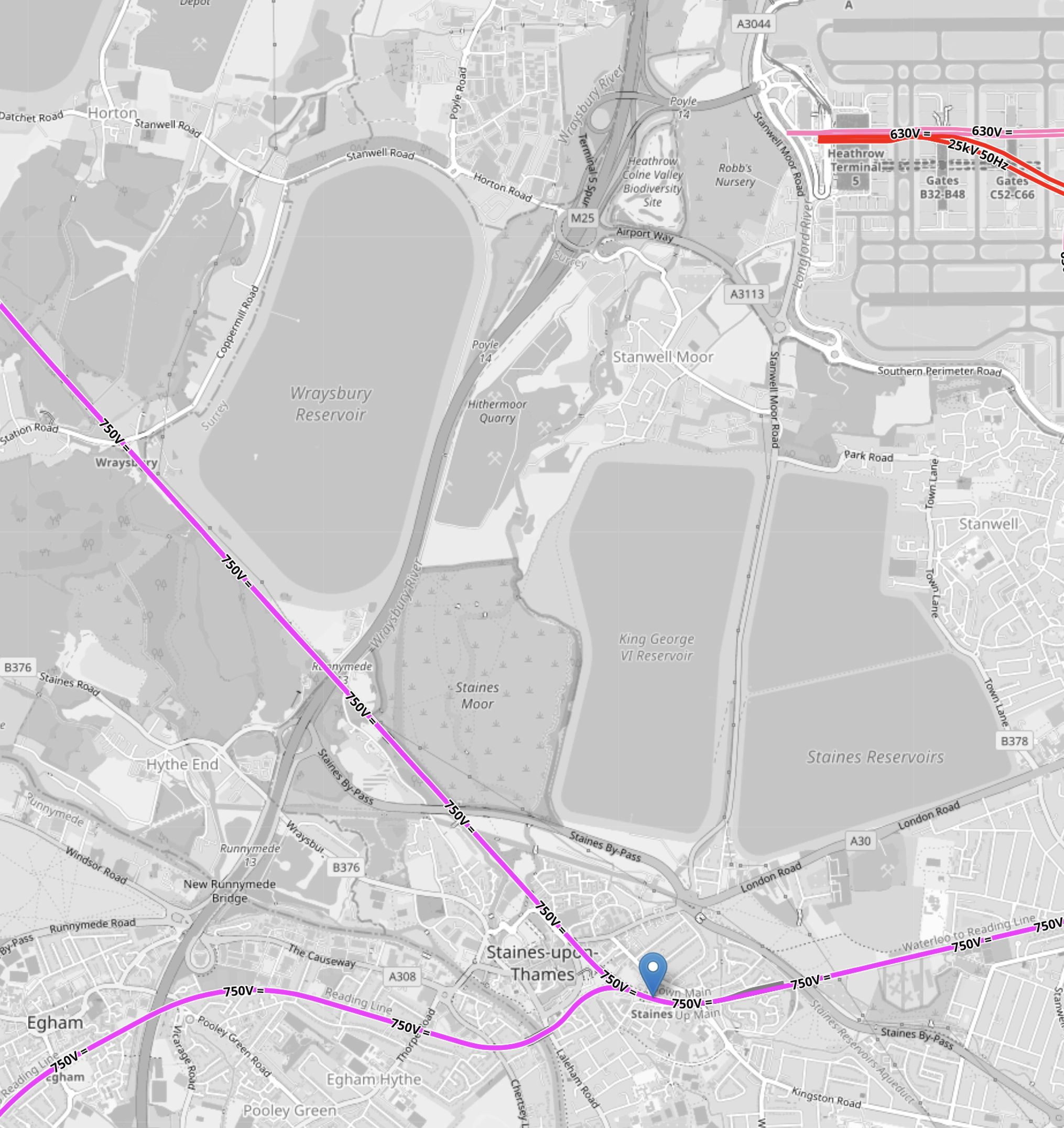
Note.
- The mauve lines in the bottom half of the map are South West Trains services out of Waterloo.
- Waterloo via Feltham, Twickenham and Richmond to name but three stations , is to the East.
- Reading is to the South-West
- Windsor is to the North-West.
- The blue arrow indicates Staines station.
- Heathrow Terminal 5 is in the North-East corner of the map.
- The pink tracks are the Piccadilly Lines
- The red tracks are for the Elizabeth Line and Heathrow Express.
- This OpenRailwayMap shows Terminal 5 to a larger scale.

Note.
- The pink tracks are the Piccadilly Line.
- The red tracks are for the Elizabeth Line and Heathrow Express.
- In front of the red tracks is what looks like a circular walkway or emergency exit, with a rectangular block to its West.
- The rectangular block is the lift tower to get from the railway station to the Departures and Arrivals floors of Terminal 5.
I asked Google AI if it would it be possible in the future to extend the Elizabeth Line to the West out of the Western end of Terminal 5 and received this reply.
Extending the Elizabeth line west from Terminal 5 is technically possible and has been proposed, notably as part of a potential westward rail link to Staines or to support airport expansion, but it is not currently funded. Terminal 5 was designed with future expansion in mind, potentially allowing a connection to Staines to create a “southern rail link” for better connections.
Perhaps there are two tunnels under the lift shafts?
How many trains per hour (tph) terminate in those two platforms?
- 4 tph – Heathrow Express
- 2 tph – Elizabeth Line to Shenfield.
Note.
- Only six trains in two platforms is easily managed.
- Because, Heathrow Express services appear to use both platforms, when I visited yesterday, the system seems to confuse passengers.
- The services surely need to be evened up, so that there are four tph of each service, with each service having a dedicated platform.
- But terminating eight trains in two platforms could be troublesome.
- Platforms are numbered 1 to 6 from the South.
- Platforms 1 and 2 have not been built yet.
Although four tph for Heathrow Express in one platform, should be easy with digital signalling, as you see it every day in London, it may be difficult on two platforms, at the same time.
In Is More Capacity Between Heathrow Airport And Central London, Needed On The Elizabeth Line?, I said this.
Currently, the Elizabeth line provides up to 12 trains per hour (including Elizabeth line and Heathrow Express) on the relief lines, making it nearly at capacity.
Note.
- When I use the Elizabeth Line, I deliberately avoid trains going to and from Heathrow, unless I’m going that way, as they are too crowded with passengers and their oversized cases.
- High Speed Two, the West London Orbital Railway and the North London Line will bring passengers for Heathrow Airport to Old Oak Common station.
- Surely, as Heathrow Airport gets bigger and increases its passenger numbers. the Elizabeth Line will need to be increased in capacity.
I believe Elizabeth Line capacity needs to be increased soon.
The only feasible plan I’ve seen is Heathrow Southern Railways plan, which included.
- Construction of a bay platform 0 at Staines alongside the Staines to Windsor line.
- A step-free bridge across the tracks.
- Construction of a single-track railway with 25 KVAC overhead electrification and a passing looop, between the new platform 0 at Staines and Platform 3 at Heathrow Terminal 5 station.
- Run four trains per hour in both directions between Heathrow Terminal 5 and Staines stations.
- This plan would would add two trains per hour through the Central Tunnel.
Various Journeys Would Be As Follows
This OpenRailwayMap shows Staines junction and the positions of the three platforms.
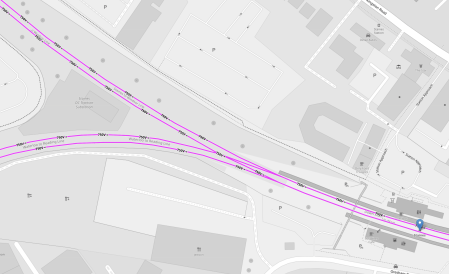
Note.
- The Windsor Line goes North-West.
- The Reading Line goes West.
- The Waterloo Line Goes East.
- Platform 1 is on the North side of the tracks.
- Platform 2 is on the South side of the tracks.
- The bay platform, which I’ve numbered 0, will be on the North side of the tracks towards Windsor.
- I suspect the step-free bridge will be over the tracks and replace the current rickety structure.
- The bridge would be a short walk from all three platforms.
Interchanges would be as follows.
- Windsor to Heathrow – Walk between Platforms 1 and 0.
- Reading to Heathrow – Walk between Platforms 1 and 0.
- Heathrow to Windsor – Cross the bridge between Platforms 0 and 2.
- Heathrow to Reading – Cross the bridge between Platforms 0 and 2.
- Waterloo to Heathrow – Cross the bridge between Platforms 2 and 0.
- Heathrow to Waterloo – Walk between Platforms 0 and 1.
Note.
- All trains to or from Heathrow use Platform 0.
- All trains to Waterloo use Platform 1.
- All trains going away from Waterloo use Platform 2.
- Reading and Heathrow gain a step-free route at 2 tph.
- All interchanges at Staines station would be step-free.
- A train like London Crosslink, which used to go between Feltham and Woking, would use Platform 1 going towards Feltham and Platform 2 going towards Woking.
Staines station would gain step-free access to all Heathrow terminals, all Elizabeth Line and High Speed Two stations.
Could Anglia Railways’ London Crosslink Be Recreated As Part Of The London Overground?
I like the idea of the London Crosslink service, that ran for a few years between East Anglia and Hampshire via the North London Line and Staines.
My arguments for its restoration are described in Could Anglia Railways’ London Crosslink Be Recreated As Part Of The London Overground?
At various times in my life, it would have been very useful.
Today, as I live about fifteen minutes from Highbury and Islington station, I could use London Crosslink for the following reasons.
- Visiting friends and family in Hampshire.
- Going to Heathrow Airport, especially Terminal 5.
- Visiting friends in East Anglia.
- Going to football at Ipswich.
- Exploring new parts of England.
- I would wait at home and time my departure to catch a booked train at a fully step-free station.
Conclusions
Extending the Elizabeth Line to Staines gives these advantages.
- Staff at Heathrow, who live in the Staines area get easy access to the airport.
- Buses and coaches between Heathrow and the local area may be reviewed.
- Less cars will be used to get to and from the airport.
- Reading and Heathrow gain a step-free route at 2 tph.
- A lot of stations would gain a step-free route to all terminals at Heathrow, and all Elizabeth Line and High Speed Two stations.
There may well be other advantages.
Would Extending The Elizabeth Line To Staines Offer Any Advantages?
I asked Google AI, the title of this post and received this answer.
Extending the Elizabeth line to Staines offers significant advantages, including improved direct access to Heathrow Airport from Surrey/south-west London, reduced road traffic congestion, and enhanced connectivity for commuters. Proposed as part of the Heathrow Southern Railway project, it would provide a “game-changer” link and support economic growth around Heathrow.
Key Advantages of Extending the Elizabeth Line to Staines:
Improved Airport Access: The extension would provide a direct, sustainable, zero-emission rail link to Heathrow for commuters and travelers from Staines, Virginia Water, and surrounding areas.
Reduced Congestion & Environmental Impact: The project is estimated to reduce road traffic by approximately 3 million journeys annually, significantly lowering emissions.
Faster Commutes & Connectivity: It would create a new, faster route from Surrey and Hampshire (via Staines) to key locations like Heathrow, Old Oak Common (for HS2), and central London.
Relieving Existing Lines: The extension would help relieve overcrowding on the South Western Main Line into London Waterloo.
Utilizing Existing Infrastructure: The project would likely use the underground space already created at Terminal 5 to facilitate a southward extension.
Challenges and Considerations:
Funding and Cost: The project requires significant upfront investment, requiring collaboration between private sectors, Transport for London, and the Department for Transport.
Capacity Constraints: The existing Elizabeth line is already high-demand, and integrating a new, long branch would require careful capacity management.
This extension is closely tied to proposals for a Southern Rail Access to Heathrow, intended to support the expansion of the airport and the economic development of the surrounding region.
Is There Enough Staff Car Parking At Heathrow Airport?
I asked Google AI, the title of this post and received this answer.
While Heathrow Airport provides designated staff parking areas—including N1, N2, and N5 near Terminal 5—finding space can be difficult due to high demand, and recent substantial fee increases have caused tension. Dedicated staff, including those for car-sharing, have access to, and must display, valid permits in, secured, monitored areas.
Key Details on Staff Parking:
Locations: Staff parking is generally located on the Northern Perimeter Road, particularly serving Terminal 5.
Costs: MoneySavingExpert Forum indicates that parking costs may be paid for by employers like British Airways, or directly by the employee.
Rising Costs: In 2024, monthly staff parking charges were increased significantly, leading to complaints from unions regarding the cost for workers.
Capacity Issues: With thousands of staff, parking can be limited, though special areas are allocated for car-sharing to encourage efficiency.
For most employees, options include using the designated, secure staff car parks, or utilizing the airport’s Sustainable Travel Guide options, which provide, alternative, more sustainable transport solutions.
Staff parking certainly seem a problem and it can only get worse, as more staff are recruited.
Is More Capacity Between Heathrow Airport And Central London, Needed On The Elizabeth Line?
I asked Google AI, the title of this post and received this answer.
Yes, additional capacity on the Elizabeth line between Heathrow Airport and Central London is needed to manage high demand, despite it being a major upgrade. While the line has greatly improved connectivity, studies suggest that rising passenger demand, particularly from potential airport expansion, may require increasing services from 6 to 8 trains per hour to prevent future overcrowding.
Key Considerations Regarding Capacity:
High Demand: Passenger demand grew by ~40% between June 2022 and October 2023, with further growth expected.
Infrastructure Constraints: Increasing services beyond 6 trains per hour is challenging due to the need for signaling upgrades and potential platform length limitations.
Alternative Solutions: Experts suggest the Western Rail Link to Heathrow could relieve pressure by allowing direct access from the west, rather than requiring travel into central London first.
Future Upgrades: Further improvements, including enhanced signalling on the Piccadilly line and other rail links, are seen as necessary to handle future passenger surges.
Currently, the Elizabeth line provides up to 12 trains per hour (including Elizabeth line and Heathrow Express) on the relief lines, making it nearly at capacity.
Note.
- When I use the Elizabeth Line, I deliberately avoid trains going to and from Heathrow, unless I’m going that way, as they are too crowded with passengers and oversized cases.
- High Speed Two, the West London Orbital Railway and the North London Line will bring passengers for Heathrow Airport to Old Oak Common station.
- Surely, as Heathrow gets bigger and increases its passenger numbers. the Elizabeth Line will need to be increased in capacity.
I believe Elizabeth Line capacity needs to be increased soon.
I Want To Go By Train Between Heathrow Airport And Central London, What is Best Train; Lizzie, Piccadilly, Or Heathrow Express?
I asked Google AI, the title of this post and received this answer.
The Elizabeth Line is generally the best balance of speed, cost, and convenience for most travelers (approx. 30–40 mins to central London,£13). The Heathrow Express is fastest (15 mins,£25) to Paddington only, while the Piccadilly Line is cheapest (hr,£6) but slowest.
Detailed Breakdown:
Elizabeth Line (Recommended): Offers direct, modern, air-conditioned trains to central hubs like Bond Street, Tottenham Court Road, and Liverpool Street without needing to change at Paddington. It is much cheaper than the Express and only slightly slower.
Heathrow Express: The fastest option, but only goes to London Paddington. It is expensive unless booked far in advance. Best if you are staying right next to Paddington station.
Piccadilly Line: The cheapest option, ideal for budget travelers, and serves all terminals. However, it is a traditional Tube train, which can be crowded and uncomfortable with heavy luggage.
Note: Fares mentioned are approximate and based on standard off-peak, single-journey, tap-on/tap-off usage.
Ask virtually anybody in London and they’ll probably give you a similar answer.
Even Larry the cat would know, as he’s probably heard the question asked thousands of times.
A Brand New Railway Line Is Set To Directly Link South West London With The UK’s Biggest Airport – And It Could Be Up And Running By The Early 2030s
The title of this post, is the same as that of this article on Secret London.
This is the sub-heading.
A shiny new railway line could provide a seamless link between south-west London and the capital city’s busiest airport.
These two paragraphs add some details.
As a south-west Londoner who can fairly frequently be found at Heathrow Airport (or at least dreaming about being there), I can confirm that a speedy service, directly linking the almighty aviation hub with the south west of the city is something that’s been perched at the very top of my wish list for quite some time now. And it seems as though my prayers may finally have been answered in the form of the Heathrow Southern Railway.
London Heathrow Airport is currently in the early stages of a rather hefty expansion. Over the next ten years, the airport (which just so happens to be the biggest and busiest in the country) is set to receive a third runway. And when said runway is up and running, Heathrow is expecting to welcome approximately 66 million more passengers a year. So now is probably a pretty good time to start thinking about how they’re all going to get there.
I have written extensively about Heathrow Southern Railway in the past.
Start by reading Why I Like The Heathrow Southern Railway Proposal, which I wrote in November 2016 and ended with this conclusion.
It is definitely one of those projects, where by creating something a bit out of the ordinary, leads to lots of other worthwhile things.
I still like it and we now have more information, which includes this map.
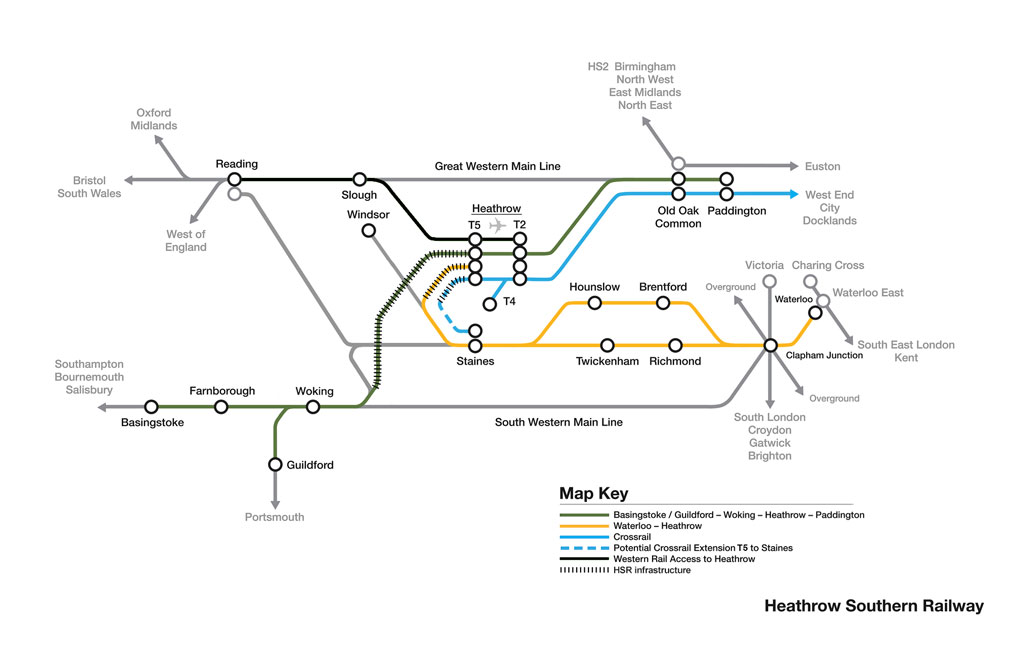
Note.
- The blue line is the Elizabeth Line.
- The yellow line is a direct link from Waterloo to Heathrow.
- The station in a six pointed star is Clapham Junction.
On the Heathrow Southern Railway web site there is a section called Service Opportunities.
It details two routes.
- Heathrow and Waterloo via Staines and Clapham Junction
- Basingstoke/Guildford and Paddington via Woking and Heathrow
These are a few random thoughts.
A ULEZ Avoiding Line
If the Elizabeth Line is extended to Staines, then Heathrow Southern Railway provides a ULEZ avoiding route for Heathrow employees to help get the Mayor out of a hole. A station guy at Staines told me a lot of Heathrow staff take buses to the airport from Staines station.
West London Orbital Railway
I believe that the West London Orbital Railway would make sense to give lots of other routes for Heathrow staff and passengers.

