A New Entrance/Exit For King’s Cross Station – 27th September 2026
A new fully step-free entrance to King’s Cross Station has opened on the South side of Euston Road.
As I was passing this morning I took these pictures.
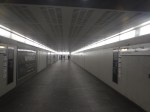

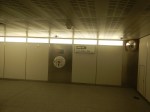
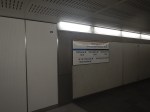

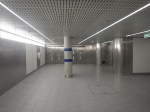
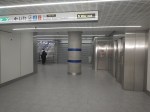
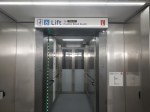

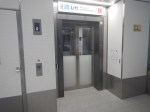





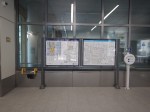
Note.
- The tunnel under Euston Road is level.
- It connects on the North side to tunnels and lifts to King’s Cross station, St. Pancras station and all the Underground lines.
- On the South side it connects to a new office block.
- There are lots of signs.
- The tunnel has stairs and lifts to the surface on both sides.
- The South entrance has a single lift.
- A kiosk appears to have been built in the South entrance.
- There are bus and tube maps in the new entrance.
These are some of my thoughts.
Westbound Buses From King’s Cross and St. Pancras Stations
I believe this could be a big benefit of the new entrance.
Within fifty metres to the West of the new entrance is Bus Stop A.
This has a good selection of buses including according to Google AI, these buses.
- 30: Towards Euston Bus Station
- 73 / N73: Towards Oxford Circus / West End
- 91 / N91: Towards Trafalgar Square / Central London (Note: Route 91/N91 may have temporary local diversions nearby)
- 205 / N205: Towards Paddington / Marble Arch
- 390: Towards Victoria Bus Station
Note.
- The 30, 73 and 205 buses provide a link to Euston.
- The 205 bus provides a link to Paddington and Marylebone.
- The stations have gained a step-free Westbound bus terminal.
I would expect this list of Westbound buses to be improved.
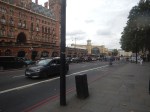
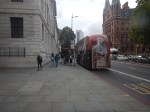
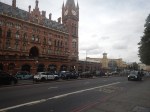
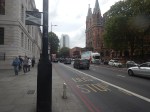
Later, I arrived at the Bus Stop A and took these pictures from the bus, as I arrived and as I walked back to the entrance.
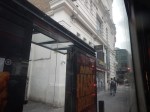
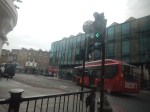
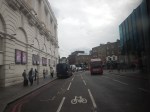
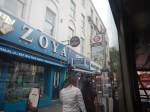



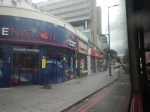
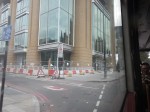
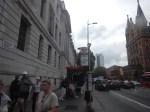
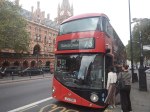
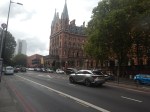
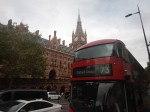
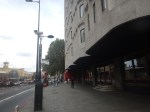
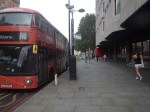
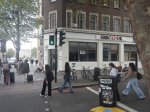
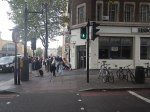
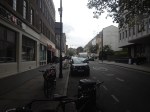
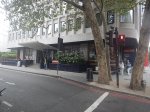
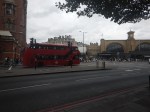

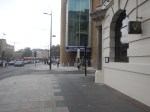
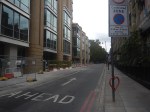
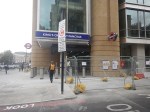
Note.
- I arrived at King’s Cross after taking a 73 bus from Angel.
- Buses twist their way onto Euston Road in front of the two stations.
- Bus Stop R is beside a crossing to in front of the King’s Cross station.
- The area in front of King’s Cross, isn’t one of London’s most salubrious.
- There are a number of trees along Euston Road.
- Bus Stop A is in front of St. Pancras station.
- Some of the side roads could have cheaper hotels.
- The walk between Bus Stop A and the new station entrance is slightly downhill.
Once inside the station complex it was an easy walk to the trains.
There May Be Some More Affordable Hotels On The South Side Of Euston Road
If they are the new entrance will help travellers find them.
If You Have Heavy Cases You May Find The Buses Easier Between Stations
Euston to King’s Cross has been easy for many years. Now the reverse is true.
As I walked Through The New Entrance About Four Illegal Migrants May Have Taken Up Residence!
Two guys about sixteen had their sleeping bags down in the new entrance.
Wrightbus Launches In Australia With Battery And Hydrogen Buses On Show
The title of this post, is the same as that of this article on Fuel Cell Works.
These two bullet points, act as sub-headings.
- Wrightbus has officially launched its Australian expansion, introducing a range of battery-electric and hydrogen fuel cell buses backed by local sales, service and long-term support
- The move strengthens the company’s international growth strategy as Australia increases investment in zero-emission public transport and heavy-duty decarbonization
This first paragraph adds more details.
Wrightbus has officially entered the Australian market, marking a significant milestone in the Northern Ireland manufacturer’s international growth strategy. The company unveiled its expansion during the Australasia Bus & Coach Expo in Sydney, where it presented its battery-electric and hydrogen fuel cell bus portfolio to operators, government agencies and transport stakeholders. The launch will be led locally by a dedicated Australian team and is supported by a long-term commitment to aftersales service, technical support and partnerships with Australian industry.
I believe that this is the start of something big.
- Wrightbus know how to sell large numbers of buses to conurbations like London, Manchester and Leeds.
- An operator can decarbonise their network in a way that suits them.
- In the Ultroliner, Wrightbus have a bus that can be introduced as a diesel and then converted to hydrogen or electric, when the operator has sorted the fuel.
- Australia must surely be a big market for Wrightbus’s hydrogen-powered coach, with a 1,000 km range on one fill-up.
- It should be born in mind, that the average Wrightbus zero-carbon bus, makes the competition from China look like junks.
Will Wrightbus manufacture the buses and coaches in Ballymena, Malaysia or Australia?
Digger Engines Drive JCB’s Attempt On Hydrogen-Powered Land Speed Record
The title of this post, is the same as that of this article in The Times.
This is the sub-heading.
The Hydromax is expected to exceed 350mph on Bonneville Salt Flats in August in a vehicle driven by the fastest man on earth — Wing Commander Andy Green
These three paragraphs introduce the story.
The British construction firm JCB will attempt to break the world hydrogen-powered land speed record this summer, using engines from the company’s latest diggers.
The record attempt will take place at the famous Bonneville Salt Flats in Utah, where Sir Malcolm Campbell broke the 300mph barrier in 1935 with Blue Bird.
The vehicle, driven by the fastest man on earth — Wing Commander Andy Green OBE — is a bespoke streamliner dubbed the JCB Hydromax.
My first job on leaving Liverpool University with a degree in Control Engineering, was in ICI’s hydrogen plant at Runcorn.
In those days, ICI had little use for the gas and except for use as a feedstock for some niche and unusual products, and research all over the country, most of the gas produced was mixed with coal gas and sent down the power station to raise steam.
But talk around the Research Department on Runcorn Heath and some older employees had memories from World War II of hydrogen being used in transport experiments.
I asked Google AI,”Was Research In World War II In The UK Done Into Hydrogen Powered Vehicles?” and received this answer.
Yes, research and development into hydrogen-powered systems were conducted in the UK during World War II, primarily focused on fuel cells for submarines rather than hydrogen-powered road vehicles, which were more commonly powered by “coal gas” or “producer gas”.
So I suspect Runcorn provided the hydrogen for the research.
In Sutton Station To Gatwick Airport By Hydrogen-Powered Bus, I describe how I made the trip to the airport in a hydrogen-powered bus. And all for free because I have a Freedom Pass and in a mouse-quiet vehicle!
These buses from Wrightbus in Northern Ireland are superb influences for the use of hydrogen as a zero-carbon fuel.
Hopefully, the JCB Hydromax will persuade more people to think positively of hydrogen.
I wish Lord Bamford and his team, the best of luck.
Is The 141 The Worst Bus Route In London?
Judging by the constant conversation on the 141 bus, that I take regularly, I thought with local elections coming up this week, this was a very timely question to ask Google AI.
Google AI gave me this answer.
The 141 bus route is often considered poor by passengers, though it is not officially ranked as London’s worst.
Criticisms center on overcrowding, issues with BYD electric buses, and reliability issues while traveling between Palmers Green and London Bridge.
Why the 141 Route is Criticized:
Overcrowding: The route is heavily used to connect outer areas like Turnpike Lane to Bank and Moorgate, leading to high passenger volume.
Vehicle Issues: Complaints have been made regarding the BYD double-deck buses used on this route, which have been described as having narrow seats, high steps, and poor handling of cold weather.
Reliability: The route has been affected by roadworks, such as on the North Circular.
Comfort: The back of the bus downstairs has been described as “pokey”.
While the 141 has negative feedback, other routes have officially received more complaints or had lower average speeds (e.g., the 14 bus).
According to, the 141 is popular for the Hopper Fare, but the issues with the buses make it a less-than-ideal journey.
I wonder who’s standing for election on a ticket, that includes improving the buses.
Google AI wasn’t any help.
A Crossing For Coeliacs?
I have been getting increasingly frustrated with the roadworks at the crossroads of Moorgate and Ropemaker Street and at the weekend, I wrote How Not To Resurface An Intersection.
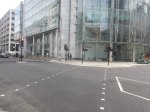
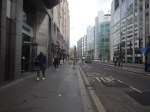
But at last order is beginning to emerge and today, I took these pictures of the new diagonal crossing.

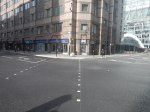
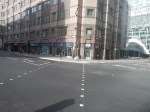
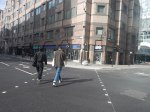
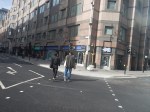
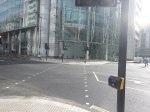
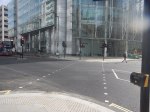
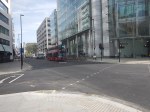


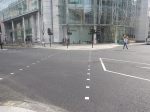



Note.
- The diagonal crossing is in use.
- At the North-Eastern end of the crossing, is the Marks and Spencer on Finsbury Pavement, with its coeliac-friendly food department in the basement.
- At the South-Western end of the crossing on Moorgate is a branch of LEON, which serves excellent gluten-free food.
- The crossing also provides a shorter route between the Southbound bus stop and Moorgate station.
The work on the crossing appears to be more or less complete. Or will it be zebraed?
How Much Electricity Do You Need To Charge A Garage Full Of Electric Buses?
Consider.
- A couple of years ago, I had a long discussion and a few beers with three managers of bus garages.
- In First Bus To Launch 1MW BESS Unit In Hampshire, Aberdeen To Follow, I talk about a specialist battery to charge buses.
- In Is Sumitomo Heavy Industries Highview Power Energy Storage System On line At Hiroshima?, I talk about an efficient, renewable power supply for an LNG Terminal.
I asked Google AI the question in the title of this post and received this comprehensive answer.
Charging a full garage of electric buses requires massive amounts of electricity, with typical, non-optimized charging for a 100-bus depot capable of drawing nearly 10 megawatts (MW) of power. To put this into perspective, a 100-bus depot might require roughly 150 Megawatt-hours (MWh) of energy to recharge over an eight-hour night.
Key Factors and Energy Requirements
Energy Consumption per Bus: A typical electric bus has a battery capacity between 300-500 kWh. Energy consumption averages around 1.11 to 1.35 kWh/km, with higher consumption in winter or with heavy A/C use.
Total Depot Power: For a 100-bus depot, power requirements can reach 10 MW, equivalent to the power output of a small hydroelectric dam.
Optimal Charging: Using smart charging, a 100-bus depot can reduce its peak demand to around 4 MW.
Daily Usage: A single, large electric bus can consume up to 500 kWh per day, with daily demand ranging from 189 to 231 kWh for typical operations.
Infrastructure and Grid Considerations
Charging Infrastructure: Depots often use 40 kW to 250 kW chargers, with 100 kW common for overnight charging.
Grid Capacity: A 34-bus depot might require a new 1000kVA transformer to handle the load.
Voltage: 11,000 volts may be required to power new substations, which are then stepped down to 400 volts for charging.
Operational Factors Affecting Energy Need
Heating and Cooling: Cold weather can increase energy consumption by up to 45% (due to electric heating).
Driving Style: Inefficient driving can increase energy consumption by 0.24 kWh/km above average.
Regenerative Braking: This can recover 37–40% of energy for 40-60 ft buses.
Cost Implications
Energy Bills: A 100-bus depot can incur monthly energy bills between $112,000 and $515,000 without optimization.
Cost Savings: Electric buses are generally cheaper to fuel, costing ~£0.21/mile compared to £0.49/mile for diesel.
Could A System Based On The Sumitomo/Highview Power System At Hiroshima Charge Electric Buses?
The optimal charging figure for a 100-bus garage would appear to be in the region of 4-5 MW.
In Is Sumitomo Heavy Industries Highview Power Energy Storage System On line At Hiroshima?, I state, that it looks like Highview Power’s CRYOBattery™ at the heart of the system has a capacity of 5 MW/20 MWh.
I also state in the post, that the Hiroshima facility is designed to support grid stability and enhance renewable energy integration.
Does this all mean that if you can install enough solar panels on the roof of the garage or perhaps a wind turbine nearby, that you can have buses substantially powered by the sun and wind.
Chicago would just love wind-powered buses!
The Diesel-Hybrid 141 Buses Always Seem To Get Through
Today, I had an all-too-typical bus-rid back from Moorgate after breakfast and a bit of shopping.
My direct bus is a 141, which is a second-rate, Chinese BYD bus, which has a number of problems as I pointed out in My 78-Year-Old Legs Are More Reliable Than The New Chinese Buses On London’s 141 Bus Route.
- I just missed a 141, so I caught the next bus that was going my way.
- It was a New Routemaster on the 76 route, so I took a chance, that it might pass the previous 141 bus, as they often do.
- As we passed Moorfield’s Eye Hospital, we passed the 141, but it was stopped at the side of the road, with all its lights flashing.
- I decided to change two stops from home and left two stops from home, from where I could walk.
- I waited perhaps five minutes before an elderly Wrightbus diesel-hybrid arrived to take me home,
After today’s experience, I can’t help but remember the old joke!
- Question: What’s red and lies in the gutter?
- Answer: A dead bus!
Other colours are available.
My 78-Year-Old Legs Are More Reliable Than The New Chinese Buses On London’s 141 Bus Route
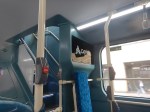
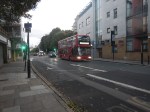
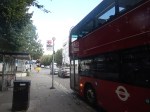
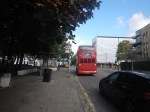
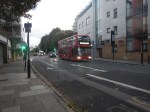
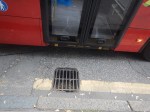
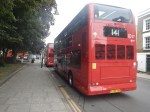
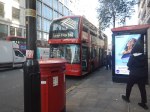
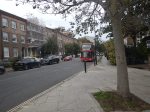
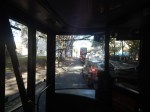
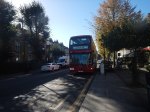
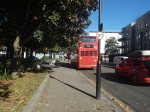
So we all know what we’re talking about, here’s a few pictures.
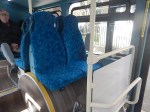
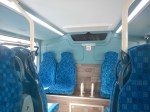
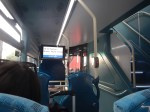
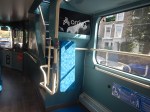
Note.
- The buses seem to have no serious faults from a passenger point of view.
- One middle-aged lady on the plump side, said she didn’t like the buses.
- The aisle between the front seats doesn’t seem to be built for large people.
- The seats are reasonably comfortable.
- One morning, I stood on a long journey and I felt the road-holding wasn’t as good as a New Routemaster.
- On several buses, the interior route display has not been working.
- As I don’t wear a watch, I find a non-working display annoying.
- I haven’t been upstairs yet.
- As picture numbers three and four show, the bus looks a bit pokey at the back downstairs.
But I am very suspicious about the buses’s reliability or ability to handle the route, which is fairly long.
Take this morning, when I was coming home from London Bridge station.
- There was only a 43 bus at the shared stop with the 141 bus.
- As the routes are identical until Old Street station, I took the 43 bus to Moorgate station.
- At Moorgate station, I took a 76 bus, which gets me within walking distance of where I live.
- Someone said, that a 141 bus would mean a wait of ten minutes.
- In the end my 78-year-old legs delivered be home.
I didn’t see a 141 bus going my way on my journey.
I have seen behaviour like this several times, since some Chinese electric buses were introduced on to the route.
As a graduate Electrical and Control Engineer, it looks to me, that there is one of two problems with these buses.
- The batteries aren’t large enough for the route.
- Not enough time is allowed for charging the batteries at the end of the route.
This page on the Wrightbus website is entitled Wrightbus Electroliner ‘Most Efficient Double-Deck Battery-Electric Bus’, and it contains this paragraph, which probably explains their philosophy and ambition.
We have already gained a strong reputation for our hydrogen double deck but we want to lead the world in zero-emissions full stop. Wrightbus has the best brains in the business when it comes to technology and our StreetDeck Electroliner puts us squarely at the front of the pack. We haven’t weighed the bus down with a high battery volume just so we can say it’s got the most power or range; instead, we’ve made it the most efficient vehicle on the road by combining optimum power with a class-leading rapid charge, meaning our electric bus spends more time on the road than any other.
It also probably sets a very high bar, which the Chinese can only achieve by adding battery volume and making their buses pokey.
To be fair to the buses, the 141 route is probably nearly 20 miles long.
In Sutton Station To Gatwick Airport By Hydrogen-Powered Bus, I wrote about what it says in the title.
In that post, I said this about hydrogen buses running on the 141 route.
Wrightbus Hydrogen Buses For My Local Bus Route 141
Consider.
- The 141 bus route is my local bus, which gets me to Moorgate, Bank, London Bridge and Manor House.
- The length of the full route is twenty miles and it takes about an hour to go from London Bridge station to Palmers Green.
- The route is currently run by older Wrightbus hybrid diesel-electric buses.
- I suspect that modern hydrogen buses could last almost all day on one fill of hydrogen, with perhaps a top-up at lunchtime.
They would have no difficulty handling the route and would greatly increase the customers current rock-bottom satisfaction.
I am sure, they would improve the horrendous reliability of the route.
I also wonder, if Wrightbus have another solution.
In UK Among Tri-Axle Zero-Emission Wrightbus StreetDeck Prospects, I talk about Wrightbus’s new Tri-Axle Zero-Emission Wrightbus StreetDeck bus and how it would be ideal for the 141 bus route.
- The 141 bus route is the old 641 trolleybus route, so all clearances are generous.
- The tri-axle design can probably carry a better-optimised battery.
- There used to be two bus routes on the route and now there is only one, so more capacity is needed.
- The 141 bus route bridges the gap between the Northern section of the Piccadilly Line and the Elizabeth Line, Bank and London Bridge.
- The new air-conditioned Piccadilly Line trains, will increase the passengers on the line.
- There will be a lot more housing built in Enfield, at the Northern end of the Piccadilly Line and more bus capacity will be needed between Manor House and the City of London.
Some of TfL’s rerouting of buses in North London, was a crime against mathematics.
East India And Blackheath Stations Through The Silvertown Tunnel – 22nd August 2025
I haven’t been through the Silvertown Tunnel for some weeks, so yesterday, as I wanted to have a look at the refurubished Blackheath station, I went and had a look.
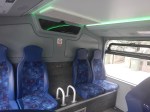
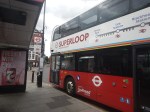
Note.
- The journey was made at about 11:00 on a Friday morning.
- The bus was more of a taxi, as only about five passengers used it.
- The tunnel wasn’t very busy with traffic.
This article on Highways Magazine is entitled Traffic Volumes Down At Blackwall And Silvertown Tolls.
This is the sub-heading.
Daily traffic volumes for both the newly opened Silvertown and Blackwall tunnels are 7.6% lower than in the same period last year for just the Blackwall tunnel, Highways can reveal.
I feel very much, that the Silvertown Tunnel is being underused and perhaps we should run more local buses or even long-distance coaches through the tunnel.
Buses On London Route 141 Now Go In Convoy
I took these pictures at the Balls Pond Road stop on the route.
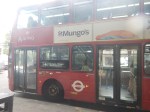
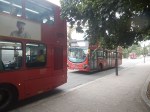
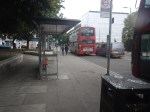
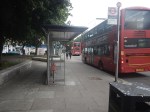
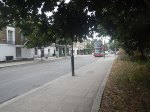
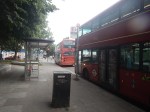
Sometimes you wait as long as twenty minutes for one to come along, but here were three in a similar number of minutes.
When I was at school, there were stories from the Second World War, when after a bus was hit by a German bomb, that buses on one route went in convoy for protection.
Perhaps, the buses are practicing for when Putin decides to attack London?
Or is it just another manifestation of the service on the worst bus route in London?

