Why Monopile Lowering Is Becoming A Critical Load Case For Jack-Ups
The title of this post, is the same as that of this article on offshoreWIND.biz.
This is the sub-heading.
As offshore wind monopiles continue to increase in size, the installation phase is emerging as a key structural design consideration for jack-up vessels. According to a recent GustoMSC study, loads generated during monopile lowering can approach — and in some cases exceed — those associated with extreme survival conditions.
This paragraph adds more detail.
With monopile diameters now exceeding 10 metres and weights surpassing 2,000 tonnes, installation dynamics are becoming increasingly complex. The challenge is no longer simply about crane capacity. Instead, the interaction between the suspended monopile and the supporting jack-up is becoming a governing factor.
In the 1970s, I worked on a similar problem as a consultant to a Cambridge company called Balaena Structures.
I described the Balaena in The Balaena Lives, but I believe the design could be applied to a large monopole foundation for a large wind turbine.
- The idea came from two Cambridge University engineering professors, who were much older than me, so they’ve probably passed on.
- The design was patented.
- None were built, as no-one ordered one.
- The computer, that I ran the simulation on doesn’t exist anymore.
- But, I’m fairly certain, I could create a design of XXL Monopile for the world’s largest wind turbine.
- The Balaena was designed to be reuseable.
- I did all the calculations and I believe that the Balaena could be turned into an easier-to-handle XXL Monopole.
None of the details of this project are written down, but they are locked safely in my head.
Hydromax Sets US Speed Record
The title of this post, is the same as that of this of this press release from Ricardo.
This is the sub-heading.
The Ricardo supported vehicle achieves 368.347 mph record
These three paragraphs add some more detail.
JCB Hydromax has set a US Southern California Timing Association (SCTA) record Bonneville Speed Week. having achieved 368.347mph.
JCB Hydromax was developed by JCB with support from Ricardo and Prodrive, with Ricardo responsible for uprating JCB’s production hydrogen engines from 75 to 800 horsepower, while also reducing their weight by 100kg. And working closely with Prodrive, to ensure the engines could run laying on their sides to improve vehicle aerodynamics, and cope with the high altitude and temperatures of the Bonneville Salt Flats.
The Ricardo team have been on site in Utah throughout speed week to support with the preparation and running of the 32 foot streamliner car.
What I find amazing is the engineering, that must have gone into the project, to update a production hydrogen engine by eleven times and lose a 100 kg. of weight in the process.
Meet The 6×6 Toyota Hilux Built To Tackle Electric Car Fires
The title of this post, is the same as that as this article on Select Car Leasing.
This is the sub-heading.
A car fire is never a good thing, and if the car is electric, the results could be even worse. If it all goes up in flames while the vehicle is in a multi-storey car park, then the consequences could be dire, with limited space available for fire services to control the situation.
This introductory paragraph adds some more details.
Such incidents happen — more than 1,000 cars were destroyed in a fire in Liverpool, while a multi-storey collapsed in Stavanger — so a UK company has converted a Toyota Hilux pickup into a six-wheel EV fire-fighting machine to keep us all safe.
A lot more details are given on the vehicle’s web site, which is called the 6 x 6 HILOAD.
I was alerted to the need for such a vehicle by this article in The Times, which is entitled How Scotland’s New £30k Fire Engines Left Crews Walking To Wildfires.
The pictures on the 6 x 6 HILOAD web site, show a vehicle with a Czechnia registration.
So, I typed “6 x 6 HILOAD Czechnia” into Google AI and received this answer.
The 6×6 Hiload (developed by Prospeed Motorsport) is a custom, six-wheeled conversion of the Toyota Hilux designed specifically for emergency response, particularly targeting electric vehicle (EV) battery fires.In Czechia, the 6×6 Hiload is undergoing trials with Czech Fire & Rescue Services (Hasiči) to test its capabilities in fast-response and confined environments. Key features of the vehicle in action include:
EV Firefighting: It utilizes specialized equipment like the Coldcut Cobra system, which pierces EV battery casings to extinguish fires directly with a minimal amount of water, reducing the risk of thermal runaway.
Low Profile: Standing at less than 1.9 metres tall, it can easily navigate low-clearance urban underground and multi-storey car parks that traditional, larger fire engines cannot access.
High Payload: The custom six-wheel chassis stretches the Hilux and increases its payload capacity to roughly 3,000kg, allowing it to carry heavy fire and rescue equipment without sacrificing off-road mobility.
This chassis will have more uses than a Swiss army knife.
I suspect the Ukrainians could find several uses.
Can A ‘Secret Sauce’ Help Store Renewable Energy?
The title of this post, is the same as that as this article on the BBC.
This is the sub-heading.
The US-Israel war with Iran has led to higher electricity bills and put the issue of energy security back in the spotlight.
These two paragraphs add more detail to the story.
Now a pilot project inspired by a 100-year-old idea aims to store renewable energy.
Those behind the high density hydro demonstrator scheme near Plymouth say the technology can “turn small hills into giant batteries”, as part of the transition away from fossil fuels.
This is one of those stories, that could only emerge in the UK.
If you have the time, click on the link to the BBC article and read it in full.
I have a feeling, that the world will be hearing a lot about RheEnergise.
I asked Google AI, “How Much Energy Can A RheEnergise Battery Store”, and received this reply.
A RheEnergise system acts like pumped-storage hydro, using a dense fluid instead of water to store energy.
Planned commercial facilities are designed to store 2 to 16 hours of energy capacity, offering between 10 MW and 50 MW of power generation.
The exact energy storage figures for their deployments scale depending on the site requirements.
The breakdown of how these installations store and yield energy includes:
Commercial-Scale Capacity: A standard commercial site ranging from 10 MW to 50 MW will yield between 20 MWh and 800 MWh of total energy output (based on operating at full capacity for 2 to 16 hours).
The “Secret Sauce”: The system uses a proprietary fluid called R-19, which is 2.5 times denser than water.
This density allows the system to generate 2.5× more power and energy from the same physical footprint and vertical drop compared to traditional water-based facilities.
Real-World Pilot: The company operates a 500 kW demonstrator project at Cornwood near Plymouth, UK. This smaller test-bed, if run continually, generates energy equivalent to powering about 400 homes for an entire year.
Zero Seasonal Losses: Unlike chemical batteries (like lithium-ion) that degrade and lose charge over time, pumped hydro setups suffer virtually zero energy loss while the fluid sits idle.
The March Of The Batteries
One of my Google alerts picked up this story from the Solar Power Portal, which is entitled Gresham House To Acquire 480MW BESS, Completes Financing On 397MW Portfolio.
This is the sub-heading.
Gresham House Energy Storage Fund signed a Sale and Purchase agreement (SPA) for the conditional acquisition of a 480MW BESS project, while also completing funding on a 397MW portfolio that will begin construction.
I asked Google AI, “How Big Is Gresham Houuse’s Portfolio Of Batteries?” an received this answer.
Gresham House Energy Storage Fund (GRID) operates a portfolio exceeding 1GW of utility-scale battery capacity in the UK, with an active pipeline of future and recently financed projects.
Their operational capacity features:
Operational Capacity: Exceeds 1GW (approx. 1,072MW/1,701MWh) across dozens of sites.
Market Share: Owns roughly 17% to 20% of all utility-scale batteries in Great Britain.
Haven’t they done well!
When Will Highview Power Complete The Carrington Battery?
Highview Power is building a 50 MW/300 MWh liquid air battery at Carrington, near Manchester.
I asked Google AI,the title of this section and received this reply.
Highview Power’s Carrington liquid air energy storage facility in Greater Manchester is scheduled to be operational by late 2026.
The grid stabilization phase is set to begin early in the year, with full long-duration operations following shortly after.The £300 million project at the Trafford Low Carbon Energy Park is a pioneering commercial-scale “cryobattery” that liquefies and stores air to capture excess renewable energy.
Key details of the completed facility:
Capacity: 300 MWh of storage (delivering 50 MW for six hours)
Reach: Capable of supplying electricity to approximately 480,000 homes
Technology: Liquid Air Energy Storage (LAES)
When Will Highview Power Complete The Livingstone Battery?
Highview Power is building a300 MW/3.2 GWh liquid air battery at Livingstone near Glasgow.
I asked Google AI, the title of this section and received this reply.
Highview Power is not currently building a battery in Livingstone. They are developing a major \(2.5 \text{ GWh}\) liquid air energy storage (LAES) plant in Hunterston, Scotland, which is scheduled to come online by 2030.
According to the Highview Power web site, a 300 MW/3.2 GWh “cryobattery” is being built at the site.
How Much Offshore Wind Power Will Be Installed This Year?
In UK Offshore Wind In 2030 – Calculated May 2026, I said that 2635 MW would be commissioned this year.
Conclusion
We’re running hard, but will we keep ahead of the tsunami of offshore wind and solar panels we are installing.
In UK Offshore Wind In 2030 – Calculated May 2026, my latest calculations show that by 2036, we will have installed 61,337 MW of offshore wind alone.
How Many Of Their 300 MW/3.2 GWh Liquid Air Batteries Do Highview Power Think They Can Install?
I asked Google AI, the title of this section and received this reply.
Highview Power plans to install several of their 300 MW/3.2 GWh “Millennium Series” cryogenic plants. They are specifically developing two initial flagship sites in the UK, with the intention to scale up rapidly over the next decade to capture a significant share of national long-duration energy storage targets.
Highview Power is executing a multi-billion-pound programme to build out these multi-technology storage facilities, which combine liquid air energy storage and lithium-ion batteries.
The two primary 3.2 GWh projects advancing through the UK regulatory system include:
Hunterston, North Ayrshire (Scotland): Slated as the first of the Millennium Series, designed to provide up to 3.2 GWh of capacity (powering around 650,000 homes).It is advancing through the regulatory assessment and construction phases.
Killingholme, Lincolnshire (England): A second 3.2 GWh facility.
Both the Hunterston and Killingholme sites were deemed eligible for support under the UK government’s “cap and floor” super-battery scheme.
Two 300 MW/3.2 GWh “Millennium Series” cryogenic plants will do very nicely!
Engineering is the science of the possible, whereas politics is dreams of the impossible.
Did This Get Lost In The Covids?
In October 2019, I wrote Asthma Carbon Footprint ‘As Big As Eating Meat’ and it made me think, when I just read it.
I would normally follow up a post like this, but I don’t remember doing anything like that.
The Wikipedia entry for the COVID-19 pandemic in England, starts with this paragraph.
The COVID-19 pandemic was first confirmed to have spread to England with two cases among Chinese nationals staying in a hotel in York on 31 January 2020.
It looks to me, that like everybody else in England, I had the Covids on my mind.
Is Respimat A Zero-Carbon Inhaler?
Just to be sure, I asked Google AI, the question in the title of this section and received this reply.
The Respimat soft mist inhaler is considered to have virtually no associated carbon emissions from its operation because it does not contain the high global warming potential (GWP) hydrofluorocarbon (HFC) propellants found in metered-dose inhalers (pMDIs).
While it has a substantially lower carbon footprint than traditional pMDIs, it is not strictly “zero-carbon” when considering its entire life cycle, which includes manufacturing, materials (stainless steel, aluminium, polymers), and end-of-life disposal. These factors contribute a small product carbon footprint (PCF).
According to Google AI, a reusable version is available.
A reusable Respimat device has been introduced, which further reduces the carbon footprint by up to 71% over six months compared to the disposable version because the device itself is kept longer, reducing manufacturing impacts.
Google AI says this about NHS guidance.
Health bodies like the NHS encourage the use of lower-carbon inhalers like the Respimat or dry powder inhalers (DPIs) as part of their net-zero targets, provided they are clinically appropriate for the patient.
But it does seem that Respimat devices are helping to cut global warming.
What Is The Patient Experience Of Respimat?
Google AI gave this answer to my question.
Patient experience with the Respimat inhaler is generally very positive, with high satisfaction for its ease of use, handling, and the “soft mist” it produces, leading to high continuation rates in studies; patients find it easier than many older devices and report good effectiveness, though common side effects like dry mouth, cough, and sore throat can occur.
Key Aspects of Patient Experience
- High Satisfaction: Over 85-90% of patients report being satisfied or very satisfied with the Respimat’s handling and the ease of inhaling the mist.
- Preference Over Other Devices: Many patients prefer Respimat over traditional metered-dose inhalers (pMDIs) or dry powder inhalers (DPIs), finding it easier to use and more effective.
- Soft Mist Technology: Patients appreciate the gentle, slow-moving mist, which helps deliver medication effectively and feels different from a typical puff.
- Good Adherence: High satisfaction often translates to continued use, with physicians reporting high patient adherence and continuation rates after studies end.
- Improved Technique: While initial use might need guidance, pharmacist-led interventions show significant improvements in patients’ inhalation technique over time.
That doesn’t look bad to me!
Could Immunotherapy Drugs Be Delivered By An Inhaler?
We always felt the device could deliver other drugs.
Google AI gave this answer to my question.
Yes, immunotherapy drugs could potentially be delivered by an inhaler, and this approach is a promising area of active research and development, particularly for treating lung cancer and respiratory diseases like asthma.
Rationale and Research
- Targeted Treatment: Inhaled delivery allows for high concentrations of the drug to be delivered directly to the lungs, which is particularly beneficial for treating lung-specific conditions like lung cancer or severe asthma. This localized approach aims to maximize the therapeutic effect where needed.
- Reduced Side Effects: By concentrating the medication in the lungs and minimizing its systemic absorption into the bloodstream, researchers hope to significantly reduce the severe side effects (e.g., systemic toxicity, autoimmune reactions) commonly associated with traditional intravenous or oral administration of some immunotherapies and chemotherapies.
- Patient Convenience: Inhalation is a non-invasive administration route, which is more convenient and comfortable for patients compared to injections or intravenous infusions, potentially allowing for self-administration and improving patient compliance.
The Soft Mist Technology could surely be a help!
Was Osborne Reynolds The Greatest Fluid Dynamicist?
I have to ask Google AI this question, as some of the discussions that led to creation of Respimat, took place in my house at Debach, where Osborne Reynolds had lived.
Google AI gave this answer to my question.
Osborne Reynolds is considered one of the most influential and foundational contributors to the field of fluid dynamics, though naming a single person the “greatest” is subjective. His work fundamentally shaped modern engineering and physics and remains central to the study of fluid flow today.
Key Contributions to Fluid Dynamics
Reynolds’ most significant achievements include:
- The Reynolds Number: He identified a crucial dimensionless parameter (now named the Reynolds number) that determines whether fluid flow is laminar (smooth and orderly) or turbulent (chaotic and eddying). This number is a foundational concept used across all engineering and physical sciences.
- The Theory of Turbulence: In an 1895 paper, he established the standard mathematical framework used in the study of turbulence, introducing what is known as the Reynolds-averaged Navier–Stokes equations.
- Experimental Validation: His elegant, yet simple, dye experiments visually demonstrated the transition between flow regimes, providing clear empirical evidence for his theories.
- Theory of Lubrication: He developed the Reynolds equation in 1886, which still underpins the analysis of hydrodynamic lubrication in modern bearings.
- Heat Transfer and Similitude: His research into heat transfer between solids and fluids led to significant improvements in boiler and condenser designs, and his work on hydraulic similitude enables engineers to use scaled-down models (e.g., in wind tunnels for aircraft design) to predict the performance of full-scale machines.
How Many Good Ideas Did The Covids Delay?
It could be that the roll-out of Respimat for was delayed by the Covids!
But it wouldn’t have been the only idea to have been delayed in that way!
Managing Earthworks In A Changing Environment
This image shows the train derailment at Shap at 06:10 on Monday.
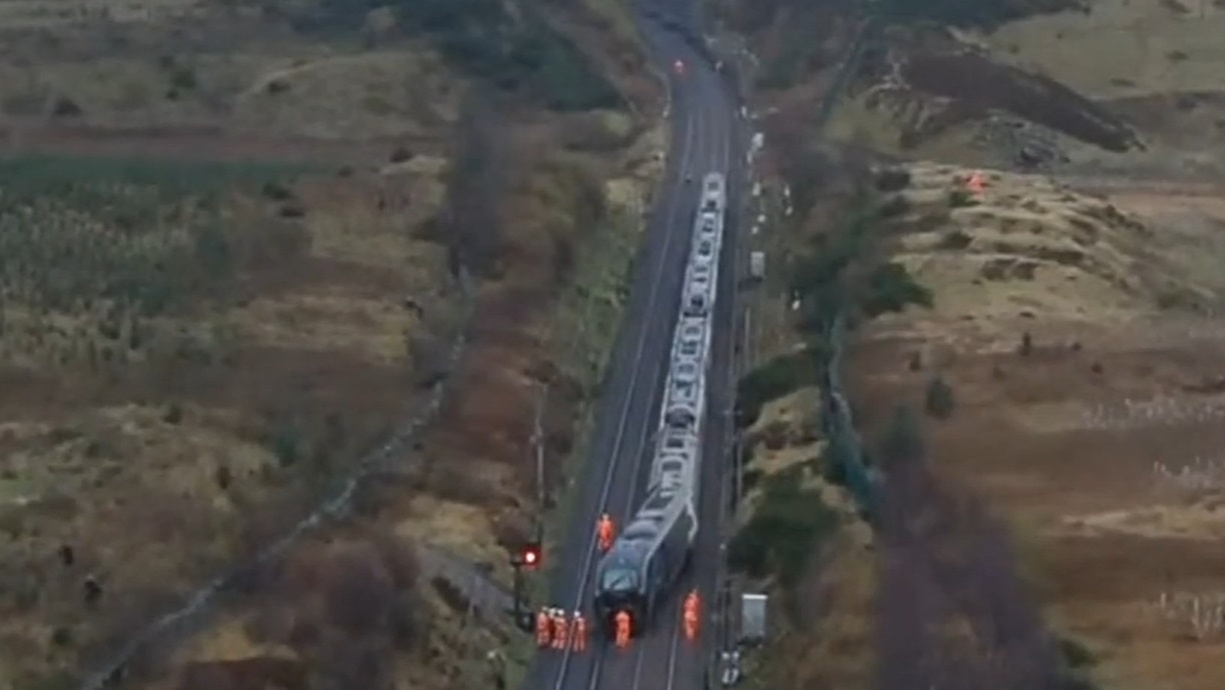
The BBC and others were talking about the cause of the derailment being a landslide.
So it was perhaps appropriate that the latest edition of Rail Engineer had a sponsorsed feature with a title of Managing Earthworks In A Changing Environment.
It is well-worth a full read.
What Happened To The Toyota Hydrogen-Powered HiLux?
I wrote about this vehicle in Toyota Unveils Prototype Hydrogen Fuel Cell Hilux, but I’ve not heard any more.
So I asked Google AI, the question in the title of this post and received this reply.
The Toyota hydrogen-powered Hilux is currently in the demonstration and evaluation phase and has not been officially confirmed for mass production. Ten prototypes were built in the UK and are undergoing testing, with some being used for customer and media demonstrations at events like the Paris Olympics. Toyota is using this project to gather data, refine its hydrogen technology, and prepare for a future European market that could see the vehicle go on sale around 2028.
A simple Google search produced this YouTube video and this article in the Toyota UK magazine.
I don’t want to drive one, as that would be illegal, but I have just added riding in one of these beasts to my bucket list.
Toyota Have Gone To The Advanced Propulsion Centre For Their Latest Project
In Toyota Leads Multi-Million-Pound Micromobility Research Project, I write about another project, where Toyota have approached the Advanced Propulsion Centre for funding and technical help. So the Advanced Propulsion Centre must be doing something right, to attract another project from Toyota.
In CoacH2 – The Next Generation Coach, I write about how the Advanced Propulsion Centre are helping to develop the powertrain for Wrightbus’s upcoming hydrogen-powered coach.
It certainly looks like the Advanced Propulsion Centre are in the middle of the net-zero transport revolution.
Conservatives Would Scrap Stamp Duty, Badenoch Announces
The title of this post, is the same as that of this article on the BBC.
This is the sub-heading.
The next Conservative government would abolish stamp duty on the purchase of main homes, Kemi Badenoch has said, in a surprise announcement at the end of her first conference speech as party leader.
These two introductory paragraphs add more detail.
Badenoch received a standing ovation from Tory activists in Manchester as she declared: “That is how we will help achieve the dream of home ownership for millions.”
She said scrapping stamp duty – a tax paid by home buyers in England and Northern Ireland – will “unlock a fairer and more aspirational society” and help people of all ages.
Note.
- I have a degree in Control Engineering at Liverpool University and graduated in 1968.
- Badenoch has a degree in Systems Engineering at Sussex University and graduated much recently.
Our degrees are both very mathematically-based and probably surprisingly similar.
My feeling as a Control Engineer, is that to selectively remove stamp duty could be a good idea, as you are affecting the derivatives rather than the rates.
Only time will tell, but some thorough mathematical modelling will probably show the validity of the idea.
It is unlikely that I will move, but given the state of the buses, there is a small chance that I might.
- My current house is probably worth about a million.
- If I bought a similarly-priced house, I would pay tax of £43,750.
- But, if I bought a house at double the price, I would pay tax of £153,750.
Given the progressive nature of the tax, I think I’ll be staying put, occupying a three-bedroom family house with a garage, all by myself.
If the tax is removed, I would be more likely to move into a house, that suited me better!
Historic Church Tower Suspended On Stilts To Make Way For London Skyscraper
The title of this post, is the same as that of this article in The Times.
This is the sub-heading.
The remaining part of the 700-year-old All Hallows Staining, off Fenchurch Street, will be the centrepiece of the public square below Axa’s £1 billion office
These three paragraphs add more details.
A700-year-old church tower is being suspended on 45ft stilts while developers clear the ground beneath to make way for the City of London’s newest skyscraper.
The tower, which is all that remains of All Hallows Staining close to Fenchurch Street station, is being preserved and will be the centrepiece of the public square at the base of 50 Fenchurch Street — the £1 billion office tower being built by the investment arm of Axa, the French insurer.
More than 125,000 tonnes of earth has been cleared from underneath and around the church — which survived the Great Fire of London in 1666 — into which the foundations will be laid and a basement level built.
The Wikipedia entry for All Hallows Staining, starts with this paragraph.
All Hallows Staining was a Church of England church located at the junction of Mark Lane and Dunster Court in the north-eastern corner of Langbourn ward in the City of London, England, close to Fenchurch Street railway station. All that remains of the church is the tower, built around AD 1320 as part of the second church on the site. Use of the grounds around the church is the subject of the Allhallows Staining Church Act 2010 (c. v).
Note.
- The Wikipedia entry gives a lot of history and other details about the tower.
- It was named “Staining”, which means stone, to distinguish it from the other churches of All Hallows in the City of London, which were wooden.
- The old church survived the Great Fire of London in 1666 but collapsed five years later in 1671.
- The church appears to have been cheaply rebuilt in 1674.
- In 1870 the parish of All Hallows Staining was combined with that of St Olave Hart Street and All Hallows was demolished, leaving only the tower.
- All Hallows Staining seems to have survived World War Two, but St Olave Hart Street suffered serious damage.
- Between 1948 and 1954, when the restored St Olave’s was reopened, a prefabricated church stood on the site of All Hallows Staining. The tower of All Hallows Staining was used as the chancel of the temporary church.
- The remains of All Hallows Staining were designated a Grade I listed building on 4 January 1950.
The tower of All Hallows Staining seems to have a very strong survival instinct.
This web page gives more details of Fifty Fenchurch Street,
This morning, I went to take some pictures of the tower and the construction site.




















Note.
- I walked around the site from the forecourt of Fenchurch Street station.
- The last three pictures were taken from the top deck of a Westbound 25 bus.
- There appears to be no accessible bar or roof-top from which you can look down on the site.
So for the present time, the 25 bus seems to give the best views.
This afternoon, I took a train to Fenchurch Street station and looked at the Eastern and Northern sides of the site.
















Note.
- The first picture was taken through the upper windows of the front of Fenchurch Street station.
- I think I might have got a better view out of the window of Fenchurch Street station, if Great Socialist Railways had cleaned the windows.
- In pictures three to nine, the “Walkie-Talkie” towers over All Hallows Staining.
- Some pictures were better than those I took in the morning, as the truck had moved.
- The last picture shows the sign for the Garden at 120.
The area isn’t short of geometric shapes to photograph.

