Zopa and the Election
I am an inveterate analyser of data. After all it’s what I’ve done since I was about seventeen and I successfully explained the shape of the response I got when a small ferrous inclusion in a copper wire passed through an electromagnetic coil.
That was forty-five years ago.
So can all the data I’ve got from Zopa be used to explain how people feel about the election and show how Zopa is affected by what is going to happen on May 6th?
Here’s a graph of my returns since the start of the year.
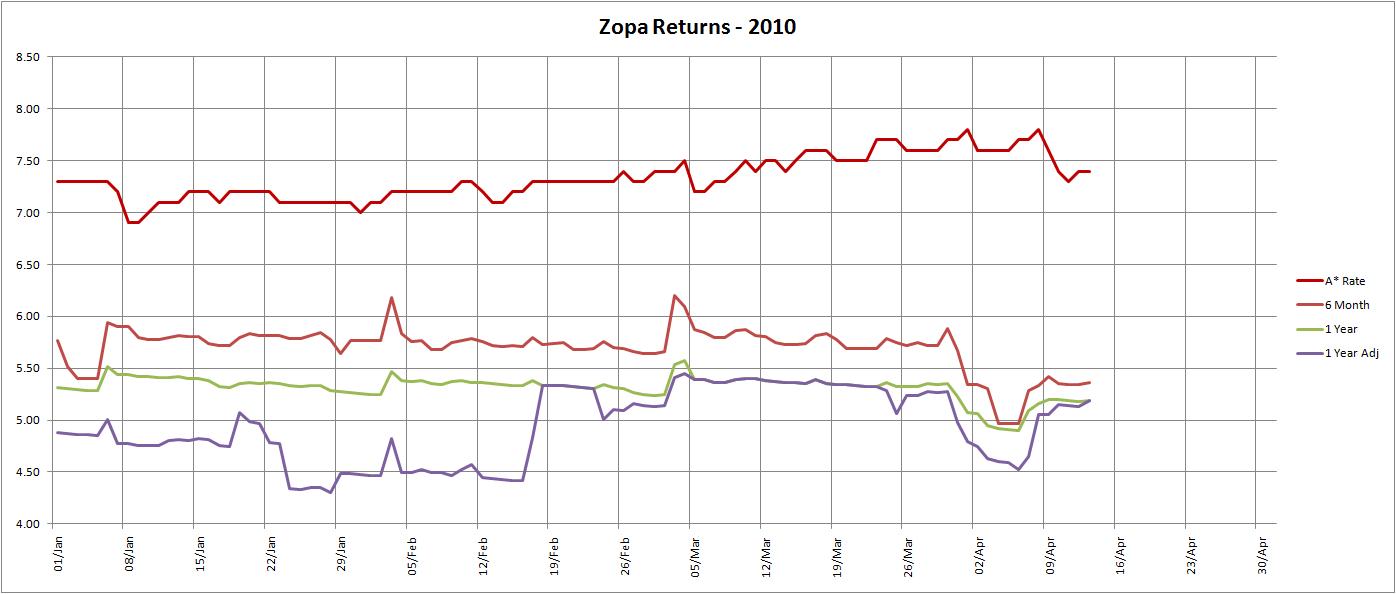
Zopa Returns - 2010
The four lines on this graph are.
- The rate at which money is lent out in the A* Rate.
- The return on money in Zopa over the last six months. This takes account of any bad debts.
- The return on money over the last year. Bad debts as before.
- The return on money over the last year, adjusted for arrears. Bad debts are accounted for and if arrears are greater than a year ago, they are counted as bad debts.
Taking the last three it would appear that things have changed since the election was announced, as they have all dropped and then recovered slightly. This is solely due to an additional bad debt, caused by the death of the borrower. No system can take care of that very sad event.
Probably the best measure of the return is to look at it in the middle of the month. Today is the 13th, so the return on money over the last year is 5.42%, 5.35%, 5.38% and 5.18% for the last four months. So it has dropped 0.2% because of that bad debt. If that is eliminated then the return for April 13th would actually be 5.37%.
So the election has done what you’d expect and had no affect, as most deals were done whilst the date of the election was not known.
But look at the A* borrowing rate.
If you look at the graph, you’ll see that the rate often drops around the 5th to the 10th of each month. This is probably because most loans are paid around the turn of the month and the effect of that money being reinvested is to drop the loan rate slightly because of the supply of money being increased.
But this month it has dropped further than normal after creeping up slightly for the last month or so. Perhaps the rate has increased because of high demand for money.
Could this be that as reported retail sales have been high this month and people are borrowing at a rate they trust to finance it? Or are they worried about the new government increasing VAT?
But really there is no hard and fast evidence that Zopa is being seriously affected by the election.
I shall return to this as the elction approaches.
Harry Markopolos – 2
I bought the book from Waterstones yesterday and I have read the first few chapters on the train home from London.
Brilliant!
He spotted what Madoff was up to in 2000, but the SEC wouldn’t listen and took no action. He also alleges that others felt the same about Madoff, but were happy to take the money.
My respect for Harry grows.
Reading his book, just increases my distrust for financial advisers. I think it is why I like Zopa. There the money is under MY control and I live or fall by my decisions. I know nothing about stocks and shares, so I keep clear of them.
The Banks Hidden Charges With Zopa
Not on Zopa!
Everything they do is detailed on your statement.
But take this week.
I wanted to put £500 into Zopa on Monday, so I did the transfer then. Only three days later has it turned up in my Zopa account. It used to be done straight from my debit card, but then one of the banks said that doing it that way, they didn’t get their pound of flesh.
So effectively they have my money for three days. At my rate of return on Zopa, that’s about forty-five pence.
Why?
I suppose they have to make their bonuses some way. My old mate, David, once told me that in the 1980s banks made a third of their profits on this sort of overnight money.
Has anything changed?
Keep it Small on Zopa
Over the last few months, I’ve been trying to reduce the size of the individual loans I make on Zopa. I now have a limit of forty pounds and the average loan is just above that figure for the over a thousand contracts I have. When I started I had a limit of two hundred pounds and a couple of those loans went into default, which meant I had some bad debts. There was also the problem then of liquidity in that there wasn’t the same number of Zopa borrowers and it was sometimes difficult to lend the money out. Now, if I put say a thousand pounds into the market, it gets lent out within a couple of days. Note that my low limits on each individual loan, do not give Zopa any extra costs, as they only check the borrower once and the other is just data processing.
There also appears to be a big difference in how Zopa checks borrowers. They have said that their checks are more stringent, but they also appear to be much faster. Perhaps, this is because they are now bigger and have more staff, but they must have better systems too!
This leads to an interesting theory. As Zopa and others like them get bigger, then the markets will get much more fluid and responsive. Money will get lent out quickly in loans split into hundreds of small ones. This will mean that larger lenders like me, will have thousands of loans which will spread their risk and thus, they will get a good return.
Do I have any evidence to back this up?
Possibly!
My rate of return over the last year is 5.39% before tax and taking it since October 2008, it is 5.55%. These are not bad returns in these troubled times.
But if I look at my returns over the last six months, the figure is 5.85%. It would appear that my policy of restricting the amount I lend to individual borrowers is having an effect, as I started this policy in the summer of last year.
When looking at loans in arrears, I have less outstanding now than I did a year ago. Partly, this is due to the smaller amounts lend, but mainly this is due to Zopa‘s better systems.
But I am not a hundred percent optimistic. We have an election coming up and who knows what that will bring.
But I certainly feel that if you want a better return on your money, that Zopa and their ilk are a better proposition than something like an Icelandic bank.
Do I have any regrets about Zopa?
Not really! But one of my borrowers died. It just goes to show how that in this world there are much more important things than money. My heart goes out to their family and friends.
Zesty Zopa
This appeared in the Daily Mail under the heading Zesty Zopa.
Who says there is no room for a new kind of banking?
The internet banking site Zopa, where lenders and borrowers decide among themselves at what rate they do business, is gathering momentum and had agreed 12,813 loans worth £63m as of January 1 this year.
It may sound like toy-town banking but it demonstrates how consumers, even bankers themselves, are determined to find ways of circumventing high street lenders.
This is typical of what newspapers, write about Zopa.
Just search Google News for Zopa and see what is written.
A Year of Zopa
I have now had a Zopa account since October 2008.
But it is now over a year since I started taking proper statistics of the lending, so that I can now put together proper results for the first time.
Overall Figures
As of the eighth of January 2010, I how have £39,473.90 invested in just nine hundred and fifteen separate contracts. This means that the average contract size is just over £43.
It should be noted that I generally lend in the two top Zopa markets, A and A*. This is because these markets have the lesser risks as people have a better credit rating. There are also two lower markets, B and C, that I ignore. I also lend a small amount in the youth or Y markets. All money is lent over three years.
Bad Debt
Bad debts are just two contracts, which total £278.13 or about 0.7% of the total. In terms of numbers is about 0.2% of the loans. Note that one contract is a Y and the other is an A.
So is that a figure that is in line with Zopa‘s predictions?
They predicted that debt for the type of lending I do, defaults would be of the order of two percent. There are two provisos to this.
- Loans between one and two years old are showing about a four to five percent level of default. Most of this was probably down to the credit crunch.
- Those issued recently are now checked to much tighter criteria and are showing lower predicted and actual levels of bad debt.
But both these levels are higher than I have encountered.
Let’s put it down to good luck.
Or did I just join Zopa at the right time with the worst of the bad lending bulge being just about in the past?
Arrears
Arrears are different to bad debt, in that they tend to be accounts that limp on. Sometimes they consistently pay a few days late and one or two I think will probably end up in bad debt.
The numbers of accounts in arrears vary between about two and seven. Interestingly the number grow at the beginning of the month and then decline until about the twenty-fifth. Some even if they do go bad will not be a problem, as I’ve only lent these people ten or twenty pounds or so. But others are more serious.
I have five in arrears at the moment.
- Y – £10 with just the last payment missing – 4 out of 5
- Y – £20 that just limps on a bit that has missed four payments, but they’ve all come in late – 3 out of 5
- Y – £100 that is a real limper but always manages the payment about ten days late – 3 out of 5
- A* – £120 with just the last payment missing – 4 out of 5
- A* – £30 that has limped and now appears to be going terminal – 1 out of 5
In total there is £211.34 in total outstanding on these loans, with total arrears of £12.06. So it would be unlikely that all this money will eventually be lost.
I suspect that the numbers will reduce as the month goes on. But I also expect others to be in arrears.
Returns
Working out a Zopa return is not easy, as money is going round and round, up and down and I have been adding about a thousand pounds a month to my lending.
According to my accountant the only fair measure is to take the amount of money earned a year ago and subtract it from today’s figure to get the yearly earnings. Dividing this by the average amount of money in the account over the year, should give a sensible answer.
This method also takes into account any monies in the holding account, bad debts and charges from Zopa.
As of today this yearly percentage is 5.44%. If I assume that all of the current arrears go bad, then this figure drops to 4.77%.
Is that a good rate of return in the current circumstances, where banks offer a lot less?
Strategy
When I started using Zopa, I didn’t have a strategy.
This was very wrong.
On the other hand, I had enough money to be able to afford any losses.
It is interesting that the two bad debts I have are one in A lending for £200 and another in Y lending for £100. Now, my limits are much lower.
As I said in this post, Zopa as a Lender, I started with the money from the sale of my late wife’s Porsche. But after testing Zopa for a few weeks, I started to be too aggressive in my lending, by allowing people to borrow too much. In some cases because two lending offers overlapped, I lent as much as £400 to some people.
Now, I have just two offers, one for A and A* borrowers and one for Y, with limits of £50 and £20 respectively. My average loan size is just over £40 now. I am not sure of the statistics but I believe that this makes it less likely I will suffer a major hit. Although, there are still some individuals with impeccable payment records, who owe me more than in an ideal world I would like.
So the strategy I now use is lend little and often and don’t be too aggressive in getting your money into the marketplace.
It also is essential that you check Zopa as often as possible, to make sure that your interest rates are up to date. I keep these at the highest level, that still gives a High rate of lending.
The RBS Dilemma
The Royal Bank of Scotland is now 70% owned by the taxpayer. Note the word taxpayer and that means you and me. Well, I suppose it might not mean you, as you might be in New York, New South Wales, New Zealand or New Caledonia.
But the dilemma will hit us all in the next few years as we struggle to get the economy under control.
In the red corner you have the public and the government, who for all sorts of reasons find million pound bonuses obscene. And in the blue corner you have the Banks, who say that they need to pay these bonuses to attract the best talent, so that they make higher profits in complex and difficult to understand markets.
This excellent article in The Times sums it all up well. The government wants to veto the bonuses and if they do, then the board of RBS will resign.
The Treasury signalled last night that it was prepared to veto a £1.5 billion bonus pool at Royal Bank of Scotland in a move that could trigger the resignation of the bank’s board.
RBS directors have been advised by the bank’s lawyers to resign if a Treasury bonus veto means they are unable to run the bank commercially and in the best interests of all shareholders.
People close to the Treasury signalled last night that Alistair Darling would throw out any bonus plan at RBS that was much higher than last year’s £1 billion. “We would not expect to see any significant increases in bonus payments. I think most people would see 50 per cent as a major increase,” one Treasury insider said.
RBS is expected to make £6 billion in profits this year from investment banking, implying a bonus pool 50 per cent higher than last year.
Is this blackmail? Yes! But is it sound business? Yes!
It’s actually more complex than you think.
Take total tax. Corporation tax on companies is lower than that for individuals. So am I right in thinking that high bonuses might actually return more money to the government? But that is a practical not an emotional response.
How true is RBS’s assertion that they need to pay the bonuses to get the right people to manage their investments? In my business life, I have often found that you have a lot more talent in a company than you think you have, but those in charge like to keep the minions down, as they see them as a threat. So perhaps, a little bit of intelligent management might improve matters. I don’t know! But I have worked with people at the highest level in a clearing bank and know that there is a lot of nonsense there. I suspect there still is!
Now let’s suppose that to get round the bonuses, RBS got some other company to manage their investments. I don’t know whether this is possible, but I suspect that it would probably cost them an arm and a leg to make the same six billion pounds. Probably one and a half billions of arms and legs. And most of that would probably never see a British tax authority again, so we, the tax payers, would lose.
So it’s difficult!
What we actually need is a change of culture.
Banks, no matter what we think, are a short-term business. For instance, a main board director of a major clearing bank, once told me that a third of their profits came from overnight money and the interest on money that had not been cleared. That’s why banks don’t transfer money instantly!
So how can we make things better?
Economists have talked of a transaction tax on banks, to move them away from short-term thinking, but that would only move the business to somewhere that doesn’t charge. So as with anything we need global standards and a level playing field.
So it will be a difficult and long uphill struggle to make the banks appear ethical in everybody’s eyes.
For my personal banking, I don’t use a bank, but a building society through the Internet and Zopa, the peer-to-peer lender. The former transfers my money efficiently and manages my credit cards. And the latter pays me around five percent on savings, with the ability to withdraw the money gradually if I need it. To get the same rate with a bank, I’d have to lock the money in for ever.
This is a model that many others will follow, leaving the global fruit machine to the so-called professionals. Unfortunately, banks will probably do their utmost to strangle innovative competitors like Zopa.
So we must educate everybody in the Internet and personal finance, so that they can make reasonable decisions for themselves. Many web sites do this very successfully.
But to return to the original dilemma.
Should the government limit bonuses for banks in which we have the major shareholding?
In my view they should not!
Why?
It will heap more bad publicity on the banks and hopefully push most of us to look for better and more ethical ways of handling our money.
How Banks Treat Competitors
As you know I’m a great fan of Zopa. I started with a post called Peer-to-Peer Lending – Zopa in July and have posted several since. Just click the “Zopa” tag.
Have the banks found a way to stop this upstart competitor? This has just been posted on the Zopa web site.
What’s happened to debit cards?
You may know that in order for a business to receive debit card payments, a merchant services licence is required. When we started out, our business model was unique and something of an unknown; as such, RBS Worldpay (the body associated with our banking partner that grants the ability to receive debit card payments) declined our application for a merchant services licence. We felt that debit card funding would be a useful service to offer our lenders, and found an alternative solution with the support of a third party in the anticipation that it would be a short term arrangement.
Given Zopa’s growth – and thanks to all your fundings – this year we thought it an appropriate time to revisit the application for our own merchant licence, with a solid track record to prove both that our model is working and that debit card business is popular with very little risk of liability to the merchant services provider. Unfortunately, despite our best efforts RBS Worldpay refuse to accommodate Zopa’s model, and have openly shown no appetite to work with us in coming to an arrangement or indeed in understanding our business. Equally, our volumes are such that the short-term process is no longer sustainable so it’s become unavoidable for us to draw the debit card funding service to a close.
The transfer will now take two days as opposed to being virtually instantaneous.
Why is it that banks assume that they are special? They are no different to any other company and should live within the same rules. But they don’t!
Infuriating Excel
I plot all of my Zopa investments in Excel. This gives me a good hold on how they are performing.
But about a week or so ago, the date axis on the chart disappeared. Strange because on my other computer the chart still works in the same way.
No matter what I do, I can’t seem to get them back. I get no message to say what is wrong either.
I hope I don’t write software like that!
I’ve done a bit of investigation and I’ve found that on the machine where the chart works, the version is Excel 2007 SP1 (12.0.6331.5000) and on the other machine that doesn’t it is Excel 2007 SP2 (12.0.6504.5001). I’ve since found that Windows updated my Office and probably Excel on the 27th of October.
Gambling Addiction
There has been an article on BBC Breakfast this morning talking about on-line gambling.
In a piece entitled Gambling, Zopa and On-Line Bots, I wrote.
A strange thing is that since I’ve been using Zopa, I have cut down my gambling on things like horse racing.
I think that using Zopa is a bit like on-line gambling with a bit of the same buzz, as you check the results of what has happened every day about 10:30 at night. Or it certainly seems so to me. But perhaps I’m more an information man, than a true gambler.
I can’t remember the last time I had a bet. In fact since I started doing detailed accounts with my new software product, there is nothing in the column marked, Gambling.
So perhaps we all need the buzz of gambling, but we need to channel it into something less risky and perhaps even productive.
 The Anonymous Widower