Bawdsey Manor
In the photographs of Felixstowe Ferry, there is a photograph of Bawdsey Manor.
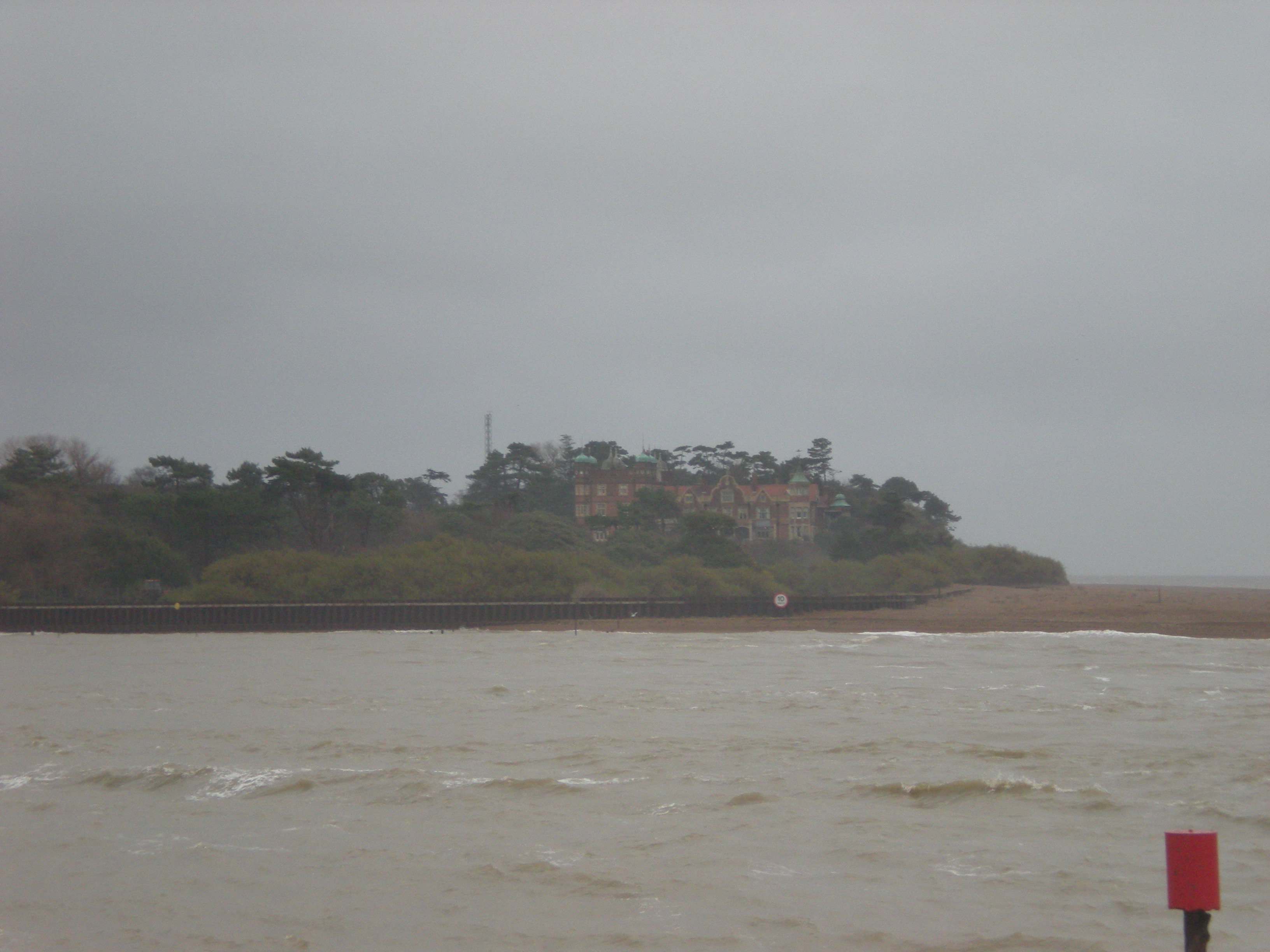
Bawdsey Manor
It is a large house in a very prominent position and was built in the late 1900s by the Quilter family.
But its role in the development of radar just before and during the Second World War has given this house its true fame. There is a museum on the site.
As a child I remember the three towers which formed part of the Chain Home radar system, that warned of early approach of German aircraft. This simple radar was very significant in the winning of the Battle of Britain.
It is interesting to note that British radar was actually inferior to German at the time. This is what Wikipedia says.
The Chain Home system was fairly primitive, since in order to be battle-ready it had been rushed into production by Sir Robert Watson-Watt’s Air Ministry research station near Bawdsey. Watson-Watt, a pragmatic engineer, believed that “third-best” would do if “second-best” would not be available in time and “best” never available at all. Chain Home certainly suffered from glitches and errors in reporting.
It was in many ways technically inferior to German radar developments, but the better German technology proved to be a disadvantage. The Chain Home stations were relatively simple to construct and comprehensive coverage was available by the start of the Battle of Britain.
I like Watson-Watt philosophy, as often something available in double-quick time is many many times better than nothing at all.
The Germans made a big mistake over these radar stations. Obviously, if they had been destroyed, victory for Britain in the Battle of Britain would have been more difficult. Wikipedia again.
During the battle, Chain Home stations, most notably the one at Ventnor, Isle of Wight, were attacked a number of times between 12 and 18 August, 1940. On one occasion a section of the radar chain in Kent, including the Dover CH, was put out of action by a lucky hit on the power grid. However, though the wooden huts housing the radar equipment were damaged, the towers survived owing to their open steel girder construction. Because the towers were untoppled and the signals soon restored, the Luftwaffe concluded the stations were too difficult to damage by bombing and so left them alone for the rest of the war. Had the Luftwaffe realised just how essential the radar stations were to British air defences, it is likely that they would have gone all out to destroy them.
What also puzzles me is that radar research carried on until the summer of 1940 at Bawdsey. If the Germans had known, the house would have been an easy target. Perhaps, it just shows how bad their intelligence was.
 The Anonymous Widower
[…] As anyone who reads this blog knows, I take a lot of photographs. Perhaps, I should be hung, drawn and quartered for taking a photograph of a secret radar station! […]
Pingback by Photograph a Chip Shop and get Arrested « The Anonymous Widower | December 4, 2009 |
[…] posts are two memories of Bawdsey Manor and Felixstowe Ferry on the other side of Deben, that I wrote after one of my last visits to the […]
Pingback by ABP’s New Lowestoft Facility To Support East Anglia Two & Three O&M Ops « The Anonymous Widower | December 17, 2025 |