Building A Station Like A Caisson
I was at the new CrossRail station at Canary Wharf today and took these pictures.

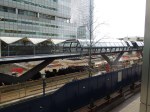

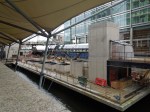
They show the enormous concrete block of a station and the walkway, that will connect it to the area of Canada Square and its offices.
Note how the main building looks almost like one of the giant caissons used for Mulberry Harbours, that were used in the Second World War to invade Normandy.
These giant Phoenix caissons, were actually built in these docks, after they had been drained and filled with sand. They were then floated out for the invasion. I’ve actually been in several of these amazing concrete structures in The Netherlands, where they were used to fill the last gap in the dykes after the North Sea Flood of 1953. They are now a museum, dedicated to the floods and those who perished.
It’s rather strange how history is repeating itself in a similar manner. I suppose though, that the engineers know that the ground is strong enough to take the weight of the station.
It does look from this web page on the Crossrail web site, that Canary Wharf Crossrail station is going to be worth the wait until 2018, although it will be substantially complete by the end of this summer.
The highlight of spring and summer will be the tunnelling machines passing through on their way to Farringdon station.
 The Anonymous Widower
The fun thing about the station is not whether the ground is strong enough to support its weight, but whether the foundations are good enough to stop the station going upwards due to its bouyancy. The concrete box acts like a very big boat and the the surrounding soil is waterlogged and not too strong. There are big piles trying to create enough friction to stop the station bobbing to the surface.
Comment by Bob | February 7, 2013 |