Can We Extend Overground Connectivity In North London?
The East London Line has four termini in South London; New Cross, West Croydon, Crystal Palace and Clapham Junction, but only two in the North; Dalston Junction and Highbury and Islington.
In the North the Lea Valley Lines are being added to the system and although these lines meet the North London Line at the Hackney Downs/Central station complex, they are not intimately connected to the core route of the East London Line, as this would need a change of train at Canonbury.
So how could we improve the extend the connectivity?
Hackney Central/Downs
I regularly take the Overground from Stratford to my home. On a wet day, I would take a train to Canonbury from Stratford, walk across the platform to a southbound train and then go one stop to Dalston Junction, from where I would get a bus two stops to my home. On a sunny day, I might change at Hackney Central to a 38 bus or walk from Dalston Kingsland.
But I usually take the Canonbury route, as it has the least amount of walking and if I’ve got a heavy parcel, there is a lift at Dalston Junction.
The two Hackney stations are being connected by a covered high level walk and this would help those changing between the North London Line and Lea Valley and Cambridge services.
But two other things could be done, if the run-down area around the stations is redeveloped.
If you want to get a bus or walk to the Town Hall area, after alighting on the westbound platform at Hackney Central, you have to cross the tracks on a footbridge. An entrance needs to be provided on the south side of the station.
The connection to the buses are better than they were a few years ago, but Downs/Central should have easy access to stops for the high-frequency bus routes that pass through the area.
I have a feeling that they may have spent a lot of money on making the footbridge step-free with lifts and in a few years time, it will be rarely used, as other better routes are developed. A southern entrance would help in this respect.
Crossrail 2 will be the driving force here, as the planners have stated a preference for only having one station in Hackney, to save a billion pounds. Whether this station is Dalston Junction or Hackney Downs/Central doesn’t matter, provided that these two stations are connected by other means. There are already two routes; the North London Line and the high-frequency buses.
For this reason, the access to buses from Hackney Downs/Central must be made as easy as possible. But that doesn’t need to wait for Crossrail 2!
There is a superb opportunity here for a developer to create a real town centre at Hackney Central/Downs, of which everybody can be proud. The original station building is not used, but it is a building worthy of saving as are few other historic buildings in the area.
An Extra Terminal In The North
If the frequency on the core section of the East London Line is increased from 16 tph to 24 tph as is stated in TfL’s plans, there could be a need for another Northern terminus to supplement Dalston Junction and Highbury and Islington, where these trains could turn back.
An extra terminus might ease the overcrowding that is prevalent at Highbury and Islington.
In the original plans for the Overground, there was talk about some East London Line trains going as far as Willesden Junction and terminating there.
With plans for a new super station at Old Oak Common, that could be a possibility. But even New Cross to Old Oak Common would be a journey of about an hour, and there will be faster ways via Crossrail at Whitechapel.
So a terminus for the East London Line at Willesden Junction or Old Oak Common, would be more about inceasing the frequency of trains on the North London Line, by using some of the eight extra trains an hour on the East London Line to provide the extra trains.
There are two other possibilities for extra Northern terminals.
If the Dalston Eastern Curve were to be reopened, then trains could move easily between Hackney Downs/Central and Stratford and the East London Line.
This would mean that Stratford could be an additional terminal and also that some East London Line trains could have an interchange with the Lea Valley Lines.
There is also a curve at Canonbury that connects the North London Line to the East Coast Main Line. It used to be double track, but is only single track now! So could this be used to get to a new Northern terminus?
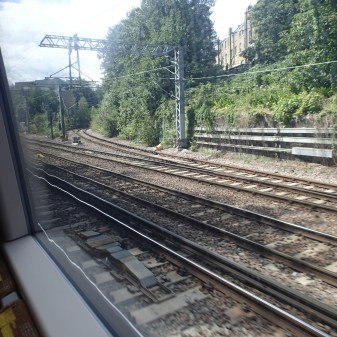
The Canonbury Curve To The East Coast Main Line
It all depends on the passenger flows, which of course TfL has at its fingertips.
We must also take note of passenger behaviour in using cross-city railways.
When Crossrail opens in 2019, all parameters will change, as many who want to use the East London Line to get on the Underground at Highbury and Islington, might get on Crossrail at Whitechapel instead. This passenger will probably go to Oxford Street, by walking to Dalston Junction, before taking the East London Line to Whitechapel for Crossrail. The alternative of taking a bus to Highbury and Islington and then getting the Victoria line, means I have to use a station I avoid as much as possible, due to the excessive walking involved to get to the trains.
The Eastern Curve At Dalston Junction
This seems an easy option to improve connectivity, as it would allow trains to pass easily between Stratford and Hackney Downs/Central and the East London Line. But there are two problems.
It might be a difficult sell to the Dalstonistas and the shopping centre at Dalston Kingsland is being redeveloped, although the Eastern Curve is safeguarded.
It would seem though, that in the next couple of years, there is a chance to make a good fist of sorting out the shops and stations at Dalston.
Tying In The Lea Valley Lines
There has been little or no speculation about how the London Overground will link the Lea Valley Lines to their current lines. London Overground has said that it will deep clean the trains and stations and that new trains are on the way.
They have also got at least three out of station interchanges between the new lines and the current system.
- Walthamstow Central to Walthamstow Queens Road.
- Hackney Downs to Hackney Central, although the way that is going, it will probably become a single station.
- Seven Sisters to South Tottenham
There are also a couple of junctions where useful connectivity already exists.
There is a rail line called the High Meads Loop that goes between the Lee Valley Lines and the North London Line, virtually straight under the old Olympic Village. This is the North London Line End just after Hackney Wick station.
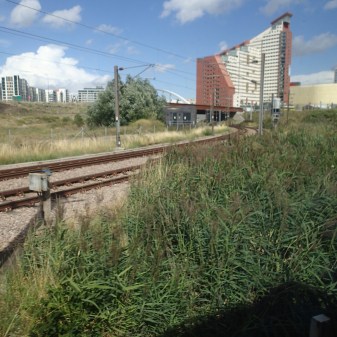
High Meads Loop At Stratford Joins North London Line
And this is the other end on the Lea Valley Line, between Stratford and Tottenham Hale
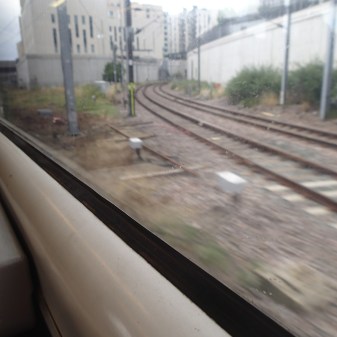
High Meads Loop At Stratford Joins Lea Valley Line
Incidentally, I don’t think there is a station under all those dwellings.
There is also another junction that links the Lea Valley Line to the Gospel Oak to Barking Line to the East of South Tottenham station.
Perhaps the most interesting proposal though, is to reinstate the Hall Farm Curve in conjunction with the reopening of Lea Bridge station. I travel to Walthamstow Central regularly and the curent timetable of the GreaterAnglia service is a bit threadbare to say the least. So if this curve is reopened, will we see trains linking Walthamstow to Stratford and even to and along the North London Line by way of the link I showed in the pictures to my local station at Dalston.
If the Eastern Curve at Dalston Junction was to be reinstated, then some of those extra trains through the core section of the East London Line could go to Walthamstow and Chingford.
Summing Up
The more I look at the East London Line, the basic concept of a high frequency line through Marc Brunel’s Thames Tunnel, fanning out to several destinations on both sides of the river, was a stroke of genius, which was probably dreamed up in the time-honoured manner of so many other good ideas on the back of serviettes, beer mats or fag packets in a real ale hostelry somewhere.
Who can predict with any certainty what the Overground will look like in 2020, let alone the 2050 target of Transport for London?
The only certainty is that Transport for London will have created another iconic brand to go with Underground and Routemaster.
It could also be argued that London’s three new cross-London lines;Thameslink, Crossrail and East London, are all following a similar design of a central tunnelled core, with a collection of branches at each end.
Certainly the current Thameslink and East London Line have shown that the concept works and if they perform in the next few years, this can only mean that further lines in London and further afield follow a similar pattern. Crossrail is adding more branches and termini and the basic design for the proposed Crossrail 2 appears to have been designed by the use of a photocopier.
How We Use A Cross-City Railway
London has two main North-South cross-city railways; Thameslink and the East London Line, which are shortly to be joined by a third East-West line; Crossrail.
These three lines are characterised by a tunnelled central core, with branches fanning out on either side. This means that if the branch you live on is paired with another branch on the other side of the city, you will probably have to change trains in the centre if you want to go to an alternative branch.
It’s not just London, who use this sort of layout. Birmingham, Cardiff, Liverpool and Newcastle in this country have similar cross-city trains or metros, and I suspect that worldwide there are quite a large number.
I did a journey a few weeks ago, which illustrates how we use these lines. I’d been to my doctor’s surgery, which is close to Haggerston station and afterwards I needed to go to Norwood Junction, which is on the West Croydon branch of the East London Line.
As it was raining hard, instead of waiting for the next West Croydon train on an exposed platform, I took the first train. I then hopped-off this train at Canada Water and hopped-on my desired train, after waiting for a few minutes in a dry underground station.
This hop-off-hop-on behaviour at a convenient station in the core will get increasingly common, as more and more branches are added to these cross-city lines.
If you use National Rail’s Journey Planner for say Sutton to Luton, some routes offered, involve a change of train at either Blackfriars or St. Pancras using Thameslink. But in the current Thameslink, these changes are not same platform ones, like they are on the East London Line and hopefully will be on the upgraded Thameslink, when it opens in 2019.
Crossrail takes this concept to a whole new level!
Most if not all of the central core stations are island platforms, so that if you are on a train from Abbey Wood to Heathrow, but want to go to Maidenhead, you just hop-off and then hop-on the first train that calls at Maidenhead, using a convenient Central London station. But the island platform, also allow you to reverse direction on a hop-off-hop-on basis. So Abbey Wood to Shenfield becomes a simple step-free one-change journey.
Sadly, there is no central core island platform station on Thameslink and the East London Line. This is probably more to do with adapting existing stations, rather than a less than perfect design.
But imagine what a lovely station the below-ground Thameslink station at St. Pancras would be with a large light and airy, central island platform with trains behind platform edge doors! Perhaps it could have a welcoming coffee-shop, where you could refresh yourself and meet friends.
 The Anonymous Widower