Should We Create A Northern Playground In Addition To A Northern Powerhouse?
George Osborne and other politicians, thinkers, academics and businessmen talk about creating a Northern Powerhouse.
I am very much in agreement to these aims, but from my London-based viewpoint, I tend to think that the North has a lot more to offer.
Two of the bigger successes of the North in recent years have been the reinvigoration of Liverpool as one of the best tourist destinations in the world and the Tour de France in Yorkshire in 2014.
So should any Northern Powerhouse plans, take more than a large nod to emphasising the leisure and tourism opportunities in the area?
The government’s plan for transport in the North released yesterday and discussed in this post, is fifty years too late and if it’s implemented, it will be some years, before High Speed Trains touch 140 mph on the way between Liverpool and Hull and Newcastle.
The high speed railway should remain an end objective, but in the mean time, we should do various things to make the wait bearable.
1. Electrification In The North
The Electrification in the North study recommended that virtually all lines north of a line drawn between Chester and Lincoln be electrified. A rolling program should be planned that virtually eliminates diesel-powered passenger and freight trains.
This would speed up services between all the major cities and also connect all of the wonderful rural lines that cross the Pennines and hug the coastline to major centres of population.
So this electrification program is just as much Northern Playground as Northern Powerhouse.
2. Contactless Ticketing
Plans for the North talk about an Oyster Card for the North. As so many Londoners will tell you, Oyster is old superseded technology and so last decade.
We need a universal contactless ticketing system based on bank cards that works all over the UK!
This would mean that you just turned up at any station, bus or tram stop in the UK, touched in and you’re off on your journey.
Those who doubt this is possible, should spend a week using their bank card as a ticket in Greater London. They will find a system totally devoid or hassle and cash, well-liked by both passengers and staff. It also automatically gives you the cheapest price for the collection of journeys you take over a day, week or month.
Leisure passengers by their more spasmodic and impulsive nature will benefit tremendously from simple contactless ticketing.
3. Maps And Information Everybody Can Understand
As London was first in the world with decent maps and also because it is so large, that no resident knows the whole city, London needs comprehensive maps and travel information displayed everywhere in a common easily-understood and learned format.
As the combined population of the North of England is upwards of eleven million as against the eight of Greater London in a wider area, I suspect those in the North find themselves in an unknown area more often than those in Greater London.
So one thing that the North needs for both Playground and Powerhouse is a universal mapping and information system, which is the same all across the various parts of the North.
I feel that the North should use London’s system, which includes.
1, A detailed local walking map on every bus stop, tram stop and station.
2. Comprehensive bus information at every station.
3, A detailed bus spider map on every bus stop, tram stop and station.
4. A five digit number on every bus stop, which if sent as an SMS message to a short SMS number, gives details of the next few buses.
,I doubt that this will ever happen, as no council in the North would ever allow something to be used in exactly the same way as it is in London. Or if it was one of the larger cities, in the same format as another.
If the system relied on passengers having and using smart phones, then it should be prohibited.
But quite frankly, at the moment the information systems in the North are truly dreadful.
4. Two Hours From London
This is a list of the major cities of the North and typical fastest journey times by train to and from London.
Barnsley – 2:34 to 2:45 – Change at Sheffield
Blackburn – 2:56 – Change at Preston
Blackpool – 2:45 – Change at Preston
Bolton – 2:45 – Change at Manchester
Bradford – 2:49 to 2:52 – Change at Leeds
Burnley – 3:41 – Change at Preston
Darlington – 2:20 – Direct
Doncaster – 1:34 to 1:38 – Direct
Halifax – 2:48 – Direct/3:08 – Change at Leeds
Harrogate – 2:43 – Change at York or Leeds
Huddersfield- 2:52 to 2~:54 – Change at Manchester or Leeds
Hull – 2:33 – Direct
Leeds – 2:11 to 2:13 – Direct
Liverpool – 2:12 to 2:14 – Direct
Manchester – 2:07 to 2:09 – Direct
Middlesbrough – 2:57 to 2:59 – Change at Darlington
Newcastle – 2:50 – Direct
Preston – 2:08 – Direct
Rotherham – 2:16 to 2:28 – Change at Doncaster or Sheffield
Sheffield – 2:01 – Direct
Stockport – 1:55 to 1:56 – Direct
Warrington – 1:44 – Direct
Wigan – 1:55 – Direct
York – 1:50 to 2:02 – Direct
This list shows several things.
1. Many of the direct journeys between London and the North could be brought consistently under two hours, once ERTMS allows 140 mph running on the East Coast Main Line and the West Coast Main Line in a few years time.
2. Electrification of the Midland Main Line to Sheffield will bring that city consistently under two hours from London, which will speed up the journey to Barnsley, Rotherham and other places.
3. Some destinations like Blackpool, Bradford, Huddersfield, Hull and Middlesbrough would get a significantly faster service to and from London, if there was no need to change.
If we get the expected speed up on the East and West Coast Main Lines, what sort of times will we get to the major cities in the North.
Adjusting for the probable speed increase from 125 to 140 mph. gives these estimates for the following journeys.
Darlington – 2:05
Doncaster -1:26
Hull – 2:17
Leeds – 1:57
Liverpool – 1:59
Manchester – 1:55
Newcastle – 2:32
Preston – 1:54
York 1:47
I think we can say that in a few years time, many more towns and cities in the North will be within two hours from London, which can only be beneficial to those places for both Powerhouse and Playground purposes.
I regularly go to the North for the day by train to see football. Some places like Middlesbrough and Blackburn are tiring journeys, but get them under two hours and leisure traffic can’t help but increase, especially, if there were more affordable good hotels and better late train services back to London..
5. Better Connectivity
More places could be brought under the important two hour ideal, if perhaps the east-west routes interfaced better with the north-south ones at places like Darlington, Doncaster, Leeds, Preston and York.
In an ideal world, a passenger from say London to Hull, should be able to step off a northbound train at Doncaster and just by walking across the platform to step on to a train for Hull. At the same time passengers from Sheffield and Rotherham going to Newcastle would just step across the platform the other way.
This may seem rather utopian, but precise timing of trains is what ERTMS is supposed to enable.
The easier it is to get between any two points in the North, the more things will be improved.
6. High Speed Lines Across The Country
When the upgrade and electrification of the Midland Main Line is completed in 2020, there will be three major 140 mph railways between London and the North.
To complement these there needs to be High Speed Lines across the country from say Liverpool to Hull and Newcastle.
Any east-west lines will connect with the north-south lines at places like Darlington, Doncaster, Leeds, Manchester, Newcastle, Preston, Sheffield and York.
As I said in the previous section, there needs to be good interfaces between the two sets of lines to speed up journeys to stations that are a change away from the north-south lines.
At some point in the future, there will be a need for purpose-built High Speed Lines across the county.
But by the time this is done, I think tunnelling techniques will have improved to such a degree that instead of building a surface railway with all the planning and other difficulties that entails, a tunnel will be bored under the Pennines to connect Hull and Doncaster with Liverpool. The tunnel would be arranged to pass under major stations like Sheffield and Manchester Piccadilly and could connect to them by lifts and escalators.
Such a tunnel could be bored to a W10 loading gauge, so that it could transfer freight containers under the Pennines to link Liverpool and the West Coast Main Line with the Electric Spine to Southampton and the East Coast Main Line to London Gateway and Felixstowe. I believe a high-capacity freight railway between east and west through the Pennines, will have the same effect as theFelixstowe-Nuneaton freight corridor has had on the A14.
This Google Earth image shows the towns and cities between Liverpool and Hull.
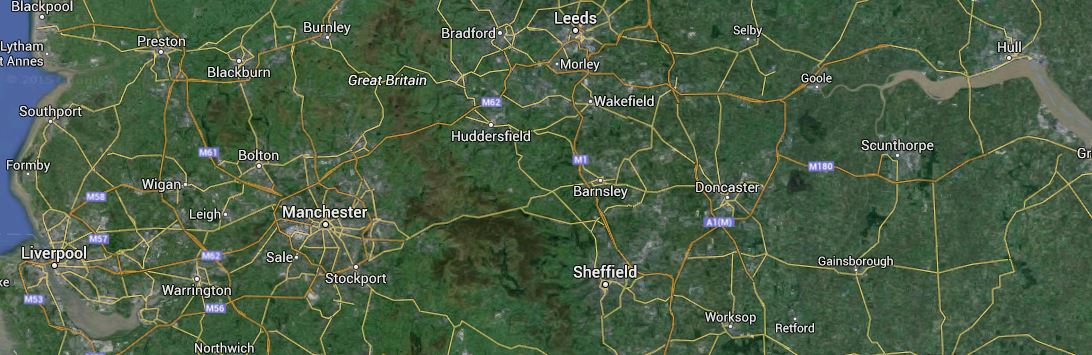
Liverpool To Hull
It may seem a long way to bore a tunnel even if it didn’t go all the distance, but we’re probably talking about 2030 and the machines then, will make today’s machines look like toys. The tunnel would probably start west of Manchester and go to east of Sheffield, which would be under fifty kilometres, connecting to Liverpool and Hull by means of surface lines.
Also if any new route could handle freight and link the Port of Liverpool to the east side of England this could have interesting possibilities.
For instance, would it be quicker for containerised freight from the United States and Canada to reach Germany and Central Europe if it went via Liverpool and a freight train through the Channel Tunnel?
Plans of this nature have existed for years, but none has ever been implemented. Some proposals for the Great Central Railway are given here.
It all goes to show that modern technology will create lots of options for putting a High Speed Line across the country.
Both Powerhouse and Playground will benefit.
No comments yet.
 The Anonymous Widower
Leave a comment