All Change At Barking
Over the next few years there are going to be changes at Barking station.
Barking and Dagenham Council have plans to redevelop the station, but compared to many 1960s stations built by British Rail, Barking station isn’t one where you need to call in the heavy demolition squads. From what I’ve seen elsewhere, a partnership between good architects and a competent construction company, should be able to create a station fit for the twenty-first century.
The station is also served by two ambitious operators; Transport for London, with both Underground and Overground and c2c with services along the Essex Coast.
So I have this hope that between the three of them, they can turn Barking into another East London gateway to Essex alongside Liverpool Street and Stratford.
It has also been announced that the Gospel Oak to Barking Line will now be going to a new station at Barking Riverside.
Transport for London have now produced two options about how this line will link up to the station.
This is Option A, which would need two single track viaducts.
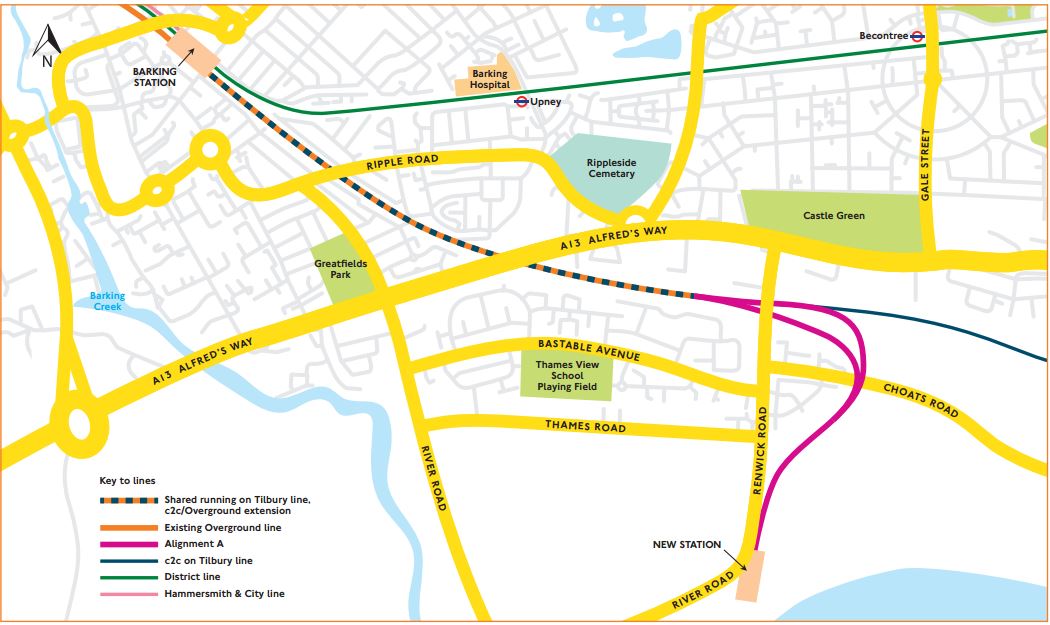
Barking Option A
And this is Option B, which gives the option of a second station and needs a double-track viaduct.
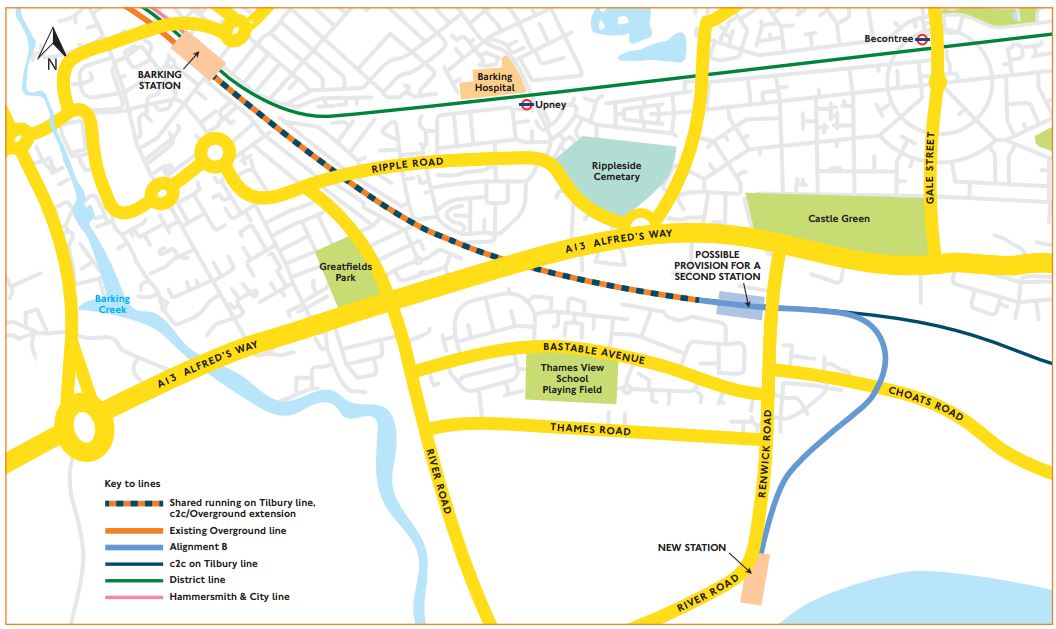
Barking Option B
As both link into Platforms 7 and 8 at Barking station, there would appear to be little difference between the two options except for the ability to have a second station with Option B and the possibility of one track layout being cheaper.
This Google Earth image shows Barking station.
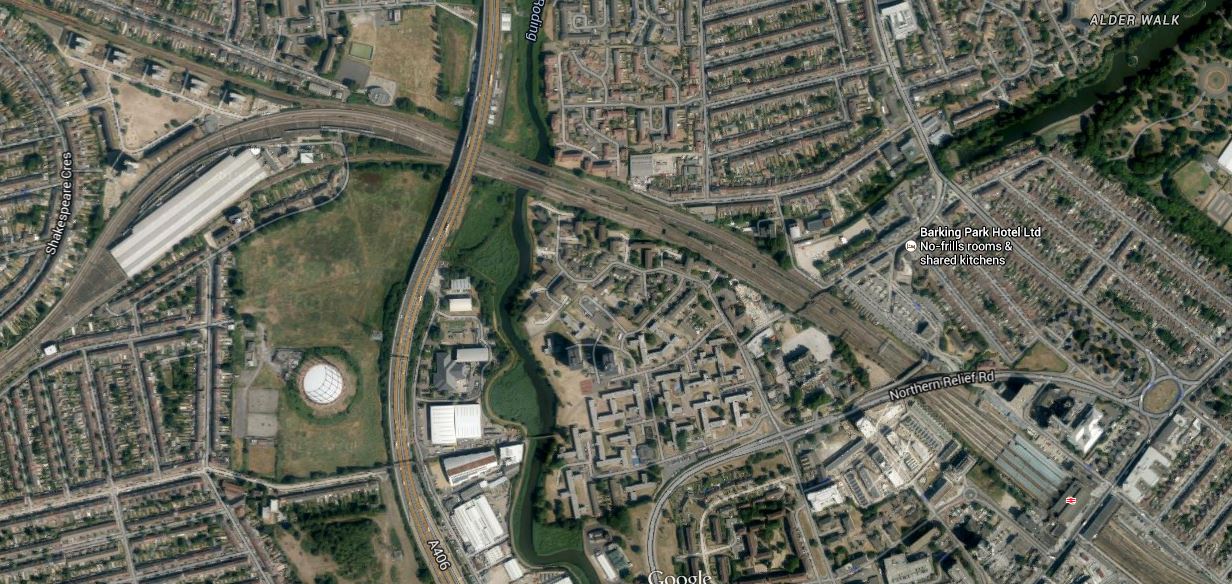
Barking Station
Platforms 7 and 8 are at the southern side of the station. So this means that trains from Gospel Oak, will have to criss over several lines to get from the northern side to the southern. But this is not a problem here, as there is a flyover, which has been built to get freight trains across the main lines. If this hadn’t been built sometime in the past, then extending the GOBlin to Barking Riverside would be a lot more expensive.
When I was at Barking recently, Underground and c2c trains were using opposite sides of the same platforms, thus allowing cross-platform interchange.
This would appear to be the platform usage.
1 – Bay platform for Gospel Oak to Barking trains
2 – Eastbound Underground – Paired with 4
3- Bay platform for Underground – Tucked between 2 and 4
4 – Eastbound c2c – Paired with 2
5 – Westbound c2c – Paired with 6
6 – Westbound Underground – Paired with 5
7 – Eastbound c2c – Paired with 8
8 – Westbound c2c – Paired with 7
If there is a problem, it is that to change between c2c and the Underground isn’t always a simple cross-platform interchange, but sometimes up and down steps. As getting on the Underground at Fenchurch Street isn’t simple and West Ham is similar to Barking with lots of steps, it would seem that this neglected part of London needs a few station improvements.
This won’t get any better after Barking Riverside is served, as this will put extra trains through platforms 7 and 8.
I would assume that Network Rail have a cunning plan up their sleeves.
It would surely be better if all c2c trains used either platform 4 to go east and 5 to go to west to Fenchurch Street.
This may not be possible with the current track layout, which would appear to split into the two services via Basildon and Ockendon respectively to the west of Barking station. The southern route via Ockendon, branches away soon after the station, so moving the junction to the east of the station to use just a single platform in each direction, might not be possible.
But a better platform layout would make it more difficult for passengers to get lost or miss connecting trains at Barking.
I think in a few years time, Barking will have an important interchange station, adding significantly to the transport options of the area.
No comments yet.
 The Anonymous Widower
Leave a comment