Herne Hill Station
The more I read about Herne Hill station, the more I’m fascinated with its problems. The Wikipedia entry starts with these two paragraphs.
The station building on Railton Road was opened in 1862 by the London, Chatham and Dover Railway. Initial service was only to Victoria, but by 1869 services ran to the City of London, King’s Cross, Kingston via Wimbledon, and Kent, including express trains to Dover Harbour for continental Europe. The arrival of the railways transformed Herne Hill from a wealthy suburb with large residential estates into a densely populated urban area.
In 2011, Network Rail recommended terminating all northbound Thameslink trains from Herne Hill at Blackfriars from 2018, freeing up capacity on the Thameslink cross-London section for trains via London Bridge. The Department for Transport announced in January 2013 that services from Herne Hill would continue travelling across London after 2018.
The first paragraph illustrates one of the problems at Herne Hill. To my mind, the real problem is that we have Victoria towards the west of London acting as a terminal for trains from Kent and the Eastern part of Surrey, which then have to cross major North-South services like Thameslink and the London Bridge to Sussex services. It’s a crazy mess that has been well over a hundred years in the making, because successive rail management has sidestepped the problem.
Network Rail’s design for Thameslink was probably the best they could do in this pressure cooker, but it annoyed too many civil servants and politicians, so it couldn’t be allowed. I’ve seen this so often in major projects, where engineers, designers and other professionals have recommendd one course of action, but polticians have said you can’t do that, as my gardener will lose his allotment.
In Improving the East London Line about Herne Hill station, I said this.
It has problems, as it would appear a gallon is being squeezed into a gill pot! If you read this article in London Reconnections, you’ll see that it is not just a serious problem, but an almost impossible one.
To make matters worse, Network Rail’s proposed solutions have seemed to be hindered by the Dulwich Estate retaining significant planning powers, which only an Act of Parliament can resolve.
With all my scheduling experience,I can’t help feeling that Thameslink is going to be a disaster unless something is done to sort out the knitting in the Herne Hill area or the number of trains through the area, is matched to the capacity.
This extract from Wikipedia explains why capacity is low at Herne Hill.
The four tracks are served by two island platforms; northbound trains call at the western platform and southbound trains the eastern platform, providing cross-platform interchange between the two routes.
There are flat junctions at each end of the station: Herne Hill North Junction, where the lines to Loughborough Junction and Brixton diverge; and Herne Hill South Junction, where the lines to West Dulwich and Tulse Hill diverge. Thameslink and Southeastern services cross each other’s paths at the junctions, constraining capacity on both routes. The station also has a turnback siding on its eastern side, adjacent to Milkwood Road.
Imagine two roads crossing at an angle, where there were traffic signals letting through a few vehicles at a time. Slow isn’t it?
The only solution would be to have a flyover, but there are too many local objectors to this.
We could always dig the guys up who designed this mess and hang them. But although we might feel better, it wouldn’t help the problem.
So I just thought I had to go and look at this troubled station and pour my four-pennyworth of burning oil on the problem. I took these pictures.
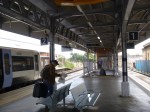
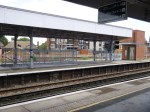
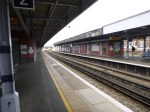
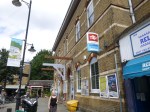
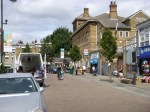
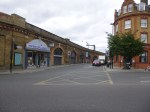

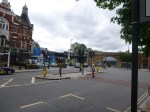
The pictures show the station is in good condition with good disabled access. There are also four bakeries and lots of cafes and restaurants for those who jump train at Herne Hill because of the slow progress.
 The Anonymous Widower
[…] This crossing should surely have been sorted years ago, as it must be a severe bottleneck in the running of Thameslink services. It must be like having road-works controlled by traffic lights, where the M1 joins the M6. I wrote about the problems in Herne Hill Station. […]
Pingback by A Tunnel Under Brixton « The Anonymous Widower | May 27, 2016 |