This has been stated in several articles on the Internet, but I’ll use this article from London 24 entitled Barking to Gospel Oak Overground line “to close for EIGHT months this year”. This is said.
A closure is necessary so the diesel stock can be replaced with electric trains and to increase capacity on the hugely-overcrowded route.
A £60m contract was awarded to J. Murphy and Sons to electrify the line in September last year but there has been no announcement from the Department of Transport, Network Rail or TfL.
London24 understands negotiations have been ongoing between the organisations over the length and nature of the closure while electrification takes place.
Shutting it will cause mayhem for thousands of passengers who will have to find alternative routes, which will often take longer and be more expensive.
I have also heard from a reliable source that there will be an eight month closure and the Gospel Oak to Barking Line (GOBlin) will open with new trains.
I feel that Murphys are electrifying the line in a novel way and I wrote about it in Are We Seeing A New Approach To Electrification On The Gospel Oak To Barking Line?
I have no specific or private information, but only what I have read in the media or seen with my own eyes.
I will of course be using my own experience of many years of supporting and observing large projects.
What Would Be An Acceptable Closure?
In Summer 2015. the Victoria Line was closed for two months, to replace a cross-over at Walthamstow Central. This was just about acceptable to the locals, but the alternative routes and Rail Replacement Buses coped.
At the right time of the year, I suspect that the residents of North London could endure a closure of perhaps 3-4 months. But of course, they’d prefer it, if there wasn’t any closures, except for odd days at weekends.
At least there are alternative routes.
- The upgraded Victoria Line can help between Walthamstow and Upper Holloway, with assistance from buses.
- After the 17th April, there would appear to be no North London Line closures.
- The Victoria Line to Highbury and Islington can partly replace going to Gospel Oak for the North London Line.
- There are a couple of out of station interchanges.
Freight trains can be routed via the North London Line.
How Much Work Can Be Done?
The key to doing anything, is the number of hours that work can be done and the amount of resources that can be used.
This is the current list of closures on the GOBlin.
- Sun 31 Jan 16 – Gospel Oak to Barking
- Sun 07 Feb 16 – Gospel Oak to Barking until 12:00
- Sun 14 Feb 16 – Gospel Oak to Barking until 12:00
- Sun 21 Feb 16 – Gospel Oak to Barking until 12:00
- Sun 28 Feb 16 – Gospel Oak to Barking until 12:00
- Sun 06 Mar 16 – Gospel Oak to Barking until 12:00
- Sun 20 Mar 16 – Gospel Oak to Barking until 12:00
- Sun 27 Mar 16 – Gospel Oak to Barking until 12:00
- Sun 03 Apr 16 – Gospel Oak to Barking until 12:00
- Sun 10 Apr 16 – Gospel Oak to Barking
- Sat 16 to Sun 17 Apr 16 – Gospel Oak to Barking
- Sat 23 to Sun 24 Apr 16 – Gospel Oak to Barking
- Sat 30 Apr to Mon 02 May 16 – Gospel Oak to Barking
- Sat 07 to Sun 08 May 16 – Gospel Oak to Barking
- Sat 14 to Sun 15 May 16 – Gospel Oak to Barking
- Sat 21 to Sun 22 May 16 – Gospel Oak to Barking
- Sat 28 to Tue 31 May 16 – Gospel Oak to Barking
- Sat 04 to Sun 05 Jun 16 – Gospel Oak to Barking
- Sat 11 to Sun 12 Jun 16 – Gospel Oak to Barking
- Sat 18 to Sun 19 Jun 16 – Gospel Oak to Barking
- Sat 25 to Sun 26 Jun 16 – Gospel Oak to Barking
- Sat 02 to Sun 03 Jul 16 – Gospel Oak to Barking
- Sat 09 to Sun 10 Jul 16 – Gospel Oak to Barking
- Sat 16 to Sun 17 Jul 16 – Gospel Oak to Barking
- Sat 23 to Sun 24 Jul 16 – Gospel Oak to Barking
No long closure seems to have been announced yet!
Note the following.
- There doesn’t appear to be any working day closures, so it would appear that Transport for London/Network Rail are looking after the passengers! And the revenue!
- I should also say, that an engineer working on an unrelated station project in London, said that it was typical to work on a twenty-four hour basis. Thus a weekend closure could give over fifty continuous hours for working.
- There are two longer closures in May at the Bank Holidays, so what is planned for these weekends?
- None of the work is in tunnels!
- The line could be blockaded at night to allow work to continue all through the night.
- Important freight could use the North London Line.
- The line connects a string of roads together, where there are various facilities like cafes and shops. I bet if someone is peckish at two in the morning, they can get a sandwich.
- I would suspect, that they will apply some of the lessons learned at Dawlish.
- J Murphy and Sons have a reputation for using lots of sub-contractors.
- A lot of the work is taking place close to Murphy’s depot!
- They can get the lights out and use the summer months to great advantage.
- Days can be used to get everything ready for the following night’s work.
- The extension of the line to Barking Riverside can be done later after the GOBlin has reopened.
I think that someone is doing a universe-class project management job and has realised that by clever working practices and selected weekend and overnight closures, there could be masses of time and resources available for the job.
Could this explain, that when the eight month closure is discussed, Mike Stubbs from London Overground is always quoted as saying no final decision has been made?
Perhaps every day, project managers are telling him a smaller and less disruptive figure.
Have the freight companies been told, that the line will be closed to them for eight months, so they can plan accordingly? It would be very sensible and I suspect they have already made alternative arrangements.
I think that Murphy’s orange army will get an amazing amount of actual work done before the end of 2016.
If the electrification gets delivered on time and budget, a great number of men and women, will be telling their grandchildren exaggerated tales about how they rebuilt London’s railways!
Trains
One problem is the Class 710 trains, as they can’t be delivered until 2018, so I suspect that opening after the eight month closure with new trains, should be opening with four-car electric trains.
In a section in my related post entitled Where Are The Trains?, I said this.
I believe that the Class 387 trains, are the only acceptable and available trains, that will be available to open the service after an eight-month blockade.
Nothing else except some old trains from British Rail’s dustbin are available.
The Class 387 trains will be available as Bombardier have sorted the production. I wrote about this in Class 387 Trains On Track
Political Considerations
In May we have the London Mayoral Election and if there is an eight-month blockade of the GOBlin, I don’t think it would be to Zac Goldsmith’s advantage.
But supposing by mid-April a plan has been published and evidence of masts and wires is creeping along between Gospel Oak and Barking!
So why has the eight months closure been so widely publicised?
I’m no spin-doctor, but wouldn’t it be better to give people low expectations and then say that there’ll be new electric trains at the end of the year.
A couple of months ago, Modern Railways published an editorial saying Network Rail needed a win to restore their image in the eyes of the general public.
Could this be their strategy to go for a win?
If it fails, it will be an own goal of horrendous proportions.
Conclusions
I am led to the following conclusions.
- Between now and December 2016, there is a very large number of man-hours available to electrify the GOBlin.
- The line can be blockaded every night and work could continue under lights
- Eight four-car Class 387 trains could be borrowed to start the electric service.
- Zac Goldsmith, Boris Johnson, Network Rail and Peter Hendy, and J. Murphy and Sons have a lot to gain if this line is electrified on time and on budget.
I have a feeling that if we don’t get biblical rain, plague and pestilence, London is in for a surprise.
January 28, 2016
Posted by AnonW |
Transport/Travel | Gospel Oak And Barking Line, London Mayor, Project Management, Trains |
1 Comment
February 2016’s Modern Railways has some news on the building by Bombardier of Class 387 trains. Three orders are in the pipeline.
- 27 trains for Gatwick Express
- 8 trains for Great Western Railway
- 20 trains for Porterbrook
All are of four cars.
Modern Railways says this.
The 20×4-car units for Porterbrook (for an as-yet unnamed operator) will be built first, followed by the 8×4-car units for Great Western Railway.
I feel that we’ll be seeing Porterbrook’s twenty trains on the UK rail network before the end of 2016 or soon afterwards. You have to admire their business acumen in spotting the need.
The article also goes on to say that Bombardier has created a new facility dedicated to the Class 345 trains, that will be for Crossrail. So their production will not effect production of other trains.
Does this also mean that Bombardier could use the existing production facilities to create more Class 387 trains or build the Class 710 trains for the London Overground?
If it’s the first then there are several operators, who would like a new 110 mph electric multiple unit. If it were a 125 mph train, there would be more takers.
If it’s the second, then I’d be pleased to be riding new Aventras on the Gospel Oak to Barking Line and up and down the Lea Valley Lines.
I think that it is true to say, that judging by the mess, that is the Great Western Electrification, that Great Western Railway will have a few spare Class 387 trains, if any operator had an electrified railway.
I would also love to ask Porterbrook and/or Bombardier how many of the leasing company’s twenty trains will be delivered with an IPEMU capability.
As I’ve said many time before, a 125 mph four-car IPEMU would be some train and would transform rail services in East Anglia, Across the Pennines, on the Midland Main Line and perhaps many other places.
All is starting to be revealed!
January 28, 2016
Posted by AnonW |
Transport/Travel | Class 387 Train, IPEMU, Trains |
1 Comment
On my holiday in Poland, I met someone, who lives on the route of HS2.
They told me that a million tons of tunnel spoil will be dumped on farmland in the Chilterns.
I was rather surprised to say the least, as having followed major projects for the best part of forty years, I know that project managers, engineers, architects and construction companies, don’t want hassle from what are collectively termed Nimbys, so they do their utmost to design projects, so that disruption and damage to the environment is minimised.
Crossrail had its problems early on, as Mayfair didn’t want the rsailway or the disruption of ten years of construction. So they devised a strategy based on openness and archaeology, which sold the project to Londoners, as something more than a railway. They have also been very helpful in giving access to the general public in events like Open House.
So I typed “HS2 tunnel spoil” into Google and found this article in the Bucks Free Press, which is entitled HS2 tunnel spoil to be dumped in Chilterns AONB. This is an extract from the article.
The announcement was made by HS2 Ltd’s Country South Area Manager Neil Cowie at a community forum in Little Kingshill on Tuesday.
He said it would be placed within a ‘sizeable area’ within two or three miles of the planned tunnel portal at Mantles Wood near Amersham – but he added HS2 Ltd did not want the location to be made public yet.
Mr Cowie said: “Rather than taking it longer distance along highways, we’ve taken some additional land alongside the route which we will landscape.
“When it’s finished it will be properly landscaped and will look very nice.”
I’m no diplomat, but it does seem a rather poor statement, which probably came out of a forum, where things were not up to scratch.
I’ve been to several Transport for London foums about projects like Camden Town station, Crossrail 2 and Hackney station and at each one, there has been an architect, engineer or project planner, who understands in detail what is proposed.
A later statement in the article says this.
In a later statement, HS2 Ltd said: “We will not being be depositing spoil/excavated materials from tunnelling in the AONB – it will be excavated materials from the cuttings going through the AONB. All tunnelling excavated materials from that part of the line will be taken out via the Colne Valley construction site.”
When dealing with any sensitive project from a children’s playground upwards, you must get your facts right! Once errors are in the local culture, they can only be eradicated with great difficulty and tremendous expense.
With respect to HS2, my project management and engineering instincts lead me to the conclusion, that HS2 will probably come up with an innovative and non-disruptive way to remove the tunnel spoil from the area.
If they don’t, then they don’t deserve to be building the line.
January 28, 2016
Posted by AnonW |
Transport/Travel | Engineering, High Speed Two, Nimbies, Tunnels |
Leave a comment
West Ham station has been upgraded over the last couple of decades. Wikipedia says this.
In 1999 platforms were re-established on the line from Fenchurch Street, now operated by c2c.
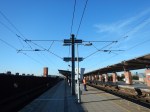
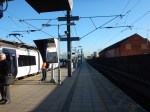
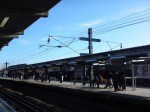
So it would appear, that the following pictures showing the overhead electrification, which dates from around 1999.
Almost uniquely for the UK rail network, the masts are in the mid-point of the two lines, with the wires cantilevered on either side.
Flimsy they are not! They have certainly been designed to survive a direct impact from a runaway Class 66 locomotive pulling several hundred tonnes of imported Chinese steel.
But as I said, the central masts probably date from 1999, so I suspect if similar structures were to be used in the electrification of the Gospel Oak to Barking Line, they would be designed to look better and probably be stronger and lighter too! I used to know a lot about using structural steel, and remember an expert telling me, that lighter structures are sometimes actually stronger.
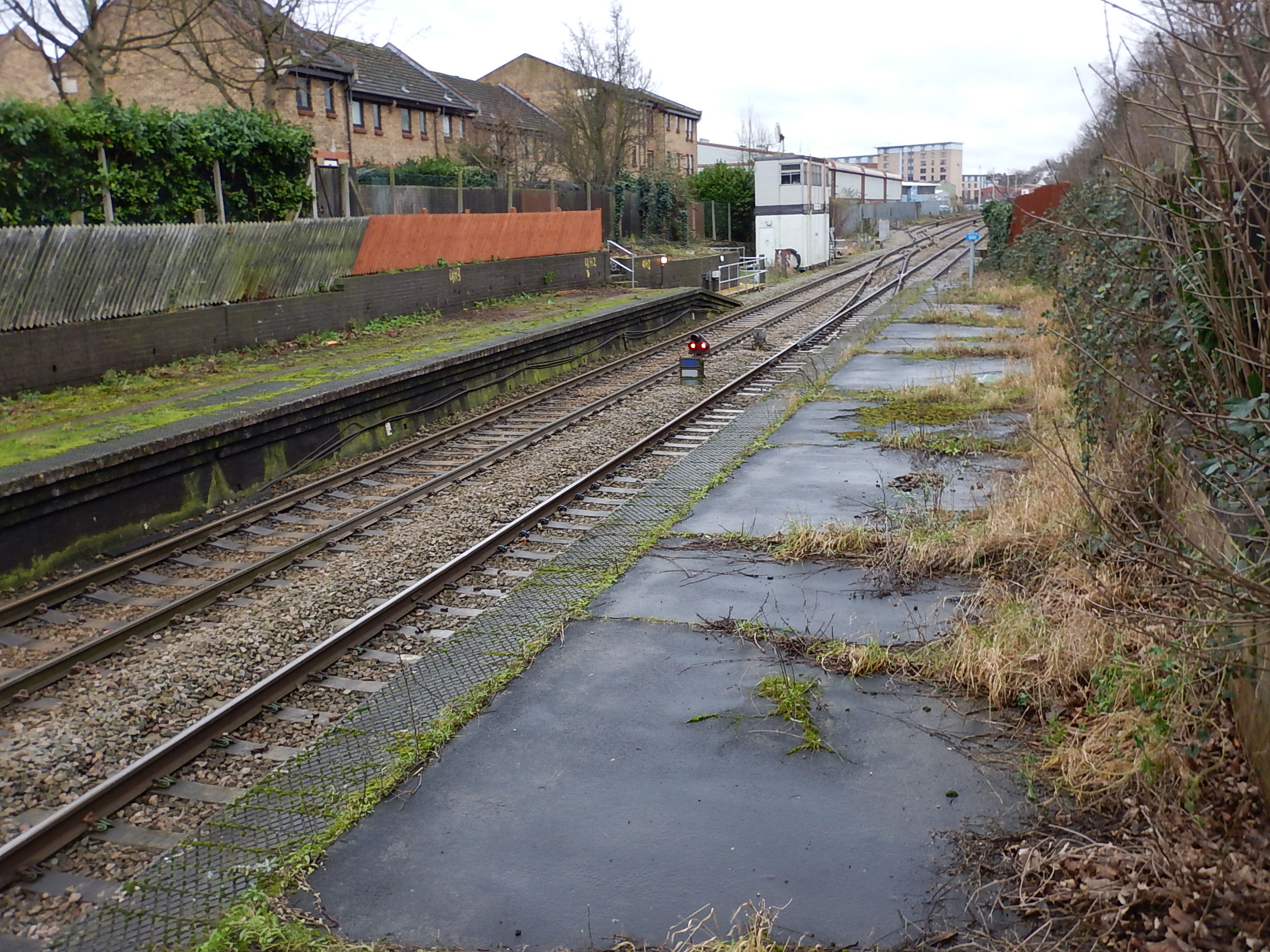
Look at this picture from Upper Holloway station.
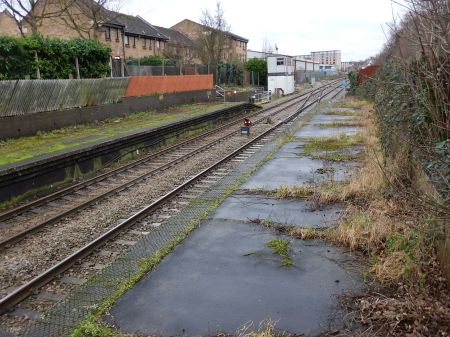
Looking West At Upper Holloway Station
It would appear that Murphys have piled around the crossing by the signal box to put a traditional portal frame across the railway to support the overhead wires. Some fifty metres behind me is a bridge that is being rebuilt over the railway.
So could the wires be installed through the station, by supporting them on the frame by the signal box, the bridge and several central masts, designed to fit between the tracks in the station area.
After seeing what was done in 1999 at West Ham station, I believe that an expert structural engineer could design a central mast to support electrification in the challenging conditions of Upper Holloway station and all the other difficult locations on the Gospel Oak to Barking Line.
There are advantages to this method.
- All of the platforms are untouched by electrification works.
- The number of piles to be driven at the side of the railway is reduced. This type of piling has caused problems in the past.
- Piles are positioned in the firm track-bed between the rails.
- Some piles will be positioned on viaducts. I suspect, that as the viaducts of the line seem sound, this would not be a very difficult problem.
- All work can probably be done by using a crane on the railway.
It does seem to me, that central masts could make the electrification easier.
January 28, 2016
Posted by AnonW |
Transport/Travel | Electrification, Engineering, Gospel Oak And Barking Line |
1 Comment
I took this sequence of pictures from a c2c train as it crossed Mile End Park on its way between Fenchurch Street and West Ham stations.
The hill covers the ventilation and access shaft in the Park for Crossrail.
This architect’s impression shows how the completed shaft will look.

Mile End Park Vent Shaft
Note the railway, from where I took the pictures in the background.
It’s certainly a less intrusive design, than the monstrosities used for the Channel Tunnel Rail Link, with architecture from the Napoleonic Wars.
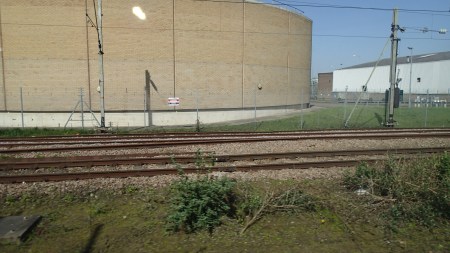
A Typical Channel Tunnel Vent Shaft
There are five of these across East London. Crossrail makes do with less than that!
I certainly feel that all those people worried about a Crossrail 2 ventilation shaft in their area, should go and have a look in Mile End Park.
January 28, 2016
Posted by AnonW |
Transport/Travel | Architecture, Crossrail, Mile End Park Ventilation Shaft |
Leave a comment



 The Anonymous Widower