Central Masts At West Ham Station
West Ham station has been upgraded over the last couple of decades. Wikipedia says this.
In 1999 platforms were re-established on the line from Fenchurch Street, now operated by c2c.
So it would appear, that the following pictures showing the overhead electrification, which dates from around 1999.
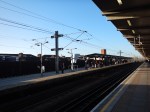
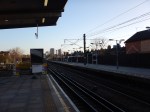
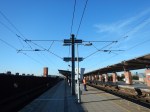
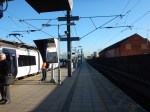
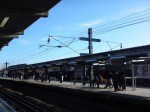
Almost uniquely for the UK rail network, the masts are in the mid-point of the two lines, with the wires cantilevered on either side.
Flimsy they are not! They have certainly been designed to survive a direct impact from a runaway Class 66 locomotive pulling several hundred tonnes of imported Chinese steel.
But as I said, the central masts probably date from 1999, so I suspect if similar structures were to be used in the electrification of the Gospel Oak to Barking Line, they would be designed to look better and probably be stronger and lighter too! I used to know a lot about using structural steel, and remember an expert telling me, that lighter structures are sometimes actually stronger.
Look at this picture from Upper Holloway station.
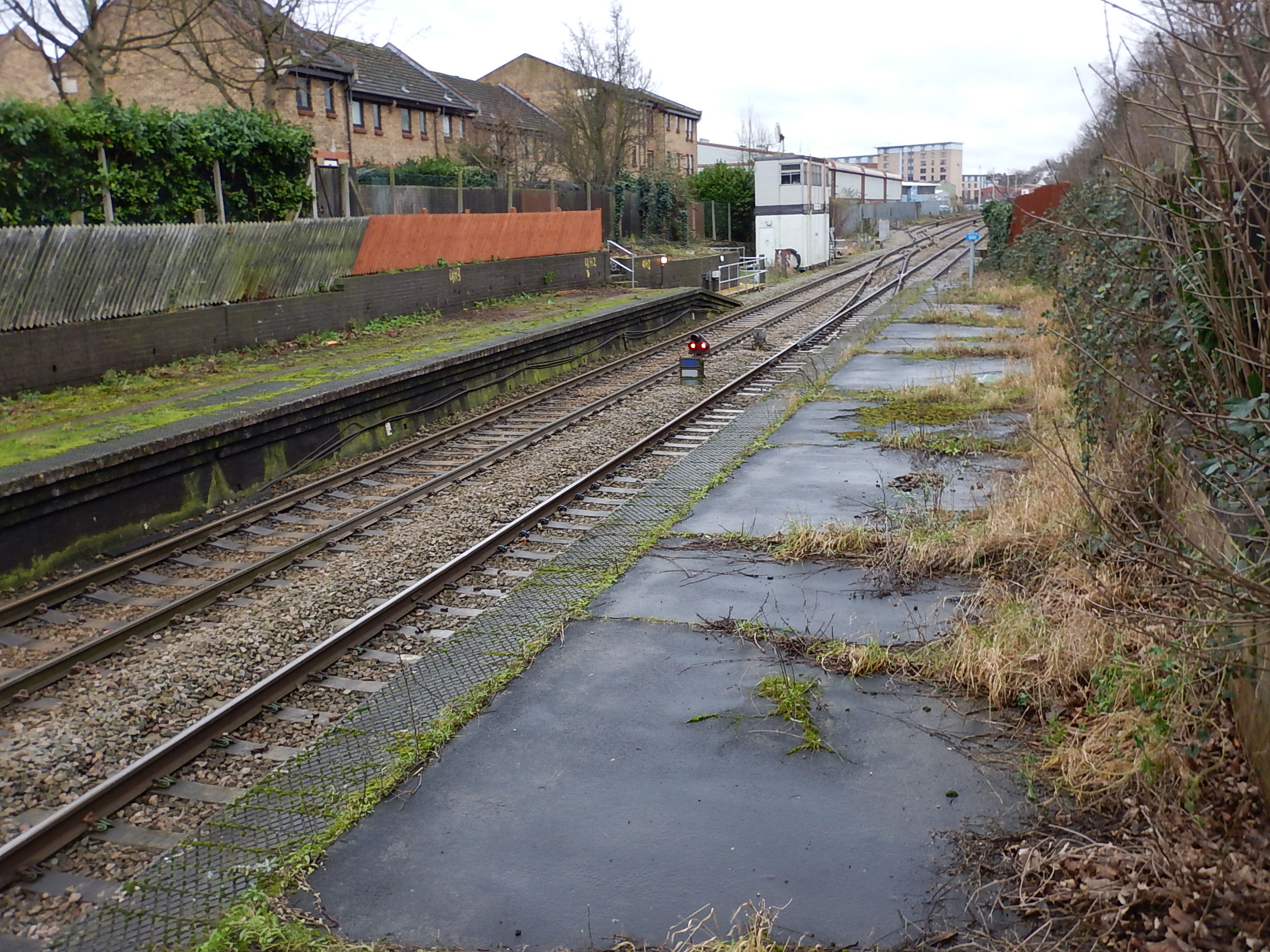
Looking West At Upper Holloway Station
It would appear that Murphys have piled around the crossing by the signal box to put a traditional portal frame across the railway to support the overhead wires. Some fifty metres behind me is a bridge that is being rebuilt over the railway.
So could the wires be installed through the station, by supporting them on the frame by the signal box, the bridge and several central masts, designed to fit between the tracks in the station area.
After seeing what was done in 1999 at West Ham station, I believe that an expert structural engineer could design a central mast to support electrification in the challenging conditions of Upper Holloway station and all the other difficult locations on the Gospel Oak to Barking Line.
There are advantages to this method.
- All of the platforms are untouched by electrification works.
- The number of piles to be driven at the side of the railway is reduced. This type of piling has caused problems in the past.
- Piles are positioned in the firm track-bed between the rails.
- Some piles will be positioned on viaducts. I suspect, that as the viaducts of the line seem sound, this would not be a very difficult problem.
- All work can probably be done by using a crane on the railway.
It does seem to me, that central masts could make the electrification easier.
 The Anonymous Widower
[…] They seem to be using T-shaped overhead gantries as they did at West Ham and I wrote about in Central Masts At West Ham. […]
Pingback by Electrifying Didcot Parkway « The Anonymous Widower | March 25, 2016 |