Could Class 387 Trains Do Norwich In Ninety And Ipswich In Sixty?
In Are More Class 387 Trains On The Way?, I postulated that Bombardier may have the capability to build more Class 387 trains, and that they could be used on services between Liverpool Street, Ipswich and Norwich.
Currently, the route is worked by Class 90 locomotives pulling and pushing eight Mark 3 coaches, with the help of a driving van trailer.
There are several problems and possible problems with the current trains.
- The Class 90s are approaching thirty years old.
- The Class 90s have had maintenance issues in the past.
- The Class 90s don’t have regenerative braking.
- The sewage discharge from the toilets in the Mark 3 coaches, doesn’t meet the latest regulations.
- The doors on the Mark 3 coaches, don’t meet the latest regulations or the expectation of passengers.
- The doors must lengthen stops at stations. I wonder what is the difference between these trains and say a Class 390 train!
- Entrance and exit from the Mark 3 coaches is not step-free.
- Ride in the Mark 3 coaches is good, but the quality of the seating and number of tables in standard class, leaves a lot to be desired.
- Wi-fi is not to the standard passengers expect these days.
- Effectively you get eight coaches of passengers in a train the length of ten cars, that is running on a line with 12-car platforms.
- The trains can’t serve Great Yarmouth.
Refurbishment is being applied to the train sets, but will that be good enough?
Updating the line’s, sixteen rakes of eight carriages would be a totally different matter to Chiltern’s creation of their superb sets of six carriages.
- Would fixing the doors and the toilets on a hundred and thirty carriages be economic?
- Is there the capacity to do the rebuild?
- Fifteen trains are probably needed to run the service, so how long would it take to upgrade sixteen trains one after the other?
- New carriages from the only source I know; CAF would mean waiting a few years.
In addition, this is said under proposed developments of the Great Eastern Main Line in Wikipedia.
In November 2013 an upgrade of the GEML to enable London-Norwich express services to achieve an improved journey time of 90 minutes was announced, this indicated that a raised line speed of 110 mph would be required and the replacement of the existing Mark 3 rolling stock with new inter-city rolling stock.
So it looks like Norwich in Ninrty isn’t on with the current trains. Could this be the reason, why the specification for the new franchise specifies just two fast trains per day in each direction?
The East Anglian Express
The starting point for this would be three Gatwick Express-style Class 387 trains working as a 12-car unit.
- Twelve cars would be able to run on the line’s long platforms.
- The Gatwick-style interior, without the extra luggage capacity, would be a good starting point for what is needed.
- It would certainly be able to maintain 110 mph for large parts of the route from London to Norwich.
- An IPEMU version would be available.
- Delivery could be as early as 2018.
What would be the issues raised by replacing the current trains with twelve-car Class 387 trains?
Capacity
Capacity is a problem on the services between London and Norwich.
It is a problem, despite passengers being squeezed in tightly.
At present the current trains have eight carriages, but Class 387 trains on Gatwick Express regularly run with twelve carriages.
I think that we can assume that, twelve-car electric multiple units are possible from London to Norwich, perhaps after some platform lengthening.
I can’t find any reliable figures on the Internet as to capacity, so I’ll have to resort to riding on the trains and counting seats.
Certainly, the Class 387 trains have more tables.
Acceleration
I don’t know if the acceleration of the Class 387 trains or the current trains is better.
But the Class 387 train has a power of 2,250 HP or 750 HP per carriage, whereas the current train has an installed power of just 1,250 HP or 156 HP per carriage.
I know it’s a bit of a comparison between apples and oranges, but it would appear that the Class 387 train has more power per carriage and might accelerate faster.
Braking
It may surprise some people, but if you want a train to run fast over a route with stops, you need efficient and high quality braking systems. The Class 387 train has the latest regenerative braking, whereas the current train has technology from thirty years ago.
As the Class 360 trains, that share the line to Ipswich have regenerative braking, I suspect that some parts of the line is built to accept returned energy, but is all of it?
With Class 387 trains, there is always the option to make them IPEMUs, so that braking energy is stored on the train and used to give extra acceleration on pulling away from the station.
Line Speed
Obviously, the faster the line speed, the quicker the journey time. At present it is 100 mph and the current trains are 110 mph capable as are the Class 387 trains.
So it looks like a bigger increase in performance can come by giving as much of the track as possible a 110 mph line speed.
Remember too, that between Haughley Junction and Norwich, the only significant feature of the line is the stop at Diss, so I would suspect it would almost be 110 mph all the way. As you’re looking for savings of thirty minutes or so between London and Norwich, I wonder if this section of line could be even faster.
Stops
Several factors determine the speed of calling at a station in a train.
- How fast the train can brake from line speed and stop in the station.
- How long it takes the passengers to get off and on the train.
- Good design of the train-platform interface, with wide doors, large lobbies and just a step across all helping.
- How fast the train can accelerate back up to line speed.
- Well-trained staff.
There are obviously other factors like waiting for other trains to connect or clear signals, but these will effect all trains.
Because of their better design, faster acceleration and regenerative braking, I think that the Class 387 trains will save something at every stop over the current trains.
I also think we’ll see stops reduced to an absolute minimum on the fastest trains, which might only stop at Ipswich and Colchester.
Interaction With Stopping Trains
I will make an assumption that London to Norwich trains will never run more frequently than four trains per hour. As it is currently two trains per hour, I think that is a reasonable assumption.
From Liverpool Street to Shenfield, there will be occasional trains stopping at perhaps, Stratford, Ilford and Romford, but with a fifteen minute window between fast expresses, I suspect everything could be fitted in, especially as local trains and passengers will use the frequent Crossrail.
Shenfield to Colchester is the difficult bit, as there are trains to Colchester Town, Clacton, Frinton and Walton to accommodate on the double-track main line.
North of Colchester it gets easier, with the only section with serious levels of traffic being the stretch between Ipswich and Haughley Junction, where freight trains to and from Felixstowe run along the double-track main line.
One way of easing the problem would be to make as many trains as possible on the line capable of running at line speed. The thirteen-year-old Class 360 trains are only capable of 100 mph.
Perhaps the expensive part of Norwich in Ninety is replacing the Class 360 trains with more Class 387 trains or some other 110 mph train?
The Digital Railway
Network Rail’s Digital Railway must surely help in running trains at up to 110 mph on some of the busier parts of the line.
Crossrail
Crossrail is going to have effects on the Great Eastern Main Line.
- Crossrail will mean that between Liverpool Street and Shenfield, a lot fewer trains will stop on the fast lines.
- Would it be possible to have 110 mph running between Liverpool Street and Shenfield?
- Journeys like Diss to Goodmayes and Ipswich to Ilford should be quicker and easier.
- If Norwich services stop at Shenfield and/or Stratford, how many passengers will transfer to Crossrail?
But we will have to wait until Crossrail opens to see how it changes travel patterns.
Stopping At Shenfield
One consequence of swifter stops is that an extra stop at Shenfield might be possible. This would connect to Crossrail, Southend and Southend Airport.
If you stop at Shenfield, there might be less need to stop at Stratford.
But passenger statistics will decide what is best.
Buffet Car
The current service has a buffet car. The Henry Blofelds of this world like to enjoy their train travel, so something better than a trolley service must be provided.
But that is a design issue, not one to do with the actual trains!
If the trains were fixed twelve-car formations, First Class might be in cars 1-3, with a buffet/shop in car 4. Car 1 would be the London end of the train.
Extra Services
There are several services in East Anglia, that could benefit from the intreoduction of new modern electric trains of at least four-cars.
- London to Norwich via Cambridge, Cambridge North and Ely.
- London to Great Yarmouth via Norwich.
- Ipswich to Cambridge and Peterborough
All routes are electrified and would be possible with a Class 387 train with an IPEMU capability.
Delivery And Introduction Into Service
If we assume that the two Norwich in Ninety and Ipswich in Sixty are to start as soon as possible, then it will be a challenging condition to meet.
Suppose, that delivery of just one twelve-car train is possible at an early date, how could it be used?
Currently, the first three trains out of Norwich leave at 05:00, 05:30 and 06:00 taking a few minutes under two hours to Liverpool Street.
Let’s suppose that after running into London in ninety minutes non-stop or with just a stop at Ipswich, it arrives back in Norwich perhaps three hours and twenty minutes later.
The train that left at 05:00 could now form the 08:30 to London and do the trip in ninety minutes, provided it could thread its way through the traffic between Colchester and Shenfield.
Obviously, the 05:30 and 06:00 trains could form the 09:00 and 09:30 trains to London respectively.
But Norwich has got two ninety minute high-capacity East Anglian Express services to London with the delivery of just one 12-car train.
Obviously, in the evening the reverse would happen.
In fact, they might get more than two Norwich in Ninety services, as I doubt the train would sit around all day in a siding. If the pattern of a Norwich in Ninety service every three and a half hours through the day, there would be at least five services possible.
Two new trains would mean that say all on the hour departures from Norwich were Norwich in Ninety, with the existing stock performing as now on the half hour.
Alternative Strategies
As only one train is needed to meet the franchise requirement, are there alternative trains that could be used? The train would need.
- 110 mph or greater top speed.
- Preferably electric power, as diesel-powered would be a backward step.
- At least eight carriages.
- A quality interior.
I don’t think a second-hand train would be good enough, as East Anglia has had enough of hand-me-downs!
The only suitable train, that the new East Anglian Franchise could obtain, would be a twelve-car Class 379 train, which is a close relation of the Class 387 train.
- The Class 379 trains are in service with Abellio Greater Anglia on Stanstead Express and Cambridge services.
- They are only a 100 mph train, but probably could be uprated to 110 mph.
But that would ask the question of what would fill in on the West Anglia Main Line.
The Final Solution
I feel that by using every trick in the book, that a suitable train can be found, that could do Norwich in Ninety and Ipswich in Sixty at least twice a day.
I suspect it would only need one train to meet the franchise requirement.
But two trains a day from Norwich in Ninety and Ipswich in Sixty will not satisfy the passengers for long.
Given that all the 100 mph Class 360 and Class 321 trains on the line, slow everything down, I can see these trains being updated or replaced with 110 mph units.
In addition to the services I mentioned under Extra Services, there are several lines that could benefit from trains fitted with IPEMU technology.
Could we be seeing a large order for Aventra trains or something similar soon after the franchise is awarded. Some trains would need a 125 mph capability for Norwich services and some would have an IPEMU capability for the lines without electrification.
Conclusions
I have come to the conclusion that Class 387 trains can probably do Norwich in Ninety and Ipswich in Sixty from London.
I think though to achieve this, the following must happen.
- Line speed is raised to 110 mph in all places possible.
- Bottlenecks like the Trowse Bridge are minimised.
- Stops will be cut to an absolute minimum on the fastest trains.
- The Class 360 and Class 321 trains must also be replaced with 110 mph trains.
- The Digital Railway will play its part.
I do think though that to get all London to Norwich trains to ninety minutes, that it might need a faster train with a speed of 125 mph on the line north of Haughley Junction, which would be upgraded for perhaps 120 mph.
But I don’t know how much good engineers can squeeze out of the current 100 mph line on the long straights North of Haughley.
Glasgow Central Station
Glasgow Central Station is one of the buildings by the architect; James Miller.

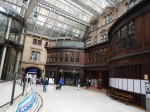

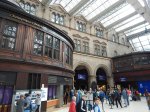
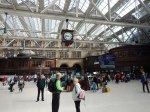
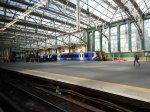
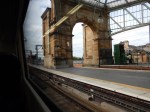
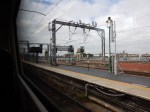
The station appears to be larger than Queen Street station, with more space and seats.
It could do with a few more tickets machines though.
St. Enoch Station
St. Enoch station is on the Glasgow Subway.
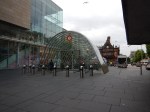
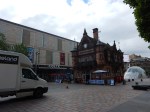
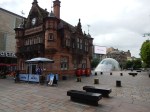
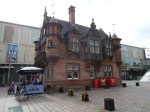
It is one of the buildings by the architect; James Miller
Glasgow Queen Street Station – 18th June 2016
I took these pictures of Glasgow Queen Street station.
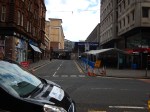
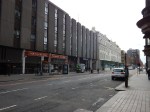
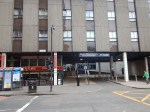
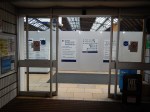
I suspect that when they have finished the station it will be rather different.
Are More Class 387 Trains On The Way?
In Sorting Out The Great Western Electrification, I said this, based on what I had read in the June 2016 Edition of Modern Railways, in an article entitled GWR To Order More ‘387s’.
So GWR have snapped up the other fourteen ordered by Porterbrook and supplemented this with an order for fifteen new build units.
This means they have got their required 29 trains to go with the eight they ordered some time ago.
Unfortunately, building more Class 387 trains, which would probably help the rolling stock shortage caused by the non-working Class 700 trains, especially as it appears Bombardier has spare capacity, is not on, as changes to crashworthiness regulations mean that these trains can’t be produced after September 2016.
So it’s probably very lucky, that the Great Western doesn’t have much working electrification.
In the July 2016 Edition of Modern Railways there is an article entitled GWR Confirms Order For More ‘387s’.
This confirms that GWR are taking Porterbrook’s fourteen trains and another twenty-three not fifteen trains.
Fleet Details in the Wikipedia entry for Class 387 trains confirms these numbers.
But the July 2016 article in Modern Railways also has this sentence.;
Previous concerns that the ‘387’ design could not be produced after September this year have proved to be unfounded, so Bombardier is not required to cease manufacturing the units after that time.
So does this mean we will be seeing more Class 387 trains coming off the production line at Derby?
Consider.
- Bombardier are building the new Aventras on a new production line at Derby.
- An airport version of the Class 387 train is available.
- The trains can run in four-, eight- and twelve-car formations.
- An IPEMU version of the train should be possible.
- How would the price on a Class 387 train compare to other trains of a similar capacity?
- Over fifty trains are in service on both lines with overhead or third-rail electrification.
- Many of the trains run under DOO rules.
So how could various operators use Class 387 trains.
GWR already have forty-five Class 387 trains on order for suburban services out of Paddington.
- If Bombardier get IPEMU technology to work, there are several places around the GWR network, where it might be possible to be used.
- GWR are thinking of obtaining more AT300 trains for Oxford services, but if wires could be erected or the IPEMU version could be used on battery power from Didcot, Class 387 trains could handle the route. Surely, more Class 387 trains would be preferable, as this would give a one-class suburban fleet.
- An airport version of a Class 387 train fitted with an IPEMU capability could handle the Reading to Gatwick route.
- The Marlow Branch and other routes away from the main line, could be handled by a Class 387 train with an IPEMU capability.
- Are there any other services in Wales and the West for which Class 387 trains would be ideal, once electrification gets to Bristol, Cardiff and Swansea.
c2c are an operator of seventy-four Class 357 trains, which are Electrostars like the Class 387s.
- c2c are taking six Class 387 trains before placing an order for sixty-eight new carriages to be delivered in 2019.
The new East Anglia Franchise will be awarded this month and requires a lot of changes to the rolling stock. Some are urgent.
- Three Class 387 trains running as a twelve-car unit with a high-class interior would probably be faster, more comfortable and spacious with an increased capacity compared to the ageing Class 90 locomotives and rakes of Mark 3 coaches. Would the Class 90/Mk 3 trains, be able to do Norwich in 90?
- Class 387 trains with an IPEMU capability could work various routes around East Anglia connecting Cambridge, Colchester, Ely, Great Yarmouth, Ipswich, Lowestoft, Norwich and Peterborough.
- There are several branch lines in East Anglia without electrification,which could be worked by Class 387 trains with an IPEMU capability.
- The Class 379 fleet working to Cambridge and Stansted Airport, may need expansion, due to the opening of Cambridge North station.
- According to Wikipedia, the invitation to tender for the france include this ” extra points will be awarded to bidders who include plans to trial new technologies in rolling stock”
Although some of the uses of Class 387 trains could obviously be filled by Aventras and other trains, as there is little development involved to build more Class 387 trains, I wouldn’t be surprised if more of these trains were built.
After all, if you are the CEO of a train operating company, currently running Electrostars, at speeds of up to 110 mph and you are offered the latest Class 387 train to your specification, with a sensible delivery date and at a price that is affordable, you must seriously consider signing the order.
You also have the example of the Class 387/2 trains that were built to an airport specification for Gatwick Express.
I wouldn’t underestimate the involvement of Porterbrook-Rent-A-Train in all this. Some of the franchises will need more rolling stock, as soon as possible.
Learning To Love Stations Again
The title of this post is that of an article on the Rail Staff web site.
This is the introductory paragraph.
The Great British public are learning to love railway stations again, says Rob Naybour, one of the founding partners of architects Weston Williamson. While so many buildings, which have for generations served as the hubs of their communities, are being repurposed, railway stations have endured and are rediscovering their role in our towns and cities.
The article is well worth reading.
After The Pop-Up Shop, Here’s The Pop-Up Depot
We’re all very familiar these days with pop-up shops.
I found this article on the web entitled DB Cargo UK and CEMEX introduce ‘pop-up’ rail depot.
It may not be for the general public, but this is said.
DB Cargo UK and CEMEX have opened a ‘pop up’ rail depot to serve the growing North West construction market and reduce the number of HGVs transporting materials from the picturesque High Peak countryside.
The ‘pop-up’ depot was installed in weeks on land adjacent to the West Coast Mainline using a ready-made weighbridge and office.
The temporary site, based in Warrington, Cheshire, will handle around 125,000 tonnes of aggregates each year.
I think we’ll see the concept used more often to get those truck-loads of heavy construction materials off the roads and onto the railways.
 The Anonymous Widower