Is This French Punishment For Brexiters?
This article on the BBC web site is entitled Dover ferry port passengers hit by traffic chaos. This is said.
Holidaymakers have been hit by delays of up to 12 hours through Kent to get to the Port of Dover, with many being stuck in traffic overnight.
Port authorities said delays built up due to French border checkpoints being understaffed overnight during heightened security levels.
There’s always some problem with the French and the Channel every summer.
But this summer it appears to be worse!
Could it be that the French are showing Brexiters, that they control the border?
After all, we never seem to get a problem with the Belgians!
The strange thing last night, as I came in from Brussels on Eurostar, was that there was some form of overcrowding in the terminal at St. Pancras.
Are The Railways Of Saxony A Benefit Of Communism?
Saxony is a German State with a lot of railways. This page is a list from Wikipedia.
In the UK, after the Second World War, we needed to modernise our railways and what we did was rather patchy and haphazard.
It finally, led to a lot of costs to no great benefit.
- I can remember taking over five hours on a journey to Liverpool in the 1960s.
- I always in the 1960s and 1970s, used to look at a heavy rail train and say how inferior they were to what the London Underground offered.
- Electrification was very slow to come in. I can remember Trains Illustrated saying Felixstowe will be electrified soon in the 1960s.
- Schemes like the Picc-Vic Tunnel in Manchester never saw the light of day.
Finally, the Beeching Report put a can on it.
But in the former East Germany, there were no such cost pressures in a centralised communist economy, where maintaining employment was a priority.
One thing you notice in the are is lots of signal boxes, often with an associated level crossing. Do they need them?
Whereas we would shut railways enthusiastically to cut costs, the East Germans didn’t, as it was against their politics.
So a lot of railways got preserved, where other countries would have closed them!
Now you can see a lot of railway development, as like the UK, Germany is coming round to the view that railways are what people want and they’re good for the economy.
Vivarail D-Trains Are Being Sent To Coventry
In A Video About The Vivarail D-Train, I said this.
I am sceptical about the Vivarail D-Train, but I do admire companies and organisations that think out of the box.
So after this report on Global Rail News, which is entitled Recycled Tube trains to re-enter passenger service this year, I am beginning to think that the Vivarail D-Train or the Class 230 train, might prove that engineering is the science of the possible. This is said.
Vivarail’s D-Train has its first customer and will enter passenger service between Coventry and Nuneaton later this year.
A Class 230 prototype, which started life as a London Underground D-Stock unit, is to be leased by the West Midlands Combined Authority (WMCA) for London Midland for an initial 12-month period.
The three-car train will act as a demonstrator, gathering feedback from passengers to inform the production of future trains.
I suppose there’s no better way to shut up the critics of a vehicle or transport system, than allow them to ride in it!
I don’t believe that the straight-talking inhabitants of the West Midlands will hold their tongue, if the train has shortcomings.
Could Beckenham Junction To Birkbeck Be Run On The Zwickau Model?
Look at this map from carto.metro.free.fr, which shows the lines to the west of Beckenham Junction station.
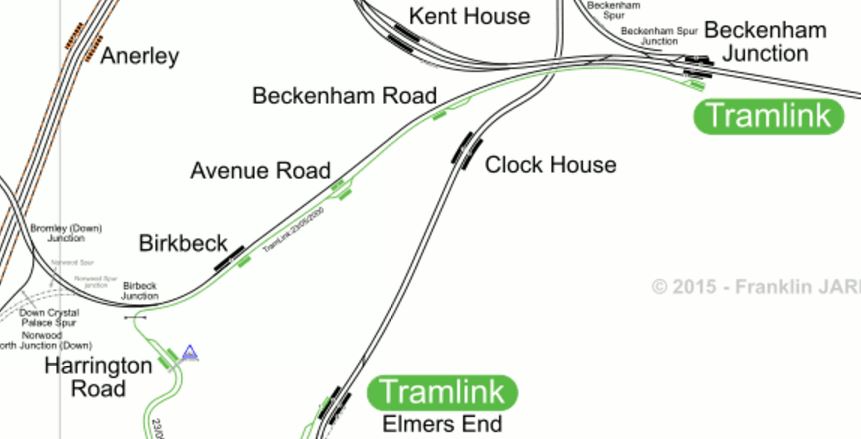
Lines To The West Of Beckhenham Junction Station
At Beckenham Junction station, there are the following platforms.
- Two through platforms.
- Two Westward-facing bay platforms for trains.
- Two Westward-facing bay platforms for the Tramlink.
But the real problem of operation of the section of line through Beckenham Junction station is that, both the main line and tram line to Birkbeck station are bi-directional, which must limit capacity.
Running Under The Zwickau Model
After what I saw at Zwickau and wrote about in Riding The Vogtlandbahn, I feel that a similar solution could be applied to this section of line.
The following would be done.
- The current Tramlink line would be for all Westbound trams and trains.
- The current heavy rail line would be for all Eastbound trams and trains.
- Both lines would have no third rail electrification and would be electrified for trams only.
- All trams using the line would be identical to now.
- All trains using the line would need to have onboard energy storage. I suspect some Class 377 trains could be modified to work the required services.
- All platforms would need to be adjusted to give step-free access to the two type of vehicles.
- There would need to be adjustment to the crossings and tram electrification at Beckenham Junction.
The whole plan is very similar to that carried out and working successfully between Zwickau Hbf and Zwickau Zentrum, except that the Germans have the problems of different tram and train gauges and use diesel multiple units.
The Current Services
The typical off-peak service frequency is:
- 4tph (trains per hour) to London Victoria (Southeastern)
- 2tph to London Bridge via Crystal Palace (Southern)
- 4tph to Orpington (Southeastern)
The Orpington to Victoria trains would be unaffected, as they don’t use the changed section of line.
The London Bridge to Beckenham Junction stations would need to be operated by an IPEMU or a train with onboard energy storage, as they’d need the power between Beckenham Junction and Birkbeck stations.
The tram services would be generally unaffected, although they would need to cross over from the Eastbound line into Beckenham Junction, as trains do now.
Advantages
I can’t believe that creating a double-track railway, that can be used by both the current trams and say Class 377 trains with an IPEMU capability, doesn’t have advantages.
The passing loops on the tram line would not be needed, as Eastbound and Westbound trams would be on different lines.
The double-tracking should reduce train delays.
It would allow the tram frequency to Beckenham Junction to be increased., which might enable a whole lot of possibilities.
I do feel though that the biggest advantages might be enabled, if Birkbeck, Avenue Road and Beckenham Road became single island platforms between the tracks. This would enable.
- Same platform interchange.
- Train passengers going East could change to a tram going West and vice-versa.
- A single lift could be installed at Birkbeck, Avenue Road and Beckenham Road stations for step-free access.
 The Anonymous Widower