Agrivoltaics Deal To Bring 9,000 Sheep To 1GW Solar Park
The title of this post, is the same as that of this article on Solar Power Portal.
When I saw the title, I felt I just had to call it out.
A 1GW Solar Park
Normally, a 50-100 MW solar farm is considered large for the UK, so a 1 GW solar farm must be truly enormous, by any standards.
According to the heading of the Great North Road Solar and Biodiversity Park web site, which says this.
Elements Green is developing proposals for a new solar and energy storage park located to the northwest of Newark-on-Trent, Nottinghamshire.
With a potential generation capacity of around 800 megawatts (MW) AC of solar energy, the scheme has the potential to provide enough clean, affordable energy to meet the power needs of approximately 400,000 homes while avoiding more than 250,000 tonnes of CO₂ emissions every year.
The size appears to be around 800 MW.
But that is still large!
The Project Area
This article on the BBC is entitled Survey Suggests Opposition To Major Solar Farm, has this as a caption to the first picture.
The solar project is made up of around 1.5 million panels covering 7,000 acres.
That is around eleven square miles or a 3.3 mile square.
A Map Of The Project
This map of the project was clipped from the Elements Green web site.
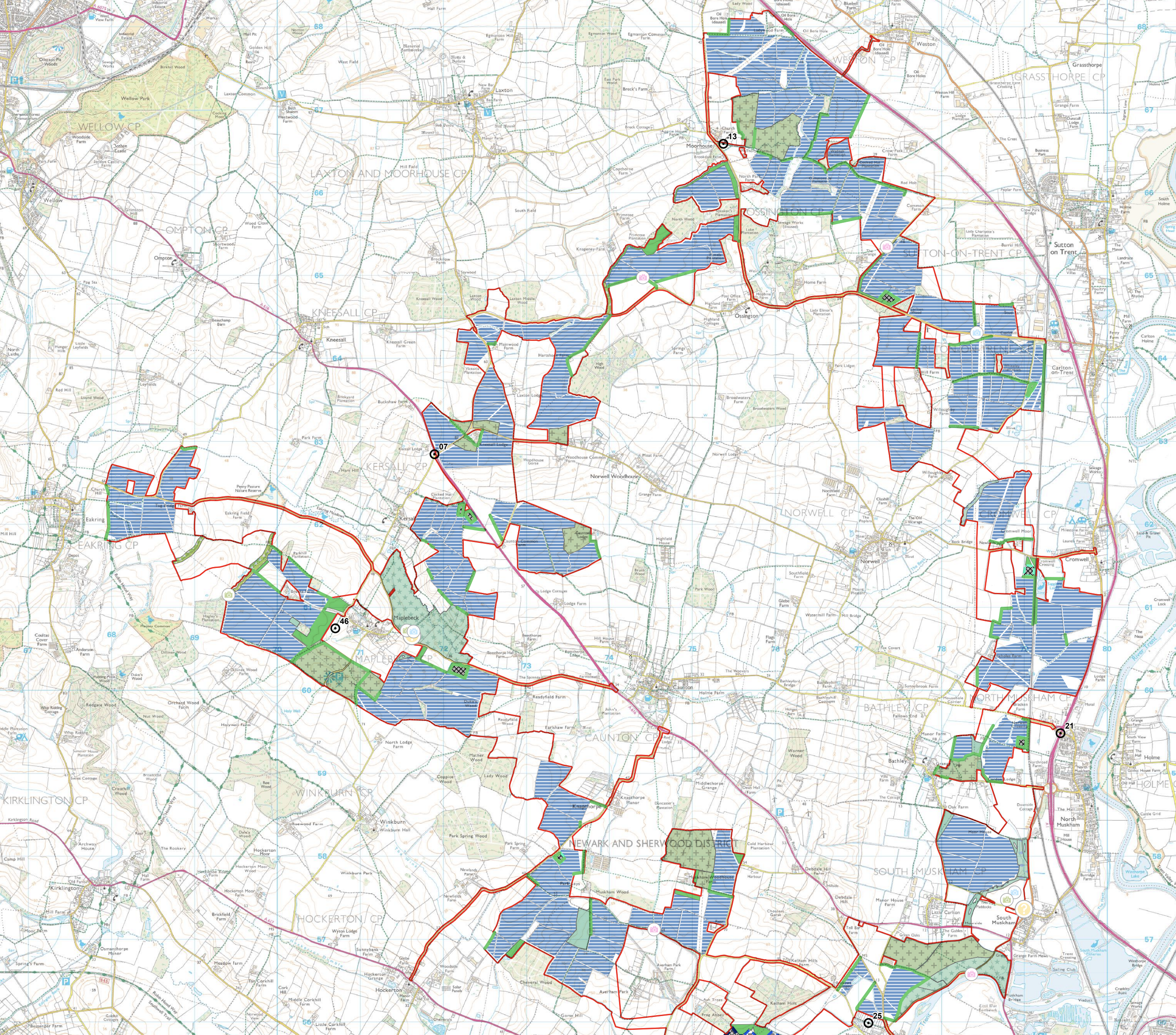
Note.
- The blue areas are solar panels.
- The red line at the right hand side is the A1 Great North Road.
- There is a lot of space for more solar panels.
It could be even bigger than 1 GW.
There Is Opposition To The Wind Farm
This article on the BBC is entitled Survey Suggests Opposition To Major Solar Farm.
This is the sub-heading,
A consultation about a major solar farm in Nottinghamshire has shown the scale of the opposition it faces to being built.
These two paragraphs detail the scale of the opposition.
The consultation, held in January and February, found 54% of respondents opposed the scheme, with 16% supporting the current plan.
Among the main reasons people gave for opposing the scheme were its visual and ecological impact.
The reasons for opposition are typical.
These two paragraphs describe the actions of the developer.
Having received the backing in principle of several key nature charities and trusts, the Great North Road Solar Park project will be renamed ‘Great North Road Solar and Biodiversity Park’, with a new logo to reflect this.
Communities who were consulted on the original proposals in early 2024 expressed a strong desire to protect and enhance their natural environment. Acting upon this feedback, developer Elements Green has formed partnerships with the RSPB, Sherwood Forest Trust, Nottinghamshire Wildlife Trust, and The Trent Rivers Trust, to ensure that nature benefits from their ambitious project.
I suspect that some of the opposition groups have labelled the last paragraph as green-washing.
Nine Thousand Sheep!
Usually, when large numbers of sheep are mentioned on the Internet, it’s usually something a bit coarse.
But in this project, it’s only letting sheep, do what they do well ; act as green lawnmowers, have lambs and provide meat and wool to increase the bottom line.
Where Is The Connection To The Grid?
The FAQs section of the Great North Road Solar and Biodiversity Park web site has this question.
Why has Elements Green chosen this location for the solar park?
This answer is given.
A key factor influencing the location of GNR Solar and Biodiversity Park is the availability of a connection at National Grid’s Staythorpe substation. The closure of fossil fuel power stations has created capacity on the grid. This would enable GNR Solar and Biodiversity Park to continue the tradition of power generation in the area using a clean, renewable resource.
In addition, a range of planning and environmental factors such as the existing land use, quality of land, as well as designations and planning and technical constraints have also informed our choice of location for the scheme.
So if you’re near the site of a disused coal- or gas-fired power station, don’t expect it to be developed as agricultural land, woodland or housing.
The Wikipedia entry for Staythorpe power station, reveals there is a 1,850 MW gas-fired power station on the site.
The Great North Road Solar and Biodiversity Park would appear to have a very able gas-fired back-up,
No Battery Or Energy Storage Is Mentioned
In an idealised day, there is a period of light and a period of darkness.
A battery would allow any excess electricity generated in the day to be used at night.
Google searches reveal energy storage could be fitted.
One of Highview Power’s environmentally-friendly 200 MW/3.25 GWh liquid-air batteries could be a starting point for a one GW solar or wind farm.
Could A Wind Farm Be Added To The Solar Farm?
In An Excursion To Retford And Worksop, I noticed a large hybrid solar and wind farm alongside the railway.
As the Great North Road Solar and Biodiversity Park uses a lot of land, would some be available for a sprinkling of wind turbines?
Conclusion
Looking at the map, you can understand some peoples’s enthusiasm for large solar farms and large onshore wind farms, as they can be so easily connected to the infrastructure of a decommissioned coal- or gas-fired power station.
 The Anonymous Widower
Using what very much appears to be prime agricultural land for solar farms seems very short sighted. Which do people need more food or electricity?
Infamously in the 19th C The then Duke of Sutherland evicted thousands of crofters (on very marginal land inthe northern wilds of Scotland) and replaced them with sheep.
Whilst sheep are very adaptable and will graze anything that grows in between the panels, their yields on lowland arable land is poor, which is why you don’t normally see them there.
Comment by Mark Clayton | December 27, 2024 |
A friend of mine, who used to judge Suffolk sheep all over the world, would probably agree with you, but he might feel, that a sheep to feed in wind farms could be developed.
Comment by AnonW | December 27, 2024 |
Blackface would probably do. Given they don’t wnat trees growing and obscuring their panels, perhaps goats, or as seen in this area deer.
Comment by Mark Clayton | December 27, 2024
Hares certainly do well in solar panels.
https://solarenergyuk.org/news/solar-farms-can-be-wildlife-havens/
Hares have been traditionally been encouraged on airports, as they like the warm grass around the runway lights.
Heathrow used to have hundreds.
Comment by AnonW | December 27, 2024 |
I like the way these developers tells us it can power 400,000 homes not at night it can’t when you going to need the lights on!! It needs to be mandatory on all solar now to fit at least a 4hr battery equivalent to rated output. The other reason being we are getting to levels of solar penetration that will force off even more generation during the day but it will still be needed at night. This is going to cost us as CCGTs dont like being cycled too rapidly so their owners are going to want paying to sit there idle. If we had batt storage then at least the evening peak could be covered and the more efficient machines kept for overnight.
Separately Im content with solar on poor land and guess grazing sheep comes into that category as they dont need same quality of grass that cows do but surely the amount of grass produced will be reduced and its quality impaired if the light isn’t getting to it?
Comment by Nicholas Lewis | December 28, 2024 |
Perhaps we should graze hares?
Comment by AnonW | December 28, 2024 |