Smart Bank Managing
When David was Metier’s bank manager, he did not put us in the bank’s database as a software company, but as a computer leasing company, as we leased the hardware and software as a package. He once told me, this was because those that be in the bank considered computer software to be decidedly high risk, but computer leasing, which was generally huge mainframes to FTSE 500 companies was a low one. He didn’t point out to those-that-thought they-knew-better, that some of the bank’s biggest losses had been in computer leasing. But then David had trust in his customers and knew those that would deliver. We did!
When David once asked me what was the difference between hardware and software, I told him, that the former hurts when you drop it on your foot and the latter doesn’t.
What Do You Do If Your Bank Is Taken Over?
Now that the Co-operative Bank is going to take over 632 branches from Lloyds TSB as is reported here, the question is what do you do?
If I apply my late friend David’s rules, there isn’t too many problems.
The Co-Operative Bank is owned by its members and domiciled in the UK.
The Co-Operative Bank is now probably of a size not to worry David, about the bank ending up being controlled by a forcefull and misdirected individual.
I’m not sure where they do their processing, but are they immune from an RBS/NatWorst problem?
On the other hand, just as some people feel that too many banks are close to the Tories, some might not like the fact that the Co-Operative Bank could be too close to the Labour party.
In fact that last point might make lots of customers go elsewhere, if they were to be transferred without asking their view. It’s like ordering a new Ford and getting a Vauxhall delivered.
And that is the heart of the matter. Can your bank account be transferred from one bank to another without your approval?
It strikes me, that this could be another part of banking, with rich pickings for lawyers.
But let’s face it most banks are the same to the general public. All they do is pay bills from on-line accounts. I bank with Nationwide, and I haven’t been into the bank for a banking purpose since probably November last year and that was to pay in a cheque for a few pounds. I do go into their branches sometimes to use a cash machine, as they often have comfortable chairs, where I can sit down to organise where I put my money.
Now here’s an idea!
Let’s put cash machines into coffee shops like Starbucks or Costa. Abbey National did have some Costa branches in their foyers, but then along came Santander and stopped it.
It would be interesting to see where I get my money out of cash machines. I’ve used these a couple of times in the last few weeks.
- Barclays by the bus stop at Islington Green, where I sometimes get off the bus.
- Nationwide next to Starbucks in Upper Street.
- Lloyds by the bus stop at the Angel, where I get the bus to come home.
- One of the machines in the subway at Kings Cross station.
So no real pattern there except that all these machines are of course free! I would never use me a cash machine that charges me for the privilege of accessing my own money.
Verified By Visa Revisited
I have moaned about this crap before.
I have been fighting it for a couple of hours and in the end I managed to buy two extra Olympic tickets. Can the reason that so many people find buying these tickets difficult is you must use a Visa card and you can’t fight your way through this awful system?
I have just written to my credit card company, saying that after the Olympics, they can put their Visa card in a place where it will hurt.
Today I was adding a new password all the time and then when I tried it the next it was rejected, so I had to start again. Surely entering a new password every time you use the card is the most insecure way to use a credit card on line.
It might well be that the US version of this system works because everybody uses the last four digits of their Social Security Number. In the UK no-one knows theirs and anyway it ends in a letter. So perhaps the problem is that the system has not been properly rewritten for the UK.
Anyway it’s crap!
NatWorst Try Traditional Marketing
This form of advertising is popular with pubs. But banks!
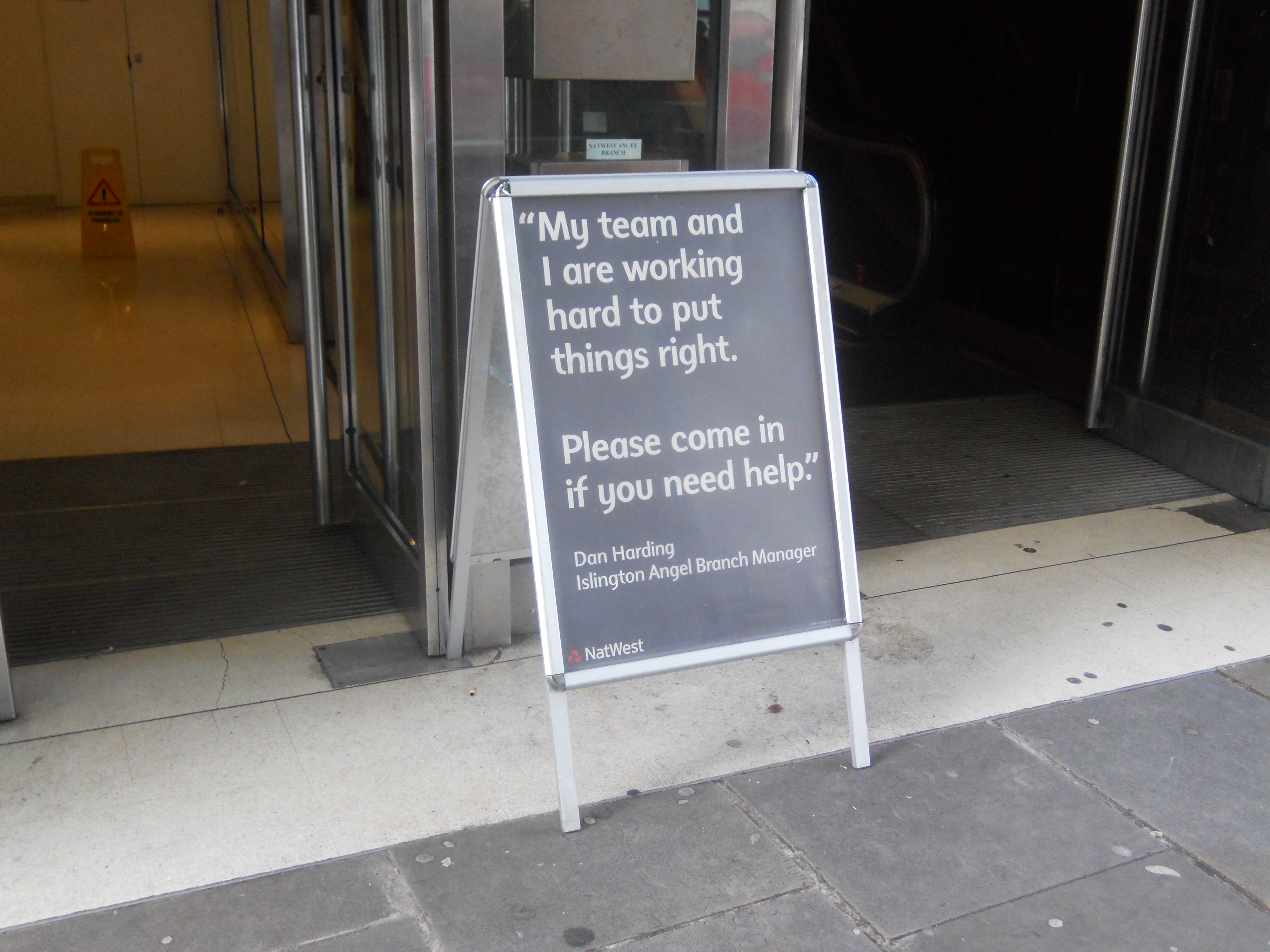
NatWorst Try Traditional Marketing
However, the message gets across. Is the problem with banks, that now customers are just numbers on the computer?
What’s Parking?
They’re discussing parking on BBC Breakfast this morning.
Two years ago, I had a stroke, which left me unable to drive. So I sold my car, moved to London and now if I want to go anywhere I just walk round the corner and get a bus, for which I never wait more than two minutes. This is because I live on a high capacity route.
The effect on my bank account has been dramatic and totally positive. A great game is to watch the idiots trying to part in my road.
Do I miss driving? No! Not at all!
What I Need From A Bank
I’ll start by listing, what I use my bank, Nationwide for.
- I use it to hold my working money.
- I use it to collect any payments from my pension or people like Zopa.
- I use it to pay all my standing orders, direct debits and other bills I pay directly.
- I use their cash machine network to get the cash I need.
- I have one of my credit cards from them, as I like to have both a Visa and a Mastercard, as some people only accept one card.
On the other hand.
- I don’t borrow money from them, except for my emergency agreed overdraft, if I get receipts and payments out of sync.
- I rarely write cheques.
- I don’t need a branch, except to pay in the odd cheque.
If banks dropped cheques, it would make a traditional bank unnecessary to me, as I could then do everything on-line.
So I would envisage in a few years time having a bank that did the few things I needed on-line and didn’t charge me for it!
Will it happen? Not if the banks have any say!
Not All Zopa Bad Debts Stay Bad
My bad debts in Zopa have been eighteen accounts owing a total of £458.35 since the eighth of June. They did reduce by the princely sum of five pence a couple of weeks ago, but yesterday, I got a surprise payment of £32,24 to reduce the number of bad debts to seventeen.
Banking Crisis
This is the title of a letter in The Times today.
A retired bank employee talks about trying to find a model for applying charges to current accounts that would be acceptable to customers. After all, free banking costs banks a lot of money.
He didn’t find one!
So he concludes without the contribution of investment banking to banks profits, which would happen if we split the banks into two, we will all have to pay for our banking.
With my use of banks, as just a means to pay bills and get cash, no-one would want me!
And I think, I’d be in a large majority.
Good Riddance!
I’ve just had a message through the ether from my late friend, David. He says, that he is pleased that Bob Diamond has resigned. Most of the other things he said were a touch garbled and until I get the proper message, I’ll not put any more of his thoughts.
I do know, that bankers of David’s era, will be happy with the splitting of retail and investment banking. After all the first is just computer processing on the back of decisions made by talking to your customers and the second is just gambling.
Incidentally, thinking about Zopa, it may not be a bank, but it is computer processing on the back of decisions made by talking to customers, with a bit of help from computerised credit scoring.
Her Majesty’s Daily Telegraph Supports Zopa
It’s all in this article here. What will Disgusted of Tunbridge Wells say, as he’s been with NatWorst since he qualified as a solicitor? The article says this about saving and borrowing.
While competition in the current account sector remains stifled, there has been innovation in the savings and loans market, much of it spearheaded by new technology. Zopa, and other peer-to-peer lenders, are prime examples. This company, which launched in 2005, puts those who have money to lend in direct contact with people who need to borrow, effectively cutting out the banks altogether.
Although Zopa takes a fee for arranging this service, the fact that it doesn’t hold the money itself, so doesn’t need to build extensive reserves to cover bad debts, means the rates on offer are far more attractive to consumers. For example, over the past year lenders had earned around 5.5pc on their money, and this is after charges and defaults have been taken into account. Given that the average savings account pays less than 1pc, it is not hard to see why such sites have proved attractive. For those borrowing money, the interest rate is typically a fifth lower than with a high street bank, although most peer-to-peer sites do have strict lending criteria, which means that if you have been turned down by a high street bank you won’t necessarily be able to borrow money through one of these sites. These criteria mean that, to date, the default rate is just 0.5pc.
Zopa may be the biggest peer-to-peer lender by some margin (it has now arranged loans worth £212m) but it is facing competition from RateSetter (which also provides a “default fund” to help cover lenders’ losses) and Funding Circle, which arranges loans for small businesses.
I only think that the peer-to-peer lenders have one serious problem. And that is that politicians bring in banking legislation, that effectively stops peer-to-peer lending in its tracks. However the banks haven’t really shown any good reason why they should be protected from upstarts.
 The Anonymous Widower