Set Back As Badgers Undermine 11 km Of Railway
The title of this post, is the same as that of this article on Railway Gazette International.
These four paragraphs outline the problems.
Deutsche Bahn reports that burrowing badgers have undermined about 11 km of embankment on the Fröndenberg – Unna railway, and repairs are likely to be very expensive and take a long time as the damage is more extensive than expected.
In some places the repairs will be equivalent to new construction, and DB says the planning and approval phase alone could take several years as the route passes through protected environments. Local media reports that the financial viability of reopening is being questioned.
DB first discovered the damage in 2022, and initiated repairs using a concrete spraying process. It also began to examine the rest of the route and 140 sett entrances have now been discovered, leading to an extensive tunnel system which is believed to have a total length of around 1 500 m spread over the entire length of the embankment.
The line runs through a nature reserve, so investigations had to be suspended over the summer until a special permit was obtained. Trees and bushes also needed to be cut back. Regional train service RB54 remains suspended between Unna and Fröndenberg and replaced by buses, extending journey times by 7 min.
Note.
- The railway appears to be only single-track from Google Maps.
- Unna station is the Easternmost station of the Rhine-Ruhr S-Bahn.
- The RB 54 – Hönnetal-Bahn runs between Fröndenberg and Unna.
I wouldn’t be surprised that this serious problem will be resolved by either closing the railway permanently or by using an expensive rebuild.
How Network Rail Deal With Badgers
I did find this document on the Network Rail web site, which appears to be part of a Safety Course.
There is this page on the Network Rail web site, which is entitled Badgers Sett To Keep Their Homes As Railway Works Around.
Unfortunately for the Germans, they seem to have whole armies of badgers, whereas we seem to have just a couple of families in the second document.
It does look like in the video in the second example, that a certain amopunt of psychology is used to persuade the badgers to do, what Network Rail wants them to do.
Sheep And The M62
When I was at Liverpool University in the 1960s, the Veterinary Department had a contract to design fencing to keep the hardy Pennine sheep off the motorway.
They found that the sheep had little difficulty climbing over a six foot high wire mesh fence.
Perhaps DB should ask Liverpool, if they have any tips!
Removing Fence Posts
I have always been an inveterate inventor. At school some of my poorly drawn efforts actually won prizes.
On the stud, we had a lot of what is known as Keepsafe fencing. Unfortunately, the idiots who put the fencing in used poor quality posts that were always rotting. So I developed a device for getting the post out of the ground without too much hard work. I’ve never been a great one for hard phyical work, although the mental stuff is a bit different. Luckily I’ve usually been able to earn enough money to afford to get a man in. Perhaps that’s the Jewish side of my mind, as one of my friends always tells me!
What follows is copy of a post from the stud blog, which shows C using the device to remove a fence by the side of the house. I’m posting it, as one of the photos is one of my favourite ones of my late wife as it sums her up so well.
We had a fence by the side of the house that needed to be removed. The fence was typical post and rail, with the posts buried half a metre into the ground. Luckily they were not embedded into concrete.
At this time, the tool was a few months old and the use had developed so thatyou could use with a high lift jack to remove fence posts without any great fuss or danger. Health and Safety fanatics please note!
As an aside here, just try the normal method of wrapping a chain round the post and then using a tractor to pull the post. This method makes a lot of mess and is very dangerous if the chain breaks.
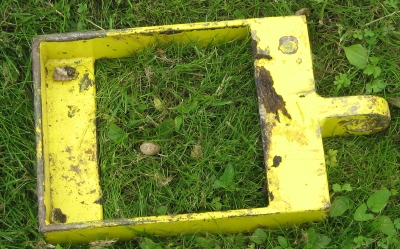
Fence Post Removal Tool
You start by just dropping the tool over the post, making sure that when it is lifted, it will bite into the post.
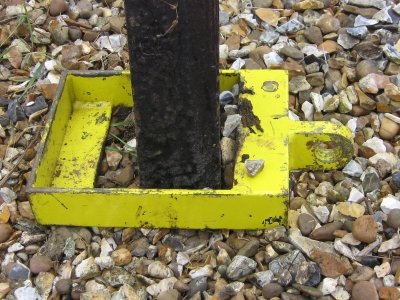
Positioning the Tool
Note that there are no moving parts in the tool and it doesn’t need to be adjusted.
Note too, that the post in this example is in pretty good condition. If the post has broken off at the ground as they often do, then all you need to do is dig a perhaps ten centimetres into the ground so that the tool can grip the good part of the post.
The tool is linked to the jack using a shackle with a breaking strain of about a tonne and a half.
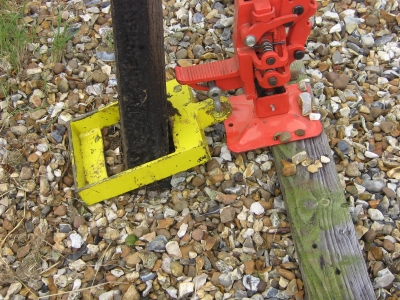
Attaching the Jack
Note that the high lift jack is stood on a fence rail to equalise the ground pressure.
The jack is now lifted to pull the post out of the ground.
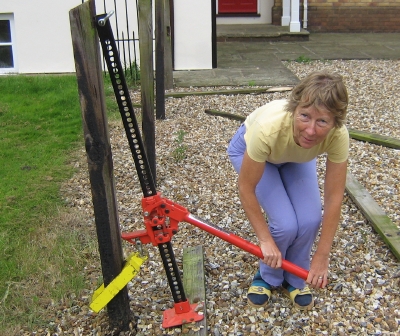
Lifting the Post
This pull took about a minute and the post came quickly out of the ground. Note C’s ever present Scholl sandals. How Health and Safety!
C did most of the pulling for these posts as it’s actually quicker if someone else (me) holds the post vertically. This just shows how powerful the jack/puller combination is. Even a wimp can pull well over three tonnes!
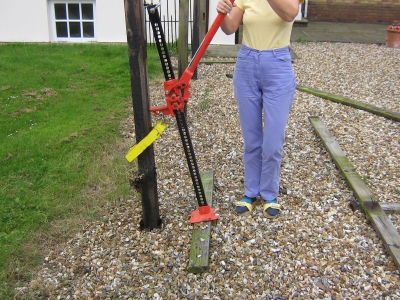
Virtually Done
Note that little damage is done to the ground and in many cases a new post could be driven firmly into the old hole.
The jack can also be used to lift the heavy gate off its hinges.
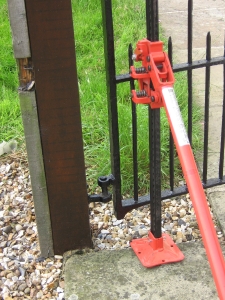
Lifting a Gate
This picture shows how easy it is to pull a post in a restricted space.
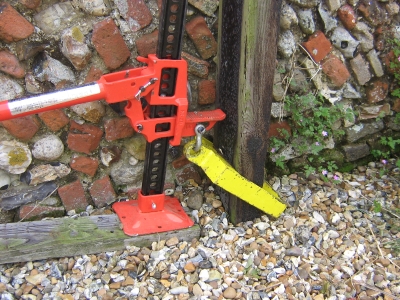
Pulling in a Restricted Space
The wall wasn’t damaged or even touched.
In the end five fence posts and one gate post were pulled in about half an hour.
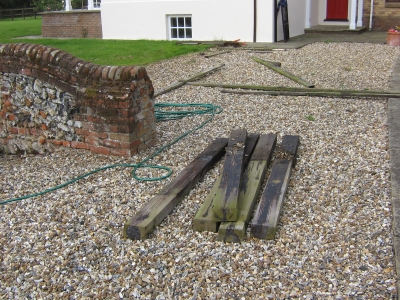
A Job Well Done
I will be taking the tool to London, not that I will have any use for it, but surprisingly, the old page gets a few hits and I’m always being asked for drawings or a tool.
So I’m going to publish the drawings on this blog, so that if you want to create one, you can do it. There will only be two conditions.
You must say thank you, if you like what you create.
And as C died of cancer of the heart just a few months after these pictures were taken, with our youngest dying of pancreatic cancer just a few months ago, the next time that a cancer charity tries to tap you for a few pounds, dollars, euros, yen or whatever, then contribute, especially if it is to do with pancreatic cancer research.
I don’t mind if you don’t contribute, because if you don’t, I suspect the Devil who has been haunting me these last few years, might have found another victim and might leave me alone!
The basic drawing is shown and don’t complain about the quality, as it is rather poorly drawn.

Fence Post Removal Tool
Perhaps one day, I’ll get a proper drawing done. There are also some notes to the forge who made the original.
- I haven’t put any dimensions on the side pieces as I will assume that you will use something close to 5 cm. L-section steel. One is upo one way and one the other to give a cutting and leverage effect.
- The endplates can be either flat or L-section. Whichever is easier and/or stronger.
- The only dimensions are that there must be 14 cm. between the ends and the width must be sufficient to allow a post of just under 18 cm. to be lifted.
- The attachment point on the front will have to be pretty strong as the jack can pull up to 3.5 tonnes.
Happy lifting!
 The Anonymous Widower