Transport for London’s Two Iconic Brands
I have a Google Alert for the word Overground to pick up any stories about Transport for London’s newest railway system the Overground. The link is to the official site and on a straight Google search, it is number one in the list.
It’s only rarely that the Google Alert picks up a news item, that is not about the Overground.
So how does the Underground fare in Google searches. As with the Overground, the official site for the Underground is first in the search list. On the first page, there are only a couple of pages that are nothing to do with the London Underground.
Even the word Tube typed by itself into Google, produces virtually a complete page of information about the Underground.
I suspect that London’s two iconic brands; Underground and Overground, together with their nickname Tube have one of the best worldwide recognitions.
Frank Pick, who led London Transport in the early days and oversaw the creation of the original corporate branding, will be laughing through history.
Who would have thought that a man from Spalding, who qualified as a solicitor, would have become one of the people with the greatest influence on the look of today’s London? Only Christopher Wren and Joseph Bazalgette come close.
God Said All London Buses Must Be Red
London’s buses have always been red in my memory and according to this piece, which is a response to the question of why London’s buses are red, they’ve been predominately red since the creation of the London Passenger Transport Board in 1933. Although buses from the London General Omnibus Company had started using the colour in 1907.
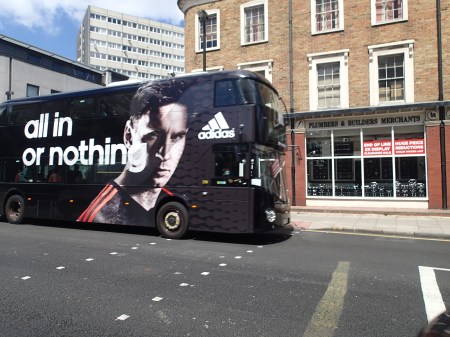
Today though I saw my first New Routemaster in a full black advertising livery.
God Said All London Buses Must Be Red
I don’t think the bus suited the livery.
By the way, God or in London Transport’s case; Frank Pick, wouldn’t have liked this bus either, as it would grate with the overall philosophy he laid down for London’s transport system.
Has anybody else ever imposed their design philosophy on a city, as Frank Pick did for London to such a positive effect?
I wonder what he’d have thought of London’s New Routemaster.
One thing he would have liked was the process where Thomas Heatherwick was involved in the design of the bus. Pick in his years as London’s transport supremo, regularly hired the best architects and designers.
He was also prepared to back those, whose designs were unconventional, like Harry Beck‘s tube map, which has evolved to be one of the most recognisable maps in the world.
Green Lanes Ventilation Station
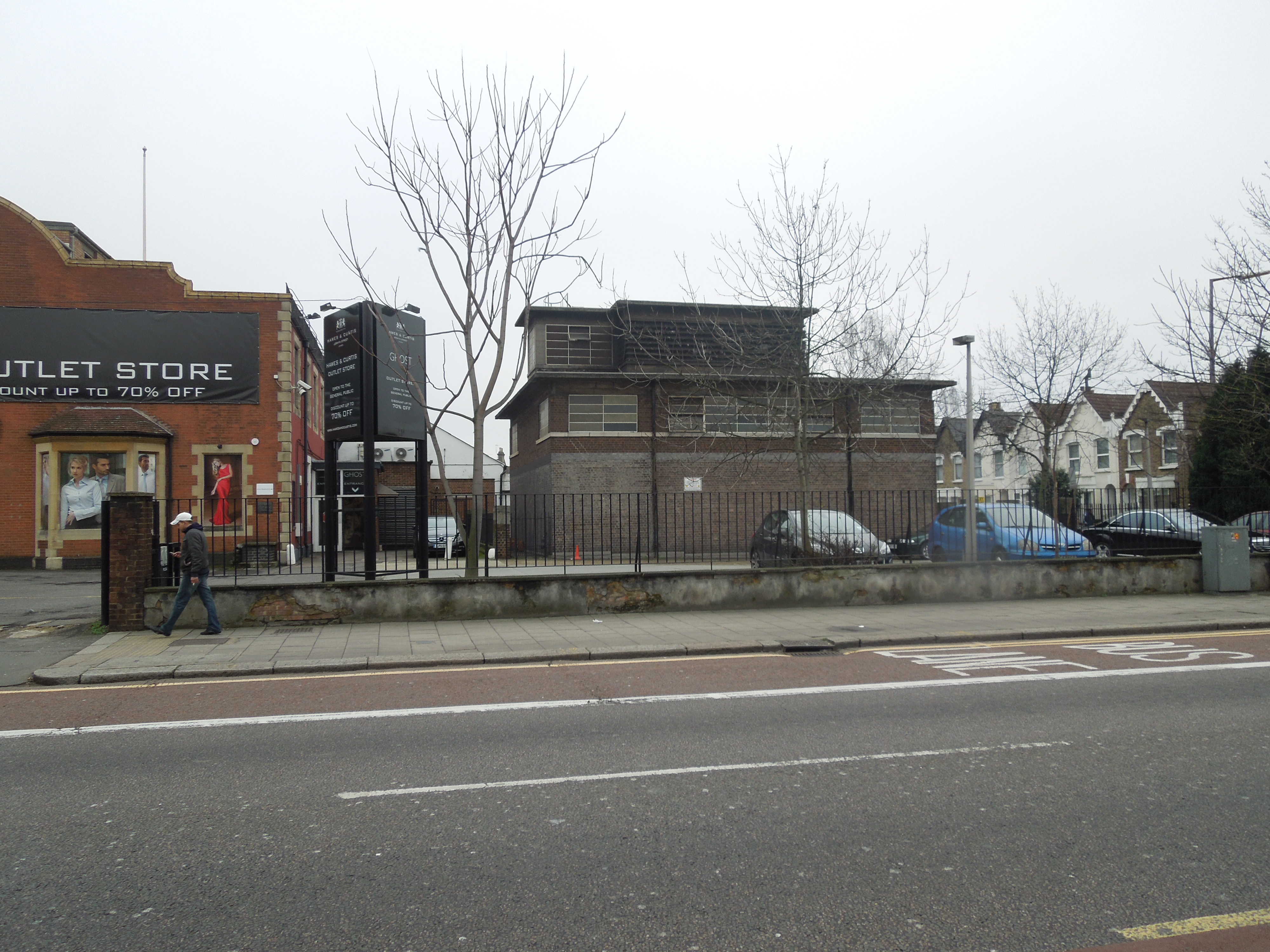
The picture shows the ventilation station on the Piccadilly line between Manor House and Turnpike Lane stations.
Green Lanes Ventilation Station
Note that it actually looks like a station, although its purpose is only ventilation. According to Wikipedia, it was intended to be a station.
It was also planned to build a station between Manor House and Turnpike Lane at the junction of Green Lanes and St Ann’s Road in Harringay, but this was stopped by Frank Pick, who felt that the bus and tram service at this point was adequate. However, a ‘Ventilation station’, in similar architectural style to tube stations of the time was provided at the site, and is visible today.
But all we have today is the ventilation station!
Frank Pick’s assertion about the buses and trams probably doesn’t hold today, as although the 29s and 141s are fairly numerous, they can get crowded.
The gaps between stations is long too and there is a plan to move Manor House station to the Victoria line and build a new station underneath Harringay Green Lanes station. I doubt it will happen in the near future. If ever!
Should We Londonise All Buses?
I know I’m a Londoner and live in the finest city in Europe, let alone the UK or England, but in my travels around the country, I have come to the conclusion, that most bus services outside the capital are very second-rate.
To start with, I should say that in most places it isn’t mainly the buses themselves, as towns and cities like Leeds, Manchester, Bristol and several others have buses that on a quick look to be on average to be the same condition and age, as those in London.
But there are three major differences.
- Most London buses are front entrance and centre exit, which effectively means that they pick up and set down passengers a lot quicker. It also means in London’s case, that a wheelchair passenger has an easier route to get on and off, as he or she uses the middle door. Because of the smaller dwell time at stops, two door buses actually travel faster and carry more people more efficiently. Whether this means the capital cost per passenger journey is lower, I don’t know. But it may well be so!
- London buses also announce the next stop both visually and audibly. Many visitors to my house are very surprised, when I say something like take the 141 to Balls Pond Road and get off there. The system also announces route changes and can be used by the driver to send a selection of common messages to the passengers.
- But the biggest difference is that all London buses are touch on, either with an Oyster card or a concession like my Freedom Pass. If you have a paper ticket, you show it to the driver and they tell you to get on. There is no timewasting mucking about with paper tickets, that London obviously deems to be just litter.
- From next summer, you will be able to touch in on your bus journey with any credit card, as Oyster is being augmented for the Olympics.
But it is the field of information that London buses are streets ahead of every other bus system in the UK.
- As a child, you were always told, that every tube station had a street map of the local area. So if you got lost, just go to the Underground station. So now, like many Londoners, when you are going somewhere foreign like Croydon for a North Londoner or Wembley for a South Londoner, you never carry a map and rely on the map at the destination station. It usually works. Now this street map system has been extended to the buses and most bus stops have a local street map. Only last night, whilst walking back from the pub, I used a map on a stop to show a tourist from Germany, how to walk to the pub where he was meeting a friend.
- These street maps are paired with spider maps, which show all the routes in the area, where they go and at which stop you catch the bus. Frank Pick and Harry Beck would be proud of this idea from their successors. Spider maps work well and if I’m lost after a walk, I just find the nearest bus and work out how to get home. Incidentally, Transport for London call them bus route diagrams, but you can’t argue with umpteen million Londoners, who call them spider maps and that term is now the one generally used by all.
- London has recently introduced text messaging at stops to find out how long you have to wait for the next bus. Other cities have this and it should be the norm everywhere.
- Important London bus stops have displays showing how long you’ll have to wait for the next bus. But as people are starting to use the text system more and more, I suspect, the number of these displays will decrease.
- You can also see when buses will arrive at a stop either through the web or from a phone app. I don’t have a smartphone, but my dumb Nokia 6310i is perfectly capable of telling me if a 30 bus, which is my preferred route home, is due ten minutes out of Kings Cross or Euston.
So how do some of the places I’ve visited compare to London in various areas?
Two Door Buses
You see the odd ones about, but not many.
On-Bus Information Systems
I’ve never seen one, but I’m told Colchester has them.
Maps at Bus Stops
Very few and most that I’ve seen have been very inferior and totally useless for visitors.
Text Information
This is a typical London next bus information notice.

London Sign For Bus Information By Text Message
And here’s one from Leeds.

Leeds Sign For Bus Information By Text Message
No prizes for guessing, which is the simpler system.
Not only is London, just a five digit number but the sign is easily read and is as low as they can put it, so that everybody from say eight to eighty can read it with ease. I can’t believe that there are over 45 million bus stops in Yorkshire! The london sign has the great advantage that it is small and just strapped to the post. So perhaps it could even be used on a temporary bus stop at road works.
I’ll let Frank Pick have the last word on this.
The test of the goodness of a thing is its fitness for use. If it fails on this first test, no amount of ornamentation or finish will make it any better; it will only make it more expensive, more foolish.
And he was born before the age of modern technology. He would have had a field day, if he was still alive and in charge of transport for the whole of the UK.
So to answer my original question, the answer must be an undoubted yes! London has proven that good, frequent and understandable bus services attract more riders, so the sooner we Londonise all buses the better.
People will go on about cost, but the first thing to do is get the maps at stops in place and get sensible text messaging systems working. And then we just have to make all new buses to the London standard! Remember too, that London retires quite a few buses each year. Many of these with a bit of refurbishment would be very suitable for lighter use in the provinces. Certainly, many of the older ones in London are much better, than the disabled-unfriendly old banger, I got back to the centre from Elland Road.
I think too, that we will underestimate the benefits of having the same bus information systems all over the country.
As an example, how much of my time and effort have I wasted trying to find out where to catch a bus on my challenge? And how much money have I wasted on unnecessary taxis?
So if it made travel easier and cheaper, would it make it easier for people to travel to work in the next town or perhaps have a day with Aunt Edna in Felixstowe?
We need any economic stimuli however small.
Remember too, that if we need new buses, that these are generally built in the UK, so much of the capital cost of new buses stays here. So if that is the case, why did Red Ken betray British workers, by buying a load of useless bendy buses? Few liked them, except perhaps fare dodgers.
 The Anonymous Widower