The Glasgow Airport Rail Link Will Be A Tram-Train
This article on the BBC is entitled Plans for direct tram-train link between Glasgow Airport and city.
This is the three opening paragraphs.
Plans to create a “tram-train” link between Glasgow Airport and the city centre have been unveiled.
The £144m Glasgow Airport Access Project could see journey times cut to 16.5 minutes and would bypass the need to use the busy M8.
It would involve a specially-designed hybrid tram-train using the existing railway network and on-street tracks.
That sounds like a sensible plan.
What Is A Hybrid Tram-Train?
As I said in Were The New Merseyrail Trains Designed In A South London Pub?, I believe that Stadler have designed a rail vehicle, that can.
- Be equipped to run on any of the electrified rail lines in the UK.
- Run as a train on heavy rail lines such as that between Glasgow Central and Paisley St. James stations, where it would use 25 kVAC overhead electrification.
- Run as a tram on a dedicated tram track to the Airport, built without electrification, using onboard energy storage charged on the journey on the electrified line between Glasgow and Paisley.
- Provide step-free access by making sure that the trains fit the platforms, which would all be built to the same height.
I believe that the trains could be a version of those that Stadler are building for Merseyrail. After all, the Swiss company are already building special trains for the Glasgow Subway.
How Many Trains?
As it takes about sixteen minutes between Glasgow Central and Paisley St. James stations., one train would probably provide an hourly service.
But obviously, things do go wrong, so at least two trains would be needed, with one as a spare or in maintenance.
Two trains could provide two trains per hour (tph), with four trains needed to provide 4 tph.
Trains, Infrastructure And Costs
Merseyrail is paying £9million for each similar four-car train, which includes extras like maintenance.
The only differences would be.
- Glasgow’s trains would be 25 kVAC trains, whereas Merseyrail’s are 750 VDC third-rail trains.
- Interior fit and colour scheme.
Note that Stadler have said that the Merseyrail trains can have 25 KVAC equipment and batteries fitted.
I would buy five trains to provide a four tph service, with one as a spare or in maintenance.
This would leave around £100million for the only new infrastructure, which will be a rail spur to the airport from the West of Paisley St. James station station on the Inverclyde Line.
This spur could be built along the following lines.
- Single- or double-track.
- On-street or dedicated fenced off track.
- No electrification.
- Traditional signalling or in-cab.
- Simple stations like the tram stops in Birmingham, Croydon, Edinburgh or Nottingham.
- Step-free level access.
I think a single-track bi-directional track would work, but space should probably be left for double track, if it proves very popular.
It might be better to think of the rail spur as a long well-landscaped siding, which just happens to end within a few metres from an airport terminal.
I think that this link could be built inside the allocated budget of £144million.
Other Airport Links
Note that if this works for Glasgow, what about Bristol, Cardiff, East Midlands and Leeds/Bradford and Liverpool Airports?
Leeds/Bradford Airport
This article on the BBC is entitled Leeds Bradford Airport railway station one of three planned.
This is said.
The proposed new station about one mile (1.6km) from the airport would also act as a park and ride for commuters to Leeds and Harrogate.
I wonder if the trains at Leeds/Bradford Airport will go the last mile? It would need the Leeds-Harrogate Line to be electrified, but it would give the Airport the high-class rail link it needs.
Liverpool Airport
I believe that Merseyrail’s new trains, have the capability to serve Liverpool Airport in the same manner, in which the Glasgow Airport Rail Link could be built and operated.
There are more details here in Thoughts On Merseyrail’s New Trains.
Conclusion
Stadler will sell a lot of these trains to provide links into places like airports and town-centres.
An Innovative Scheme For A Rail Link To Glasgow Airport
This article on Renfrewshire 24 is entitled New Option Could See Glasgow Airport Rail Link Run From Relocated Glasgow St. James Station.
The new option, which is proposed by Junction 29 (Scotland) Ltd, would relocate Paisley St. James Street station nearer to the airport and it would be connected to the airport using a PRT system similar to that used at Terminal 5 at Heathrow.
This Google Map shows the area.
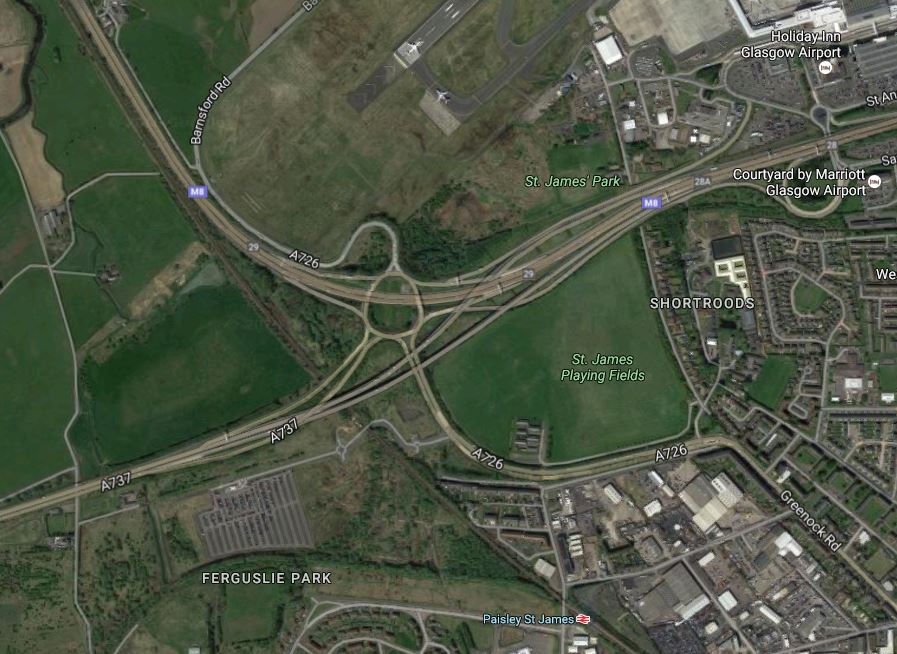
Note.
- Junction 29 of the M8 is the mass of spaghetti in the upper middle of the map, with the Inverclyde Line passing to the South-west of the junction.
- Paisley St. James station is towards the bottom of the map.
- Junction 29 (Scotland) Ltd. own the block of land to the West of the railway and the new station would be built in this area, where the PRT system would connect to the Airport.
I think it could be a feasible plan and these are my thoughts.
A Proven System
Wikipedia says this about the PRT System at Heathrow.
Construction of the guideway was completed in October 2008. The line is largely elevated, but includes a ground level section where the route passes under the approach to the airport’s northern runway. Following various trials, including some using airport staff as test passengers, the line opened to the public in May 2011 as a passenger trial. Subsequently it was made fully operational and the bus service between the business car park and Terminal 5 was discontinued. The pods use 50% less energy than a bus. They run 22 hours a day. Unlike all UK road and rail traffic, which drives on the left, the PRT system drives on the right. As of May 2013 the system passed the 600,000th passenger milestone.
The interesting thing, is that it runs under the runway approach, so it must have a fairly small footprint.
I actually think that using this system has other advantages.
- It could go on a roundabout route between the station and the Airport, serving car parks and other important places.
- It could serve the car parks, which are also proposed for the site.
- It could bring those with movement difficulties to the station for the Park-and-Ride to Paisley and Glasgow.
- It is very much a proven system.
- The tram-train alternative works in many places in the world, but the concept seems to cause Network Rail indegestion.
- The PRT System is independent of the railway.
But in my view the system’s biggest advantage is that it could have a serious wow factor for children of all ages.
Cost
The cost of the PRT option is quoted at £70-£80m, as opposed to £144m for the tram-train alternative.
Journey Times
Journey times to the airport will certainly be competitive, but I think the wow factor will encourage passengers to use it, whether they come by train or car to the station.
Why Would You Want To Close The Existing Station?
I would not close the existing Paisley St. James station for these reasons.
- It serves Paisley Town centre and St. Mirren Football Club.
- Closing it could be a hassle.
- Extra stations are never a bad thing.
- Modern trains stop and start again at a station very quickly.
- The new station could be called Glasgow Airport to avoid confusion.
But then there may be better reasons to close it.
Train Frequency
There needs to be at least four trains per hour (tph) to Paisley Gilmour Street and Glasgow.
If not more, as the frequency of the PRT system will annoy passengers waiting for the trains.
I also think that a turnback facility should be provided, so that a posh Airport shuttle train could work a 2 tph limited-stop service to Glasgow Central.
If Glasgow got its act together, the posh train could also serve Edinburgh.
Construction
It is stated in the Renfrewshire 24 article, that the new station and the PRT system could be built in twelve months alongside the existing network.
As all the land is owned by the Airport, Junction 29 and Network Rail, this must help, unless they find newts.
They could even lift a lot of the design of some of the other new stations like Kirkstall Forge.
Future Development
I’m sure Junction 29 (Scotland) Ltd. have got some good plans for the rest of their site.
Conclusion
Go for it! Glasgow has been procrastinating for far too long!
I think we’ll see a lot of systems like this around the world!
The system is described here in Wikipedia.
It’s British by the way and was developed in Cardiff and Bristol.
 The Anonymous Widower