Enfield Town Is Almost Ready For Boris
I went through Enfield and Enfield Town station this morning before nine thirty. I used my Freedom Pass, which of course I couldn’t have done before the Overground takeover.
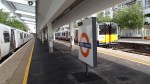
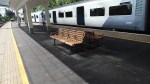

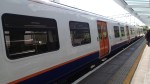
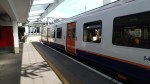
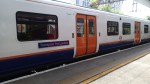

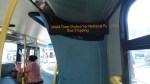
Apart from the 307 bus from Oakwood tube station, that I used to get to Enfield, which still thought National Rail was in charge, there didn’t seem to be too much to fault.
Green Scars Across East London
When the Lea Valley Lines were built across East London in the 1800s, they didn’t seem to box them in with houses, like they did elsewhere in the capital.
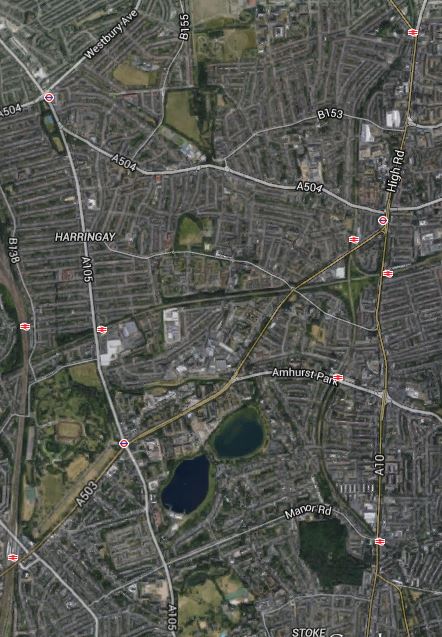
This Google Earth image shows several stations between Bruce Grove in the North, Harringay Green Lanes in the West and Stoke Newington in the South.
Green Scars Across East London
Note the green scars between the stations, where the lines often take up quite a small part of the available land. Look at this Google Earth image of the area between Seven Sisters station and South Tottenham station.

Seven Sisters
Surely, the development possibilities for this space, when linked to a new station are endless, even if you just develop a park.
7/10 For Day Zero For The New Overground Lines
You might ask how I can give the 7/10 for the new Overground lines, when the service hasn’t officially started.
But I didn’t see anything wrong and there was a lot of positivity from staff and passengers. Here’s a few things I noticed.
1. Freedom Passes
Transport for London obviously know their passenger model and the Freedom Pass holder I spoke to who said she would use the line from Enfield at all times of the day, must mean that TfL know they can accommodate the extra passengers, who will turn up early in the morning and in the rush hour to go home.
Perhaps, the small modal shift say from vehicular transport to trains, will actually free up the roads.
I’ll just let the data do the talking, when passenger numbers are published in a few months.
2. The Deep Clean At Enfield Town
It looks like they’ve deep cleaned Enfield Town station for the launch and if this is indicative of the standard we’ll see at the piles of bricks, that double as stations, they’ve inherited from Abellio Greater Anglia, then the good burghers of East London will be pleasantly surprised.
To be hard on London Overground, choosing Enfield Town station for the launch was a bit of a cheat, as the station is naturally step-free and it was built in 1957, as opposed to the 1840s for most of the stations.
It is certainly built and cleaned to a standard, that few if any, would complain about.
3. Staff
The staff seemed positive in a lot of ways, just as they do in a typical Overground or Underground station.
4. Trains
The trains, I travelled in today were clean and one lady thought that Abellio Greater Anglia could have done more to keep them clean.
If London Overground follow the cleaning procedures they use on the North and East London Lines, where litter is regularly collected throughout the day, the passengers will be pleased.
5.Future Overcrowding
From experiences with the current Overground, I can see a small problem. And that is overcrowding.
But whereas on the North and East London Lines providing more capacity is a problem, on the Lea Valley Lines, all platforms can take eight car trains, as they do in the rush hour and you can always couple two Class 315 trains or Class 317 trains together. And as Class 345 trains are delivered for Crossrail, more of these will come available.
6. Future Investment
London Overground have acquired these routes from Abellio Greater Anglia, with all the skill of an East End trader who sold car aerials in Ridley Road Market.
They have similar costs to Abellio Greater Anglia in terms of trains, track charges and stations, but they get more of the revenue, as they are a not-for-profit organisation and don’t have external owners.
So they get the benefit of all the investment they make, provided of course it is sound! But Transport for London have said they are going to put £25million into the Lea Valley Lines.
But it won’t be just Transport for London putting money into the Overground. The proposed new station at Hackney Wick has a variety of sources of funding and I think we’ll see other stations built by external developers, so that their houses, offices or industrial units are more desirable.
In this section in Wikipedia, it says that the current trains will be replaced by thirty-nine new trains in 2017. New trains always attract more passengers, but unlike the current Overground lines, adding more capacity will not involve any expensive platform lengthening.
7. Everybody Will Want Overground
The only serious long term problem, they have is that if the Lea Valley Line takeover is as successful as the current Overground, then there will be a clamour for other lines to be taken over, or at least run on the same lines.
I have a feeling that there are going to be some very unhappy train operating companies, who lose some quite lucrative routes in the next few years.
Transport for London Serves Up A Delicious Turkey
The local media is starting to pick up East London’s train revolution, if this article from This is Local London entitled Lower fares for overground stops that include Southbury and Turkey Street is anything to go by. I’m pleased to say that I spotted this one earlier.
It will be interesting to see if traffic goes up at stations like Southbury and Turkey Street.
I think the Overground takeover will define one of the battlefields for the next London Mayor in 2016. Who can prove they can offer most lines might come under TfL control, will gain an advantage at the ballot box.
Thank You Transport for London
On the 31st May 2015, Transport for London take over the lines out of Liverpool Street to Enfield Town, Cheshunt, Chingford and Shenfield and two days ago they published this press release on their web site, which is entitled Passengers set to benefit as key commuter rail services transfer to TfL.
So what does that mean?
1. The services currently operate with National Rail pay as you go fares, which are generally higher than TfL fares. When services transfer, over 80 per cent of current rail journeys will reduce in price and TfL concessions will apply – giving customers substantial savings. The remaining 20 per cent of fares will remain unchanged.
2. All TfL concessions and discounts that currently apply to London Underground, the Docklands Light Railway, and London Overground will apply on the rail services transferring to TfL. I think that means I can travel free to Brentwood and Shenfield using my Freedom Pass.
3. There are a few other technical things that seem beneficial, like Brentwood being moved into Zone 9.
4. I suspect too, that the level of customer service will be better under TfL than Abellio Greater Anglia.
I can’t see any average passengers complaining about this package. Except perhaps those who commute on lines like c2c into London, where there are no fare reductions.
So it’s probably a big thank you to Transport for London.
An Information Free Journey
This afternoon, I took an Abellio Greater Anglia train from Bruce Grove to Hackney Downs.
An Information Free Journey
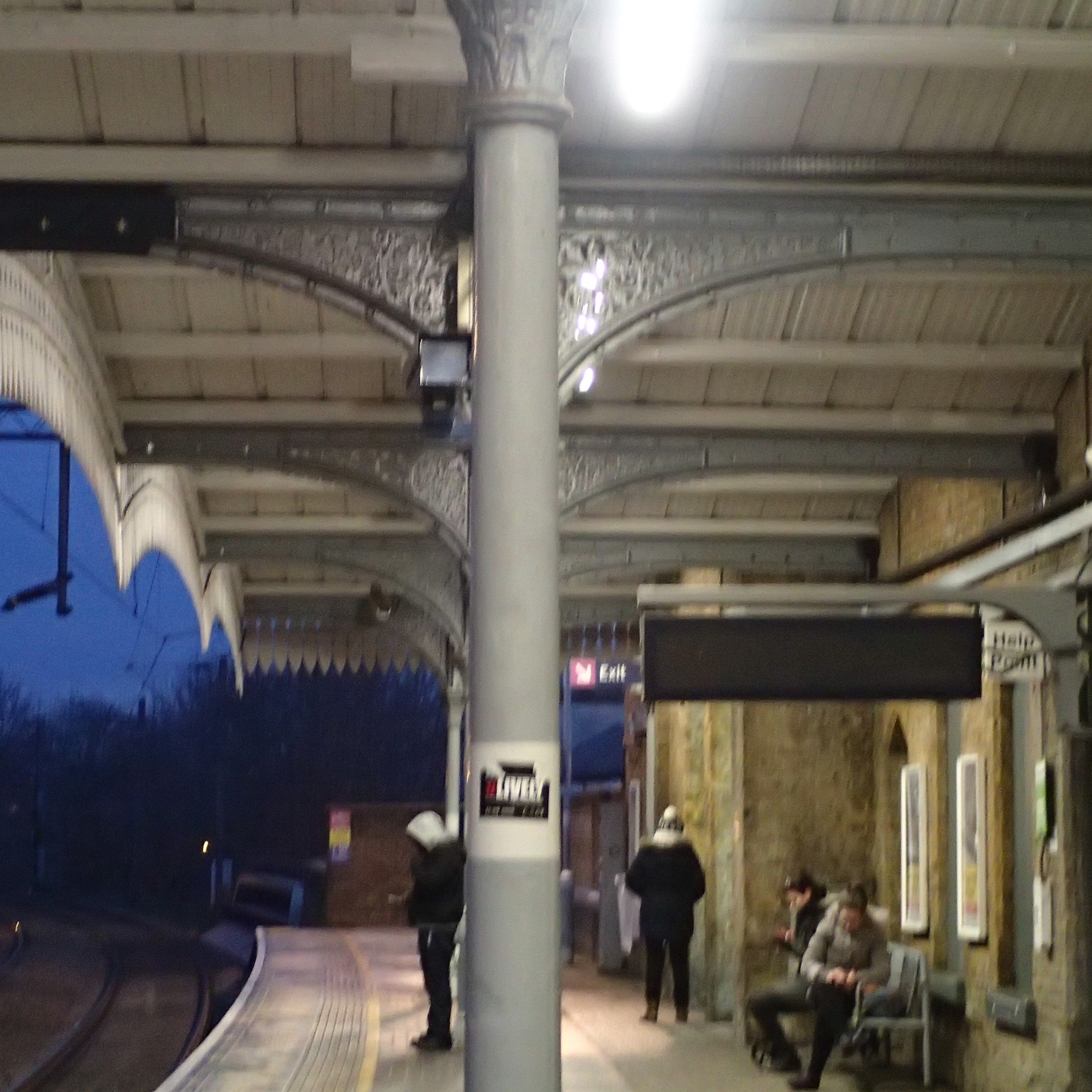
The displays weren’t working on both platforms at Bruce Grove station and the only way to tell where the train was going, was to read the display on the cab, as the train trundled out of the gloom.
The Class 315 train, resplendent inside in all its girlie pink, doesn’t have information displays and as the driver was economical with his announcements, you were left peering into the dark to determine the stations, from the names on the badly-lit platforms.
Luckily, just before Hackney Downs station, is the floodlit blue Mossbourne Community Academy, and I was forewarned of our arrival, and didn’t end up in Liverpool Street.
I know that on the thirty-first of May this year, the Lea Valley Lines will come under the control of Transport for London, so Abellio may think they have reasons to provide minimal service on these lines.
But that is no reason to keep passengers in the dark!
Before Overground – The Terrible Fifteen
I have now visited all of the stations that will be added to the London Overground on the 31st May 2015.
There is a large group of fifteen stations, that are characterised by steep staircases, no lifts or escalators, few facilities and often poor shelter from the weather on the platforms.
I suppose Walthamstow Central could be added to this list, but the problems there are more fundamental and are more down to the way the station was rebuilt for the Victoria Line.
Looking at the main list, it would appear that nothing short of lifts like those that will soon be operational at Edmonton Green will help to solve the problem.
And a sensible pair of lifts cost upwards of a million pounds. Enfield Borough Council have a page, describing the funding of the upgrades at Edmonton Green. This is an extract.
The Council are working in partnership with Network Rail to deliver two lifts at Edmonton Green Station to enable step free access to both Platforms 1 and 2.
The Council has been awarded £850k for the project following a successful bid for funding from the Department for Transport’s Access for All programme. However, the total cost of the project is estimated to be £1.45m and the balance of funding is being provided by the Council, utilising a mixture of contributions from nearby development schemes and grant funding from Transport for London .
So are we prepared to fund improvements like this which for the terrible fifteen which will probably cost over twenty million pounds?
Although it would be a laudable aim to have every station totally step-free, because of passenger behaviour some stations might never need to be upgraded.
I am not disabled, but at times, I take a roundabout route to my destination, as perhaps it only has a short walk on the level. Rain also affects my chosen route, as I rarely carry an umbrella. But I do know the bus/tube/Overground combinations with the least exposed walking. For instance, I must use about half a dozen routes to get to and from Liverpool Street station depending on various factors and which bus arrives first.
So when a station like Edmonton Green gets a significant upgrade, does this alter all of the travelling patterns in the area?As an example, will passengers for the Silver Street area and the North Middlesex Hospital go to Edmonton Green and get a bus?
So perhaps instead of upgrading all of the stations, we should do a few more major schemes first and then do others as necessary, and as the budget allows.
Where would I start?
White Hart Lane
White Hart Lane is down to be redeveloped, as part of the new Spurs stadium. All options of Haringey’s development plans for the High Road West area, show the station moved a short distance to the south and connected by a wide pedestrian way to the High Road and the new stadium. Click here for the main council site for the development.
I will be very surprised if something much better doesn’t happen at White Hart Lane. which makes travel in the greater Tottenham area better. But then I remember the area well from the 1950s and 1960s and if ever an area has shown an ability to get no worthwhile development it is this one. The council, the politicians and the football club, should all hold their heads in shame.
Walthamstow Central
The Walthamstow area is on the up and something must be done to complete the Victoria Line station and make interchange to the Chingford branch easier and hopefully substantially step-free.
This probably means adding the third escalator to the Victoria Line and putting either a lift or escalator connection between the Victoria Line entrance and the Chingford branch platforms.
If only the job had been done properly in the 1960s.
Hackney Downs
Until the pedestrian link is installed between Hackney Downs and Hackney Central stations is completed, I won’t comment on it.
But it does strike me, that as the two Hackney stations taken together will be very important to the Overground, that some selective and intelligent design could improve the complex substantially.
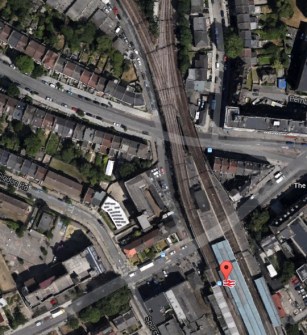
Let’s face it, You wouldn’t design a station like Hackney Downs, with four platforms connected by a subway, these days. The picture shows an aerial view from Google Earth.
Hackney Downs Station
Note how the lines split to the north of the station, with the right branch going to Chingford and Tottenham Hale and the left branch to Enfield Town and Cheshunt. Platform 1 is to the right in the picture, 2 and 3 make up the island in the middle and platform 4 is to the left.
So could the use of the station be changed so that all northbound and southbound services use just one platform each? When I use the station to go to Walthamstow or Enfield Town, I often have a lonely long wait on an empty platform. So as the off peak service through the station is just ten trains per hour in both directions, surely this could it be arranged, so that southbound services generally call at Platform 1 and all northbound services call at Platform 4. Incidentally, in the evening rush hour, there are around twenty trains an hour from Liverpool Street, that stop at Hackney Downs. You’d still have the two middle lines for fast trains going through the station without stopping, but they’d be running past the current Platforms 2 and 3, which for most of the time would be unused.
Surely, with the modern in-cab signalling, that should be universal in the next few years, Hackney Downs can be reduced to working most of the time, as a two-platform station.
As Thameslink and Crossrail are talking twenty-four trains an hour through tunnels under London, surely ten though Hackney Downs for much of the day and twenty during the rush hour must be possible. I suppose that platform allocation at Liverpool Street could be a problem, but then Crossrail will release platform space in 2018, when it starts using the tunnels.
This would reduce the step-free requirement to just two platforms and would also mean that anybody travelling south and wanting to change to a train from Hackney Central, would have a fairly easy interchange, through the new pedestrian link.
Remember though that at Canonbury and Clapham Junction, London Overground have shown they can think out of the box, where platform usage is concerned.
So don’t be surprised at what might happen at Hackney Downs!
Before Overground – Mind The Gap
Some of the gaps between platform and train are more than passengers and probably Transport for London would like. Here’s two.
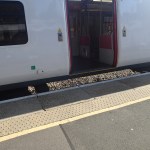
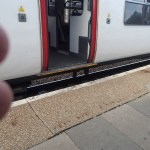
I would think it was fair to assume that nothing will be done about this gap problem until the promised new trains are delivered.
Before Overground – Wood Street
More Steep Stairs And Few Facilities – Rating 2/10
Wood Street station was the last station on the Lea Valley Lines I visited. But I hadn’t saved the best to last!

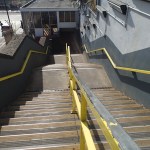


Wood Street is like many on the Lea Valley Lines with steep stairs, few facilities and rudimentary roofs.
 The Anonymous Widower