Advice For Expectant Mothers
There is a widely trailed story today about what expectant mothers should avoid. It’s here on the BBC. This is the main advice.
- Use fresh organic food rather than processed
- Avoid food and drink in cans and plastic containers
- Minimise use of moisturisers, cosmetics, shower gel and fragrances
- Avoid buying new furniture, fabrics, non-stick frying pans and cars when pregnant or nursing
When C was pregnant with our first child, she was a student in her last year at Liverpool University. She actually did her exams at nearly seven months pregnant. She got a II-2, so she couldn’t have done badly.
She didn’t purposedly avoid any chemicals, but as the nice flat we lived in didn’t have a shower, she did at least avoid shower gel, which is on the list of products to avoid. As to the last point, we couldn’t afford new furniture or cars. our frying pan had been borrowed from her mother and was a well-used steel one, complete with a bit of added rust. Did it put iron into the food?
Neither of us smoked, although throughout her pregnancy, she had to endure the Capstan Full Strength cigarettes of her tutor; Robert Kilroy Silk.
But advice was different in those days. We went to stay with a family in Hingham in Norfolk, where C had been a mother’s help during University holidays. The mother, who incidentally was the daughter of a doctor, asked if she’d like a brandy before going to bed, as it would make the baby sleep better. She declined, but only because she was pretty abstemious with alcohol.
We also moved south just a week or so before the expected birth date and then in London, she didn’t have a hospital. I told that story in a post called Waiting for Apollo 11. Theses are the links to Part 2 and Part 3 of the story. We didn’t do boring, even in 1969.
We all survived and the only question, that sometimes comes to mind, is was the cancer that killed her caused by all of those smoky tutorials forty years before she died?
I do know that if she was here today, she’d be laughing like a drain!
More CERN Photos
There are more CERN photos uploaded here to Flickr by other visitors from our Liverpool University Alumni Relations group.
CERN Humour
Research establishments are serious places, but it doesn’t mean they are humourless ones.
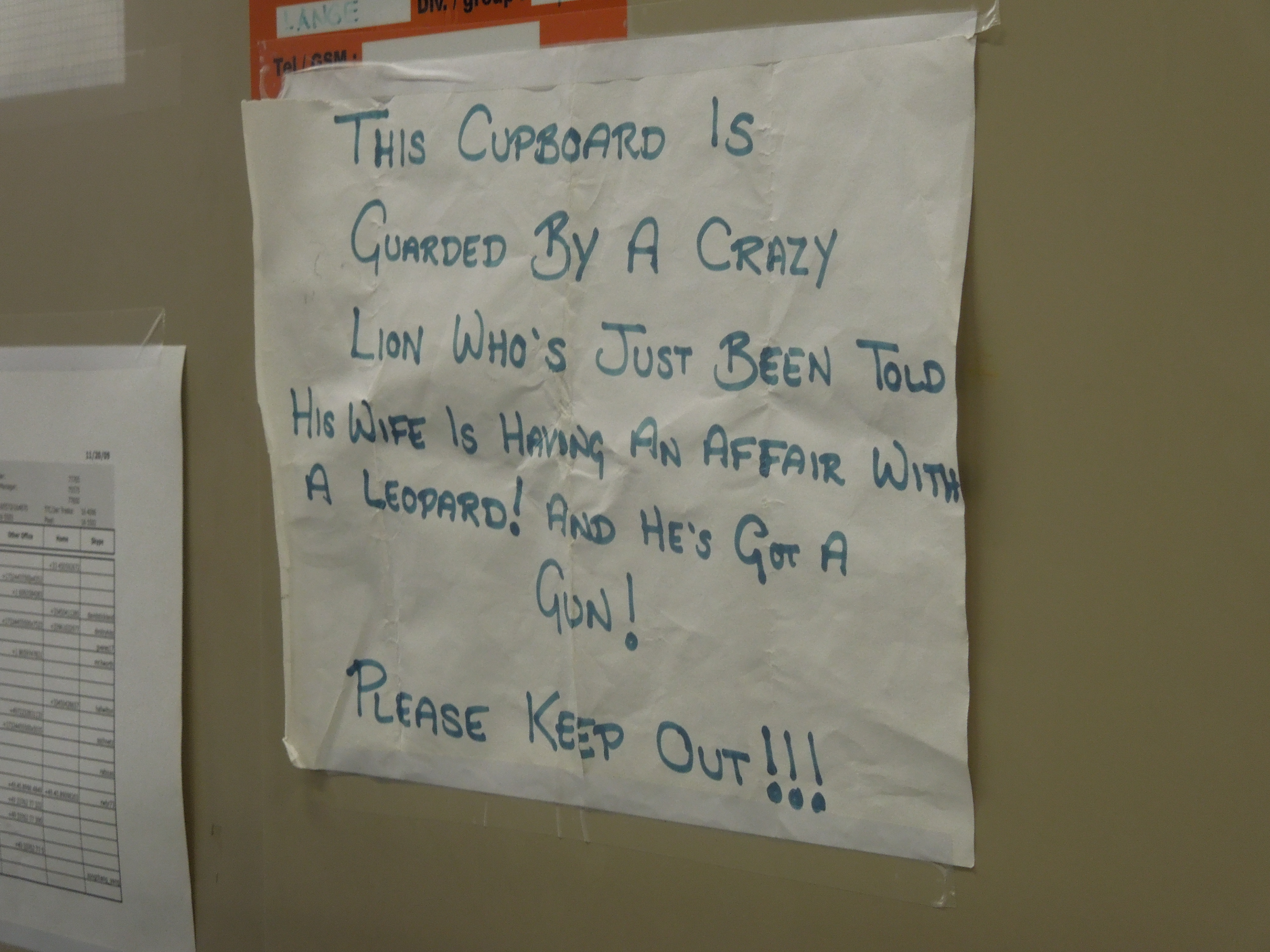
CERN Humour
When I worked at ICI’s Research Establishment on Runcorn Heath, the big joke was signs using the newly discovered Dymo machine in mock German.
When I was at Liverpool University in the mid-1960s, the old cyclotron that James Chadwick had built pointed towards the mound on which the Catholic Cathedral has now been built. One wag told me, that they weren’t going to floodlight the cathedral, as it would glow in the dark.
I heard a similar remark on Saturday.
CMS – Back At The Surface
Back on the surface, we had another talk from a Liverpool University-educated Civil Engineer on the problems of building the CMS and other parts of CERN and the LHC.

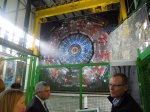


Civil Engineering is one of the major disciplines, that must be applied to a high level at CERN. The engineer had previously worked on tunnels under London.
The Higgs Boson
I have heard many commentators try to explain about the Higgs boson and the search for its existence.
All have failed to make head or tail of the complex subject. Admittedly, my physics stopped at A-level in 1965, but I have read extensively to extend my knowledge.
However, Phil Allport of Liverpool University, explained it all pretty well in words that I could understand. Or at least the detection process, even if the theory of the boson’s existence, is way beyond me.
But I should say, that if Professor Allport were to write a Brief History of the Higg’s Boson, I’d certainly buy it, as it is my type of holiday read. But then I read a book called something like, In search of the Quark, by a pool in the West Indies, only to find that one of the other guests was a Professor of Physics at a prestigious American university. it was this book, that got me looking for Lise Meitner. Sadly, it’s gone the way of a lot of my books.
Again, I wish I’d videoed his talk.
ATLAS
ATLAS is the name of one of the experiments performed at CERN.

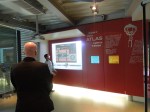

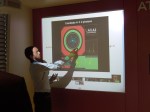
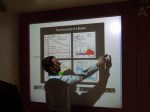
Liverpool University had a significant part in the building of this experiment. Their participation is described here.
CERN And Liverpool University
We were then treated to a lecture, about how Liverpool University fitted into the CERN firmament. Here’s some pictures that I took.
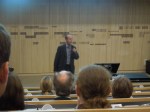

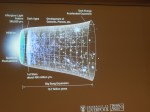
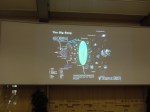
I think I should have made a video.
I can’t find a decent tome about how CERN and Liverpool University started their collaboration, so if anybody has one, send me a link, as the history of science fascinates me. That has led me to two of my heroes being Lise Meitner and Rosalind Franklin.
Nuclear physics at Liverpool dates back to the 1930s, when James Chadwick, who discovered the neutron, was appointed professor. The story of his research at Liverpool and the building of the cyclotron there is described here.
One phrase stands out from the talk. I think it was Sir Howard Newby, the University Vice-Chancellor, who said.
Research is global.
This is so true and it is why places like CERN must exist.
A Three Hour Eye Test
Yesterday, I went to Moorfields Eye Hospital for an eye test.
Not your average eye test, but one that was part of a study to test new diagnosis methods, rather more than my eyes. The eyes incidentally, seemed to be much the same as ever.
What I found interesting was how far the new equipment is moving down a patient-friendly route and the more things they could tell you.
As an example, with my eyes, I hate the standard ‘puff of air’ test, that checks the fluid pressure inside your eye. If you want to read more on what is called ocular tonometry, it’s here on Wikipedia. I had a test from a new instrument, that was much kinder to my sensitive eyes. So that one instrument, seems a big improvement.
I also had a visual field test on the state of the art perimeter. There’s more on perimetry here. This was to compare with the results found on some of the new methods they tried in another test.
I had the same test in Cambridge in 2010, soon after I had the stroke. Unfortunately, they didn’t send me the results. Surely, it’s about time, that we all had an NHS account, where we could access all of our notes, X-rays and tests. I shall be trying to get those field vision results from Addenbrooke’s, as it would be nice to know, if my eyes have got worse.
Even a chain of opticians like Vision Express can’t access results of tests performed in one shop from another. That is apparently down to the Data protection Act. How stupid is that?
This is the second University research project, in which I’ve collaborated. The other was respect to widowhood at Liverpool University.
I would like to get involved in more, as research is something, I feel will be the saviour of this world.
Perhaps we need a web site, where people could register, to say they would be prepared to take part in research, that universities could tap into for volunteers.
Both the research projects I’ve been involved in, have been non-invasive and the worst danger I’ve faced is probably crossing the road to get to Moorfields. I suspect too, that much of the medical research in the next few years, will be of this non-invasive nature. I recently had a request from Liverpool University, looking for gay men, who had suffered bereavement, for a study. This is the sort of project for which a national database of possible participants would be a great help.
It was interesting to see how yesterday, one instrument was virtually a laptop in a frame. The boundaries between specialist professions like doctors, vets and dentists, and those like engineers and computer scientists, are getting very porous.
Liverpool University’s New London Campus Gets An Unusual Plug
I usually listen to Fighting Talk on BBC Radio 5 on Saturday.
This Saturday was no exception and I was surprised to hear one of the panellists work Liverpool University’s New London Campus into an answer to a question about the University Boat Race.
The four panellists were Cornelius Lysaght, John Rawling, Louise Hazel and Bob Mills. I don’t think it was Lysaght, although he is an Everton supporter, Rawling went to Manchester University and Hazel went to Birmingham. So that leaves Bob Mills, who has no Liverpudlian connections. All of this information is according to Wikipedia, so it might be suspect.
Paying It All Back
Liverpool University has been good to me in many ways, so it is only right, when they ask me if I would mind being interviewed as part of their research into widowhood, I don’t say no.
Last week, I was interviewed by a student and as ever I found it rather a pleasant experience, which is probably better than paying for therapy.
I very much believe that we should all use our experience to help others and what better place to start than your old school or university. I can’t go back to my old school, as it no longer exists, so Liverpool University will have to put up with me.
In an ideal world, there would be a central database of research projects, that needed guinea pigs or experienced professionals to help fulfil the research.
 The Anonymous Widower