Ørsted Raises EUR 7.98 Billion In Oversubscribed Rights Issue
The title of this post, is the same as that of this article on offshoreWIND.biz.
This is the sub-heading.
Ørsted has completed its rights issue, raising DKK 59.56 billion (approximately EUR 7.98 billion) with a subscription rate of approximately 99.3 per cent, the company said on 6 October.
These two introductory paragraphs add more details.
Existing shareholders were offered new shares at DKK 66.60 (EUR 8.92) each. The demand for shares not taken up via the rights issue was “extraordinarily high,” according to the developer’s announcement of the Rights Issue results, and allocations were capped per application, meaning no subscriptions were required under the underwriting bank syndicate.
As reported in August, the company appointed a syndicate of BNP PARIBAS, Danske Bank A/S and J.P. Morgan SE as Joint Global Coordinators, next to Morgan Stanley & Co International, to jointly underwrite the rights issue for the approximately 49.9 per cent that would not be subscribed to by Ørsted’s majority shareholder, the Danish state (50.1 per cent).
I dread to think what spiteful punishment that Trumpkopf will inflict on Ørsted.
But the oversubscribed Rights Issue may be good news for the UK.
Ørsted has only one major project under development or construction in the UK.
But it is the large Hornsea Three wind farm, which has this opening paragraph on its web site.
Hornsea 3 Offshore Wind Farm will deliver enough green energy to power more than 3 million UK homes. An £8.5 billion infrastructure project, Hornsea 3 will make a significant contribution toward UK energy security, as well as the local and national economy.
Note.
- Ørsted are raising £7.98 billion and spending £8.5 billion, which must do something for the UK’s economy.
- Hornsea 3 will have a generating capacity of 2.9 GW.
- Ørsted are now delivering the world’s single largest offshore wind farm.
- Hornsea 3 will connect to the National Grid at Swardestone in Norfolk.
In Grid Powers Up With One Of Europe’s Biggest Battery Storage Sites, I describe how the 300 MW/600 MWh Swardestone BESS will be built, where Hornsea 3 connects to the grid.
As Swardestone will have 2.9 GW from Hornsea 3 and a powerful battery, I would expect someone will be looking to site a data centre or something with a need for a lot of stable electricity at or near Swardestone.
In Opportunity For Communities To Have Their Say On National Grid Proposals For Norwich To Tilbury Project, I talk about a line of pylons between Swardestone and Tilbury and show this map of the route.
This page on the National Grid web site has an interactive version of this map.

Note.
- The mauve line indicates the route of the Norwich to Tilbury project.
- Swardestone is at the Northern end of the project a few miles South of Norwich.
- Tilbury is at the Southern end of the project on the Thames estuary.
- The project connects Norwich, Ipswich, Colchester and Chelmsford to Hornsea 3 at Swardestone.
- I suspect the project will connect to Ipswich at the Bramford substation.
- The Sizewell nuclear site is to the North-East of Woodbridge and connects to the grid at the Bramford substation.
I know East Anglia well and I would suspect that Norwich, Ipswich, Colchester, Chelmsford and Southend-on-Sea could support one or more data centres.
Conclusion
I asked Google AI, who owns Hornsea 1 and received this reply.
Hornsea 1 is owned by a partnership including Ørsted, Equitix, TRIG, GLIL, Octopus, and Brookfield, with Ørsted also providing the operational management. A 2018 agreement between Ørsted and Global Infrastructure Partners (GIP) originally established the 50/50 joint venture for the project.
I then asked Google AI, who owns Hornsea 2 and received this reply.
The ownership of the Hornsea 2 wind farm is shared between several entities, including a 37.55% stake held by Ørsted, a 25% stake each by AXA IM Alts and Crédit Agricole Assurances, and a 12.45% stake held by Brookfield. The wind farm is located offshore in the UK’s North Sea, approximately 89 km off the Yorkshire coast.
In November 2019, I also wrote World’s Largest Wind Farm Attracts Huge Backing From Insurance Giant.
It does seem to me that Ørsted are past masters of developing a wind farm, then selling it on and using that money to develop the next wind farm.
The Rights Issue just makes that process easier.
Grid Powers Up With One Of Europe’s Biggest Battery Storage Sites
The title of this post, is the same as that of this article in The Times.
This is the sub-heading.
Orsted’s huge facility in Norfolk will store energy generated by its offshore wind farm
These three paragraphs give more details of the project.
The world’s largest developer of offshore wind farms is planning to build a vast battery storage facility near Norwich.
Orsted will install the energy storage system, which will be one of the largest in Europe, on the same site as the onshore converter station for its Hornsea 3 wind farm in Swardeston, Norfolk.
The project will store energy generated by Hornsea 3 when weather conditions are windy and when electricity supply exceeds demand so that it can be discharged later to help to balance the nation’s electricity grid.
Note.
- There is also a visualisation and a map.
- Tesla batteries will be used.
- The The battery will have an output of 300 MW, with a capacity of 600 MWh. So it is another two-hour BESS.
- It should be operational in 2026.
- The battery is on a 35-acre site.
- Cost is given as £8.5 billion, but that would appear to include the 2852 MW Hornsea 3 wind farm.
The BBC is reporting that local residents are worried about fire safety.
I have some thoughts of my own.
The Location Of The Swardeston Substation
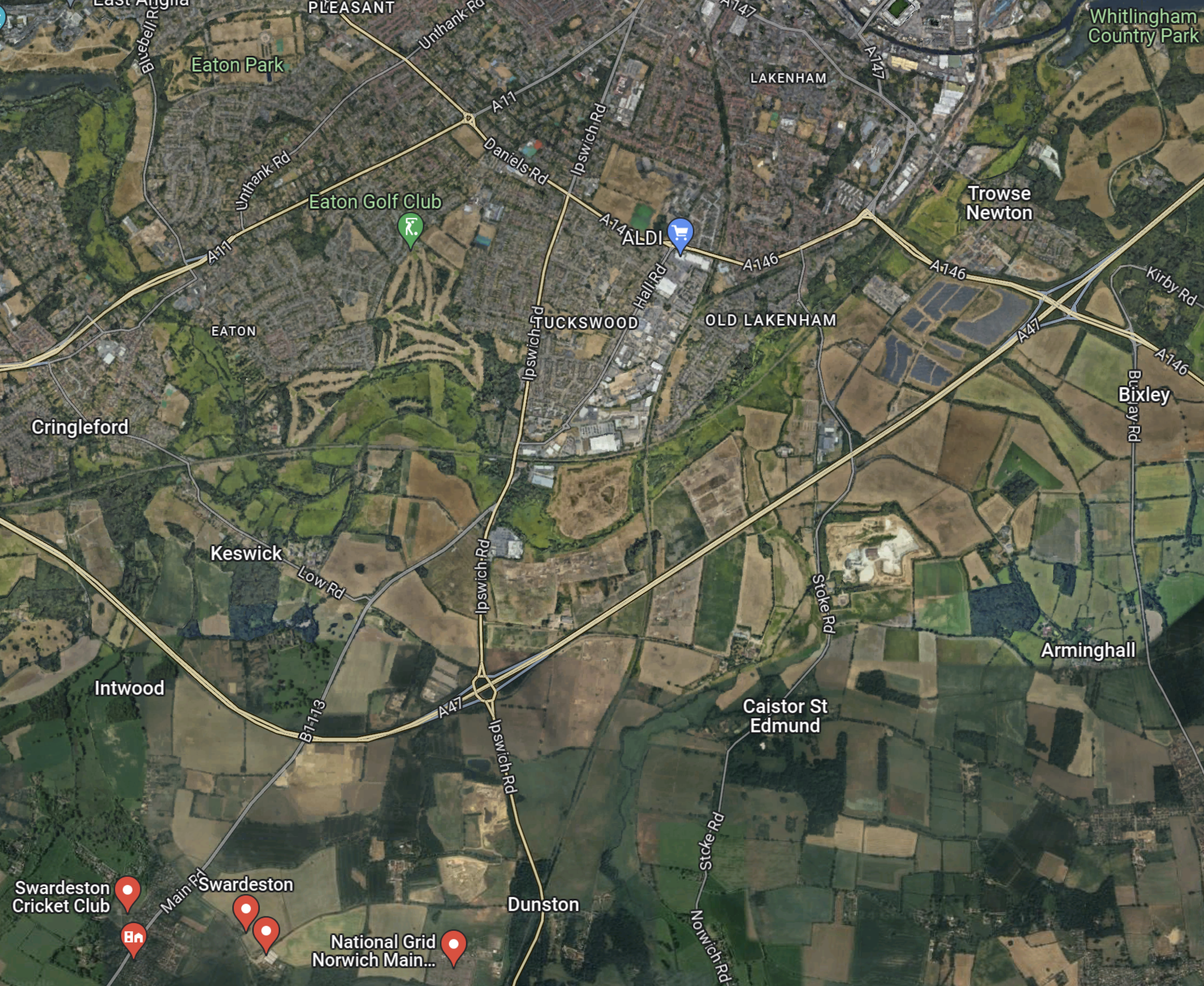
This Google Map shows the location of the Swardeston substation, which will also host the Swardeston BESS.
Note.
- The East-West road is the A 47 Norwich by-pass.
- Norwich is to the North of the by-pass.
- Just to the left-centre of the map, the main A 140 road runs between Norwich and Ipswich, which has a junction with the A 47.
- The A 140 passes through the village of Dunston, which is to the East of the National Grid sibstation, which will host the connection to the Hornsea Three wind farm.
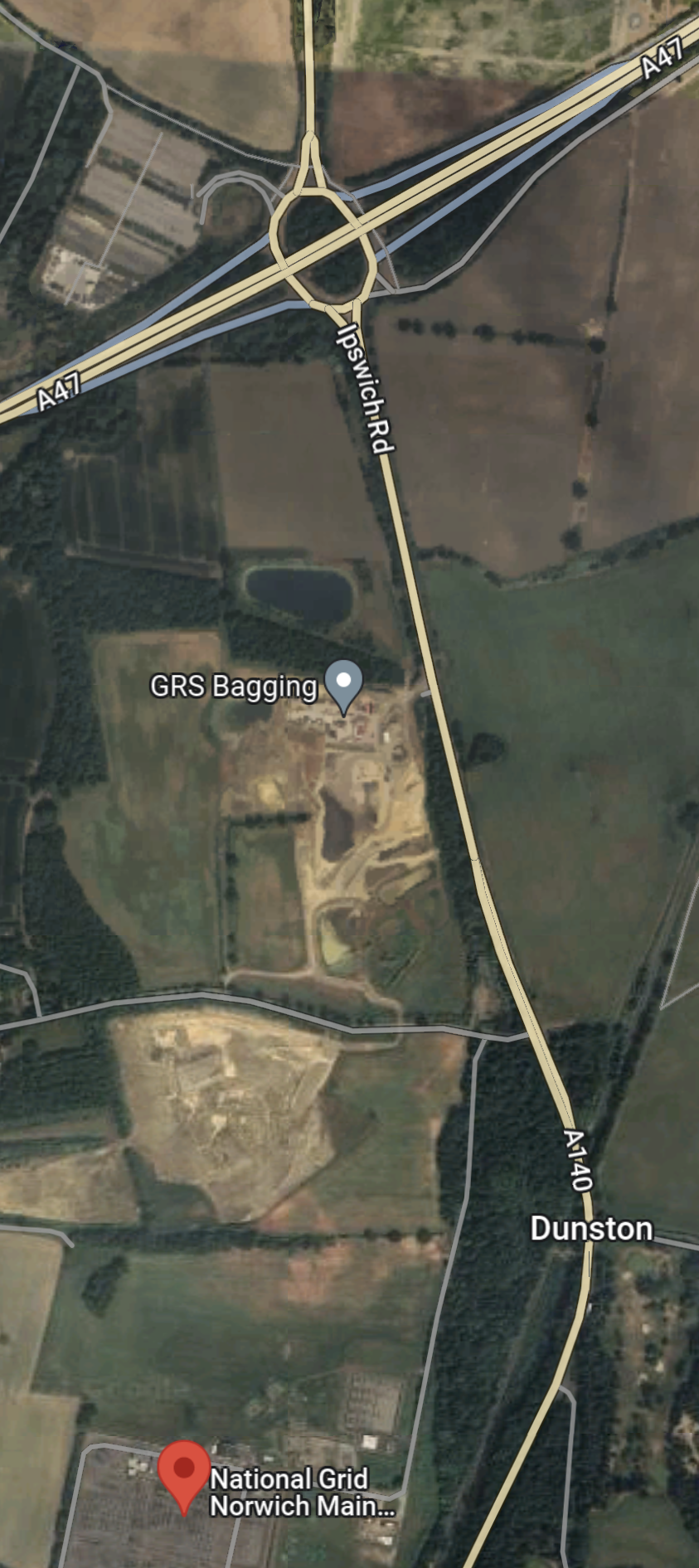
This second Google Map shows the A 140 in detail from the junction to the A 47 to the Swardeston substation.
Note.
- The Swardeston substation is on a substantial site.
- The Norwich to Tilbury transmission line will have its Northern end at Swardeston substation.
- Once the infrastructure is complete at Swardeston substation, Hornsea Three wind farm will be connected to the electricity infrastructure around London.
There would appear to be plenty of space at the site for all National Grid’s plans.
Capital Cost Compared To Big Nuclear
Hornsea Three is a 2852 MW wind farm, that will cost with the battery and a few extras £8.5 billion or around around £ 3 billion per gigawatt.
Hinckley Point C on the other hand will cost between £ 31-35 billion or £ 9.5-10.7 billion per gigawatt.
Conclusion
National Grid would appear to be using a BESS at Swardeston substation to improve the reliability and integrity of the Hornsea Three wind farm.
How many other big batteries will be placed, where large wind farms connect to the National Grid?
As an Electrical and Control Engineer, I certainly, believe that energy storage at major substations, is a proven way to improve the grid.
Opportunity For Communities To Have Their Say On National Grid Proposals For Norwich To Tilbury Project
The title of this post is the same as that of this press release from National Grid.
These three bullet points are sub-headings.
- National Grid is consulting communities for 10 weeks, between Wednesday 10 April to Tuesday 18 June, on its infrastructure proposals to connect new clean energy sources into the East Anglian electricity network.
- Norwich to Tilbury will enable National Grid to connect the sources of power generated from offshore wind to homes and businesses across Britain, helping to reduce our reliance on fossil fuels and bring the cost of energy bills down.
- The project will help the UK achieve its aim of generating 50GW of energy from offshore wind by 2030 and reach net zero by 2050.
This page on the National Grid web site has an interactive map of the route.
This paragraph invites people to comment.
National Grid is encouraging communities in East Anglia to comment on proposals to upgrade the high voltage power network in England as part of a 10-week consultation process which runs between Wednesday 10 April and Tuesday 18 June.
National Grid have also announced dates of when public information events are being held.
- Wednesday 24 April 2024 – 12pm – 5pm – Towngate Theatre, St Martin’s Square, Basildon, Essex SS14 1DL
- Thursday 25 April 2024 – 2pm – 7pm – The Brentwood Centre, Doddinghurst Road, Pilgrims Hatch, Brentwood, CM15 9NN
- Saturday 27 April 202 – 11am – 4pm – Chelmsford City Racecourse, Chelmsford, CM3 1QP
- Tuesday 30 April 2024 – 12pm – 5pm – Gislingham Village Hall, Mill Street, Gislingham, IP23 8JT
- Wednesday 1 May 2024 – 11am – 4pm – Copdock Village Hall, Old London Road, Copdock, IP8 3JN
- Friday 3 May 2024 – 1pm – 6pm – Needham Market Community Centre, School St, Needham Market, Ipswich IP6 8BB
- Saturday 4 May 2024 – 11am – 4pm – Lawford Venture Centre 2000, Bromley Road, Lawford, Manningtree CO11 2JE
- Wednesday 8 May 2024 – 4pm – 7pm – The Civic Hall, Blackshots Lane, Grays, RM16 2JU
- Thursday 9 May 2024 – 1pm – 6pm- Thorpe Hall, Ashwell Thorpe and Fundenhall Community Centre, Muskett Road, Ashwellthorpe, NR16 1FD
- Friday 10 May 2024 – 1pm – 6pm – Tibenham Community Hall, Pristow Green Lane, Tibenham, Norwich NR16 1PX
- Tuesday 14 May 2024 – 11am – 4pm – Witham Public Hall, Collingwood Road, Witham, CM8 2DY
- Wednesday 15 May 2024 – pm – 6pm – Diss Town Football Club, Diss, IP22 4QP
- Thursday 16 May 2024 – 2pm – 7pm – Langham Community Centre, School Road, Langham, Colchester, CO4 5PA
- Friday 17 May 2024 – 1pm – 6pm – Great Bromley Village Hall, Parsons Hill, Great Bromley, Colchester, CO7 7JA
I shall be going to the Brentwood and Needham Market meetings.
I have some thoughts.
T-Pylons
There is a chance that this route will not use conventional pylons.
These pictures show the T-pylons, that have been used in Somerset to connect Hinckley Point C power station to the National Grid.


Note.
- They are a Danish design.
- They are shorter than current pylons.
- They have a smaller footprint on the ground.
- The design won a National Grid-RIBA design competition.
- We will probably see them around the country in the next few years.
They are certainly better than the standard ones that connect the Sizewell site to the National Grid, that passed by my first house in Suffolk.
 The Anonymous Widower