Could Centrica Build An Alternative Grid For The UK?
Andy Burnham’s Speech In Liverpool Introduced The Great British Grid
This extract is what he said on energy and the grid.
One of the biggest barriers to growth in the UK is the cost of energy. British businesses and billpayers pay some of the highest energy costs in Europe.
Within 10 years, I want those costs to be in line with our neighbours.
This means reforming a broken energy market so it better serves the public interest.
We are already taking more control of our electricity prices with a massive expansion of home-grown renewables and nuclear. I have asked Miatta to speed up the breaking of the link between what we pay for power at home and the international gas market, to get bills down.
And we will be pragmatic in relation to the North Sea as we build a bridge to a clean energy future and face the climate crisis.
But it’s not just the price. The system needs to work better too. You would not believe how many businesses complain to me they can’t get going because they can’t get connected to the grid.
It pushes costs up. It drags growth down. And it holds Britain back. We won’t get the growth and inward investment we need if we don’t fix it.
So, for the first time, we will have a national energy plan and we will bring back local democratic control through a stronger role for mayors and local leaders.
But we must go further. Today I can announce our plan for Great British Grid. A new branch of Great British Energy. A publicly-owned company that will challenge the private sector operators.
But is Andy Burnham’s plan realisable?
The Great Grid Upgrade From Norwich To Tilbury
National Grid are aiming to replace the grid between Norwich and Tilbury to add extra capacity and the details of the project are on this web site.
This is a map of the route.

To ascertain the level of objections, I asked Google AI “Norwich to Tilbury grid objections” and received this reply.
Local councils, residents, and organizations object to National Grid’s Norwich to Tilbury Project primarily due to the visual and ecological damage of using 50-meter overhead pylons instead of offshore or underground alternatives.
Key Objections and Concerns
Overhead Pylons vs. Alternatives: Opposition to roughly 100 miles (159–183 km) of towering onshore overground lines. Objectors demand fully costed offshore high-voltage direct current (HVDC) or underground cabling options.
Environmental & Landscape Harm: Severe impact on protected and valued landscapes, including the Dedham Vale national landscape and Waveney Valley, alongside extensive tree loss and disruption to local wildlife habitats.
Heritage & Property Impacts: Damage to the settings of historic buildings and significant property or land devaluation, including negative impacts on planned developments like the Dunton Hills Garden Village in Brentwood.
Unrealistic Delivery Timeline: Concern that the targeted 2030/2031 completion deadline is overly ambitious, forcing rushed implementation without proper scrutiny of cumulative effects from multiple East Anglian energy projects.
Community Disruption: Strain on local highways, disruptive weekend and bank holiday working hours, agricultural disruption, and a lack of adequate community compensation or tangible social value.
The Nimbys don’t seem very keen on more and bigger overhead power lines.
Conclusion
I believe building a second set of power lines across the country will be very difficult, if not impossible.
The Investment Of Centrica And Others In innovative Energy Technology
I think we’ll see innovation from the likes of Centrica, Octopus, National Grid and others, as to how we get our energy delivered.
Centrica and others, who include the UK Government, have backed four British companies, that I’m sure will be used in the grid of 2030.
- Ceres have developed a fuel cell that runs on hydrogen, biomethane or natural gas. It was thought it would be used to power data centres, but it could be used to provide power anywhere there is a gas supply, like a big factory or a new housing estate.
- Heata was developed by British Gas Research and is part of a data centre, which sits in a domestic hot water tank and the waste heat gives you affordable hot water.
- Highview Power make liquid-air batteries up to 300 MW/3.2 GWh. Significantly, Andy Burnham performed the groundbreaking for a 50 MW/300 MWh battery in Manchester, when he was Mayor of Greater Manchester.
- HiiROC from Hull University have a way to make hydrogen that uses only a fifth of the electricity. Cemex are using HiiROC to make low-carbon cement at Rugby. I also think Jim Ratcliffe has plans for HiiROC, as he is an investor with Centrica and others.
Could Centrica build an innovative Great British Grid from their investments?
I don’t think so because of the problem I indicated earlier with Norwich to Tilbury of putting up more overhead cables.
But all of these four companies can provide support and enhancement to the existing grid.
- Ceres could be used to provide extra power, where it is needed, if there is a suitable gas supply.
- Heata could be used to give a large proportion of houses and flats affordable hot water.
- Highview Power could be used to provide energy storage where too much energy is being generated at times and needs to be stored for a number of hours.
- I believe that many large wind farms will be connected to the grid, with a Highview Power battery at the sub-station.
- I also believe that we could see Highview Power batteries installed offshore to smooth wind farm output.
- HiiROC could produce hydrogen when and where it is needed.
The big problem will be that the grid will get more complicated and will be more difficult to control.
In Centrica And Return Partner To Scale Battery Flexibility In Germany, I ask Google AI if Centrica are good at optimising batteries and received this reply.
Yes, Centrica is considered a strong and established player in grid battery (BESS) optimisation.
Centrica Energy leverages over 15 years of flexible asset trading experience and has actively optimised battery energy storage systems since 2018. They currently manage over 950 MW of grid-scale batteries on contract across the UK and Europe.
It may be difficult to manage all these assets, but it does appear that Centrica have the mathematicians and engineers, who are up to the task.
The Future Of Nuclear
Consider.
- The four nuclear stations at Hartlepool, Heysham 1, Heysham 2 and Torness are to be shut down by March 2030, which will lose approximately 5 GW of zero-carbon electricity.
- Hinckley Point C will deliver 3.2 GW from the early 2030s.
- Sizewell C will deliver 3.2 GW at some time in the future.
Can we rely on solar and wind power to power the UK?
It is not a question of can, but we have to.
But Centrica have made a bold move to link up with X-energy of the US to build a fleet of small modular reactors called an Xe-100.
- I wrote about the initial deal in Centrica And X-energy Agree To Deploy UK’s First Advanced Modular Reactors.
- In Hartlepool Nuclear Reactor Moves To UK Regulatory Assessment, I talk about how the first reactor will be built at Hartlepool.
- In Centrica, X-energy Advance Nuclear Plans As UK Regulators To Begin Design Review For Xe-100, I say more about the design and the parners in the Xe-100.
- In With Federal Funding Windfall, X-energy Advances Small Nuclear Reactor, I talk about US Federal funding for X-energy.
- In TRISO-X Completes Vertical Construction Of TX-1 Fuel Fabrication Facility, I describe how they are cracking on with the fuel facility in the US.
It certainly, seems to be a project that has started with a certain degree of momentum, which says to me, they have got the project management right.
But believe that these 80 MW Xe-100 reactors, if strategically placed around the country will keep us going as older nuclear and gas power stations are retired.
The Relationship Between Andy Burnham And Chris O’Shea
I wrote about this in Have Chris O’Shea And Andy Burnham Met?
I will assume its a good relationship, until proven otherwise.
Conclusion
I wonder whether in the end, the Great British Grid is a series of extensions to the current grid we have.
Hornsea 3 Battery Energy Storage To Start Operations Next Year, Ørsted Selects Arenko’s Platform to Operate BESS
The title of this post, is the same as that of this article on offshoreWIND.biz.
This is the sub-heading.
Arenko has been selected by Ørsted to deploy its Nimbus optimisation, asset management and trading platform at the 300 MW/600 MWh Iceni battery energy storage system (BESS) that will be part of the 2.9 GW Hornsea 3 offshore wind farm in the UK. The BESS project is scheduled to enter operations in the first quarter of 2027.
These are the first three paragraphs.
Named Iceni, the battery storage project is being developed as one of the UK’s first large-scale co-location projects under the Offshore Transmission Network Review (OTNR).
Iceni is designed to share transmission infrastructure and an onshore grid connection with Hornsea 3, rather than securing a separate grid connection. According to Arenko, this makes it the world’s first utility-scale battery to be directly integrated into offshore transmission infrastructure.
Under the agreement with Ørsted, Arenko’s Nimbus software will be used to forecast market and asset conditions, determine how battery capacity should be allocated in real time and automate trading across power markets. The platform will also support the technical, data and controls integration required to operate the battery alongside the offshore wind farm through their shared connection.
Note.
The Offshore Transmission Network Review (OTNR) has a web site.
The Hornsea 3 wind farm has a capacity of about ten times that of the battery.
Centrica Energy And Zelestra Sign Battery Storage Tolling Agreement
The title of of this post, is the same as that as this press release from Centrica.
This is the sub-heading.
Centrica Energy and Zelestra have signed a physical tolling agreement for 99 MW / 297 MWh of battery storage capacity at Zelestra’s Hilgermissen BESS project, located in Lower Saxony, Germany.
These three paragraphs add some more details.
Under the agreement, Zelestra will develop, construct and own the battery storage project, building on their experience in delivering major projects in other markets and their extensive pipeline across Europe. Engineering and procurement activities will be completed this year leading to start of construction in 2027 and operations in 2028.
Under the tolling agreement, the battery will be optimised through Centrica Energy’s multi-market trading and optimisation services, enabling participation across Day-Ahead, Intraday and Ancillary Services in Germany.
Lower Saxony has a strong industrial base, from the automotive industry to agriculture and food production, as well as being a strong wind power and biomass energy producer. With a growing need for flexible capacity to support the stability and resilience of the power system, the BESS project will help accelerate renewable integration, strengthen grid flexibility and support Germany’s wider decarbonisation objectives.
In some ways, I find this press release a bit surprising.
Surely, a nation like Germany has the mathematicians, who are capable of doing this optimisation of a Battery Energy Storage System or BESS.
In New Optimisation Agreement For 70 MW / 160 MWh BESS In Sweden, I wrote about Centrica doing the same thing for the Swedes.
It strikes me, that somewhere in Centrica are one or more very bright mathematicians.
They have a web page, where they describe what they can do for your BESS.
I also believe, that underlying the management of the UK’s gas and the Grain LNG Terminal, which I talk about in Andy Burnham Set For Clash With MPs Over North Sea Oil And Gas, there is some very clever mathematics.
RWE To Build Large-Scale Storage At Hambach Mine
The title of this post is the same as that of this press release from RWE.
These four bullet points act as sub-headings.
- 236 megawatts capacity and 470 megawatt-hours storage capacity
- First battery containers have been delivered; commissioning is planned for 2027
- Large-scale storage system balances fluctuations in the electricity grid in fractions of a second
- RWE currently constructing around 1.7 Gigawatts of battery storage capacity in Germany
This first paragraph gives some more details.
RWE is continuing to expand its battery storage portfolio and is constructing a new large-scale storage facility on the site of the Hambach opencast mine. The battery storage facility is being built near the village of Niederzier in the district of Düren. Preparatory work on a three-hectare site began at the end of 2025. The first of a total of 128 lithium-ion battery containers have already been delivered. The large-scale storage facility will have a capacity of 236 megawatts (MW) and a storage capacity of 470 megawatt-hours (MWh). The facility is scheduled to come on stream in 2027.
Note.
- According to the Wikipedia entry for the Hambach opencast mine, it was used to mine lignite or brown coal.
- The battery will be a two-hour battery.
- The site was originally the Hambach Forest, of which only ten percent remains, as the rest has been cut down because of the mining.
- The pit is 500 metres deep.
- Full cessation of lignite mining planned by 2030 as part of Germany’s coal phase-out.
The site is being gradually transformed into a reclaimed landscape, including the future Hambach lake.
It is well-worth reading the whole Wikipedia entry for the Hambach opencast mine.
Four Of The Largest Grid Batteries From Fidra
Fidra have made a big splash as they enter the UK’s Long Duration Energy Storage market, with three grid batteries.
Bicker Fen 1 and 2
Capacity – 1.20 GW/2.40 GWh
Web site
Commission Date – BF1-2028, BF2-2029
Thorpe Marsh
Capacity – 1.45 GW/2.90 GWh
Commission Date – Q1-2027
West Burton C
Capacity – 500 MW/1 GWh
Commission Date – Q4-2027
Note.
- All are two-hour batteries.
- Each battery has some drone footage of the site.
JERA Nex BP, EnBW Submit Morven Offshore Wind Farm Application
The title of this post, is the same as that of this article on offshoreWIND.biz.
This is the sub-heading.
A joint venture between JERA Nex BP and EnBW has submitted Section 36 consent applications for the Morven offshore wind farm to the Scottish government
These two paragraphs add a few details.
The developer secured the seabed rights for the Morven offshore wind farm as a single project in the ScotWind Leasing Round in 2022 and split it into two separate projects during the early development phase.
Located around 60 kilometres off the coast of Aberdeenshire at its closest point, the site is planned to house Morven North and Morven South, which would have a combined installed capacity of up to 3 GW and around 190 wind turbines in total.
Morven Offshore Wind Farm now has a comprehensive web site.
The web site says that the electricity will be brought ashore at Hawthorn Pit.
This Google Map shows the location of Hawthorn Pit.
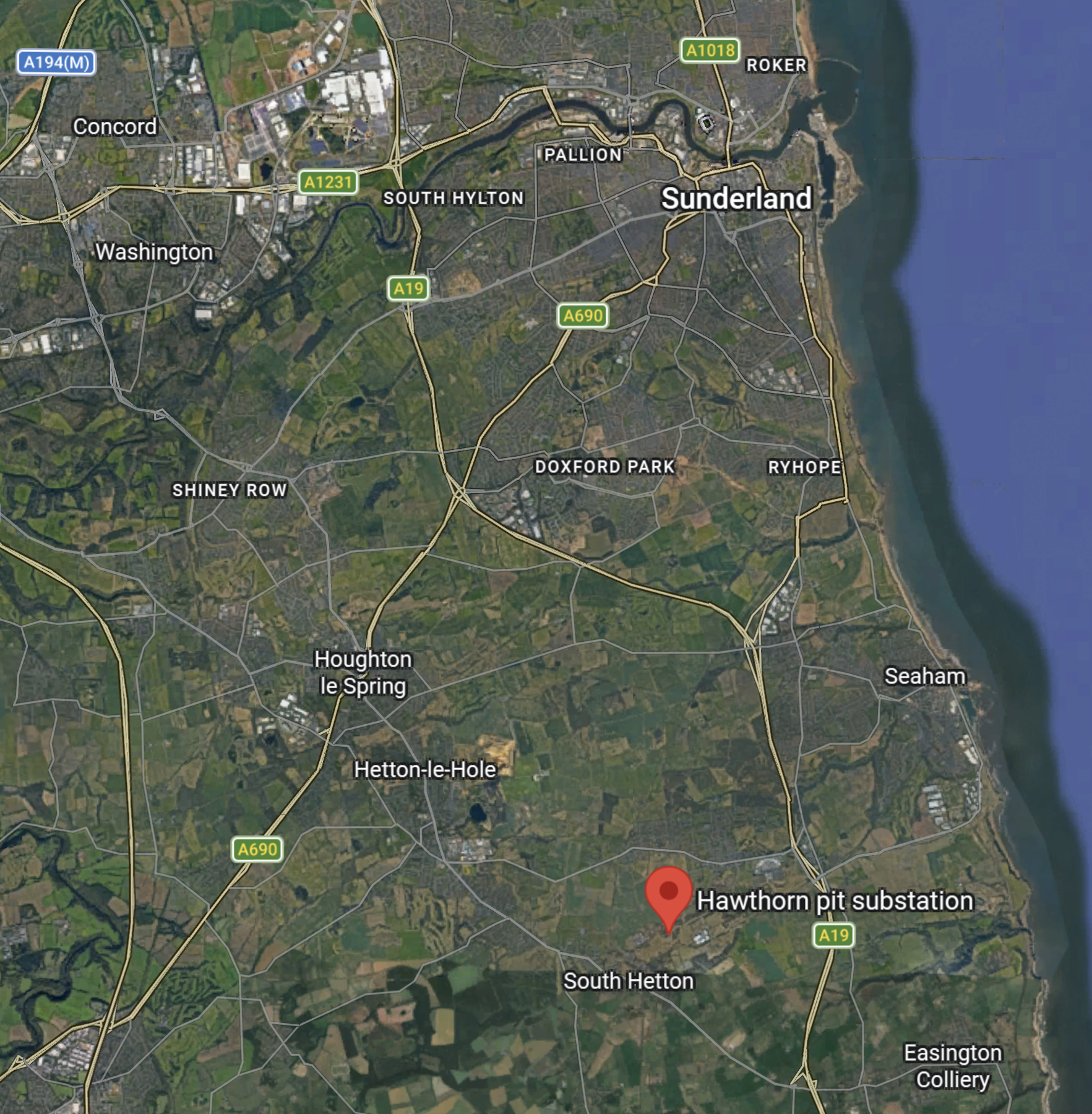
Note.
- Hawthorn Pit is indicated by the red arrow.
- Sunderland is at the top of the map on the coast.
- Aura Power has already obtained planning permission for Hawthorn Pit solar farm, which will be up to 49.9 MW.
- Zenobe are developing a battery-energy-storage-system(BESS) 1.5 km to the South-East of the new Hawthorn Pit substation, which will have an output of 300 MW. Sloppily, there is no detail on capacity, but Google AI indicates, it is a 300 MW/600 MWh battery.
- Hawthorn Pit substation is also the expected to be the Southern end of Eastern Green Link 1, which will help to bring Scottish wind power to England, which will be a 2 GW undersea interconnector to Torness.
In Murphy Starts Work On £2.5bn Eastern Green Link 1, I detail the start of building of Eastern Green Link 1 and say it should be operational by 2029.
When Is The Morven Offshore Wind Farm Expected To Be Commissioned?
I asked Google AI the question above and received this answer.
The 2.9 GW Morven offshore wind farm is expected to be fully commissioned and operational between 2031 and 2035, with initial grid connections and power export potentially starting as early as 2030.
The timeline for full deployment of the Morven Offshore Wind Farm remains somewhat flexible as it depends on final planning approvals and connection offers from the National Energy System Operator (NESO).
The Cables For The Morven Offshore Wind Farm And Eastern Green Link 1
This map clipped from the Morven Offshore Wind Farm web site, shows the locations of Aberdeen, Hawthorn Pit and the Morven Offshore Wind Farm.
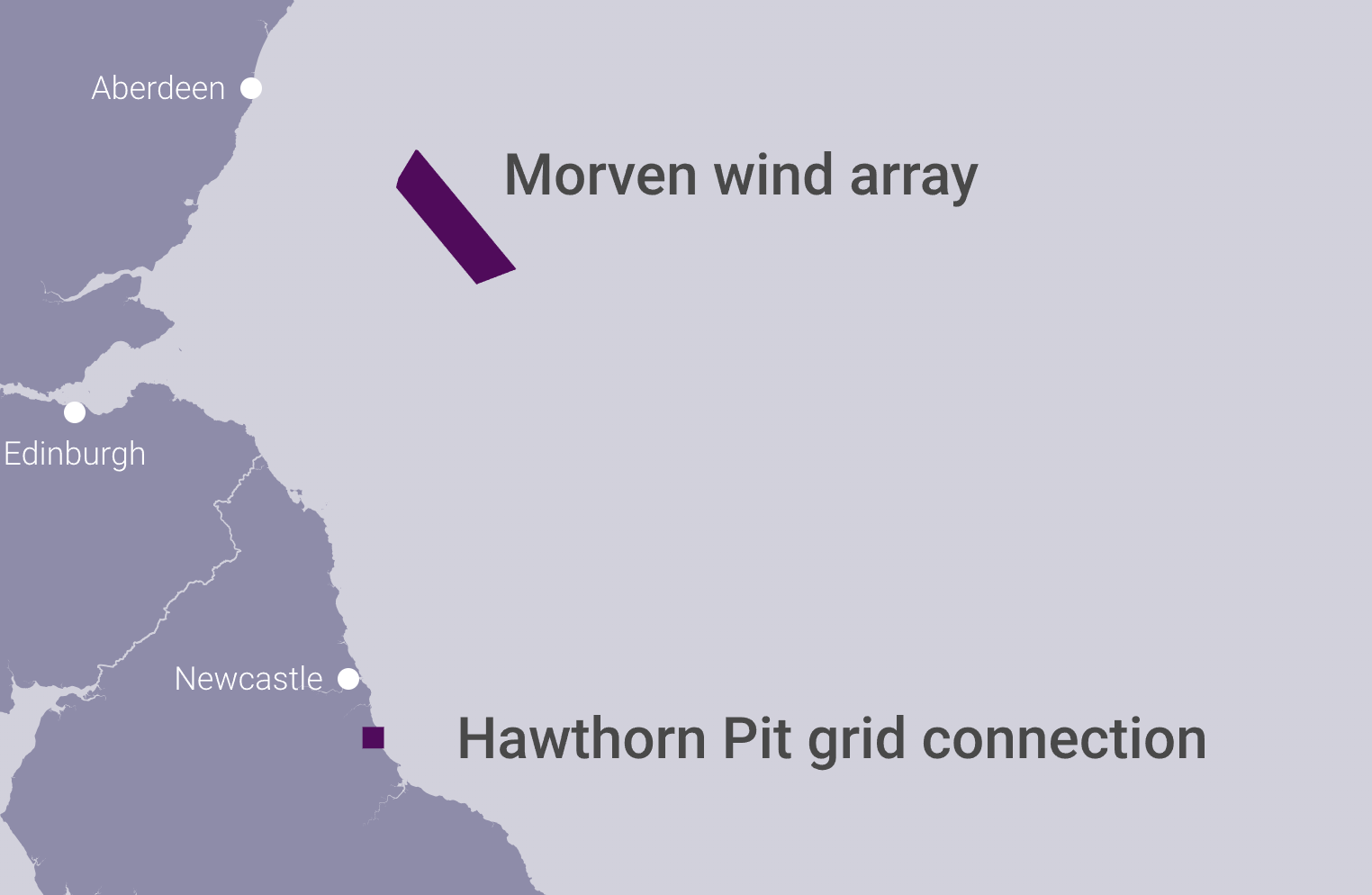
Note.
- The location of the Morven wind array was first mentioned in June 2020, as part of ScotWind by Crown Estate Scotland.
- The development of Eastern Green Link 1 was first mentioned in May 2021, by National Grid.
- Torness is to the East of Edinburgh.
- Eastern Green Link 1 connects Torness and Hawthorn Pit.
- the Morven wind array connects to England at Hawthorn Pit.
Over the last few years National Grid and other companies have been developing a technique called offshore hybrid assets, which I describe in What Are Offshore Hybrid Assets?.
An offshore hybrid asset typically connects two countries via a large offshore wind farm, which can then send electricity to both countries.
In a traditional design, there would need to be.
- A 2 GW cable between Torness and Hawthorn Pit.
- A 2.9 GW cable between Morven and Hawthorn Pit.
In the Offshore Hybrid Asset design, there would need to be.
- A 2 GW cable between Torness and Morven
- A 2.9 GW cable between Morven and Hawthorn Pit.
I suspect cable would be saved.
This map shows the position of each ScotWind Leasing wind farm.

Note.
- The numbers are Scotwind’s lease number in their documents.
- Morven is ScotWind lease number 1.
- Eastern Green Link 1 is one of four interconnectors down the East Coast of the UK.
- I have added up the ScotWind lease numbers 1-6 and they total 10.5 GW.
That would be a lot of power to capture just by converting the four Eastern Green Link interconnectors into offshore hybrid assets.
How Will Aquaventus Connect To Aberdeen?
This is RWE’s description of AquaVentus, which is sub-titled Hydrogen Production In The North Sea.
Hydrogen is considered the great hope of decarbonisation in all sectors that cannot be electrified, e.g. industrial manufacturing, aviation and shipping. Massive investments in the expansion of renewable energy are needed to enable carbon-neutral hydrogen production. After all, wind, solar and hydroelectric power form the basis of climate-friendly hydrogen.
In its quest for climate-friendly hydrogen production, the AquaVentus initiative has set its sights on one renewable energy generation technology: offshore wind. The initiative aims to use electricity from offshore wind farms to operate electrolysers also installed at sea on an industrial scale. Plans envisage setting up electrolysis units in the North Sea with a total capacity of 10 gigawatts, enough to produce 1 million metric tons of green hydrogen.
RWE have also put this AquaVentus video on their web site.
Note, that in the video AquaVentus connects Germany to Denmark, Norway, The Netherlands and Aberdeen and Humberside in the UK.
I asked Google AI, the question in the title of this section, and received this answer.
AquaVentus connects to Aberdeen through a strategic infrastructure partnership with Hydrogen Scotland. The two organizations are integrating offshore wind power, offshore electrolysis, and a shared cross-border pipeline to link Scottish renewable generation with European industrial markets.
The connection strategy relies on a multi-stage approach across the North Sea:
Offshore Production & Transmission: AquaVentus aims to produce green hydrogen directly offshore. It will be transported via a pan-European pipeline network—such as the planned 400 km AquaDuctus to link offshore hubs with both the UK and mainland Europe.
Scottish-German Export Corridor: Building on previous research like the Scot2Ger study, this pipeline corridor directly connects Scotland’s abundant offshore wind resources to European demand, establishing Aberdeen as a critical origin node.
Integrated Energy Backbone: The initiative champions hybrid connection concepts (combining both power cables and hydrogen pipelines). This allows for maximum flexibility when integrating Aberdeen’s local onshore hydrogen infrastructure with broader transnational energy grids.
I will now ask Google AI some supplementary questions about AquaVentus in UK waters.
“Will AquaVentus Produce Hydrogen In UK Waters?”
Google AI gave this reply.
Yes, AquaVentus plans to produce green hydrogen in UK waters. The German-led consortium has partnered with Hydrogen Scotland to harness Scotland’s offshore wind potential for large-scale, cross-border hydrogen production and export.
Key Details of the UK-German Initiative
Production Scale: The initiative aims to install 10 gigawatts (GW) of offshore electrolysis capacity in the North Sea by 2035, producing up to 1 million metric tonnes of green hydrogen annually.
The “Pipes and Wires” Model: Offshore wind parks will be equipped with hybrid connection concepts, providing the flexibility to either send electricity directly to the grid or convert it into hydrogen via offshore electrolysers.
Transportation: The produced hydrogen will be transported to land via a shared transnational subsea pipeline corridor, linking Scottish resources to Germany and mainland Europe.The partnership is specifically aimed at creating a North Sea hydrogen corridor to boost energy security and build the foundational European Hydrogen Backbone.
“Will AquaVentus Land Hydrogen In Scotland?”
Google AI gave this reply.
Yes, the German-led AquaVentus initiative plans to land green hydrogen in Scotland as part of a coordinated North Sea energy corridor.
The cross-border initiative involves the following components:
The Pipeline Connection: A key part of the plan is the AquaDuctus offshore subsea pipeline, designed to collect green hydrogen produced from central North Sea wind farms and land it on the coast.
Scottish Partnership: Hydrogen Scotland and AquaVentus have formalized a Memorandum of Understanding to combine Scotland’s massive offshore wind potential with German infrastructure and electrolysis expertise.
Export Ambitions: Scotland aims to produce up to 3.3 Mt of green hydrogen per year by 2045, heavily relying on pipelines and networks to export this to mainland European hubs like Germany.
Offshore Facilities: The broader initiative plans to install 10 GW of offshore electrolysis capacity in the North Sea to produce up to 1 million tonnes of hydrogen annually.
Note that Google AI has told me that a Megatonne of hydrogen is currently worth around £2.5-5 billion.
“Will AquaVentus Connect To Any Of The ScotWind Leasing Wind Farms?”
Google AI gave this reply.
Yes, AquaVentus plans to link Scottish offshore wind resources (including ScotWind farms) to mainland Europe. Through an agreement with Hydrogen Scotland, AquaVentus intends to utilize hybrid “pipes and wires” infrastructure to transmit power or convert it into green hydrogen for direct pipeline transport.
The partnership serves several strategic goals:
The “Pipes & Wires” Concept: Wind farms built under the ScotWind leasing round will have the flexibility to either route electricity to the UK grid or convert it into green hydrogen via offshore electrolysers.
Cross-Border Pipelines: The hydrogen generated by Scottish offshore wind is targeted to be fed into the planned AquaDuctus pipeline, which forms a transnational energy corridor connecting the UK to Germany and the rest of Europe.
Policy Integration: AquaVentus is actively advocating for legal reforms to accommodate these cross-border hybrid connections, allowing direct pipeline integration for future offshore parks.
I believe these ScotWind Leasing wind farms could be connected to AquaVentus.
- 1 – Morven – 2.9 GW – JERA Nex BP, EnBW
- 2 – Ossian – 2.6 GW – SSE Renewables
- 3 – Bellrock – 1.2 GW – Falck Renewables
- 4 – CampionWind – 2 GW – Scottish Power, Shell
- 5 – Muir Mhòr – 0.8 GW – Vattenfall
- 6 – Bowdun – – 1 GW – Thistle Wind Partners
Note.
- All companies are major energy companies.
- The wind farms are in a cluster to the South-East of Scotland.
- Wind farms 2-5 are floating, and 1 and 6 are fixed.
- There is a maximum power of 10.5 GW.
- These wind farms would not need to be shut down, when there was too much wind, if the excess electricity could be converted into hydrogen.
- The “Pipes & Wires” Concept would allow all energy generated to be transferred to shore, either as electricity or hydrogen.
Cables would need to be laid to perform the functions of the Eastern Green Links 1-4.
- Eastern Green Link 1 – Torness and Hawthorn Pit
- Eastern Green Link 2 – Peterhead and Drax
- Eastern Green Link 3 – Westfield and Lincolnshire
- Eastern Green Link 4 – Peterhead and Lincolnshire
Eastern Green Link 5 is under development between Aberdeenshire and Lincolnshire.
“Is Anderby Creek An Important Node In The Electricity Grid?”
Google AI gave this reply.
Yes, Anderby Creek has become a highly important landfall location for the UK’s electricity grid, acting as a crucial connection point for high-capacity subsea cables bringing renewable energy from Scotland and offshore wind farms into England.
Its role in the national grid’s infrastructure centers on several major “superhighway” projects:
Eastern Green Link 5 (EGL 5): This £3bn National Grid project involves a 585km subsea High Voltage Direct Current (HVDC) cable carrying up to 2 GW of clean power (enough for two million homes) from Aberdeenshire, Scotland, to Anderby Creek.
Eastern Green Links 3 & 4 (EGL 3 / EGL 4): These are additional massive subsea cable projects that also plan to make landfall at Anderby Creek to transport Scottish wind energy down the UK coastline.
Offshore Wind Export Cables: Beyond long-distance transmission, the village already hosts export cables from local offshore wind developments like the Triton Knoll Wind Farm.
Because of the massive volume of power coming ashore, Anderby Creek serves as the starting point for significant onshore infrastructure. The cables transition underground at the beach and run roughly 8km inland to a proposed new converter station near Bilsby/Alford, where the power is converted and integrated into the broader Great Grid Upgrade.
“Will AquaVentus Have Access To The UK’s hydrogen Storage On Humberside?”
Google AI gave this reply.
Yes. Through a strategic partnership with Hydrogen Scotland, the AquaVentus initiative aims to establish cross-border offshore infrastructure that connects the central North Sea with existing and planned hydrogen networks across the UK, including those on Humberside.
The pipeline infrastructure associated with AquaVentus is envisioned to reach the UK just south of the massive hydrogen storage facilities located in East Yorkshire. While the German offshore pipeline (like AquaDuctus) is focused on landing green hydrogen into Germany, the broader AquaVentus framework is designed to integrate with British transmission networks and link to underground cavern storage in the UK.
On Humberside, major energy giants (including Centrica, Equinor, and SSE Thermal) are developing the integrated Humber Hydrogen transport and storage network. This system encompasses large-scale hydrogen storage at the Aldbrough Hydrogen Storage site and Rough Gas Storage. Because the AquaVentus UK branch connects to the Humber area’s onshore network, it positions the initiative to take advantage of these regional storage assets as a cornerstone for international trade and domestic energy resilience.
I think this is key as it gives AquaVentus access to very large hydrogen storage.
Conclusion
It almost looks to me, that National Grid and AquaVentus are combining their pipes and wires between the Southern North Sea and Aberdeen.
- Hydrogen offtake for Germany will be at Wilhelmshaven.
- Hydrogen offtake for England will be at Humberside.
- Hydrogen offtake for Scotland will be at Aberdeen.
- Electricity offtake for Germany will be at Wilhelmshaven.
- Electricity offtake for England will be at Anderby Creek.
- Electricity offtake for England will be at Hawthorn Pit.
- Electricity offtake for Scotland will be at Torness.
- Electricity offtake for Scotland will be at Aberdeen.
Note.
- There will probably be other connections to onshore locations and offshore wind farms.
- Hydrogen imports will be possible from Denmark, Norway and The Netherlands direct into AquaVentus.
The March Of The Batteries
One of my Google alerts picked up this story from the Solar Power Portal, which is entitled Gresham House To Acquire 480MW BESS, Completes Financing On 397MW Portfolio.
This is the sub-heading.
Gresham House Energy Storage Fund signed a Sale and Purchase agreement (SPA) for the conditional acquisition of a 480MW BESS project, while also completing funding on a 397MW portfolio that will begin construction.
I asked Google AI, “How Big Is Gresham Houuse’s Portfolio Of Batteries?” an received this answer.
Gresham House Energy Storage Fund (GRID) operates a portfolio exceeding 1GW of utility-scale battery capacity in the UK, with an active pipeline of future and recently financed projects.
Their operational capacity features:
Operational Capacity: Exceeds 1GW (approx. 1,072MW/1,701MWh) across dozens of sites.
Market Share: Owns roughly 17% to 20% of all utility-scale batteries in Great Britain.
Haven’t they done well!
When Will Highview Power Complete The Carrington Battery?
Highview Power is building a 50 MW/300 MWh liquid air battery at Carrington, near Manchester.
I asked Google AI,the title of this section and received this reply.
Highview Power’s Carrington liquid air energy storage facility in Greater Manchester is scheduled to be operational by late 2026.
The grid stabilization phase is set to begin early in the year, with full long-duration operations following shortly after.The £300 million project at the Trafford Low Carbon Energy Park is a pioneering commercial-scale “cryobattery” that liquefies and stores air to capture excess renewable energy.
Key details of the completed facility:
Capacity: 300 MWh of storage (delivering 50 MW for six hours)
Reach: Capable of supplying electricity to approximately 480,000 homes
Technology: Liquid Air Energy Storage (LAES)
When Will Highview Power Complete The Livingstone Battery?
Highview Power is building a300 MW/3.2 GWh liquid air battery at Livingstone near Glasgow.
I asked Google AI, the title of this section and received this reply.
Highview Power is not currently building a battery in Livingstone. They are developing a major \(2.5 \text{ GWh}\) liquid air energy storage (LAES) plant in Hunterston, Scotland, which is scheduled to come online by 2030.
According to the Highview Power web site, a 300 MW/3.2 GWh “cryobattery” is being built at the site.
How Much Offshore Wind Power Will Be Installed This Year?
In UK Offshore Wind In 2030 – Calculated May 2026, I said that 2635 MW would be commissioned this year.
Conclusion
We’re running hard, but will we keep ahead of the tsunami of offshore wind and solar panels we are installing.
In UK Offshore Wind In 2030 – Calculated May 2026, my latest calculations show that by 2036, we will have installed 61,337 MW of offshore wind alone.
How Many Of Their 300 MW/3.2 GWh Liquid Air Batteries Do Highview Power Think They Can Install?
I asked Google AI, the title of this section and received this reply.
Highview Power plans to install several of their 300 MW/3.2 GWh “Millennium Series” cryogenic plants. They are specifically developing two initial flagship sites in the UK, with the intention to scale up rapidly over the next decade to capture a significant share of national long-duration energy storage targets.
Highview Power is executing a multi-billion-pound programme to build out these multi-technology storage facilities, which combine liquid air energy storage and lithium-ion batteries.
The two primary 3.2 GWh projects advancing through the UK regulatory system include:
Hunterston, North Ayrshire (Scotland): Slated as the first of the Millennium Series, designed to provide up to 3.2 GWh of capacity (powering around 650,000 homes).It is advancing through the regulatory assessment and construction phases.
Killingholme, Lincolnshire (England): A second 3.2 GWh facility.
Both the Hunterston and Killingholme sites were deemed eligible for support under the UK government’s “cap and floor” super-battery scheme.
Two 300 MW/3.2 GWh “Millennium Series” cryogenic plants will do very nicely!
Engineering is the science of the possible, whereas politics is dreams of the impossible.
Mooir Vannin Offshore Wind Farm
This is a wind farm off the Isle of Man, that I missed as it is not on Wikipedia’s List of Offshore Wind Farms In The United Kingdom.
But it does have a web site, which has this handy map.
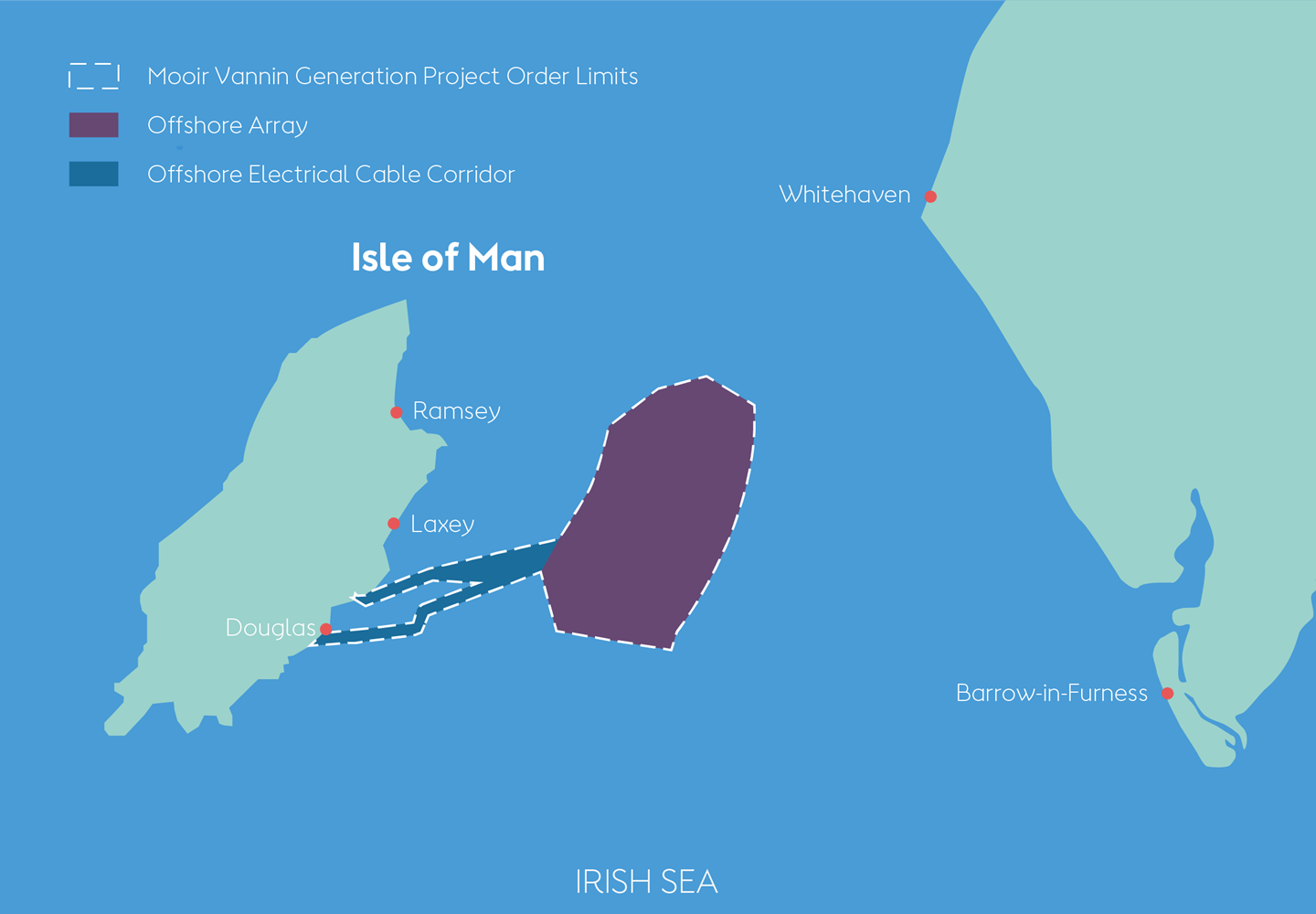
Note.
- The wind farm will have a capacity of 1.4 GW.
- Ørsted is building the web farm.
- It has planning permission.
- The operations base for the proposed Mooir Vannin Offshore Wind Farm will be located at Douglas Harbour on the Isle of Man.
- The Port is Owned By The Isle Of Man Government.
- Anticipated operational start date is the mid 2030s. I’ll assume 2035.
- According to the web site, connection will be to Douglas on the Isle of Man and Penwortham, Lancashire in the UK.
- Penwortham is part of Preston.
- Penwortham substation already has a 50 MW/50 MWh BESS and may get a bigger one.
- Current fossil-fuel power stations on the Isle of Man, include a number of diesel power stations and a 64 MW CCGT. They also have a 23 MW steam generator.
It looks like Mooir Vannin is large enough to give the island a carbon-free energy supply, backed up, by the UK National Grid at Penwortham.
I asked Google AI, “If The Isle of Man Was Going Into The Data Centre Business”, and received this reply.
The Isle of Man is actively positioning itself as a premier hub for data centres, tech firms, and AI companies. The government is utilizing its robust infrastructure, strong regulatory environment, and competitive tax policies to attract high-value data businesses to the island.
It also looks like they have a water system, that has a hydro-electric power-station.
Ørsted Is Danish
Ørsted is Danish and all of those countries to the North East of the UK have lots of islands.
So I asked Google AI, this question.”Does Denmark Have Any Islands With Power Stations?”, and received this comprehensive answer.
Yes, Denmark has several islands with power stations, ranging from natural islands utilizing large wind and biomass facilities to massive, pioneering “Energy Islands” built specifically as offshore power hubs.
Key Examples Include:
Bornholm (Baltic Sea): Designated as a major green “Energy Island” hub. It functions as a massive collection and distribution point for surrounding offshore wind farms, routing renewable energy to both the Danish grid and neighboring countries like Germany.
SamsØ (Kattegat strait): Known globally as a renewable energy island.
It is entirely powered by local onshore and offshore wind turbines and uses a mix of solar and battery storage systems to manage its energy needs, including marina charging.
North Sea Energy Island (VindØ): This is a colossal artificial island project (located roughly 80–100 km off the coast of Jutland) designed to act as an offshore power plant.
It acts as a hub to harvest and convert wind energy from hundreds of surrounding turbines.
Are Ørsted and Highview Power Still Talking?
In Highview Power, Ørsted Find Value In Integrating Offshore Wind With Liquid Air Energy Storage, it appeared that they still were.
As it appears that Highview Power’s Liquid Air Energy Storage can be sized to the application, I wouldn’t be surprised to see one of their batteries on an island powered by Danish wind turbines.
In Is Sumitomo Heavy Industries Highview Power Energy Storage System On Line At Hiroshima?, I describe how a Highview Power application, that uses cold, solar panels and a small Highview Power battery to increase the efficiency of a CNG Terminal.
How Many Of The UK’s Power Stations Are On Islands?
I asked Google AI this question and I received this answer.
There are three major, conventional thermal power stations on the UK’s offshore islands (two in Scotland and one in the Channel Islands), alongside several small-scale community-owned renewable plants that operate entirely off-grid.
The main island-based power stations include:
Lerwick Power Station (Shetland): A 66-73 MW diesel-fired plant commissioned in 1953. It provides a baseline of electricity for the Shetland mainland.
Sullom Voe Terminal Power Station (Shetland): An independent gas-fired station (roughly 92 MW capacity).
Its primary purpose is to serve the Sullom Voe gas terminal, but it also supplies the Shetland grid.
Queen’s Road Power Station (Jersey): A multi-engine facility in the Channel Islands that uses a mix of gas turbines and diesel generators to maintain island capacity.
(Note: Major UK islands, like the Isle of Wight, Anglesey, and the Isle of Skye, are physically connected to the mainland electricity grid via subsea cables, so they do not house their own large-scale, standalone power stations).
Beyond these conventional thermal stations, several smaller Scottish islands run on micro-grid, renewable-only power stations.
For instance:The Isle of Eigg: Powered entirely by a micro-grid of hydro, wind, and solar, completely disconnected from the UK grid.
It looks to me, that the Isle of Man, Shetland and Jersey, are the three most likely islands to get upgraded power systems and it also looks like Ørsted have the experience to make a good fist of it.
Conclusion
I have asked the question, I asked for the UK for a range of countries and I have received some interesting answers from Google AI. But the general trend seems to be to use appropriately-size medium-size and upwards, zero-carbon power stations with microgrids as on the Island of Eigg in the UK.
But I do believe that applying the technology that Ørsted, Highview Power and others are rolling out, that we can give the remote islands and places of Buckminster Fuller’s Spaceship Earth, the zero carbon power they need.
New Optimisation Agreement For 70 MW / 160 MWh BESS In Sweden
The title of this post is the same as that of this press release from Centrica.
This is the sub-heading.
Centrica Energy, the energy trading and optimisation arm of Centrica plc, has signed an optimisation agreement with Ånge Storage Solutions AB, a project company jointly established by Delta Capacity, a Swiss-based developer of utility-scale battery storage systems, and Wood & Co., a leading European investment bank and asset manager, for a 70 MW / 160 MWh battery project in Ånge, Sweden, scheduled to be commissioned in Q2 2026.
These three paragraphs add more detail.
Once operational, the Ånge project will be the largest BESS currently in operation in the Nordics, underlining the strong partnership between the companies and the project’s clear strategic significance and market impact. The project represents a major step forward for grid flexibility in Sweden, supporting the country’s rapidly growing renewable energy capacity while strengthening system stability in the SE2 bidding zone.
Under the agreement, Centrica Energy will act as optimiser for the project, providing 24/7 in-house trading and optimisation services. Leveraging advanced forecasting, real-time market benchmarking and AI-enhanced trading algorithms, Centrica Energy will optimise the battery across wholesale electricity markets and ancillary services, dynamically capturing value across multiple revenue streams.
The agreement on the Ånge project kicks off the partnership between Centrica Energy and Delta Capacity, underlining the companies’ shared ambition to accelerate flexible energy solutions across the Nordics.
It seems that Centrica are doing some serious programming, which mirrors the offbeat engineering, that was hinted at in Centrica Tackles Difficult Terrain To Deliver Sustainable Solar Solution For Derbyshire Manufacturer.
You can’t do anything but like Centrica’s robust attitude and their determination to get things done.
I also wonder, if Centrica are putting their expertise and technical excellence alongside the money and risk of others!
You can argue it was like that with Artemis in the last thirty years of the last century. One quarter million pound computer and software package would be planning and controlling the building of a multi-billion pound project.
I feel now, that I can say that now the Channel Tunnel is part of my history.
From the words of the press release, they seem to have developed a very-sophisticated hybrid-battery-control system, where types with expertise-honed on the trading floor or even the battlefield, could be intimately involved in the decisions.
As a check on my use of battlefield, I asked Google AI”if ex military weapons officers good operators on a city trading floor?” and received this reply.
Ex-military weapons officers—and military officers more broadly—can make excellent operators on a city trading floor, as their skill sets in leadership, pressure management, and risk assessment are highly transferable and increasingly sought after by financial institutions.
Key Reasons Military Officers Succeed as Traders
Decision-Making Under Extreme Pressure: Operational officers are accustomed to making critical, split-second decisions with limited information, which mirrors the environment of a volatile trading floor.
Risk Management & Discipline: The military teaches meticulous planning, risk mitigation, and strict adherence to procedures. In trading, this translates into managing margin, controlling losses, and following a strict, repeatable trading strategy.
High Mental Stamina and Resilience: The ability to stay calm and focused when others are losing their composure is a key trait that veterans bring, helping them survive high-stress trading scenarios.
Adaptability: The ability to respond to changing circumstances on the battlefield translates into managing portfolios in rapidly shifting market conditions.
Transferable Skills Checklist
Strategy & Logistics: Background in understanding supply chain imbalances (supply/demand).Communication: Ability to convey orders clearly and concisely.
Integrity: High level of discipline and accountability.
Potential Challenges and Considerations
While they possess strong psychological skills for trading, ex-military personnel often face a steep learning curve regarding technical financial knowledge and specific market terminology. Furthermore, the transition from a highly structured hierarchy to a meritocracy—where the only measure of success is profit/loss—requires a change in mindset.
Industry Adoption
Banks and trading firms in both the UK and US have recognized the value of these skills, with firms like Citibank and various prop firms establishing veteran-focused programs to hire and train former military personnel.
Conclusion
If ex-military weapons officers can adapt their ability to assess risks and manage operations to financial data, their natural inclination to stay calm under pressure and operate with discipline makes them top candidates for trading roles.
Shares Available In ‘UK-First’ Community-Owned Battery Energy Storage System
The title of this post is the same as that on this article on Solar Power Portal.
This is the sub-heading.
Low Carbon Hub, an Oxfordshire-based developer of community-owned renewable energy projects, is inviting investment in the 3MW/12MWh BESS.
These four paragraphs add more details.
Consumers have the opportunity to invest in the UK’s ‘first’ community-owned battery energy storage system (BESS).
Low Carbon Hub, an Oxfordshire-based developer of community-owned renewable energy projects, is inviting investment in the 3MW/12MWh BESS, which is co-located with the Ray Valley solar power plant.
At one time the largest community-owned solar development in the UK, the 19MW Ray Valley solar project came online in 2022.
Low Carbon Hub now plans to install battery energy storage at the site to “ensure more clean energy is used, and more money is generated for communities,” it said. As such, members of the public and organisations can buy shares in the Community Energy Fund through direct impact investing platform Ethex.
I think we could see more of this in the future.

