It’s Nearly Ten Years Since I Wrote The Streatham Virtual Tube
In the June 2016 Edition of Modern Railways, there was an article entitled Turning South London Orange.
One of the proposals in the article is to create a virtual tube through Streatham.
So I wrote The Streatham Virtual Tube.
My curiosity has been aroused, as to why the article is one of my top posts.
Does anybody have any ideas?
Or could it just be that someone is promoting the Streatham Virtual Tube In The Local Elections?
The Streatham Virtual Tube
In the June 2016 Edition of Modern Railways, there was an article entitled Turning South London Orange.
One of the proposals in the article is to create a virtual tube through Streatham.
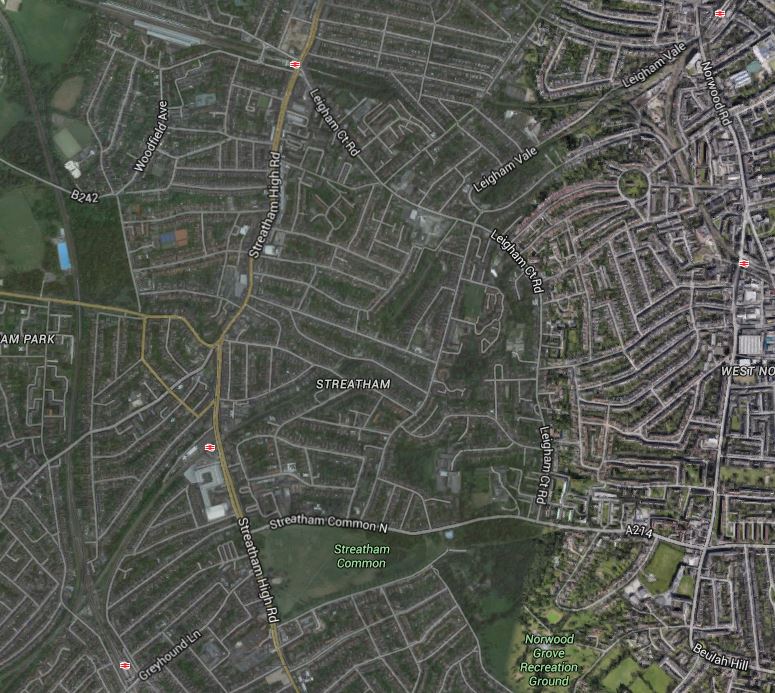
This Google Map shows the area.
Streatham Stations
The stations shown on the map are.
- Streatham Hill station is at the top of the map just to the left of the middle.
- Tulse Hill station is in the top right.
- West Norwood station is on the right in the middle.
- Streatham Common station is at the bottom left.
- Streatham station is almost on a line between Streatham Common and Streatham Hill stations.
The Modern Railways article also says.
TfL has proposed the creation of a Streatham Interchange south of the town centre at the convergence of the Thameslink, London Bridge and Victoria routes near Streatham Common. But it is suggested that with such a move Streatham town centre would still be poorly served for travel in the direction of Clapham Junction, Victoria and the West End.
To take a quick snapshot of the complexity of the Streatham Interchange problem, look at this Google Map of the lines in the area.
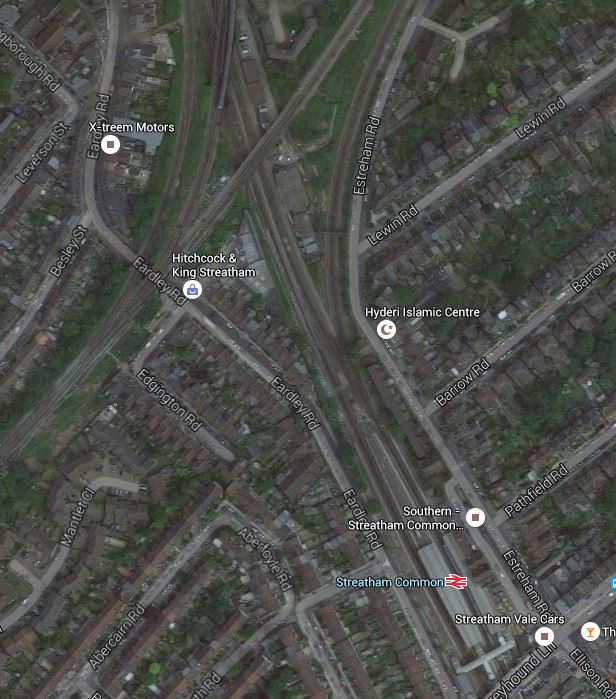
Streatham Common Station And The Tangle Of Lines
In an attempt to sort the problems, the Centre for London is proposing something radical in the form of a virtual tube giving a frequent service between all three Streatham stations; Streatham Common (Interchange), Streatham and Streatham Hill.
The connection would be achieved by.
- A tunnelled flying junction between Streatham and Streatham Hill stations.
- Streatham station would be four-tracked to give within-station interchange.
- A flying junction with the local lines would be provided at Streatham Common.
This would enable some stopping services to Victoria to stop at all three Streatham stations.
A Tunnelled Flying Junction Between Streatham And Streatham Hill Stations
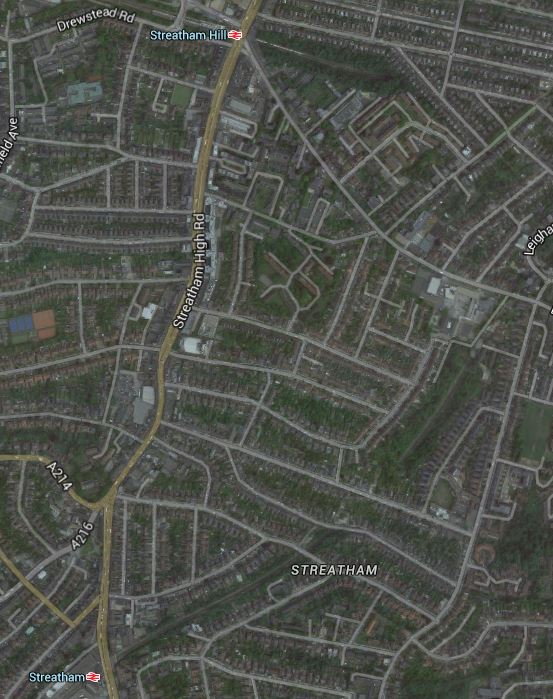
This is a Google Map of the area between Streatham and Streatham Hill stations.
From Streatham To Streatham Hill
Streatham Hill station is at the top of this map and Streatham station is at the bottom.
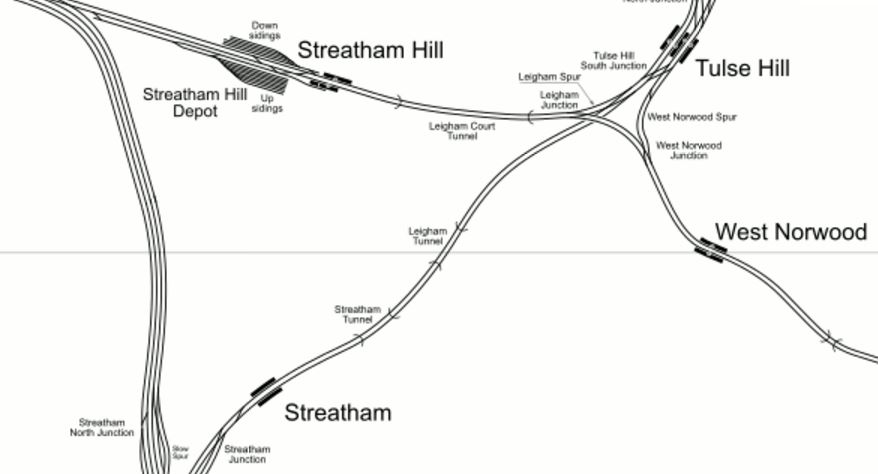
This map from carto.metro.free.fr shows the rail lines in the area.
Lines From Streatham To Streatham Hill
The proposed tunnel would leave the line between Streatham and Tulse Hill stations just after the Streatham Tunnel and curve Northwards to join the line between Streatham Hill and West Norwood stations, probably at the Western end of the Leigham Court Tunnel.
As this is in a serious report produced by professional consultants, I would suspect that subject to full surveying and design, that this is a feasible idea. In the Modern Railways article it is stated to be a three kilometre tunnel.
Four-Tracking Through Streatham Station
The Centre for London proposal states that two pairs of tracks with within-station interchange, should go through Streatham station.
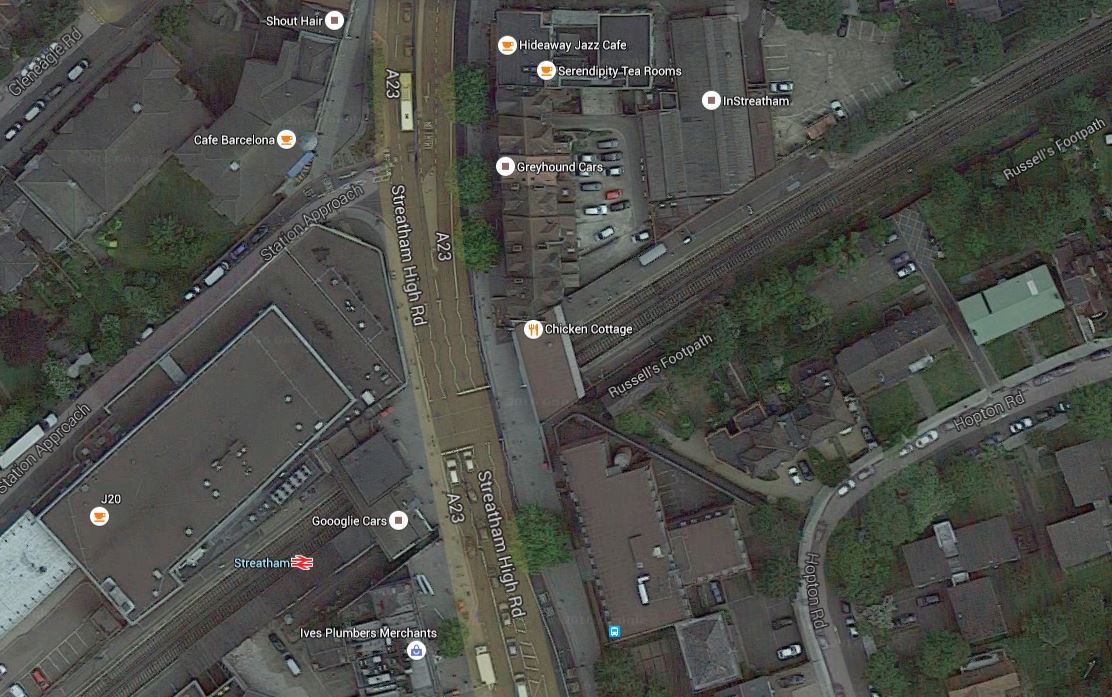
This Google Map shows Streatham station.
Streatham Station
It looks to be tight for four-tracking, but as the report says, two could be below ground.
Streatham Common
This map from carto.metro.free.fr shows the rail lines in the area.

Streatham Common Lines
Simple it isn’t!
I think that there would be a flyover, so that trains going from Streatham Common to Streatham didn’t interfere with other trains going through Streatham.
But there is plenty of space in the area to take the right actions!
Learning From The Tube And Crossrail
If the line through the three Streatham stations is to be a virtual tube, it should take some design clues from the Underground and its bigger and newer sister; Elizabeth.
I’ve probably ridden the Northern part of the Piccadilly Line, hundreds of times and the below-ground layout of stations like Southgate, Wood Green, Arsenal and others is two platforms separated by a wide central concourse, which is linked to the surface by escalators. It is a very workable format, that is used on the Victoria, Central, Northern and Jubilee Lines and from what I’ve seen Crossrail will use the layout at a lot of Central London stations.
It is a layout, that offers many advantages, especially, if the distance between the lines allows a wide and spacious area.
- Passengers have somewhere to wait.
- Some newer stations have kiosks, where drinks, snacks or something to read can be bought.
- Information can be bigger and better.
- Passengers can reverse direction.
- Passengers can change easily to a train going the same way, but to a different destination.
- Escalators and lifts in the centre serve both platforms.
- Three escalators are often provided, so if one needs refurbishment, the station stills has one up and one down escalator.
- Toilets can be provided that serve both platforms.
It is a design that has worked for nearly a hundred years and I believe that Crossrail will improve it sufficiently, so it lasts a thousand.
The S Stock trains of the Underground, the Class 378 trains of the Overground, the new Class 700 trains of the Thameslink route and the new Class 345 trains of Crossrail, are all walk-through trains, which bring several advantages.
Passengers can adjust themselves to the best place for their destination.
Passengers can move along the train to find a seat.
The capacity of the trains is greater.
The Modern Railways article says this about the difference between traditional and walk-through trains.
Analysis by TfL, has shown that station dwell times between Selhurst and Clapham Junction could be cut by up to 42%, if the current Class 377 EMUs were replaced with London Underground’s S Stock, which would be more suited to this type of operation.
So the trains actually go faster, as they spend less time in the stations.
The next generation of trains that replace the Class 377 trains on Metro routes in South London, may well be walk-through.
Trains Between The Stations
I will look at the number of direct trains in the Peak and Off Peak between stations in a typical hour. I have chosen 08-09 for the Peak and 10-11 for the Off Peak.
- Streatham to Streatham Common – Peak – 2 tph – Off Peak – 2 tph
- Streatham to Streatham Hill – None
- Streatham to Tulse Hill – Peak – 8 tph – Off Peak – 8 tph
- Streatham to West Norwood – None
- Streatham Common to Balham – Peak – 8 tph – Off Peak – 7 tph
- Streatham Common to Streatham – Peak – 2 tph – Off Peak – 2 tph
- Streatham Common to Steatham Hill – None
- Streatham Common to Tulse Hill – Peak – 2 tph – Off Peak – 2 tph
- Streatham Common to West Norwood – None
- Streatham Hill to Streatham – Peak – None
- Streatham Hill to Steatham Common – None
- Streatham Hill to Tulse Hill – Peak – None
- Streatham Hill to West Norwood – Peak – 5 tph – Off Peak – 4 tph
- Tulse Hill to Streatham – Peak – Peak – 8 tph – Off Peak – 7 tph
- Tulse Hill to Steatham Common – Peak – 2 tph – Off Peak – 2 tph
- Tulse Hill to Streatham Hill – Peak – None
- Tulse Hill to West Norwood – Peak – 2 tph – Off Peak – 2 tph
- West Norwood to Streatham – None
- West Norwood to Steatham Common – None
- West Norwood to Streatham Hill – Peak – Peak – 4 tph – Off Peak – 4 tph
- West Norwood to Tulse Hill – None
Note.
- Streatham Common to Balham is included, as the proposal assumes some of these will take the new route.
- 4 tph between Streatham and Tulse Hill are Thameslink
Frequencies are generally low compared to the 16 tph on the East London Line or the projected 24 tph on Thameslink and Crossrail.
What Would Be The Termini Of The Virtual Tube?
The Modern Railways article talks about Victoria and Clapham Junction being Northern termini, but what about the new station at Battersea?
But the article doesn’t mention the Southern termini.
So would the line go to the places shown on the map in the article; Mitcham, Selhurst, Sutton and Wimbledon?
We mustn’t forget West Croydon.
In How Trains Reverse At West Croydon, I investigated how trains reversed at West Croydon.
There are two methods; a bay platform and a reversing siding and I reckon with some good driving and signalling and some clever timetabling, that some more trains could be squeezed in. So if the virtual tube goes ahead, I suspect that West Croydon could reverse a few trains.
West Croydon station is also linked to the Tramlink.
Frequencies Through The Virtual Tube
The Modern Railways article says this about the frequency of trains through the virtual tube.
Using this link, some stopping services to Victoria could be rerouted via all three Streatham stations, while it is proposed that Streatham would see a peak service interval between trains of just two to three minutes. To maintain times to Sutton and Croydon, it is anticipated that 4 tph would continue to run directly from Streatham Common to Balham.
So are we really going to see trains every two or three minutes through Streatham station in the peak?
Where are twenty trains going to come from?
On the current provisional timetable for Thameslink, four eight-car Trains trains from the Sutton Loop Line going to London Bridge and on to St. Albans and Luton.
As Thameslink expands to cope with more passengers, surely these trains will go to twelve-cars, once all platforms are long enough. But Thameslink’s provisional timetable already uses all paths through the core, I can’t see any more trains on this route.
At present between eight and nine in the morning peak, nine trains go between Streatham Common and Balham, so this might give us another five trains through Steatham, with four trains still taking the direct route. They will also be trains of at least ten-cars.
So we now have nine trains of 10-12 cars trains going through Streatham. That still means that to attain a twenty tph frequency, we need to add eleven trains.
Perhaps four tph could run between a Southern terminus like West Croydon and Clapham/Battersea/Victoria.
Streatham Common Station
This is the first of the Streatham stations coming into London.
If the virtual tube was built, then inbound services to London would split here, with according to the Centre for London proposals, four tph would go via Balham and the rest would take the Streatham route.
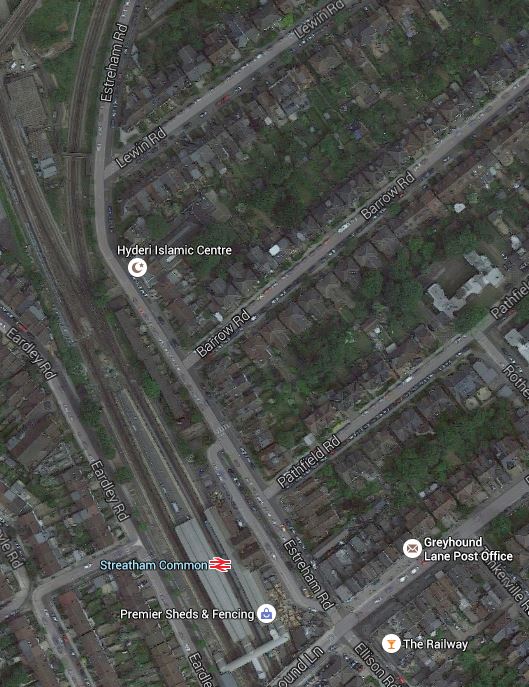
This Google Map shows the station.
Streatham Common Station
Note.
- All services use the Eastern pair of tracks at Streatham Common station.
- Lots of fast services on the Brighton Main Line pass through on the Western pair of lines.
- Services to and from Steatham station curve away to the East.
I think it could be a tight fit to squeeze a bay platform into Streatham Common station, to act as a terminus of the virtual tube.
Streatham Station
This is the second of the Streatham stations coming into London.
It strikes me that the plan for a peak service interval of just two to three minutes is over-ambitious, although the Centre for London report is planning for 2050. Note that the capacity of a twelve-car Thameslink Class 700 train is eighteen-hundred passengers and that the next generation of trains on the Victoria routes will probably be similar in terms of passengers per car.
In a couple of years time on the East London Line, the properly designed two-platform stations like Canada Water, Whitechapel and Shoreditch High Street, with the help of sophisticated modern signalling, will be handling twenty tph.
So surely a well-designed two-platform station at Streatham could handle a similar number of trains! Provided of course, provision was made in the design to four-track the station if that was required in the future.
I think that if it could be done, Streatham needs a single wide island platform, with London-bound services on one side and Sutton, Wimbledon, West Croydon and other services on the other. This would enable single-platform interchanges between all trains, just as is being implemented on Crossrail at Whitechapel.
Escalators and lifts would provide step-free access to both sides of Streatham High Road. Remember the Thameslink trains will be walk-through as will probably be the next generation trains into Victoria, so most of the savvy passengers will position themselves correctly, when they board the train at their initial station.
I think the problems will be more about passengers getting to the station, by foot, bicycle or bus, rather than in properly designed and rebuilt stations and on the trains.
I took these pictures of Streatham station on the first of June 2016.


Note.
- There is a large bus parking area between the Streatham station and the Tesco next door, which could be developed into a full interchange.
- The station has little architectural merit.
- Opposite the station, there is a large gap in the buildings.
- The Morrisons supermarket next door is derelict and could be part of any development.
- It is a drab, dark station with all the style of a 1960s pedestrian underpass.
It is one of those sites where any decent architect could create a practical and good station with the following characteristics.
- A wide island platform capable of taking twelve-car trains on both sides.
- Two sets of escalators and lifts, one on each side of Streatham High Road.
- Appropriate over-site development of flats or offices, that would enhance the area and help pay for the scheme.
- A proper bus station linked to the station.
- A design that would enable two extra lines and platforms to be added in the future.
I’m fairly certain, that whatever Network Rail decide they want at Streatham to meet the required level of service, they will get.
Streatham Hill Station
This is the third of the Streatham stations coming into London.
If the tunnel is built between Streatham and Streatham Hill station, then the traffic through Streatham Hill in the morning peak could be.
- From Streatham Common – 5 tph
- From West Norwood – 4 tph
- Extra Trains – 4 tph
Which makes a total of 13 tph.
These pictures show Streatham Hill station.


It is step-free to both platforms and could certainly handle the required number of twelve-car trains.
But I doubt there is no way that the layout of the station could be improved to allow passengers to go between West Norwood and Streatham stations, without going over the bridge.
Conclusion
I think that a higher service between the three Streatham stations is a possibility, where perhaps four tph between Streatham Common and Balham are diverted through the three Streatham stations.
This could be reinforced by extra trains from West Croydon and possibly Sutton.
A rebuilt Streatham station would give cross-platform interchange with Thameslink and give services to London Bridge.
At the northern end, the trains would terminate at one of these stations.
- Victoria – Is it too crowded though?
- Battersea – For the Northern Line Extension
- Clapham Junction – Perhaps possible, but not the right place!
Or it could take the West London Line at Clapham Junction and go all the way to Stratford or Watford!
TfL will pay their money and take their choice.
Puzzled Over Streatham Common Station
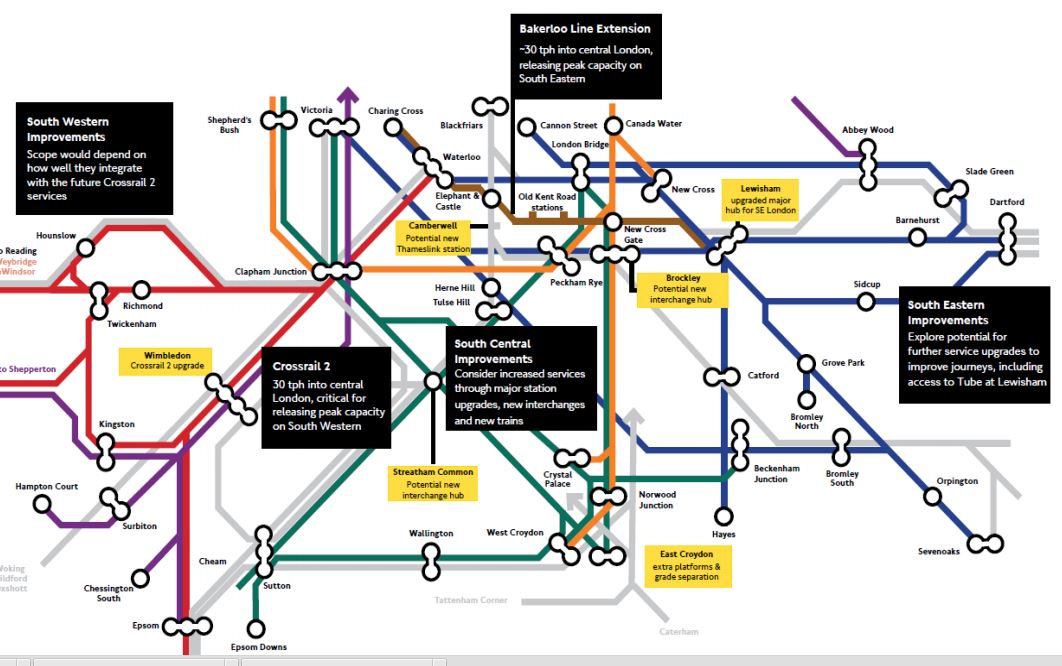
Transport for London’s proposal for the Bakerloo Line Extension comes with a very nice map of the various projects that will be carried out to improve rail services in South London.
Rail Improvements South Of The Thames
It is all good stuff and most is easily explained.
The black boxes are about more general and larger projects, whereas the yellow boxes are comments about specific stations.
The projects; large and small, fit together like a jigsaw. And not a particularly difficult one to understand!
Of the larger projects, the simple extension of the Bakerloo Line to Lewisham station via two new stations and New Cross Gate station is a masterstroke.
- It provides a thirty trains per hour rail link through the Old Kent Road Opportunity Area.
- It gives all those living on the East London Line, as I do, a much needed connection to the Bakerloo Line.
- Coupled with an upgraded Lewisham station, it gives South East London access to the Underground.
- The project can be opened without an expensive set of new trains.
- New Cross Gate and Lewisham stations have space for construction.
- The extension can be built with minimal closure of the Bakerloo Line.
- The project is almost a repeat of the Northern Line Extension.
- No-one’s current train service will be discontinued.
- There is no replacing heavy rail with smaller Underground trains.
- If in the future, the line needs to be extended, this will be no problem, if Lewisham station is designed correctely.
The only negative, is that the plan doesn’t provide a much-needed rail link in Camberwell.
But Transport for London have done there research and have concluded that reopening the disused Camberwell station on Thameslink could be a worthwhile alternative.
The TfL report gives this concise summary.
A new station at Camberwell would be a significantly lower cost option to a Tube extension, whilst serving the same catchment area. Investigations show significant journey time improvements could accrue to Camberwell passengers and that operationally there may be scope to integrate re-opening of the station into the launch of the completed Thameslink programme.
We will therefore undertake further planning work with Network Rail and the London Borough of Southwark to assess the proposal.
It is a second masterstroke.
Camberwell station will probably get a similar service to Loughborough Junction station. I’m not sure what it will be, but something like four eight-car trains an hour both ways. In around fifteen minutes, passengers could be at.
- Balham for the Northern Line and Crossrail 2
- Elephant and Castle for the Bakerloo and Northern Lines
- Blackfriars for the Circle and District Lines
- Farringdon for Crossrail and the Metropolitan Line.
- Kings Cross St Pancras for main line services and the Victoria Line.
Camberwell station could easily be double-ended, with entrances on both sides of Camberwell New Road.
Camberwell would get at least a high-capacity four trains per hour service to virtually everywhere, with just a single change.
And this could be delivered by 2020, if they get the turbo-charged engineering skates out.
On the South London map, there are some other stations mentioned.
- Brockley – Potential new interchange hub
- East Croydon – Extra platforms & grade separation
- Lewisham – Upgraded major hub for SE London
- Streatham Common – Potential new interchange hub
- Wimbledon – Crossrail 2 upgrade
All of these station upgrades are understandable, with the exception of Streatham Common station.
I can only believe that Transport for London have a cunning plan for this station and the tangle of lines to its North.
Streatham Common Station And The Tangle Of Lines
So what would an interchange hub be like?
In the simplest design, two platforms would be built across the lines through Streatham Common station alongside the Sutton Loop Line. They would be connected to extended platforms from the existing station, by stairs and lifts.
I think there would be space to build some bay platforms into the station, so that Streatham Common station could be used as a terminus.
This schematic of the rail lines is from carto.metro.free.fr
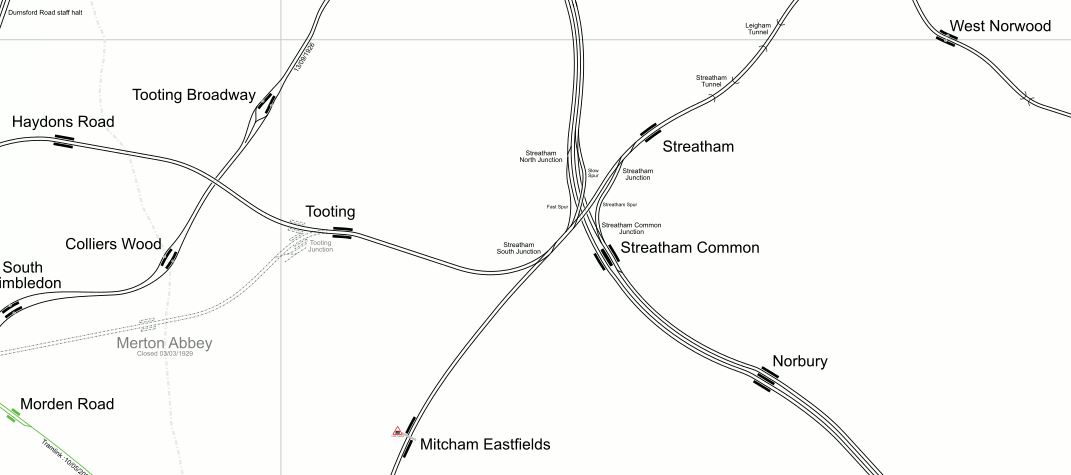
Lines At Streatham
Note how there are very few rail lines, south of Streatham towards Mitcham Eastfields station. Wikpedia says this about the station.
The station is located at Eastfields Road level crossing, in an area previously poorly served by public transport. The nearest station was Mitcham Junction, which along with Mitcham tram stop, was over 1 mile (1.6 km) from the district.
I wrote about the station in Mitcham Eastfields Station.
The lines that currently go or could go through the Dtreatham stations are set out in the following sections.
The Sutton Loop Line Of Thameslink
Streatham station is the last station on Thameslink before the Sutton Loop starts and finishes. Stations on the Sutton Loop include.
- Tooting
- Haydons Road
- Wimbledon
- Wimbledon Chase
- South Merton
- Morden South
- St. Helier
- Sutton Common
- West Sutton
- Sutton
- Carshalton
- Hackbridge
- Mitcham Junction
- Mitcham Eastfields
The fourteen stations have the following service.
- Currently, there are two trains per hour in each direction on the loop.
- Only Mitchan Junction and Wimbledon have connecions to Tramlink.
- I think Streatham to Streatham takes about forty-five minutes of travelling time.
- These trains eventually terminate and come back at St. Albans or Luton in the Peak.
- When the ongoing Thameslink Programme is finished, there will be two eight-car Class 700 trains in each direction every hour.
When the Thameslink Programme was planned, Network Rail intended to terminate these services at Blackfriars.
Residents and their politicians objected! Wikipedia says this.
Network Rail had planned to terminate Sutton Loop Thameslink trains at Blackfriars station, rather than have them continue through central London as at present. This upset many residents in South London and their local politicians, who saw it as a reduction in services rather than an improvement. In response to pressure, government has ordered Network Rail to reverse the decision.
I think this illustrates a certain sensitivity about train services in the area. Do they think that other places like Balham, Croydon and Wimbledon, get all the goodies?
So we have four trains an hour through the core section of Thameslink going on the Sutton Loop.
Although, this shouldn’t affect the services on the loop, could this cause problems for passengers on the trains through Wimbledon and Sutton, as long-distance trains are being used for short local journeys.
For example, you might have mothers with buggies taking babies and children to nurseries and schools, mixed up with commuters, who want to go north of the Thames.
A simple solution would be to have more trains going round the loop, so that instead of just two trains per hour each way, there were perhaps four or even more.
But where would they come from?
They could come a long way from somewhere like Orpington or Cannon Street, which would mean finding paths all over South East London and perhaps beyond.
Or perhaps they could just do the loop and start and finish at either Streatham or an expanded Streatham Common.
As Streatham is just a two platform station, with little space to expand, a bay platform in Streatham Common might be one solution.
Possible Reason for an expanded Streatham Common station – The station could be the terminus of a two train per hour local service around the Sutton Loop.
The Brighton Main Line
The Brighton Main Line goes from Victoria to East Croydon with fast trains generally only stopping at Clapham Junction station en route. However services pass through several important stations like Balham and Streatham Common without stopping.
Could there be advantages in stopping some of these services at an upgraded Streatham Common?
I don’t know under normal circumstances, but there may be good operational reasons for services to be able to call at Streatham Common station.
Possible Reason for an expanded Streatham Common station – The station could be a valuable interchange between Brighton Main Line and other services.
Tramlink
Although Tramlink doesn’t go anywhere near Streatham at present, it does have a main route, south of the area.
There is also a distinct lack of rail services in the area between Streatham and Mitcham, which led to the building of Micham Eastfields station.
In Wikipedia, it says that extensions to the Tramlink have been proposed North and South of Croydon. This is said about North of Croydon.
To the north of Croydon, it is proposed to use a highway alignment based on London Road. To the south of Thornton Heath Pond, the use of a shared carriageway is a possibility. North of this point the road becomes the A23 again, but there are likely to be some opportunities for trambaan type segregation to Norbury and between Norbury and Streatham, although Norbury is a pinch point. The proposal is to terminate the line at Streatham railway station, providing an interchange to the extended East London Line
Possible Reason for an expanded Streatham Common station – The station could be a destination for Tramlink.
Tram-Trains
In areas of Germany, where there are both trains and trams, the Germans are getting very enthusiastic about tram-trains which can run on both networks.
If tram-trains, were to be used on a possible Tramlink Extension to Streatham, they could join the railway at a convenient station, like Norbury or Streatham Common and become trains to go round the Sutton Loop.
Possible Reason for an expanded Streatham Common station – Tram-trains on Tramlink.
The East London Line
I use the East London Line a lot and it has the problem of success.
Trains have grown from three to five cars and some recent trips from Denmark Hill to Dalston Junction have shown, that at times standing is common.
Increased frequencies in 2018/2019, will ease the problems, but would another terminus in South London be a good idea for the East London Line?
The capacity of the core section of the East London Line is twenty-four trains per hour, so even from 2018/2019, there are four more paths available.
So could we see some services going to Streatham Common station perhaps via Peckham Rye, Tulse Hill and Streatham?
A factor that might apply here, is can Platform 1 at Clapham Junction cope with enough trains from Dalston Junction?
Possible Reason for an expanded Streatham Common station – A terminus for a branch of the East London Line.
The West London Line
Southern’s hourly service between South Croydon and Milton Keynes calls at Streatham Common station.
London Overground has a service of around four trains per hour on the West London Line between Clapham Junction and Willesden Junction, which Southern’s service augments for part of the route.
But there are problems with the West London Line.
- There are some extended service intervals at times.
- The Southern service doesn’t call at Willesden Junction.
- West London Line services call at different platforms at Clapham Junction.
- As with the East London Line, could platform space at Clapham Junction be a problem for the West London Line of the Overground
Unlike the East London Line, the West London Line is not a turn-up-and-go service.
So could there be advantages to use Streatham Common station, as a southern terminus for services through the West London Line?
Possible Reason for an expanded Streatham Common station – A terminus for the West London Line.
HS2
When HS2 opens in 2026, getting to Euston station will not be easy, as it is unlikely that Crossrail 2 will have been started, let alone up and running.
Passengers will need to get to a Northern or Victoria Line station and have a deep and possibly tedious journey across Central London.
Thameslink will be of use to some, but there will be a walk or a short-but-difficult tube journey between St. Pancras and Euston.
But HS2 will stop at Old Oak Common station on the North London Line. If the West London and East London Lines were to be extended to Streatham Common station, either could be a good alternative route to HS2 and the West Coast Main Line.
I estimate that Streatham Common to Old Oak Common will take thirty three minutes, compared to Morden to Euston on the Northern Line, which can take forty-one minutes.
Possible Reason for an expanded Streatham Common station – The station could be an important hub, collecting passengers for HS2 and the West Coast Main Line
Crossrail 2
Crossrail 2 is not planned to call at Streatham Common station, although it might go underneath in its route from Balham to Wimbledon.
Even so, I suspect that an expanded Streatham Common station will be to the advantage of Crossrail 2.
As I said earlier the station can help improve services on the Sutton Loop, which would have effects.
- Bring more passengers to Wimbledon for Crossrail 2.
- If extra stations were added to the Sutton Loop, these could help solve the Tooting Broadway/Balham wars.
- Could a new station be built at St. George’s Hospital, between Tooting and Haydons Road stations?
But the biggest benefit would be that Streatham Common station, would be an alternative hub, for those wanting to avoid Wimbledon during the building of Crossrail 2.
Possible Reason for an expanded Streatham Common station – Crossrail 2
East Croydon
When East Croydon station is being extended or the grade separation at Windmill Bridge Junction is being built, surely a well-connected interchange at Streatham Common, could be an asset towards helping to maintain a service.
Even under normal circumstances with a decent tram and train connection to Croydon, Streatham Common station may take the pressure off public transport in Croydon.
Possible Reason for an expanded Streatham Common station – Alternative routes for Croydon
Conclusions
Build a Streatham Common interchange hub!
It is just a pity that Crossrail 2 can’t have a station at Streatham Common.
Is the Streatham Common interchange hub, a third masterstroke?
 The Anonymous Widower