An Unpleasant Experience
I took this picture at Highbury and Islington station from the second footbridge, that links the platforms to the Emergency Exit.
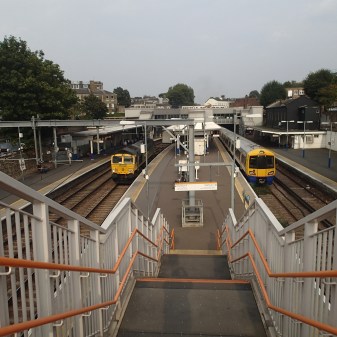
An Approaching Class 66
I have talked about the noise of Class 66 locomotives before in this post, where I said this.
It is important that rail locomotives are improved, as the current mainstay, the Class 66 is not liked by those who live on busy freight routes, due to its noise. I’ve also talked to drivers, who feel they have other problems too.
I could have been more critical. The Class 66 to the left of the picture was pulling a heavy freight train and passed under me, whilst working hard.
The noise was bad, but not as bad as the stink of the exhaust of the massive diesel engine.
I remarked on this to a member of the station staff, who was tidying up underneath the bridge and he said he hated them.
As there are now alternatives, surely pure diesel engines like the Class 66, that don’t meet the latest environmental regulations, should at lest be banned from operating in heavily-populated built-up areas.
In fact, as this line is electrified, what is a Class 66 doing on this line anyway?
Steel Flying Arches At Shadwell Station
These pictures show the steel flying arches at Shadwell station on the East London Line. They appear to be similar in form to the brick arches at Chorley.

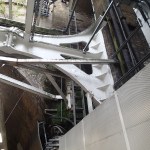
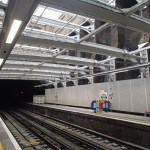
The purpose of these structures is to stop the walls of the cutting collapsing inwards.
They’re not pretty or elegant, but they seem to work!
Is Work Starting On The Hackney Downs/Central Link?
I took this picture today.
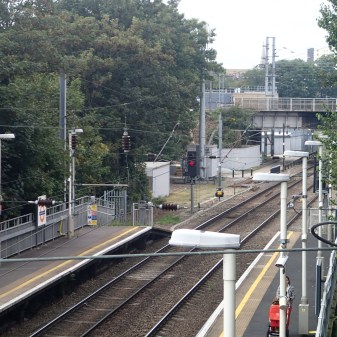
Is Work Starting On The Hackney Downs/Central Link?
It looks like something is finally happening to build the pedestrian link between the two stations.
It should all become clear in the coming weeks.
An Unusual Picture
I have cut this picture out of Google Earth of the railway north-west of Chorley.
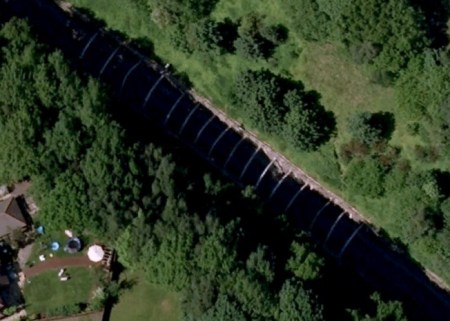
Sixteen Butresses
There would appear to be sixteen buttresses over the twin track railway.
They are actually some of the last examples of flying arches on UK railways. There’s more about the Chorley Flying Arches here.
I’m posting this, as the line through Chorley has just reopened after the related Chorley Tunnel has been expanded to allow for electrification. That is reported here on Modern Railways. It says this about the arches.
As well as upgrading the tunnel, the 16 historic Chorley flying arches – Grade II listed structures on the approach to the tunnel which are the only remaining examples on the British rail network – were refurbished following co-operation and consultation with English Heritage.
On the 22nd of this month, I’m going to see Ipswich play at Wigan. I think, I’ll go and look at these unique structures.
How many countries would actually restore te arches, rather than replace them with modern steel structures?
The Orange Tickets Fight On
It’s the first time, that I’ve noticed it, but this orange rail ticket, I bought at Kings Cross on Saturday has one of those square bar codes.

The Orange Tickets Fight On
As you can see it wasn’t used by any ticket inspector to get to Rutland, as one used a Mark 1 pen and the other some stamp.
It just shows how the original ticket was such a good design from 1986.
I suspect that the basic design of the ticket will outlive me, by a good few years.
Match Five – Derby 1 – Ipswich 1
Derby is one of the easier grounds to get to from the excellent rail station, in that it’s just about a walk of about ten minutes.
Today though, I went via Oakham to have lunch with a friend, so I had to change trains twice at Peterborough and Leicester. Both changes were the ones that should be avoided, where you have to climb up one set of steps and then down to another platform. There were lifts, but in some places on the rail network, we’re seeing reorganising, that mean the up and downs are minimised. We need more innovative thinking.
Oakham is a small simple station, with a pub and brewery attached, so it’s a good place to meet for business or pleasure.
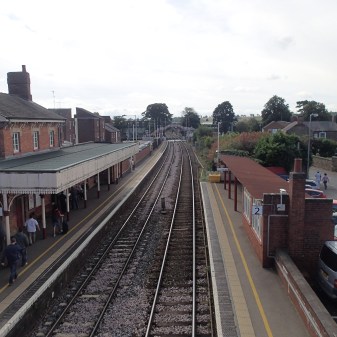
Oakham Station
The picture shows the station from the footbridge. In the distance you can just see the infamous level crossing, that is a pain to people living in the town. The signal box there was used as a model for the Airfix kit.
After an excellent lunch at the Finches near Oakham, I arrived a few minutes late at Derby and thought I’d buy my return ticket before the match.
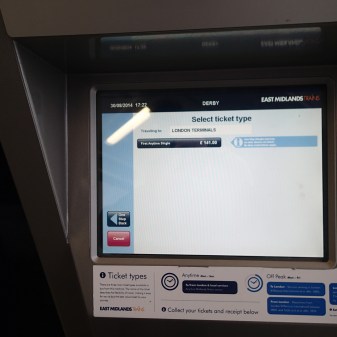
£141 – You Must Be Joking!
This was the only ticket offered by East Midlands Trains. A First Anytime Single at £141.
For Ipswich fans, the match was overshadowed by the news that David McGoldrick is leaving for Leicester. If he had played, the result might have been different as a couple of chances missed in the second half, were possibly the sort, he wouldn’t have missed.
But if Mick McCarthy has got the reported eight million for McGoldrick, then turning round the player’s career and getting half a season out of him for Town, has been good business for all concerned. Let’s hope Mick can resurrect Conor Sammon‘s career in the same way.
The match was enlivened by the debut of Ted Bishop, who after a quiet first half, started to create trouble for Derby in the second half. In dealing with him in one instance, Derby gave away the free kick that led to Ipswich’s equaliser. One shot from distance and another he had when he came on as a substitute at Crawley, show that he might have some serious talent in the future as a scorer from midfield, in the manner of Matt Holland. In some ways, the shot today, was reminiscent of some from Ipswich’s legend Ted Phillips, who I saw score several goals in the early 1960s.
When Bishop tired, he was replaced by Alex Henshall, who showed he could torment the Derby defence.
So two youngsters with a combined age of 38, showed the Ipswich fans, that this season might not be in the dire mould of some of recent memory.
I eventually got home with a ticket that cost £42.90, which was just forty pence more than their on-line price and £2.70 more than the sum of my two tickets to get to Derby. But why don’t East Midlands Trains make their ticket machines easier to use. The trouble was that I tried to buy a ticket via EMTrains, rather than Any Permitted Route on the machine. But as East Midland Trains was the operator I needed for London, surely my choice was logical.
Incidentally, on the train to London, I sat with a Derby fan, who said that for Tuesday night matches he reluctantly had to drive, as there is no late London-bound train after the match.
I don’t find East Midlands Trains good value and avoid them, if I possibly can.
Forward Thinking In Liverpool
As a Londoner, I have always been fascinated with the City’s transport system. I have watched it develop and grow for over sixty years, from the days of trams and trolley buses through the classic Routemaster buses and the birth of the Victoria Line to the present day. London always seemed to have some sort of plan, even if sometimes some of them like the Bakerloo Line extension to Camberwell don’t get implemented and some like bendy buses were a mistake. In some ways one of the best parts of London’s transport system, that has grown over these years has been its coherent and understandable non-electronic information system, which is second to none in the world.
When I first went to Liverpool in the 1960s, the local train system was old and decaying and although the buses were generally younger than most of London’s, the only way to find how to get to different parts of the city, was find out your bus route before you started. It was the same in London in those days, but now generally turn up at any bus stop, train or Underground station in the capital and want to go a particular tube station and you can easily find the route.
Liverpool, Manchester, Birmingham and most of our large cities, still have public transport systems that are fairly incomprehensible to a visitor, who perhaps just wants to get to the hospital to see their Auntie Gladys.
I have never seen something as basic as a decent pedestrian or bus route map at a bus stop outside of the capital.
Could London’s obvious superiority in this area and others in particular, be down to London having an overall transport body, whose origins go back almost a hundred years? Part of Transport for London’s genes say that you must make the best of what you’ve got and that all design must be top class, even if you can’t afford the best architects and designers.
Most conurbations outside London don’t have overall transport bodies with such a heritage. They also often seem to allow the train and bus companies to go off in their own directions, rather than one that is best for everyone.
As an example, ask any visitor to London, how many bus companies there are. They will probably say one. Which is not true as there are several, who each run a number of routes to the same rigid standards laid down by Transport for London. How many areas outside London have a joined-up transport system?
Merseyside is slightly different, in that many of the local rail routes are run under the name of Merseyrail, in much the same way as the London Overground. It is system that seems to serve the city and its visitors well.
I was pleased to see on Global Rail News, that Liverpool is developing a thirty year rail plan. Here’s the first part.
The Liverpool City Region has worked with Network Rail to draw up a 30-year plan to improve passenger and freight rail links.
The Long Term Rail Strategy outlines 12 high-priority rail projects for the city and surrounding area designed to improve both suburban and intercity rail services.
Are other cities so forward thinking? I shall get hold of their plan and explore it.
A Good Score Draw For The Overground’s Ticket Machines
I wrote here about how I bought my ticket to Reading using the machine at Dalston Junction, rather than on the Internet.
Yesterday at about 17:00, I bought my ticket for Ipswich, that I used today.
And I paid the same price, as I would have done on the Internet.
But I didn’t have to go through the rigmarole of entering an 8-character code to get my tickets.
So I think the machine got a good score draw today.
September 6th 2015 – A Date For All Scots
According to this report in Global Rail News, Alex Salmond has just announced that the Borders Railway will open on this date.
Perhaps a bigger uncertainty than the opening date, is whether he will open this significant new railway in an independent Scotland?
Do We Want Platoons of Trucks?
I first read about this idea in the Sunday Times, but I have found a detailed article on the bbc.com website. Here’s the lead paragraph.
Convoys of wireless-linked semi-autonomous vehicles could soon be hitting our roads, giving drivers a chance to put their feet up on the morning commute.
I don’t drive and I miss driving, like you miss the teenager next door, who thinks he’s the best drummer since Ringo, who has just left home.
The technology may well work, but it’s in the same category as driverless cars and unmanned level crossings. They’re all perfectly good and safe until something goes wrong. How many air accidents were never envisaged, when the aircraft was designed?
The thing though about this technology, is there is already a proven alternative in the UK. It’s called freight trains. The money would be better spent removing trucks from the roads, as far as possible. Obviously for long distances across countries like the US, Canada, Australia and Russia, it may well have a place.
 The Anonymous Widower