Will High Speed 2 Have Go-Anywhere Trains?
I ask this question as after writing Plans For Toton Station For HS2 Are Beginning To Emerge, I started to think about the specification of the trains that will work on HS2.
Extending North |From Toton Or East Midlands Hub Station
Extending HS2 to Sheffield from Toton will eventually be via a dedicated High Speed Line, where the trains can run at their design speed of 225 mph.
But Toton HS2 to Sheffield via Chesterfield will be linked by the Erewash Valley Line, where trains will be able to travel at least as fast as 125 mph.
The Erewash Valley Line will probably be electrified before HS2 opens to Toton HS2 around 2030, to bring Sheffield consistently under two hours from London.
Extending North From Crewe
Similarly Crewe to Liverpool will not be getting a dedicated High Speed Line, but there is already a route where at least 125 mph is possible.
As passengers won’t want to change trains, Liverpool will get two trains per hour (tph)from London on HS2.
The only work needed North of Crewe would be to create extra and longer platforms at Liverpool Lime Street, provided that the new HS2 trains can work on classic high speed lines like the West Coast Main Line.
These improvements at Liverpool Lime Street are actually underway and knowing Scousers as I do, you could bet your house on it being ready in 2027, as they would want to have HS2 services at the same time as Manchester, if not a couple of years before.
Learning From The French
We should also look at how the French do things.
If you travel from Biarritz to Paris via a TGV, the service runs on both High Speed and classic lines.
From the Liverpool and Sheffield examples, I suspect that we will adopt a similar philosophy.
Consider when HS2 opens, the places that could be served directly from Crewe.
- Runcorn and Liverpool
- Manchester Piccadilly, if there is platform space.
- Warrington, Preston, Carlisle, Glasgow and Edinburgh – Why not?
- Chester and Holyhead – If the North Wales Coast Line is electrified, as has been threatened!
Note most of the West Coast Main Line routes are covered.
Can this explain the decision to combine the HS2 and West Coast Main Line franchises and the early extension of HS2 to Crewe?
The new franchise could even use the same 225 mph trains for HS2 at a slower speed on the West Coast Main Line to replace the Pendelinos.
The only disadvantage would be that the new trains couldn’t take advantage of the more generous HS2 loading gauge, unless of course the classic lines, where they are to run have their gauges enhanced. This may already be the case, as many of these routes have a loading gauge of W10 to take large freight containers.
The Trains For HS2 And West Coast Main Line
I think we’ll be seeing a very interesting specification for the HS2 trains.
- 225 mph capability on High Speed Lines
- 140 mph Pendolino performance on classic lines where possible.
- Short and long trains. Class 800 trains and others seem to be ordered this way, as five and nine/ten car units.
- Automatic coupling and uncoupling of units, just as Class 395 trains do now!
As the trains won’t be delivered for nearly ten years, wouldn’t be surprised to see that they have a 100 mph independently-powered capability of perhaps 100 miles. This would enable the trains to reach places like Aberdeen, Barrow in Furness, Blackpool, Inverness and Lincoln from the West Coast Main Line or Phase 1 of HS2.
Expanding The High Speed Network
It may seem strange to use perhaps onboard energy storage to extend services away from HS2. But this capability would probably only be given to the shorter trains that can join and split at Crewe or Birmingham International for fast running to and from London. Generally, when operating on onboard energy storage, the trains will be travelling at slower speeds. so less energy is needed.
This would mean that places like Barrow-in-Furnace, Blackpool, Cleethorpes and Lincoln could be easily added to the high speed network.
The High Speed network could also be expanded by improving the current network with selective electrification and the capability for higher line speeds.
All of these improvements on the classic lines, would mean that local and freight trains were able to provide a better service too!
Coupled with HS2, they would make a wonderful marketing opportunity.
I estimate the following using new trains and HS2 from Crewe, when Phase 2a of HS2 is complete.
- Glasgow-London would take under four hours for the journey as opposed to just over four and a half hours now.
- Liverpool-London would come down from two hours twelve minutes to one hour 33 minutes.
- Preston-London would down from two hours fifteen minutes to under a hundred minutes.
- Wigan-London would come down from just over two hours to just 87 minutes.
And some commentators and politicians doubt HS2 is needed.
Conclusion
Certainly, the decision to extend as fast as possible to Crewe was a very good idea.
Consider going from Euston to Glasgow in say 2028.
- The train would run from Euston to Crewe at full speed of 225 mph stopping if required at Old Oak Common and Birmingham International in a time of 58 minutes.
- From Crewe to Glasgow, the train would run at least at 125 mph stopping as appropriately.
- Selective improvements and in-cab signalling would reduce journey times from those of today to the North of Crewe.
Ten years or so later, the journey time will be even faster as the High Speed line was extended past Crewe.
Seamless Interchangeability
At several places on the UK rail network, two trains running as a pair will split, with one train going to one destination and another going to another.
I wrote about trains splitting and joining in Trains Uncoupling and Coupling at Cambridge.
In the past, UK railways used to use the concept of slip coaches, so that coaches could be dropped from an express without stopping. But the last time it was used in the UK was in September 1960 at Bicester North station.
I have just read this article on the Rail Engineer web site, which is entitled Seamless Interchangeability.
The article talks about a concept of dynamic coupling, where trains are automatically coupled and uncoupled at line speed.
It also talks about the issues this would raise.
As a Control Engineer, I’m fairly certain, that it would be very easy to create a system, where say an eight-car Kings Lynn train could split just before Cambridge station, with the front four-car train going to Kings Lynn and the other four-car train stopping in Cambridge station.
It could either be done using two drivers or by driver-less trains. Although the unions would have a lot to say about the latter.
I also believe that if the trains could uncouple, then coupling at line speed would also be possible.
So what is the point?
An Example From The Brighton Main Line
To make full use of the capacity available, Southern serve Littlehampton and Ore, with a train that divides at Haywards Heath. It is a well-proven technique that has been used for decades.
Automatically splitting the two trains at line-speed, can give journey time advantages.
Take the 19:47 from Victoria, which arrives at Haywards Heath at 20:30 as an example.
The following is taken from the timetable.
- The front portion to Ore leaves at 20:34.
- The rear portion to Littlehampton leaves at 20:36.
- Stops at East Croydon and Gatwick Airport take about a minute.
This leads to the following, if the two trains split immediately after stopping at Haywards Heath and before the trains take different directions after Keymer Junction where the East Coastway Line divides from the Brighton Main Line, a few miles South.
- The Ore train performs a one-minute stop instead of one of four minutes, thus saving three minutes.
- The Littlehampton train performs a one-minute stop instead of one of six minutes, thus saving five minutes.
- The platform at Haywards Heath is only occupied for a minute, as opposed to six.
- The Littlehampton and Ore portions must be capable of providing enough capacity for their route.
For those worried about driver-less trains, the driver of the second train for Littlehampton, would probably step up at the previous stop at Gatwick Airport or at Haywards Heath.
But the outcome would be a small increase in capacity on the line, due to the platform at Haywards Heath being occupied for five minutes less.
Coming North, take the 09:47 from Littlehampton as an example.
The following is taken from the timetable.
- The first train arrives at Haywards Heath at 10:35 and leaves at 10:45.
- The second train arrives at Haywards Heath at 10:41.
The pattern of the trains would be different.
- Whatever was the front portion of the train would go through Keymer Junction first
- The train forming the rear portion would be the next train through the junction.
- The rear portion could catch the front portion and the two trains would be automatically coupled together before Haywards Heath.
- The joined train would stop at Haywards Heath for a minute.
- The driver of the second train could step-down at Gatwick Airport or Haywards Heath.
In some ways the mathematics involved in the coupling, are not unlike those for a fighter jet connecting with a tanker aircraft. Except that speeds are a lot lower and there is no need to control direction only closing speed.
Haywards Heath station would be occupied for up to nine minutes less, thus creating capacity.
This simplistic analysis, shows how automatically coupling and uncoupling trains at line speed can create capacity and decrease journey times.
- Journey time from Victoria to Ore would be reduced by three minutes.
- Journey time from Victoria to Littlehampton would be reduced by five minutes.
- In the Down direction the platform at Haywards Heath station would be occupied for just one minute instead of six.
- Journey time from Littlehampton to Victoria would be reduced by nine minutes.
- Journey time from Ore to Victoria would be reduced by three minutes.
- In the Up direction the platform at Haywards Heath station would be occupied for just one minute instead of ten.
Obviously strategies would have to be developed for various eventualities including.
- Unsuccessful coupling or uncoupling.
- Late trains.
- Signalling and train failures.
- Leaves on the line.
- Extreme weather.
But as during all coupling and uncoupling operations, both trains would have a driver in the cab, keeping an expert eye over the procedure and each train could be driven independently, I think all safety issues could be overcome, to the satisfaction of all parties.
If you read the full article, you’ll see that there are some much more exciting possibilities, than the simple ones I have outlined here.
But I do believe that line speed uncoupling and coupling of trains with a driver in the cab of both trains involved, can be a very powerful tool in creating capacity on the UK’s railways.
The Great Eastern Main Line
I know the Great Eastern Main Line well and several trains are coupled and uncoupled regularly on this line.
As Greater Anglia has ordered new five-car Aventra trains and nearly all platforms can take 12 -car trains, running these trains in pairs and coupling and uncoupling appropriately, is probably in their plans for the line.
As on the Brighton Main Line, could coupling and uncoupling at line speed, unlock capacity on the line?
A few weeks ago, I caught a train from Chelmsford to Manningtree, that divided at Colchester, with the front four-car train going to Clacton and the rear four-car train going to Harwich.
The 16:44 from Liverpool street is a train that divides at Colchester, when it arrives at 17:40. These timinings are from the timetable.
- The Clacton portion of the train leaves at 16:44.
- The Harwich portion of the train leaves at 16:47.
As the Sunshine Coast Line for Clacton leaves the Great Eastern Main Line immediately after Colchester station, it would appear that the two trains must uncouple during the stop at Colchester.
Surely, an improved and well-designed automatic uncoupling system could separate the trains faster, saving minutes on both services.
Towards London, two trains leave Harwich and Clacton at 07:16. The timetable shows.
- The Harwich train arrives at Colchester at 07:47 and leaves at 07:54.
- The Clacton train arrives at Colchester at 07:50 and leaves at 07:54.
Surely, an improved coupling system, could join the trains faster, saving minutes on both services.
The time savings will not be as great as those at Haywards Heath, but automatic coupling and uncoupling must be a worthwhile feature of the new trains.
|As Bombardier are adding automation to the Aventra, could they be adding the ability to automatically couple and uncouple trains, both in the station and at line speed?
The West Coast Main Line
I have seen Class 221 Trains, join at Crewe, but I don’t think this is done any more.
However, with the need for direct services from London to places like Blackpool, Burnley and Huddersfield, the ability to be to couple and uncouple trains quickly must be something that would be useful to make optimal use of the valuable train paths on the line.
The East Coast Main Line, Midland Main Line, Great Western Main Line And South West Main Line
If the West Coast Main Line could benefit, then surely these lines could as well.
Class 800/801 Trains
The Class 395 train is very much related to the Class 800 and Class 801 trains, that are being built by Hitachi for the East Coast Main Line, Great Western Railway and other routes.
In The Impressive Coupling And Uncoupling Of Class 395 Trains, I talked about the design of the coupling system for the Class 395 trains.
I would be very surprised if this feature was not incorporated in the Class 800 and Class 801 trains.
So will we be seeing two five-car Class 800/801 trains dividing and joining at a convenient station and then running as a ten-car train to and from London?
Class 385 Trains
What about the Class 385 trains for Scotland?
- These are another version of Hitachi’s A-Train, like 395s, 800s and 801s.
- These will come in two lengths; three-car and four-car.
- Edinburgh-Glasgow services will need at least two units to be coupled together.
- The trains are being introduced from Autumn next year.
It seems to me, that Scotrail are acquiring a very flexible fleet that can run in various lengths.
Will they have the ability of the 395s to couple and uncouple in under a minute?
And if they do, will Scotrail use this ability to adjust train formation to the traffic?
Aventras
There are three definite orders for Bombardier’s new Aventra train at the present time.
- Class 345 trains for Crossrail.
- Class 710 trains for London Overground.
- Five and ten car units for Greater Anglia.
All trains are fixed formations in a mixture of lengths.
Will Aventras have similar coupling and uncoupling performance to Hitachi’s Class 395 trains?
I suspect normally, the Crossrail trains will never be coupled together, as where are platforms for a four-hundred metre long train?
But suppose a train fails in the central tunnel, will the quickest way to remove it, be to attach it to another train and drag it out?
The routes where the London Overground trains will run, are currently served by a mixture of four-car and eight-car trains. So will London Overground, adjust train length to the known traffic patterns?
Greater Anglia do couple and uncouple trains at present to serve Harwich. So I suspect, we’ll see use of an automatic and fast coupling and uncoupling feature to create a more efficient timetable.
Cross City Lines
There are several cross-city lines in the UK.
- Cross-City Line – Birmingham
- Crossrail
- North Berwick Line – Edinburgh
- Northern Line – Merseyrail
- Snow Hill Lines – Birmingham
- Thameslink
One of the characteristics of cross-city lines, is they are busiest in the centre of the city, where passengers tend to use the trains for short hops , as well as longer distances. Then in the suburbs, outside of Peak hours the trains could run almost empty.
Crossrail’s trains are designed so that hopefully they could cope with the variable traffic, but would it be possible to have half trains, which join and split at outer stations.
Thameslink
I think that Thameslink could be the line that might benefit most, as it would probably want to serve more places.
In All Change On Thameslink, I detailed the current proposed schedule of trains.
- 4 trains per hour (tph) – Sutton to St. Albans (2 tph via Wimbledon, 2tph via Mitcham)
- 2tph – Brighton to Bedford
- 2 tph – Three Bridges/Gatwick Airport to Bedford
- 2 tph – Brighton to Cambridge North
- 2 tph – Horsham to Peterborough
- 2 tph – Maidstone East to Cambridge
- 2 tph – Sevenoaks to Blackfriars
- 2 tph -Orpington to Kentish Town/West Hampstead
- 2 tph – Rainham to Luton (via Dartford and Greenwich)
- 2 tph – East Grinstead to Bedford
- 2 tph – Littlehampton to Bedford
This makes a total of twenty-four tph, which is the design limit for the central tunnel.
In this schedule 4 tph go to Cambridge and 2 tph go to Peterborough. Suppose, it was decided that Peterborough needed 4 tph.
The path limit of 24 tph through the central tunnel makes this impossible, but if Peterborough and Cambridge services joined and split at perhaps Stevenage, then both Cambridge and Peterborough would get 6 tph through the core tunnel.
It would need new six-car trains, that could couple and uncouple quickly.
Conclusion
I believe that improving the coupling and uncoupling of all modern trains to the standard of that of the Class 395 trains could be very beneficial, to train operators, staff and customers.
If coupling and uncoupling could be done at line speed, this might bring extra benefits.
The New Norton Bridge Junction In Action
I was travelling between Birmingham New Street and Manchester Piccadilly stations on a Cross-Country train.
After leaving Stafford station, the train took the new route through Norton Bridge Junction on the flyover over the West Coast Main Line to j0in the line to Manchester. The Norton Bridge page on the Network Rail web site, links to this map.
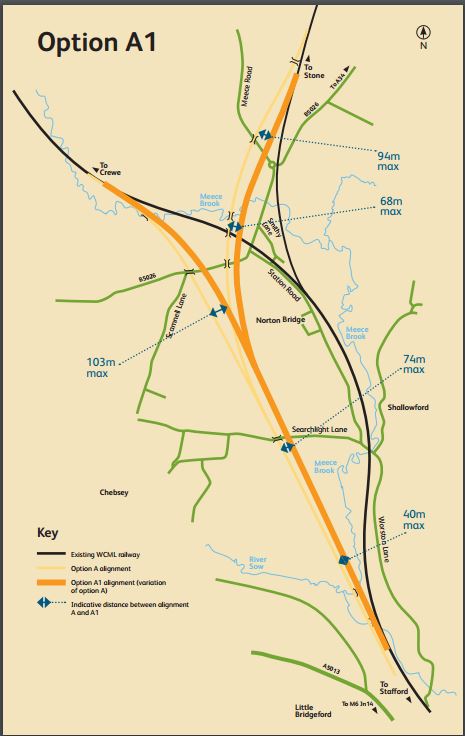
The New Norton Bridge Junction
Trains continuing up the West Coast Main Line take the black route, whereas trains to and from Manchester use the orange line and the branch to the North-East.
This pictures show my progression threough the junction.
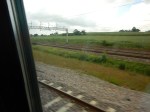
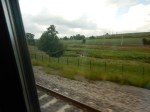
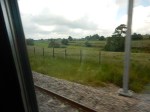
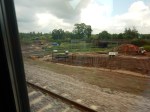
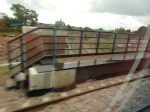
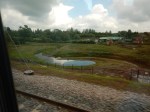
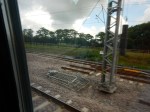
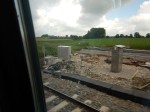
I was sitting on the right side of the train.
It looks like the new route is being electrified.
Would this mean that an electrified service could be run on the following route?
- Euston
- Birmingham International
- Birmingham New Street
- Wolverhampton
- Stafford
- Stoke-on-Trent
- Manchester Piccadilly
- Preston
- Carlisle
- Glasgow/Edinburgh
There is also a current electrified route, using the Crewe to Manchester Line and the Styal Line.
- Wolverhampton
- Crewe
- Manchester Airport
- Manchester Piccadilly
Throw in the Ordsall Chord and I suspect that Virgin Trains, TransPennine and Northern Rail have been looking at their traffic, to see if the reconfigured and electrified Norton Bridge Junction could be to their and Manchester Airport’s advantage.
It should also be pointed out, that much of the line from Preston to Crewe, Stoke and Stafford will have line speeds of on or about 100 mph and the new generation of trains like Aventras, Class 700s and Class 800s will be able to take advantage.
It seems to me, that the Norton Bridge Junction and Orsall Chord projects at £250 million according to this document and £85 million according to Wikipedia, respectively, will help to improve services all along the corridor from Preston to Rugby via Manchester, Manchester Airport, Wolverhampton, Birmingham and Coventry.
Only when you take a train from Birmingham to Manchester and look seriously at Norton Bridge Junction, do you realise its significance.
Freight Through Nuneaton
Nuneaton is where freight trains between Felixstowe and the North West and the West of Scotland, join and leave the West Coast Main Line (WCML).
This Google Map shows the rail lines through Nuneaton station.

Freight Through Nuneaton
Note how the WCML runs diagonally North-West to South-East, though Nuneaton station.
Freight trains from Felixstowe arrive and turn North alongside the WCML before crossing the WCML on a flyover.
Trains can either go straight on to Birmingham and the West Midlands or turn North using the 2012-built single-track Nuneaton North Chord to proceed up the WCML.
This Google Map shows the flyover and the Nuneaton North Chord.

Nuneaton Flyover And North Chord
Trains from the West Midlands to Felixstowe take the flyover in the other direction, but trains from the WCML proceed through Nuneaton station and then turn off to Felixstowe.
This Google Map shows the WCML to the South of Nuneaton station, with the line to Coventry turning off to the West and the line to Felixstowe turning off to the East.

Lines South Of Nuneaton Station
As I came through the area today from North to South, I took these pictures.



I didn’t take any south of the station, as I was sitting on the wrong side to show the line going East.
The Nuneaton North Chord was a one-mile chord and cost £25.6million, which in terms of railway projects isn’t a lot of money.
But it is one of a pattern of short railway lines that have been built or planned in recent years to unlock the potential of the UK’s railways.
- Bicester Chord was opened in 2015 as part of a £130million project to extend Chiltern services to Oxford.
- Hitchin Flyover was opened in 2013 at a cost of £47million.
- Ipswich Chord was opened in 2014 at a cost of £59million.
- North Doncaster Chord was opened in 2014 vat a cost of £45million.
- Tinsley Chord is being built to enable tram-trains to run between Sheffield and Rotherham at a cost of £2million.
- Todmorden Chord was opened in 2015 at a cost of £9million.
But iit is not all plain sailing, as the saga to create the Ordsall Chord in Manchester shows. Plans show it should be finished in December 2016 at a cost of £95million, but a determined local protester has stuck the development in the Courts with the local Councils, Network Rail, the train companies and the Government on the other side.
I do wonder how many of these short railway lines and chords can and should be built.
 The Anonymous Widower