London Overground’s 2026 Map
Transport for London (TfL) have published a map of what they feel the London Overground will look like in 2026.
Most of the changes actually will occur next year, so I suspect there will be other things added before 2026.
My money would be on some of these being completed.
- Electrification of the Dudding Hill Line as a westward extension of the Gospel Oak to Barking Line to rejoin the North London Line.
- A More Comprehensive Interchange at West Hampstead station.
- Some developer-led station rebuilds and perhaps additions.
- Reopening Of the Hall Farm Curve to enable services between Chingford and Stratford, with a stop at Lea Bridge.
- Extra Overground branded services in a loop across South London.
With the exception of the electrification of the Dudding Hill Line and the works at West Hampstead, most of the other projects could probably be classed as smallish ones in terms of cost to TfL. But they may have a high return.
At present the Overground is being upgraded to take five-car trains, but judging by this picture taken at Camden Road station, it would appear that where they can fit them in, platforms are being readied for the next upgrade to six cars.
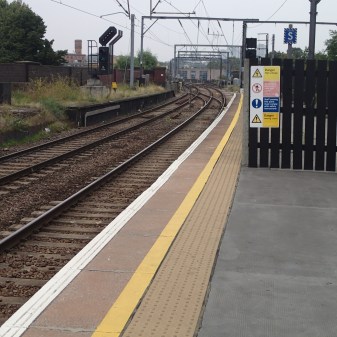
Platform Extension At Camden Road Station
TfL have said, that where stations can’t be extended selective door opening will be used. As the Class 378 trains are walk-through and have a full information system, I’m sure the self-loading cargo, will get used to it.
This afternoon, I travelled along the North London Line and it would also appear that TfL are taking the opportunity presented by the platform lengthening to widen a few of the narrower platforms, like those at West Hampstead. This picture was taken at Brondesbury Park.
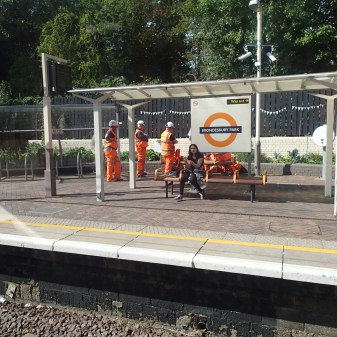
An Oasis At Brondesbury Park
It would appear that they’ve created a much wider platform with a roof and a garden.
TfL also don’t seem to be using a one-size-fits-all at the stations. Too often railway lines seem to be designed to a very limited set of rules to save costs. The London Overground inherited a series of run-down and mismatched stations, which they have almost used to advantage. Some like Hampstead Heath, were probably beyond saving, so they have rebuilt them to a station that befits their location.
In asddition, three external factors will drive the development of the London Overground; freight, the need for the development of more homes and commercial properties of all sorts and Crossrail.
Freight
The Overground gives over a lot of paths to freight, especially on the northern lines. A lot of these trains are still hauled by unfriendly Class 66 diesel locomotives. Alternative electric locomotives or the new Class 88, should be an aspiration for all lines that go through cities.
Bear in mind that once, the Midland Main Line, the Great Western Main Line and the Gospel Oak to Barking Line are electrified, which should all be complete by 2020, the Dudding Hill Line would be the only line, habitually used by freight trains in the northern part of London, not to be electrified.
So for freight reasons alone, I would think electrifying the Dudding Hill Line is a good idea.
But expect a few surprises if Option 1 is implemented, as Transport for London and especially the Overground has a history of doing the unexpected but excellent. Look at the one platform solution at Clapham Junction, where the West and South London Lines of the network meet.
Development of New Homes and Commercial Properties
London may need new railways to cope with the increased population, but it also needs new homes and commercial properties. Land in London is at a premium, but see what was done here in building flats over the new Dalston Junction station.
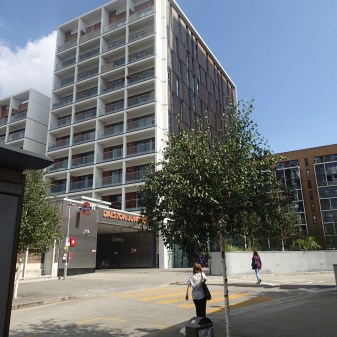
Residential Development Over Dalston Junction
It is not the highest quality of developments, but it was probably the best that could be done at the height of the recession. Small scale development is already taking place at some stations like Highbury and Islington and West Hampstead.
But in this country, we have some very good architects and developers, so I would expect to see some innovative development proposals all round the London Overground.
I must admit, that if I had to live in a modern development, surely one on top of a well-connected railway station is probably best!
Crossrail
London’s new railway; Crossrail, will change a lot of things in London’s transport system.
As a simple example if I go to Heathrow from home, the journey takes about an hour and twenty-two minutes. But after Crossrail is running, the journey will take less than an hour.
But this means, I’ll take the East London Line to Whitechapel to connect with Crossrail.
In addition, Crossrail and the Overground have interchanges at Stratford, Whitechapel and probably by 2026 at Old Oak Common.
So I suspect that many journeys in London will change because of Crossrail.
Predictions made now will be valueless after Crossrail opens in 2019.
No comments yet.
 The Anonymous Widower
Leave a comment