Gatwick Makes A Pitch For The Third Runway
Canary Wharf tube station is all decked out in adverts for expanding Gatwick.
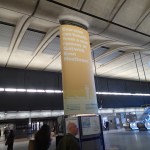
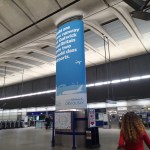
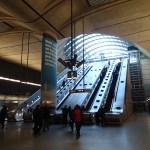

It’s certainly a tough fight between the two airports about which one gets developed.
On the ninth of October, I had a letter published in The Times, under the title, Plane or Train?
Sir, The closure of Richard Branson’s Little Red airline (News, Oct 7) comes at a time when people in their millions are rediscovering trains, raising a question over the attraction and viability of short-haul air services. Together with the introduction of aircraft that can carry up to a third more passengers, this leads me to wonder whether we need new runway capacity.
Effectively, it is a shorter reworking of some of the arguments in Hot Air Over London’s Airports.
To also stoke up the fire, Heathrow Hub were also advertising heavily in the papers at the weekend.
As I said in Hot Air Over London’s Airports, I quite like this proposal. This liking gets bigger every time I read about it.
One thing their reports and all the other proposals don’t talk about for obvious reasons, is the unpredictability of some of the world’s worst air accidents. Just read up on the circumstances that led to the Tenerife Airport Disaster.
For this and other reasons, I would leave the decisions to the professionals. And they will probably say that some proposals have a bigger safety margin than others!
But I still feel my last statement in the Hot Air post might be correct.
But I have this sneaking suspicion that no new runways will be built or extended and in twenty years time or so, we’ll wonder what all the fuss was about.
Passengers will just choose their airports with more care and airports will be competing with us with better and better facilities and more point-to-point flights.
But then some politician might want to add his name to a new London airport.
Squeezing A Bridge Between Working Railways
Crossrail has shown some impressive pieces of engineering to the media. But I’ve seen little about the work that is going on at Whitechapel station where Crossrail goes underneath the Overground, which contrary to what you might think, goes underneath the Underground. These pictures show how one of London’s most delapidated stations is being transformed.
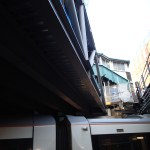
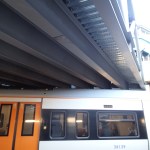
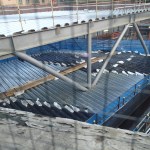
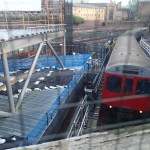

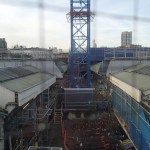
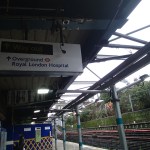
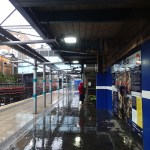
I’m not sure, if the impressive steel bridge is for the Underground lines or passengers. But inserting it isn’t camel-going-through-the-eye-of-a-needle stuff, but something a lot more challenging. Especially, if you’re doing it in the space between two busy rail lines. Luckily for Crossrail, when the East London Line was rebuilt a few years ago, the decision was made not to convert it to overhead electrification.
Look at this section on the Crossrail web site, which shows some images, which help you to make sense of what I photographed. Helpfully, the architect has drawn the trains in the right colours.
Waxing Lyrical About The Overground
My Internet trawler found this article on a web site called The Quietus. It’s an interview with veteran writer and filmmaker; Iain Sinclair.
He says this about the London Overgroiund, when asked about the effect of the lines on his life.
It’s changed mine enormously, in a sense. It’s so convenient that I tend to make journeys that reflect on the railway rather than journeys that I need to make. I wouldn’t have thought of going to Clapham Junction if I couldn’t just jump on this train and get to Clapham Junction. I wouldn’t have gone to Willesden Junction, which proved to be very useful, because I got a better sense of Leon Kossoff as a painter. He’d done some fantastic paintings of Willesden Junction but I didn’t really know Willesden Junction.
I think the Overground railway is a bit like the cinema project in that it curates. It curates a London of disparate elements. What relates Denmark Hill to Finchley and Frognal or Camden Town to Shadwell? They are now an organic identity. And sitting on this train is like sitting in a cinema. You’ve got this screen, and the landscape changes. Patrick Keiller writes that as being the view from the train; that is, really, a form of cinema. I really believe that walking is a form of cinema, and being on a train is a form of cinema, and having the excuse to stop and go to these venues and see some wonderful movie enhances that experience.
Read the full article.
I can see my own behaviour in what he says.
Every city deserves its own Overground network, designed and run to the same principles.
In the UK, Birmingham, Bristol, Cardiff, Glasgow, Leeds and Liverpool seem to be going or starting to go in this direction. Manchester is going a slightly different direction by integrating its trams and trains in the Northern Hub.
As somebody once said in the past – “The Future’s Bright – The Future’s Orange!”
 The Anonymous Widower