Match Nineteen – Charlton 0 – Ipswich 1
Unlike Bournemouth, Charlton was only a short trip across the Thames. I actually crossed on the Emirates Air Line.

On The Emirates Air Line
It was then a short ride on a 486 bus to Charlton station.
As I set out, I thought we might have had a chance of a win, but hopes were beginning to fade as a close fought match, which had produced 40 shots according to the BBC, was coming to the end.
But then substitute, Noel Hunt playing his first match for Ipswich, came on and a few minutes after suffering a blood injury, he managed to drill home his first goal for nearly two years.
We certainly all celebrated long after the match.
Getting home everything seemed to be locked solid, so I walked to Woolwich and got the ferry to my side of the River.
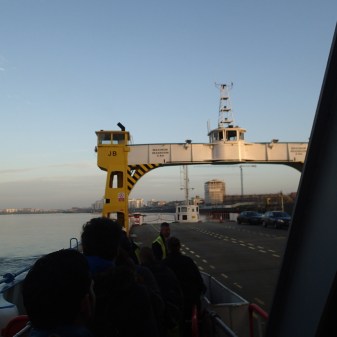
On The Woolwich Ferry
I wonder how many people have flown to a football match and then taking a ferry home.
At least, when I got home around five, I had the pleasure of knowing that Ipswich are now up to second in the Championship.
I also looked at the map after I got home.
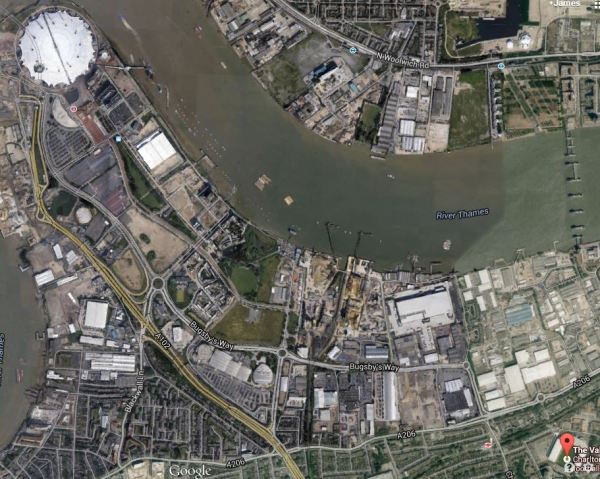
The O2 To The Valley
Note the O2 in the top left, with North Greenwich station just below and The Valley in the bottom right, with Charlton station close by.
I would estimate that next time, I get stuck there, it will take about half-an-hour to walk to North Greenwich station for the Jubilee line.
Raw Material For A New Train
I wrote a couple of days ago about an innovative use of old London Underground trains, to create the D-Train
So what is the raw material; the D78 Stock like? I took a trip on one from Whitechapel to Kew Gardens, where I took the North London Line home.
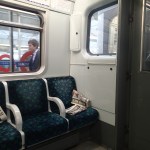

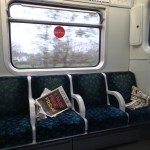
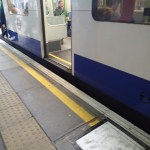
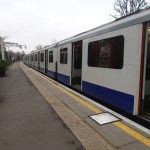
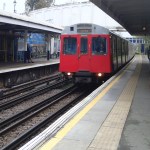
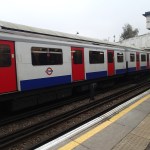
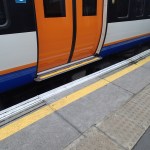
Scrapyard specials they are not! They ride well on rubber coil suspension, with a quality somewhere just short of the S Stock on the Underground. When the train emptied a bit and I got a seat, it made me wonder, why Transport for London are replacing all of them.
Wikpedia says this about their withdrawal.
The stock is scheduled for replacement by S Stock in 2016. It is being replaced about 15 years short of its intended lifespan, as a consistent fleet will allow for frequencies to be increased.
So that’s why. It must also be so much easier for staff on the sections of the line, where it shares tracks with the Metropolitan and Circle lines, that all trains are identical and stop in the same place. Passengers also like the walk-through design of the new S Stock, which eases getting on and off. It also increases capacity by spreading it through the train.
I suppose the main problem is their boxy design, which is not by any means sexy! But you could argue, that they look better than a Class 142. They certainly ride better on those rubber springs.
The more I read about this concept the more I like it.
The designers seem to have taken the approach that a good architect would do, when they’re presented with a Listed building like Kings Cross station and told to make it fit for the next few decades. Every preconception has been thrown out of the window and the designers have just concentrated on a limited set of objectives. These certainly include an affordable, reliable train that meets all the regulations and the expectations of staff, train companies and passeners alike.
But nothing of any substance, can be created without good foundations. The current trains ride well, make the maximum use of the loading gauge and thanks to the refurbishment of the last few years, they have an airy feel, with lots of windows that can be opened for ventilation, if required. I suspect too, that say if you wanted to create some new internal components, a lot of the jigs and mock-ups are still sitting in a shed or are on a computer somewhere.
I particularly like the concept of the power pack. Roger Ford in Modern Railways describes it as being so far off the wall, as to be in next door’s garden. Each driving motor car, will have two fully-enclosed power packs or rafts fitted underneath the train, The engine is a Ford Duratorq, which is built in that centre of railway technology; Dagenham. Vivarail claim that one engine will get the train home, but surely the great thing about having four power packs to a train, means that they can be selectively shut down, when the route allows. The Class 185 trains used across the Pennines, have an Eco-Mode, which selectively adjusts the power to the route, so something similar is surely possible. Computers have been used to control multiple engines according to conditions, fuel economy and power need in aircraft for decades, so I suspect the expertise to create a train that chugs efficiently round the country, is not difficult to find. In the ultimate manifestation, the engine control system would be geared to the ERTMS signalling, when that comes in, so the system would start up and shut down engines in an optimal manner according to traffic.
The power rafts give a tremendous advantage for maintenance. Roger says that taking one out will be a simple ten minute job with a pallet truck, and units will be replaced rather than repaired. Obviously, they’ll be repaired centrally. Vivarail says the concept needs less time in depots
The power raft concept also allows a new raft with perhaps energy storage, like a flywheel to be designed and tested. Given the projected life of the trains, I doubt that a Mark Two power will be developed, but who knows?
The design appears to have an amazing degree of flexibility. Look at this page on the Vivarail web site, which shows some example configurations. Trains can have two or four doors per sides, toilets if required and pictures show the classic four-to-a-table-by-the-window layout is possible.
I also think a seaside or country special would be possible with a large area dedicated for bicycles. Sometimes on Ipswich-Cambridge services, there are bikes everywhere and it is virtually impossible to get in and out.
If I look at the concept from my field of project management it is a dream. Trains arrive from London, as they are replaced by new ones, so for a start there is no storage problem. A separate factory produces the power rafts as required, so materials and cash flow are all as needed.
Even testing and certification is not the extended process it must be with a new train.
There are only a couple of problems that have been flagged up.
Some people think the doors are too narrow. But then, the trains currently run on one of the busiest routes in London and cope well.
Roger worries about the reliability of the power rafts and their Ford engines. I don’t, as if they get the control system right and run the engines efficiently, this will make the task less onerous.
I might flag up another – It’s just a pity, that there aren’t a few more D78 trains to save from the scrapyard.
 The Anonymous Widower