Up And Down The Lickey Incline
When I was growing up in the 1950s, books for boys, used to have pictures of massive steam or diesel locomotives working in twos and even threes to bring heavy freight and passenger trains up inclines in places like the Rocky Mountains and the Alps.
In the 1950s and 1960s, it was quite common to see two engines double-heading a freight train, but it is a practice you rarely see now, except in special circumstances. This video shows a single nuclear flask double-headed by two Class 57 locomotives.
Occasionally, in places in the world, where there are steep gradients, an extra banking engine will be added at the rear to help push the train up the incline. You can imagine it, whilst crossing serious mountains or possibly even on the the Highland Main Line, where I rode in the cab of an InterCity 125 from Edinburgh to Inverness.
But you wouldn’t think you’d see this technique on the south-west approach to Birmingham from Bromsgrove!
You would be wrong, as this video shows. It was uploaded in 2007.
It shows a Class 66 locomotive taking a coal train up the Lickey Incline, assisted by a similar locomotive at the rear. If you search YouTube for Lickey Incline, you’ll find some real engineering pornography, like massive steam locomotives being assisted by four smaller tank engines.
But in a few years time, the pictures will all be different, as the Cross-City Line from Lichfield via Birmingham is being electrified to Bromsgrove and Redditch. Bromsgrove will also be getting a new four-platform station, which should open in November according to this article in the Bromsgrove Advertiser. Three new Class 350 trains have been ordered to provide a much-improved service, of three trains an hour to each of the two southern termini.
It looks like the improvements to the southern end of the Cross-City line with come out at around £65 million and the new Bromsgrove station at £17.4 million according to various reports on the Internet.
I would think this investment is money well-spent, as the line is the busiest commuter railway outside London.
I think that if the next government devolves transport to local areas, then other projects like this will be undertaken in the West Midlands.
For example, the reinstatement of passenger services on the Camp Hill Line is a long term aspiration of the city.
To Dive Or Fly At Werrington
Network Rail are doing their bit to speed up trains on the East Coast Main Line. Over the last few years they have upgraded the Great Northern Great Eastern Joint Line from Werrington Junction, just north of Peterborough, to Doncaster via Spalding, Sleaford and Lincoln, so that the number of freight trains on the East Coast Main Line can be reduced and the passenger services can be speeded up. This page on Network Rail’s website describes the work.
But all these freight trains have started to get up the locals noses. This article in the Peterborough Telegraph is entitled Werrington And Peakirk Residents’ Plea On Rail Plans. It starts like this.
Two petitions signed by 752 people in Peterborough opposed to plans to increase freight services on the railway have been presented to Parliament.
Householders in Werrington and Peakirk have signed the petitions calling on the Government to start talks with rail operator Network Rail about the proposals.
The line is also noted for its numerous level crossings and proposals to shut them and according to this article in the Lincolnshire Echo, there is opposition to the closure of at least one crossing.
So now Network Rail want to create a flyover or a dive-under at Werrington Junction to speed northbound freight trains turning on to the line through Lincoln. This map from Network Rail, shows the two options.

Werrington Junction
The dive-under is shown in red and the flyover in blue.
I have a feeling that the decision for this much-needed junction and its construction will be a long-time coming.
I also think that it is complicated, by the fact that Peterborough is very much a city, where most people don’t use public transport, as they have their own cars, so any local vote would not be in favour of improving public transport or the railway, unless perhaps it improved commuting to London.
Perhaps the solution to these problems, could be a bit of bribery in the form of some strategically-located new stations and a very much improved rail service between Peterborough and Doncaster via Lincoln.
Removing One Hundred And Seventy Years Of Inadequate Design
The Manchester to Preston railway is san important line in the North-West of England, that was completed in 1841.
To say that is not fit for purpose is a total understatement, as it is not electrified and has a speed limit of just seventy-five miles per hour.
Finally, the line is being electrified and the speed limit will be raised to a hundred. From December 2016, hopefully refurbished Class 319 trains will be speeding from Manchester via Bolton and Preston to Blackpool and possibly Windermere.
The major problem on the line are the twin tunnels at Farnworth. They have a history of make-do-and-mend and are too small to take the overhead wires and Network Rail have come up with a practical solution, that should last several hundred years at least. This Google Earth image shows the ends of the tunnels with respect to the location of Farnworth station and the A666.
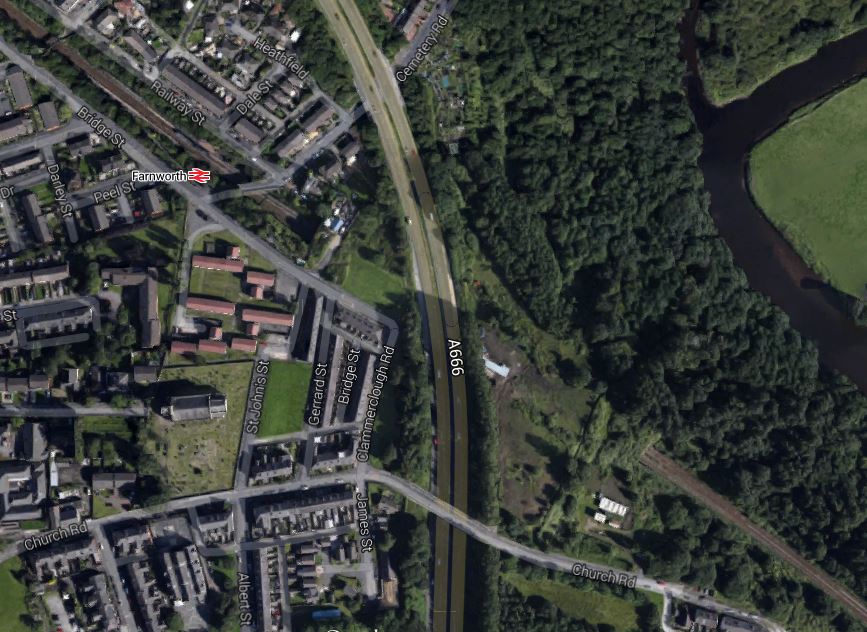
Farnworth Station And Tunnels
The smaller of the two tunnels will be refurbished and given a concrete lining, so that during the works, there will always be one track for trains. They will then bore out the larger tunnel, so that it is big enough to take two tracks and the overhead lines.
This will require that between May and October this year, there will be significant disruption to rail passengers. The whole project is described in this article in the Bolton News. It may cause a lot of disruption, but the passengers seem philosophical, as these paragraphs from the article show..
Jeff Davies, part of the newly formed Bolton Rail Users Group, said: “The station closures are the bad news, but there is good news here actually.
“It is the beginning of big investment which could take us out of the present problems and the companies have been at great pains to minimise inconvenience and ensure that Bolton people who work in Manchester will still be able to get there.
Perhaps this is because Network Rail have done their public relations well, if this YouTube video entitled Rebuilding the Farnworth Tunnel is anything to go by.
It all goes to prove that politicians should have sorted out the mess that are the railways of the North many years ago.
 The Anonymous Widower