Racing Trains To Scotland
As a child, I was never a great reader of books, except for encyclopaedias and other factual books. In an effort to get me to read more, my mother got me a book from the library about how the various train companies in the late 1800s tried to outperform each other to Edinburgh in 1888 and Aberdeen in 1895.
All of this has come back to me, as this month’s edition of Modern Railways is talking about developments in the services to Scotland, that could happen over the next few years.
The Press of the time, dubbed this Victorian rivalry as the Race To The North and in the section in the Wikipedia entry about the rivalry to Aberdeen in 1895, this is said.
In his 1958 book about the series of races, Oswald Nock wrote of the 22/23 August journey, “And at that astonishing average speed of 63.3 mph made sixty-three years ago the London–Aberdeen record still stands today”
The time was even more astounding, when you consider it wasn’t beaten until the 1970s by an InterCity125, which still work the route today.
The time on the night of the 22nd/23rd of August 1895 was eight hours forty-two minutes with Victorian steam locomotives and today the 200 kph diesel train takes just a few minutes over seven hours. But the modern train takes the shorter East Coast route!
The East and West Coast routes obviously don’t race each other these days, but according to Modern Railways, it looks like travel between London and Edinburgh is going to get faster and more interesting, as Virgin are aiming for quite a few four-hour trains throughout the day and two new companies are applying to run direct services between the two capitals.
If I understand the article correctly, by 2020 Virgin will be running three trains an hour between London and Edinburgh. The train from London on the hour will stop at Newcastle with York in alternate hours. The one stoppers will do the journey in four hours with the others just a few minutes slower.. Hopefully by 2020, the new Class 800 and Class 801 trains will be running the semi-fast services in four hours twenty-three minutes. The fastest trains now take four hours and twenty minutes.
Two new operators are applying to run trains on the route.
GNER which is ultimately a subsidiary of Deutsche Bahn is planning to use 12×9-car Pendelinos to provide an hourly ‘fast’ service in three hours forty-three minutes from December 2018. They have said, that they are aiming to tempt passengers to switch from plane to train.
The article quotes that rail has a 30% share of the London-Edinburgh market, where there are 42 flights a day. They want to push rail’s share up to 50%.
In Edinburgh – Train or Plane? I compared a journey up by easyJet from Stansted with a return in First on East Coast. Both journeys cost and took about the same time from Hackney to the centre of Edinburgh.
FirstGroup is aiming to run five trains each way between London and Edinburgh in four hours from December 2018, using new Hitachi AT300 electric trains with three stops en route at Morpeth, Newcastle and Stevenage. First has said it will be targeting passengers from the low-cost airlines.
I’ve only talked about Edinburgh in this piece, but a lot of the analysis will also apply to the West Coast Main Line, which has already hsad a dose of a competing service, in the share of First TransPennine to Manchester.
If these plans come to fruition, it would look like the slowest trains on the Edinburgh route will be the Virgin semi-fasts, which will take just a few minutes longer than the fastest trains today.
Out of curiosity, I looked at trains and flights for tomorrow (today is a Monday). I could get the 08:00 out of Kings Cross, which gets me into Edinburgh at 12:20, just in time for lunch, for a Second Class cost of £33.95 and a First Class cost of £65.95 (both costs third-off with Railcard), whereas the easyJet flight from Gatwick or Stansted costs around £60, but would probably mean leaving home well before five in the morning.
This leads me to think, that if all these train services to Edinburgh come to fruition, that the only losers will be the airlines, especially if the large increase in capacity on the route brings down train fares.
What Are We Going To Do With The Palace Of Westminster?
The Palace of Westminster has an iconic status, in addition to its function as home to the two houses of the British Parliament.
It’s well-document problems, as detailed here with their solution in the Guardian are pretty serious, so something drastic needs to be done to either preserve or replace the building. The article suggests complete modernisation of the way we are governed with electronic voting, modern offices and the like. This is a typical paragraph.
Yet the buildings cannot be considered in isolation. The deterioration of the estate is an opportunity as well as a crisis. There can be no question of expensively retrofitting the palace to recreate outmoded working practices, traditions and habits. Parliament must become a workplace, instead of a Victorian club. Few modern offices do or should have bars, let alone subsidised ones. A rethink of the institutions, organisation and culture is well overdue, and it must be reflected in the renovations chosen.
I agree with the first part of it, but in some ways too much change in the way it works could destroy British democracy for ever.
I feel so strongly, that I wrote this letter to The Times.
I spent most of my working life, writing software to support the project management of large enterprises.
This has led me to the conclusion, that often what gets created is often very different in concept to the original proposals, once engineers and architects apply some innovative thinking.
I have heard so many arguments in all different directions on the rebuilding of the Palace of Westminster, that I despair anything will ever be agreed. So let’s think laterally!
If you go a couple of bridges upstream, you come to the home of MI6. On the river frontage of this building, one of several large junctions for the new Super Sewer is being dug deep into the river.
The most pressing problems in the cramped Palace are space, services and vehicle access and parking.
We could use the techniques of the Super Sewer, to create a building for these urgent needs alongside, but a respectful distance away from the Palace, deep under the river.
The two buildings would be connected by tunnels and if an island garden could be created on top of the new building, by footbridges. Vehicles would enter through tunnels at either end to and from the Embankment. Parking would be solely in the new building, thus releasing space in front of the Palace and freeing up the parking underneath for more important uses.
I believe that creating this second invisible building, would allow the current Lords and Commons to function as normal during the rebuilding. Modern lighting, would even allow the creation of world class offices and perhaps a third chamber under the Thames.
It wasn’t published, as I suspect they filed it under madmen!
But is it so unfeasible and just silly?
Look at this Google Map of the River Thames between Westminster and Lambeth Bridges.
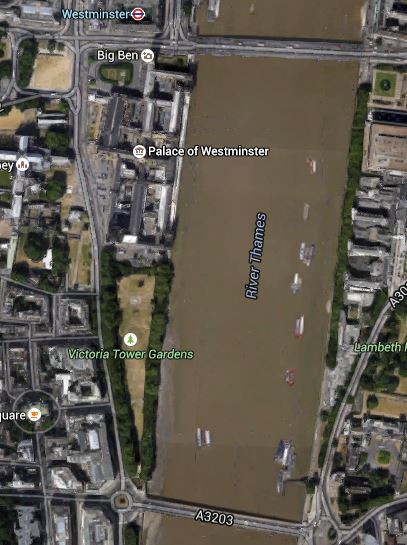
The Palace Of Westminster And The Thames
The only construction in the river, will be the Super Sewer, that goes underneath it somewhere in the middle. This picture shows the River looking from Victoria Tower Gardens towards Westminster Bridge.
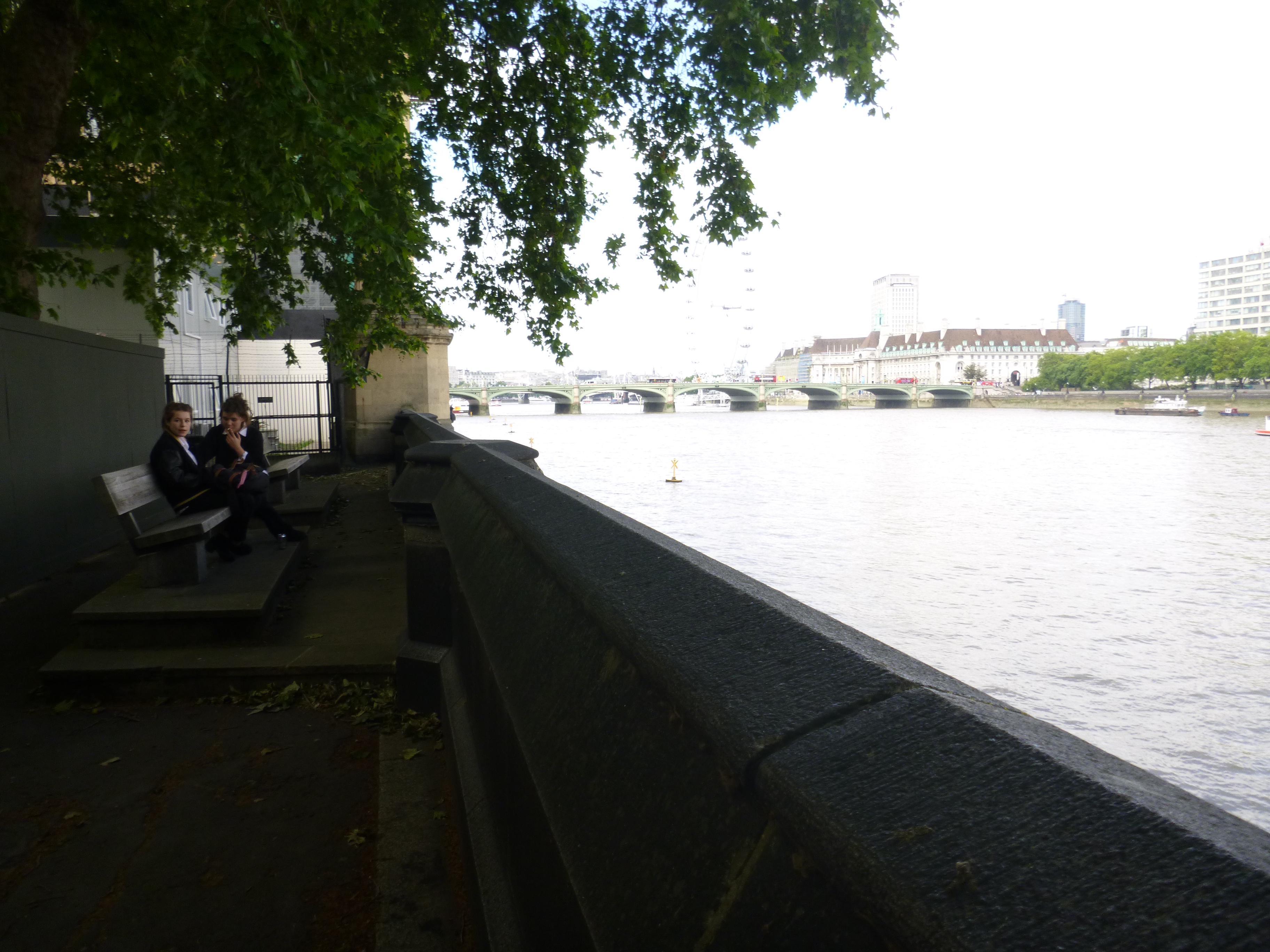
Westminster Bridge
It is a view that must be protected. On the other hand the view on the other side of the Palace, is just a jumble of security blocks and car parking.

In Front Of The Palace Of Westminster
The whole area is a World Heritage Site and it is not treated with the respect it deserves. In fact, it is a complete disgrace.
This Google Map shows the area of the World Heritage Site.
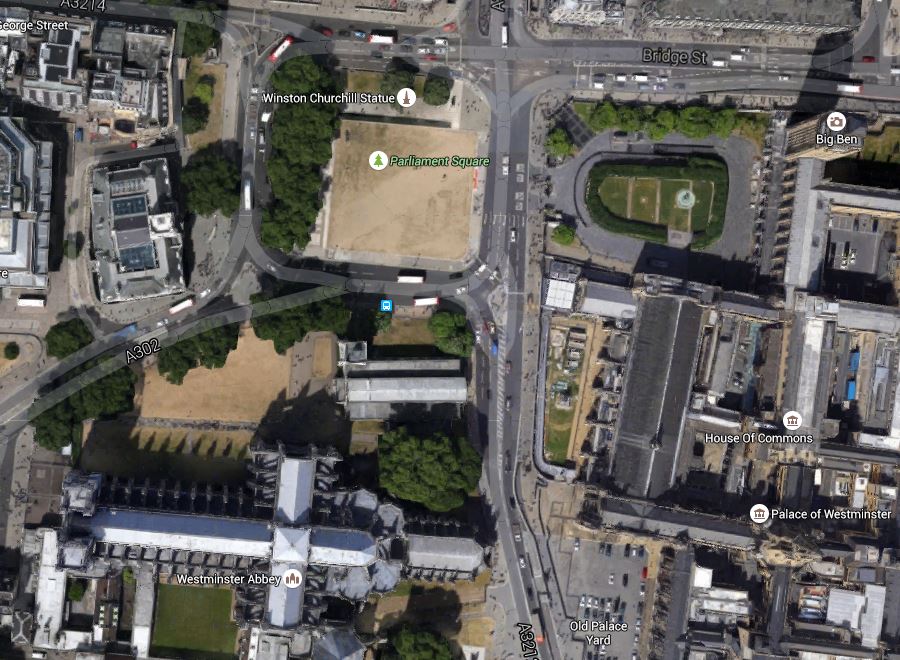
Westminster World Heritage Site
It needs to be improved by banning all traffic except bicycles and buses from the whole area around Parliament Square, the Palace of Westminster and Westminster Abbey.
Extending my plan to do this would put an immersed tunnel in the river from say Whitehall Gardens opposite the London Eye to Lambeth Bridge.
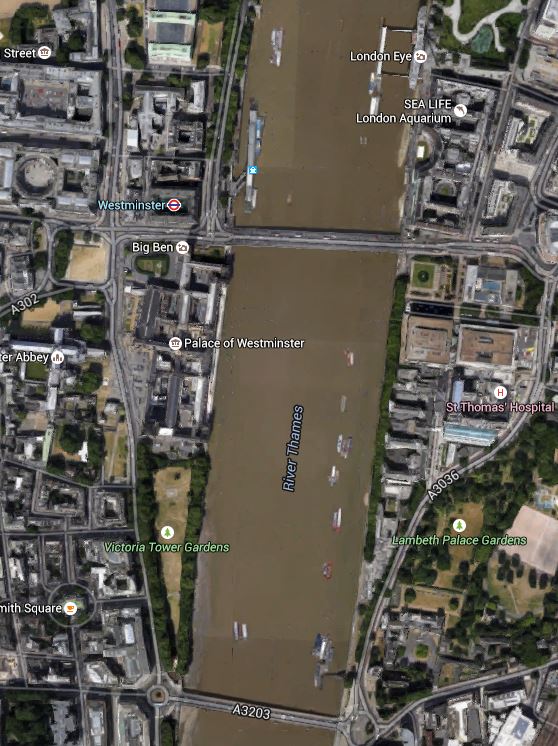
Whitehall Gardens To Lambeth Bridge
It would run through or alongside the new building under the river, that I proposed in the letter to The Times.
Note that there is another building in London, that is built deep down into the water connected to everywhere else by tunnels. It is the massive Lord Foster-designed Canary Wharf station for Crossrail.
The construction of the new building and the tunnels, should be well within the compass of those that designed and built the station. Incidentally that station was built in six years at a cost of five hundred million pounds., without interfering with the daily life, going on all around. You could even bring in construction materials and take out the large amount of spoil on the river.
Once the building, with its car parks and tunnels is complete and connected to the Palace of Westminster, you could start to refurbish the historic palace.
I think that it is totally feasible,
I would also incorporate the following into the design.
1. Pedestrianise as much of the area as possible, whilst allowing buses and cyclists.
2. Build a modern semi-circular third chamber in the new building, to act appropriately as the Commons or Lords during refurbishment. And why not build it big enough for joint sessions of both houses with all the modern features that most parliaments around the world possess?
3. Put all services, car parking and vehicle access into the new building.
4. The new building would of course contain the extra much needed offices.
5. Perhaps more radically, the top of the building could be covered by a floating island, which could be a viewing garden for the Palace, with access by walkways from Westminster Bridge and Victoria Tower Gardens. It can’t be fixed, as the river is tidal.
I think if we think radically, architects and engineers can come up with a scheme that is workable and turns the Palace into a modern Parliament without any loss of history, and the area into a World Heritage Site worthy of the name.
It won’t happen and in thirty or forty years time, they’ll be another crisis concerning the state of the Palace of Westminster.
The Tragedy In Tunisia
For the second time in my life terrorism has got personal with my memories.
Two weeks after I stayed in the Taj Mahal Hotel in Mumbai, it was attacked.
It must be nearly twenty years ago, that C and myself, stayed in Sousse and had a wonderful holiday.
But, it is nothing to all of those directly affected, whose lives will be changed forever by the pointless actions of the terrorists.
My heart goes out to everyone who has suffered loss!
When will it all end?
I sometimes think, that the time has come to send in the troops to cleanse the world of the scourge that is Islamic State, Boko Harum and all of the others, who just like killing people and destroying things and the lives of others for fun!
These groups are no more Muslim than I am!
But we would reap the whirlwind, as things would just get worse!
 The Anonymous Widower