Do Politicians Make Too Much Fuss About Currencies?
The Needs Of People
I travel extensively across Europe and after trips like my Home Run From Krakow or my Home Run From Stockholm, I end up with a walletful of assorted zlotys, crowns etc.
But it won’t always be like that, as increasingly contactless cards and smartphones will take over from cash. How long will it be before a lot of public transport in the world uses the London model, where you just touch and go?
So I suspect cash will become very much a method of payment that will not bother visitors.
Other developments will also help.
1. Using Coins
Vending machines, toilets, left luggage lockers and other places that need small cash payments will get intelligent and probably respond to the local currency and a selection of others, like one and two euros, pound coins and dollar quarters.
So a visitor to Europe, would just make sure they topped up their one euro coins.
2. No-Commission on Credit Cards When Used Abroad
The credit card I use abroad, is a Nationwide Select Credit Card and this page on their web site, describes its use abroad. And so far, they’ve done what it says on the tin.
As the card was recommended by one of the Personal Finance Experts on the BBC, it can’t be that much of a con.
All credit cards should be like this!
3. Late Rooms et al.
On my trip to Poland, I used lateroom.com to book accomodation and some of the hotels were paid in zlotys. But I paid in advance in Pounds Sterling.
All of these systems are giving both the seller and the purchaser a bill in the currency they want.
Summing Up The Needs Of People
All people want is a system that buys that drink, meal or rents that room or sun lounger giving them a good rate with no hassle.
The Needs of Business
When it comes to business, I’ve just paid two overseas bills using SWIFT from my Nationwide account. I got charged £20 for each one, which was a bit steep in my view, but these days you can transfer money pretty easily.
The Greedy Bankers
So I come to the conclusion, that on a small transaction basis and that probably means anything under a couple of grand, transactions should be possible on what we have today.
Just look at what you can do with PayPal and an eMail address.
But would greedy bankers and their friends in Central Banks allow multi-currency transactions to become the norm for money transfer between consenting adults or companies?
The Innovators
Just look at how finance has changed in the last few years.
Nothing is cast in stone and who’s to say what will be the financial flavour of 2016.
Every problem is an opportunity for an innovator. And this type of disruptive innovation often hurts established players!
Summing Up The Needs Of Business
A business just wants money transferred to a client or supplier at the best rate instantly, for the lowest possible commission.
So Who Needs A Single Currency?
The only advantage of a single currency like the euro or the dollar, is that you know easily what you are paying and that accounts and paperwork are simpler.
Politicians also say it creates jobs as it encourages industries like tourism.
It may do, but the UK gets masses of tourists and not being in the Eurozone doesn’t seem to be a problem. Visitors are happy to use their credit cards or prepay for everything in their own currency, so it probably illustrates that if you have a good product, then the tourists and money will roll in.
I think it is probably true to say that politicians also like a single currency as it’s a big idea, with which they might leave their mark on history.
I was probably in favour of a single currency for Europe at one time, but I think now, that so many innovations will get round the rules and create lots of jobs, that it is rather an outdated concept.
I much prefer a simple process that allows me to spend pounds everywhere with the best exchange rate and no commission.
In some ways this will be an unrealistic idea, as politicians will protect their useless banks.
But they will have to legislate a ban to stop it.
Remember that politicians don’t understand new technology. Look at the mess they;re all in over Uber.
A Circular Walk From Royal Oak Station
When I wrote about my last visit to Royal Oak and the Westbourne Park Footbridge in October last year, I said this.
It will be fascinating to go back here, to see the area, as the railway and its infrastructure progresses.
So this morning, I went back and took these pictures, to see if they could add to what I saw yesterday.


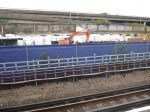




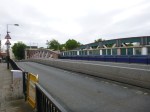



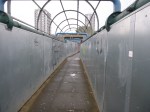
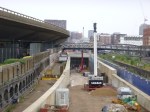




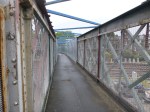
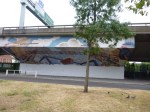
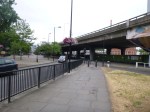


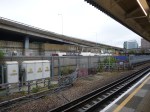





Things have moved on apace.
1. Royal Oak station is no longer the rusting ruin it was last year and all of the glass is now clear and immaculate.
2. Crossrail has also dropped the height of the blue security fence, which means tall people can get good pictures of the Crossrail site from the platform of Royal Oak station.
3. It is now clear that the arches support the slip road up to the Westway and that they may have once supported an old railway line.
4. I was pleased to see the lith-style information displayed in a poster. It must help with putting information in places, which are too small or not suitable for a full size lith. It all goes to show how good, Legible London is.
According to Wikipedia, it is now the world’s largest pedestrian wayfinding project. So if Ipswich can have one, why can’t any number of important capital and tourist cities.
5. Crossrail’s Royal Oak Portal is now clearly visible from the Westbourne Park Footbridge and the pictures show what a tight squeeze the double-track railway is between the Westway and the Metropolitan Line.
6. I don’t think it will be long before they start laying track, as this will make it easier to get men and materials in and out of the tunnels.
7. I have read that between the portal and the existing bus garage, the area will be used to store trains and also turn back those running to Paddington. The bus garage extension is being built over the sidings.
Crossrail is certainly coming together in Westbourne Park, where it squeezes between the Westway and the Great Western Main Line.
Crossrail’s Royal Oak Portal
Unlike the Crossrail tunnel portals at Abbey Wood and Stratford, the portal at Royal Oak is rather hidden away under the Westway, with no suitable vantage point to see the site. This Google Map shows the tunnel portal from Royal Oak station to the footbridge at Westbourne Park, where I took these pictures.
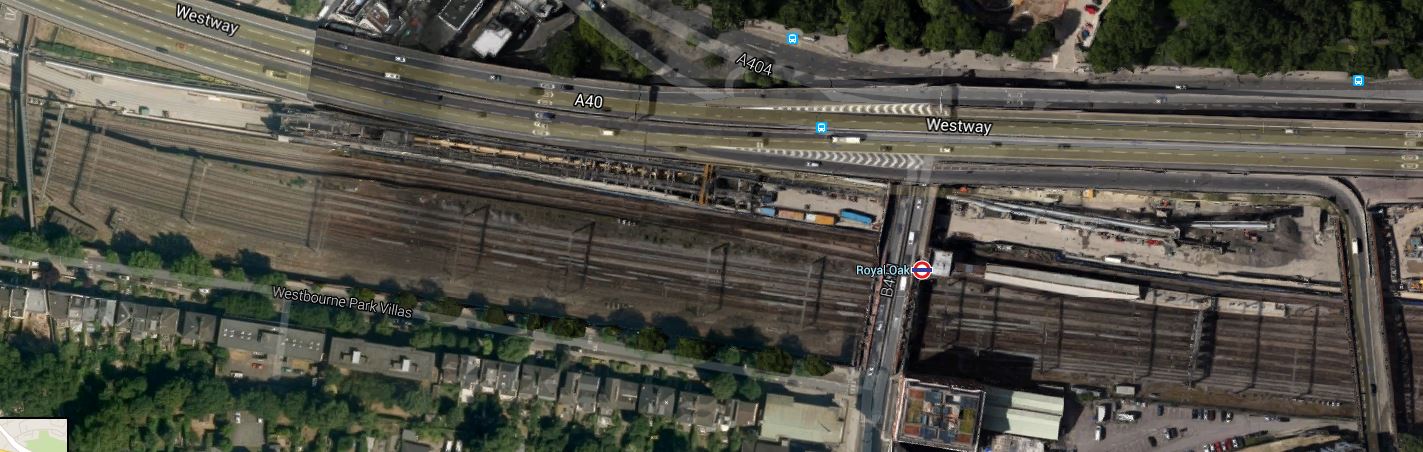
Royal Oak Tunnel Portal
It shows the cramped nature of the site, which is just 21m. wide. This is an enlarged image of the ramp leading down to the start of the tunnel under London.
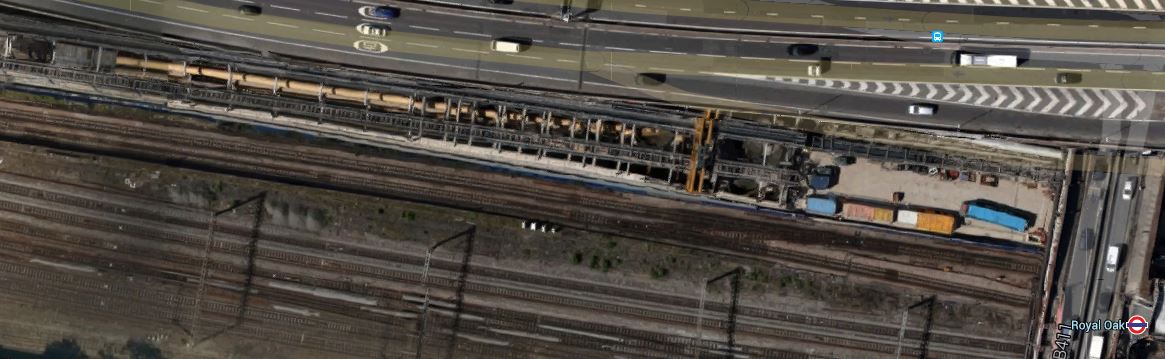
An Enlarged View
The only pictures I can find on the web with a proper explanation are in this article on the London Reconnections web site. In that article a picture is labelled as the remains of the arches and they are shown under the Westway and facing South. They are probably the arches in these pictures I took from the train.


I am not sure, but it looks like the arches support the access ramp that lead up to the Westway. But they are not shown in this architectural drawing from Acanthus, which shows the area around the Ventilation shaft they have designed for Crossrail.
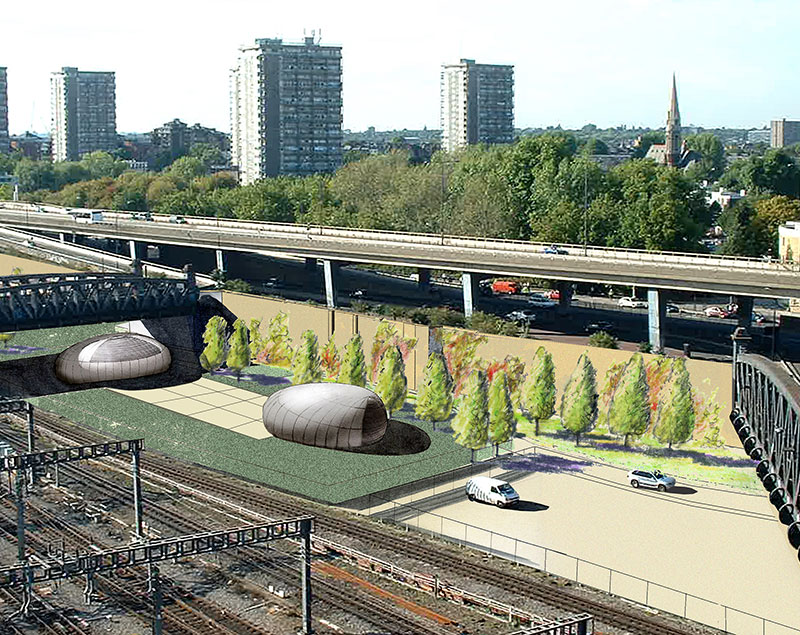
Crossrail Ventilation Shaft By Acanthus
This Google Map shows the current access with relation to the two bridges and Royal Oak station.
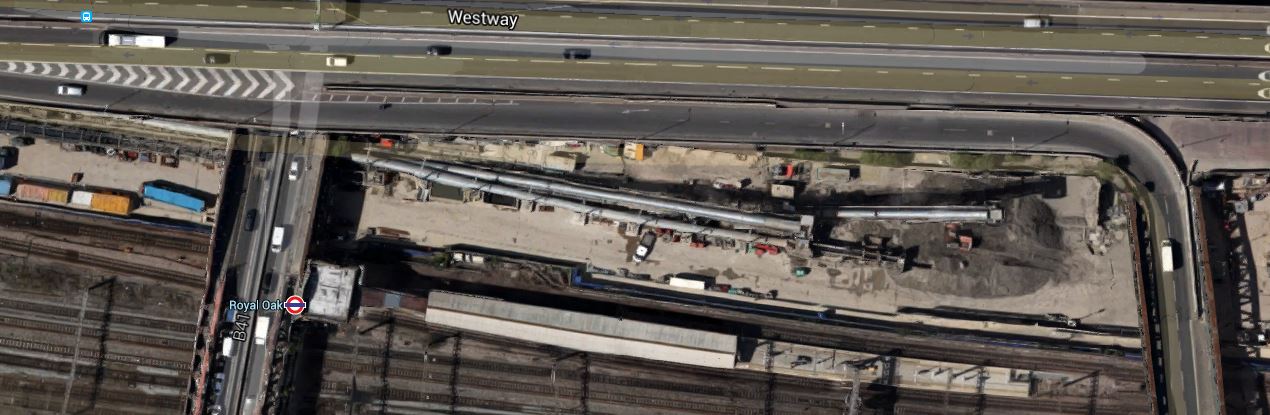
Access To The Westway
Note the long pipes, which I assume are either covering conveyors that remove the spoil for the tunnels or are to there to pump fresh air into the tunnels.
The station has recently been renovated, but once Crossrail is complete to the North of the station, are we going to see a comprehensive redevelopment of the area.
All will be revealed in time.
 The Anonymous Widower