Could Tramlink Use The Heavy Rail Lines In South London?
Look at these pictures, I took at Birkbeck station, where one track is for heavy rail and the other is for London Tramlink.
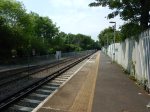
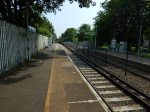


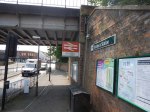
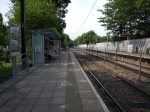

When I took these pictures, I wondered, if it would ease the expansion of the Tramlink network, if trains and trams could share lines.
I am not talking about tram-trains, but more a useful approach to benefit both types of transport.
So lets list the problems.
Rail And Wheel Profile
One of the problems in Sheffield with the introduction of tram-trains is that the rail profile needs to be changed to one that is compatible with the existing trams and the new Class 399 tram-trains.
But to be fair it is a trial and problems will be thrown up.
Platform Height
As someone, who has travelled all over Europe on trams, trains and tram-trains, one of the biggest problem is getting the platform height right, so that everybody including those in wheel-chairs can get on and off easily.
On a scale of five, we generally score about four, but we mustn’t be complacent and I think it will get better.
Some continental countries have problems as their trains have a low step and you step up into the train. This is because traditionally, they had low platforms, whereas for some time, we’ve been aiming for step across.
Karlsruhe has been running tram-trains on their Stadtbahn for over twenty years and are putting in a tunnel to take the tram-trains under the city.
This is said about platform height.
In addition, the platforms of the station’s tunnel will have pedestals that are about 15 metres long with a height of 55 cm above the rail so that the first two doors of Stadtbahn trains will have step-less entry. This will make possible stepless entrance on lines S 4 / S 41 and S 5 / S 51 / S 52 in Karlsruhe for the first time, reflecting a trend that has long been standard elsewhere. The platforms cannot consistently have a height of 55 cm, because the tunnel will be used by trams and DC services of the Stadtbahn, which have an entry level on the modern lines of 34 cm.
If the Germans have to go to that sort of solution, with all their experience, then platform height must be difficult to get right.
I have not heard anything about the platform design at Rotherham Central station, where the platforms must accept trains as different as Pacers and Class 399 tram-trains.
Power Supply
The current trams need overhead power, which with most tram systems is 750 VDC.
So if you want to run Tramlink trams on third-rail lines in South London, you’ll need to put up overhead wires or fit the trams with contact shoes.
It is my view, that for Health and Safety reasons and some design ones too, that running trams using third-rail power will not be practical.
Remember, passengers know they can walk across the tram lines and frequently do, so whatever happens, you don’t want live rails under the trams.
So any rail route, that will be running trams will have to have the 750 VDC overhead supply.
In the Sheffield trial, to extend the Sheffield Supertram, a freight route to Rotherham is being electrified at 750 VDC, rather than the main line standard of 25 KVAC.
Signalling Systems
Rail and tram signalling are different. But after a successful tram-trial in Sheffield, the problems of trams and train sharing the same track, should have risen to the surface.
Rules Of The Tracks
Trams and trains run under different rules.
One main difference is that trams have a maximum speed of 25 mph, whereas trains run at whatever speed the line permits.
So for safety and other reasons, if trams and trains were sharing a length of track, they would have to run under the same set of rules.
I suspect this would mean that the maximum speed would be 25 mph.
In some ways the problems are the equivalent of managing traffic at an airport like Southend, where light aircraft share the runways and airspace with Airbus-319s.
I don’t think it is an insurmountable problem, as two-car diesel multiple units have shared tracks with 125 mph expresses and hevy freight trains for years.
An Ideal Mix Of Trains
So is an ideal solution to use 750 VDC overhead wires for the trams and diesel trains?
Possibly!
But you could always use IPEMUs or EMUs with an on-board battery.
Supposing there is a chord or link line, that would be ideal to be used by trams and say the ubiquitous Electrostars that are popular in South London.
Wires would be put up and all Electrostars using the line, would have to have enough battery capacity to bridge the gap in the track with no electrification.
West Croydon Station
A possible application might be at somewhere like West Croydon station.
The map from carto.metro.free.fr, shows the heavy rail lines through the station and the tram lines around it.
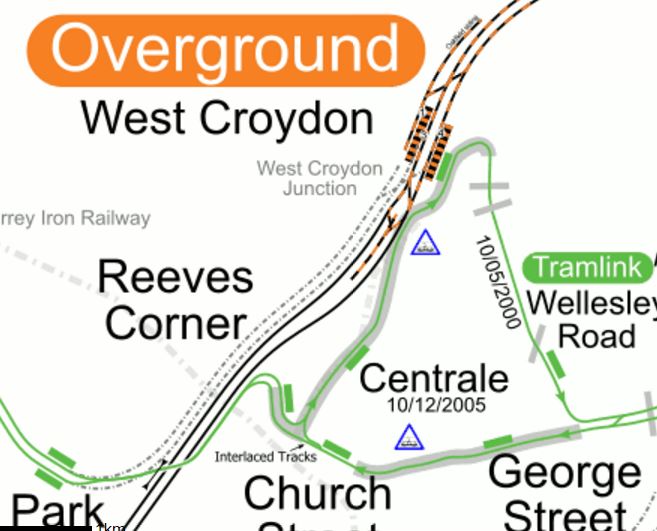
Lines Around West Croydon Station
I’m sure that the engineers in Karlsruhe would have had the trams going through the station to give same-platform interchange to and from trains.
Conclusion
Network Rail has a lot of tools in the box and I think that as technology develops, we’ll see some interesting ideas.
No comments yet.
 The Anonymous Widower
Leave a comment