A Glimpse Of London’s Future
London will soon be getting Crossrail, but Leipzig already has a cross-city underground railway called the Leipzig City Tunnel, which is the centrepiece of the S-Bahn Mitteldeutschland.
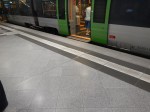
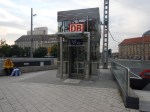
These are a collection of pictures taken of the various stations in the tunnel and on the surface sections of the lines.

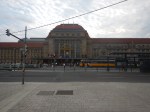
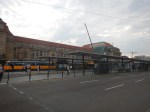
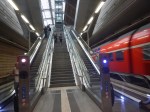
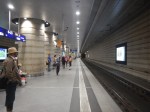


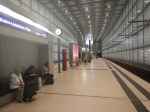
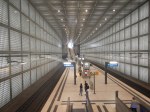
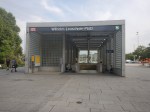





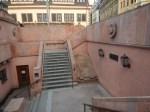



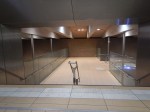
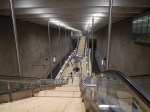

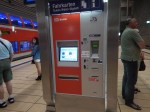

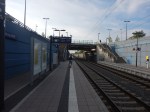

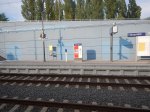
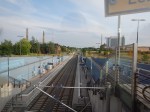
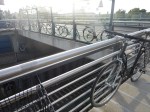
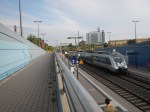
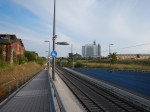

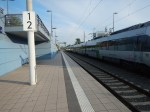


Unlike Crossrail, which is considered one line with two branches at both ends, there are several railways through the tunnel.
Wikiedia has a section on the Operating Schedule.
This is said.
It was planned that each hour and in each direction, there were up to ten S-Bahn, two regional trains and one express (as of July 2007)
There would appear to be seven S-Bahn routes, with intervals of between 30 and 120 minutes. As Crossrail, Thameslink and the East London Line in London, are all planned to or could handle twenty-four trains an hour, it does seem the Germans do things differently.
Note the following.
- The Seaside Park Hotel, where I stayed was about 200 metres from the trains.
- The line certainly has some spectacular stations.
- Central stations in the tunnel appear to be island platforms.
- Ticket machines were on the platforms, where they are really needed.
- Bicycles were everywhere underground.
- There are no platform-edge doors.
- Leipzig Markt Station was of an older era on the surface.
- There tended to be two escalators and steps to descend to and ascend from the trains. That is usually, the design-on-the-cheap problem.
- The one surface station I visited, Liepzig MDR, wasn’t step-free.
- The frequency through the Leipzig ity Tunnel, is low compared to the sixteen trains per hour through the East London Line and very low compared to that proposed for Crossrail and Thameslink.
I have a feeling that because it was designed a few years before Crossrail and uses older, refurbished rolling-stock, that certain features of the line are not as good as others.
Looking at the three systems; Leipzig, Crossrail and Thameslink, I feel that to get the most out of an expensive tunnel, you must do the following.
- Use trains designed specially for the tunnel.
- Design the trains for fast entry and exit.
- Make access between surface and platforms fast and with a large capacity.
- Use double-ended stations to ease passenger journeys.
- Have a large selection of routes through the tunnel, to get a maximum return for the tunnel. It may be that Crossrail needs more destinations.
- Use island platforms if possible.
- Make all stations step-free.
I think too that after seeing Leipzig, there are implications for London.
Bicycles
One problem for London, shown up by the Leipzig system, is what to do with bicycles on the train. These seem to be allowed at all times in Leipzig, but this page on the Thameslink web site, says that we do things differently.
More Destinations
As I indicated earlier, I think, that to maximise return on the massive investment of the tunnel, that Crossrail needs more routes and destinations, as Leipzig and Thameslink have.
As things stand, Crossrail intends to run a service like this according to Wikipedia.
The Elizabeth line will run a familiar London Underground all-stops service in the core section, but the western section will have non-stopping stations – like the Metropolitan line. The Eastern section has extra peak hour services that will either not enter the core section or that will be non-stopping at some stations. Similar to the Bakerloo line’s outer sections, the Elizabeth line will share platforms and rails with other services outside the tunnelled sections. About two-thirds of all Elizabeth line westbound trains will loop back after Paddington, about one third of peak-hour Elizabeth line trains to/from the north-east section will start/end at Liverpool Street main line platforms bypassing Whitechapel.
So it looks like if 24 trains per hour go through the centre tunnel, that sixteen of them will turn-back at Paddington.
That looks like a waste of resources to me.
Suggestions have been for services in the West to go.
- Up the West Coast Main Line to Watford, Tring and Milton Keynes.
- Along the Chiltern Line to West Ruislip and High Wycombe.
I wouldn’t be surprised if a couple of trains an hour went to Oxford.
The East is more problematic, as the only suitable extension is probably Southend, unless the Great Eastern Main Line is four-tracked, which would be very unlikely.
Kent is more fruitful territory, as an extension to Gravesend has been safeguarded. But surely Ebbsfleet with its Continental links would be better.
The Long Distance Crossrail Train
The Class 345 trains that will be used on Crossrail are Bombardier Aventras. According to serious reports, these trains could have the following features if needed.
- 200 kph capability.
- Metro, commuter or long-distance interior.
- 750 VDC, 25 KVAC or battery power.
- The ability to fit the platform-edge doors in Central London.
So you might reserve a few paths through Central London for long distance trains, if passenger statistics showed it would be profitable.
Imagine being able to get a train from Cardiff to Ebbsfleet for the Continent or from Birmingham to Southend.
Obviously services would only be provided if there was seen to be a demand.
But Crossrail’s and Bombardier’s engineers have designed the tools, so that many East-West journeys are possible.
No comments yet.
 The Anonymous Widower
Leave a comment