A North London Line With Digital Signalling
In Digital Signalling Implications For North London, I indicated that there may be benefits in equipping the North London Line with digital signalling.
- It would ease co-ordination of services between Gunnersbury and Richmond stations, where track, stations and signalling are shared with the District Line.
- All freight trains are being fitted with digital signalling capabilities.
Obviously, the other benefits of digital signalling like closer running of trains would apply.
Current Service Levels
The Service Levels section of the Wikipedia entry for the North London Line, gives the following details..
Services run seven days a week and since the December 2018 timetable change are the same all day.
- Four trains per hour (tph) – Richmond and Stratford
- Four tph – Clapham Junction and Stratford
Which gives eight tph between Willesden Junction and Stratford
Compared to the service I remember from the 1980s, it is a great improvement.
Possible Future Service Levels
London Reconnections is a web site, that usually gets things right.
In this article, which is entitled More Trains for London Overground: A Bargain Never to be Repeated, this is said.
London Overground have a long-held desire to increase the frequency on the WLL from 4tph to 6tph. They also aspire to another 2tph (at least) from Clapham Junction continuing to Stratford, to further increase the frequency on the North London Line (NLL). This would enable 10tph on eastern end of the North London line. This is due to be implemented with the main order of the new Class 710 stock.
What, it is suspected, London Overground would really like is to have 6tph from Richmond to Stratford and 6tph from Clapham Junction all the way to Stratford. Unfortunately, the additional trains to Stratford would appear to rely on freight, travelling between East London and the West Coast Main Line, using the route via Gospel Oak instead of via the NLL. Until that actually happens, sometime after the electrification of the GOBLIN, such an intensive service on the NLL can only be a dream.
Would this mean this service?
- Six tph – Richmond and Stratford
- Six tph – Clapham Junction and Stratford
Which gives twelve tph between Willesden Junction and Stratford
I can’t say I’d complain living equidistant from Dalston Kingsland and Canonbury stations.
Richmond Station
The current service between Richmond and Gunnersbury station is as follows.
- Four tph – London Overground to Stratford
- Six tph – District Line to Upminster
Digital signalling on the District Line is likely to add 33% capacity to Peak Hour services, so this would mean another two trains to Upminster.
So a future service could be as follows.
- Six tph – London Overground to Stratford
- Eight tph – District Line to Upminster
This level of service could be easily handled by conventional signalling and good driving or by digital signalling.
Piccadilly Line To Ealing Broadway Station
This article on Chiswick W4, is entitled Major Reorganisation Of Local Tube Services Planned.
This is said.
The decision appears to have been made by Transport for London (TfL) to press ahead with a major restructuring of local underground services. This would see the District line service to Ealing Broadway ended and services switched to the Piccadilly line. The rolling stock would transfer to the Richmond and Wimbledon branches of the District line allowing an increase in regularity for these services.
Currently, Ealing Broadway station has a six tph service to Upminster on the District Line.
This map from carto.metro.free.fr shows the lines at Ealing Broadway station.
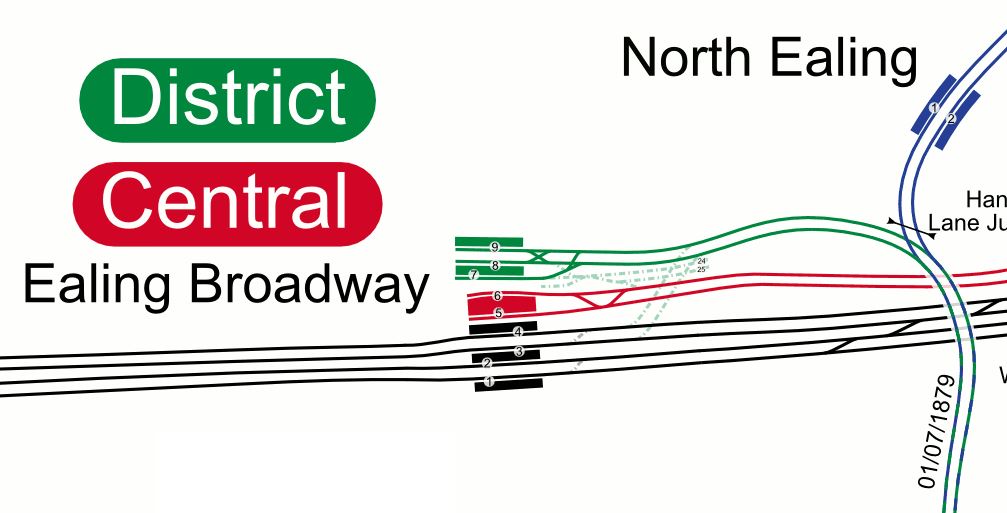
Note that after the changeover, the following would apply.
- The Piccadilly Line would have three platforms.
- In a few years time, the Central and Piccadilly Lines will have similar trains.
- Passengers for Turnham Green, Stamford Brook and Ravensbrook Park, would use the Piccadilly Line, which would probably have a higher frequency.
- Passengers for Victoria and other stations in the East on the District Line, would probably have a step-free cross-platform interchange at a number of stations.
But I think, that probably the main reason for the change, is that it will make the proposed frequency of well upwards of twenty tph of the Piccadilly Line easier to operate.
Consider.
- The platforms would help with service recovery,
- I suspect that TfL would like to see a Victoria Line frequency of thirty-six tph.
- Currently, twenty-four tph run between Arnos Grove and Acton Town in the Peak.
- Twenty-one tph run in the Off Peak.
If thirty-six tph is the intended frequency, then two terminal platforms in a rebuilt step-free Ealing Broadway station, could turn a lot of trains.
A Side Effect Of Changing The District Line Terminus
If the District Line service of six tph to Ealing Broadway, were to be reallocated between Richmond and Wimbledon, this would add three tph to the section between Gunnersbury and Richmond.
So now we could be looking at seventeen tph between Gunnersbury and Richmond stations.
Will that mean that North London Line trains to Richmond will need digital signalling and automatic train control?
The West London Orbital Railway
The proposed West London Orbital Railway will use the Dudding Hill Line to create the following services.
- West Hampstead to Hounslow
- Hendon to Kew Bridge
If both routes run at four tph, then it will add eight tph to the North London Line between Acton Wells and South Acton junctions.
Added to the six tph between Richmond and Stratford, this would be fourteen tph through Acton Central and South Acton stations.
Digital signalling on the North London Line and the West London Orbital Railway would probably ease the merging of trains for the joint section.
Freight
It appears that there are up to four freight trains per hour in both directions on the line.
The Level Crossing At Acton Central Station
I doubt the users of the level crossing at Acton Central would like the levels of traffic, that digital signalling would enable.
A Summary Of Passenger Services
I can summarise the passenger train frequencies as follows.
- Stratford to Willesden Junction – 12 tph
- Willesden Junction to Acton Wells Junction – 6 tph
- Acton Wells Junction to South Acton Junction – 14 tph
- South Acton Junction to Gunnersbury – 6 tph
- Gunnersbury to Richmond – 16 tph
I have assumed all developments mentioned earlier take place.
The Effect Of High Speed Two And Crossrail
When High Speed Two and Crossrail open at Old Oak Common station, this must surely increase the number of passengers using the North London Line, by a significant amount.
There will be two new stations.
- Old Oak Common Lane station will be between Willesden Junction and North Acton stations.
- Hythe Road station will be on the West London Line between Willesden Junction and Shepherds Bush stations.
Will the proposed six tph, each of five cars have sufficient capacity?
Conclusion
It looks to me, that they’ll come a time, when digital signalling will be needed to squeeze the required number of trains along the North London Line.
As I said in the previous section, traffic will continue to grow on the North and West London Lines because of High Speed 2 and Crossrail, as it has done since the route’s reopening with new trains in 2010.
I feel there will come a time, when trains will have to be lengthened from their current length of five cars.
Can all the stations on the route be extended if necessary?
Digital Signalling Implications For North London
As I write this post, two big digital signalling projects are ongoing.
Four Lines Modernisation
This project is described in this document on the TfL web site.
This video is from that document.
The TfL web site says this about the new signalling system.
Work to install a new signalling and control system began in summer 2016. This will eventually allow the trains to be driven automatically, with a train operator in the cab to open and close the doors. The train operator will be responsible for managing customer information and safety.
Similar technology introduced in recent years on the Jubilee and Northern lines improved performance. The new signalling system allows trains to be run closer together, meaning a more frequent service and shorter waiting times, allowing more people to be carried. This new technology will enable us to reduce delays and improve reliability.
The programme will allow us to operate 32 trains per hour, a 33% increase in peak-hour capacity. Installation work will require some line closures.
So it looks that by around 2023, there will be a lot more trains running on the Circle, District, Hammersmith & City and Metropolitan Lines.
The Four Lines Modernisation will have implications for other services.
North London Line
Between Gunnersbury and Richmond stations, the District Line and the North London Line share track, stations and signalling.
This map from carto.metro.free.fr shows the complexity of the tracks around Gunnersbury station.

Obviously, whatever signalling is installed, it must be capable of handling both District and North London Line trains at Gunnersbury Junction and to and from Richmond.
Metropolitan Line To Amersham
Between Harrow-on-the-Hill and Amersham stations, the Metropolitan Line and the London-Aylesbury Line, share track, stations and signalling.
This map from carto.metro.free.fr shows the lines at Harrow-on-the-Hill station.
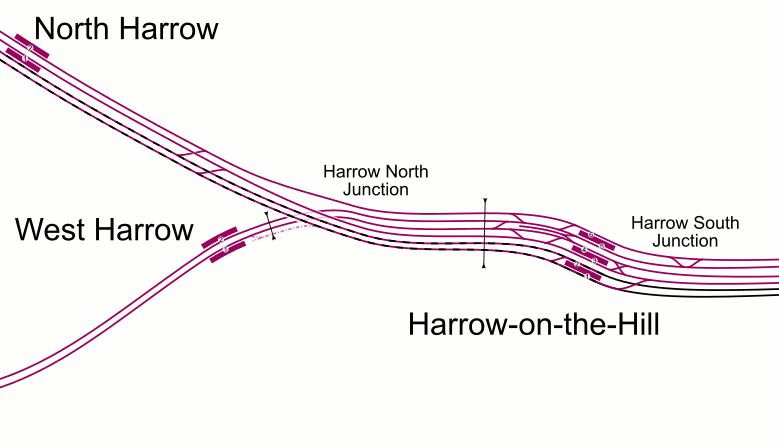
and this one shows the layout at Amersham station.
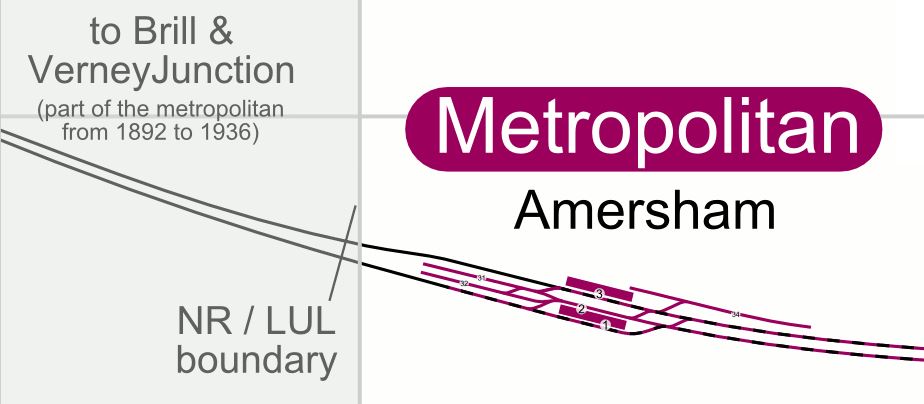
The solution for this section of track is detailed in the Wikipedia entry for the Metropolitan Line, where this is said.
Trackside signals with automatic train protection (ATP) will remain on the line north of Harrow-on-the-Hill, shared with Chiltern Railways DMUs
It is a solution, but will it last for ever?
And what about the Croxley Rail Link, if that is ever built?
Freight Trains Are Going Digital
This page on the Network Rail web site is entitled Freight Trains In Britain To Be Upgraded With Delay-Busting Digital Technology In Multi-Million Pound Deal.
The article says that all 750 freight locomotives will be upgraded.
This project must have implications for the freight services that run across North London on the Gospel Oak to Barking Line and North London Line, especially if these lines were in the future to be digitally signalled.
A Digitally-Signalled Bakerloo Line
At some tie in the next few years a decision will be made about what to do with the Bakerloo Line.
- It will be extended to Lewisham.
- It will receive new trains.
- It will be left as it is.
Options one and two would probably involve new digital signalling.
Addition of digital signalling to the Bakerloo Line would mean implications for the Watford DC Line, with which the Bakerloo Line shares the track between Queens Park and Harrow & Wealdstone stations.
Conclusion
I am drawn to the conclusion, that digital signalling in North London could bring capacity benefits.
 The Anonymous Widower