Cunning Electrification On The North London Line
I took a trip on the North London Line from Highbury & Islington station to Richmond station.
I took various pictures on the way.
25 KVAC Overhead Electrification
East of Acton Central station, typical 25 KVAC overhead electrification is used.
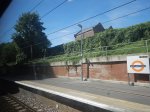
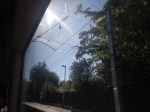



It may need to be beefed up, if more large electric locomotives haul freight trains along the North London Line.
Gunnersbury Station
Gunnersbury station is a two-platform station with London Underground four-rail electrification.

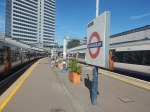

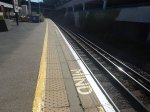
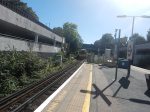

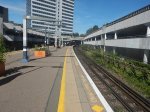




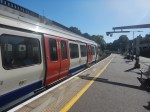
It can be used by London Underground S-Stock and London Overground Class 378 trains.
It must help that both trains were built by Bombardier in Derby.
Kew Gardens Station
Kew Gardens station is a two-platform station with London Underground four-rail electrification.
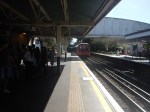

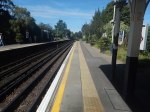

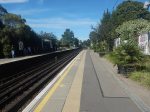

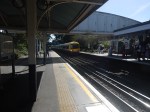

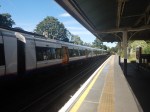
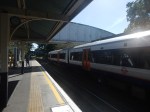
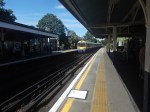
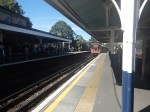
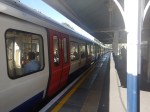
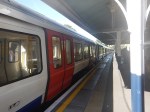
As with Gunnersbury station, both types of train can use both platforms.
Richmond Station
Richmond station is both a through and terminal station.

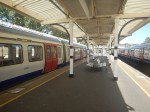
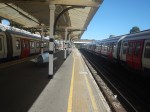

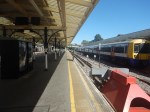
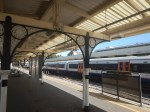

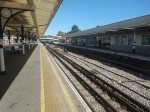

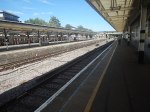
Note.
- Platforms 1 and 2 are through platforms for South Western main line services.
- Platforms 3 to 7 are for terminating London Underground and Overground services.
- Platforms 1 to 3 have traditional third-rail electrification.
- Platforms 4 to 7 have London Underground four-rail electrification.
- If needed, it may be possible to add another platform between platforms 3 and 4.
It looks like a lot of flexibility has been built in.
I have a few general thoughts.
Getting The Voltages Right
London Underground’s system used to use 630 VDC for its four-rail system, whereas Network Rail’s system uses 750 VDC.
I wouldn’t be surprised to find out that both trains use quality power electronics that can work on a range of voltages. This would enable London Underground to up their voltage to the same 750 VDC as used by Network Rail.
In Chiltern Sets Out New Fleet Ambitions, I talked about how Chiltern Railways could use London Underground’s four-rail electrification between Harrow-on-the-Hill and Amersham stations to charge the batteries.
As an electrical engineer, I don’t think this is outrageous.
 The Anonymous Widower
NLL elecn will be fine for class 93/99 locos. Actually as its relative slow speed it doesn’t get the heavy sustained loadings that you get when hauling a 1000T intermodal up Shap at 75mph
Comment by Nicholas Lewis | August 23, 2023 |
Well as far as the 25kV goes but you won’t see Class 93/99 on the line from Acton South down to Richmond even on diesel as I doubt they’d get route clearance.
Comment by fammorris | August 24, 2023 |
They will have been built to national clearance so no reason they cant go down there. Mind you a 93 unlikely to have enough oomph in diesel mode to haul much the incline. Its farciv4this section not electrified.
Comment by Nicholas Lewis | August 25, 2023
When I mentioned the difficulties of the route I really meant to say that the gauge clearances especially from South Acton to Gunnersbury would probably preclude serious freight trains. The gauge clearance there is at best W8 (I suspect W6), a line speed varing from 15 to 25 mph and two low bridges. Currently any freight trains on the line through South Acton travel via Brentford and the Hownslow Loop to access South West Division metals rather than going via Gunnersbury and Richmond.
The line from Willisden Junction to Richmond is electrified via 750V third rail which is not much use to the 93/99 locos.
Class 93 has a Route Availability Index of 7 which isn’t bad in terms of universal operations. I don’t think the Class 99 RA is easily found but if it’s more than 8 they won’t be able to access as much of the network and I doubt this section of the NLL.
Comment by fammorris | August 25, 2023
OK i concur that route isn’t suitable and not sure its even connected anymore anyhow
Comment by Nicholas Lewis | August 25, 2023
I wouldn’t get too attached to the nominal rating of the supply voltage, at different times of day and different sections of track the voltage can vary by around ±5% providing the insulation class of the windings is either of the two highest grades. Old but rewound dc motors used in LUL 630v D stock had ‘tolerated’ nominal 750v running on the District Line for some time.
Charging on the Amersham – Harrow on the Hill? Providing the negative rail is bonded to the running rails a la the Richmond – Gunnersbury section it sounds like a viable proposition.
I presume that when the Siemens stock is introduced on the Piccadilly line the traction supply voltage will also be increased to 750v as the first part of Deep Tube Infrastructure Upgrade Programme.
Comment by fammorris | August 24, 2023 |
According to a contact in Liverpool, various updates had to be done to the electrification for the new trains. Modern Railways also reported updates to third-rail power supplies in the old Southern Region, when they brought in the new trains. I suspect all the kit is similar.
Comment by AnonW | August 25, 2023 |
Fundamentally third-rail is an inefficient conductor in which most of the electricity that’s put into the rail is lost as heat. As a result Network Rail have been increasing the voltage at frequent intervals involving the installation of many new substations and associated 33kV grid supplies. This allows operators to increase the number of trains they can run and avoid overheating of existing substations.
I’d guess what your Liverpool informant was alluding to upgrades for Merseyrail which is addressed in this informative article https://www.railengineer.co.uk/bringing-more-power-to-merseyrail/?amp
It’s absolutely true that updates being done in Southern England to third-rail power supplies are similar to that being done on Merseyrail.
Comment by fammorris | August 25, 2023
@famorris 3rd rail is less efficient than 25kv but most of it isnt lost as heat in 3rd rail somewhere between 15 to 20% but with regen it will be less.
Main issue with new units like 777s is they are alot more powerful and they have a hefty hotel load for air con and this has driven the need fir reinforcing the traction system. The farce is i doubt they will exploit that power with reduced running times in the timetable just use more energy.
Comment by Nicholas Lewis | August 25, 2023 |
The next generation of 3rd rail units will use batteries for regenerative braking.
Comment by AnonW | August 25, 2023 |
I would think that any extra capacity South of South Acton would be used for the West London Orbital.
Comment by AnonW | August 25, 2023 |
I agree. With regards to the West London Orbital development from South Acton down to Old Kew Junction they are going to have to put in third-rail electrification, at the moment it’s unelectrified.
Comment by fammorris | August 26, 2023 |
The gap in the electrification between South Acton Junction and Old Kew Junction on the Hounslow Loop Line must be less than four miles, so would be easily bridged on batteries.
Between South Acton Junction and New Kew Junction by Kew Bridge station would be about the same.
I suspect the trains would be four-car dual-voltage Class 710 trains, which could use the pantographs for charging at Hounslow and Kew Bridge station with perhaps fifty metres of 26 KVAC over electrification in the two bay platforms.
Comment by AnonW | August 26, 2023
Yes you’re right battery equipped trains would be a better option although there could be operational questions around having dedicated trains. Depending on timescales a derivative of
the existing 710 makes sense, after all unless operational imperatives dictated the trains should be capable of running on other Overground routes using the battery, the range of the battery is not a critical issue. The length of the line that’s unelectrified south of Acton South is less than one and half miles and considering the West London Orbital, Dudding Hill unelectrified section that gives access to Hendon Central is around 4-5 miles. For West London Orbital services better to have charging facilities at Hendon Central and Hounslow the two termini which are only 10 miles apart.
Comment by fammorris | August 26, 2023 |