Ricardo Develops Advanced Ranger HEX 6×6 Conversion With Hybrid Electric Drivetrain
The title of this post, is the same as that of this press release from Ricardo.
This is the sub-heading.
The new vehicle has been conceived to help improve the sustainability of future defence mobility while retaining the highest performance demanded by the toughest environments
This picture is from the press release.
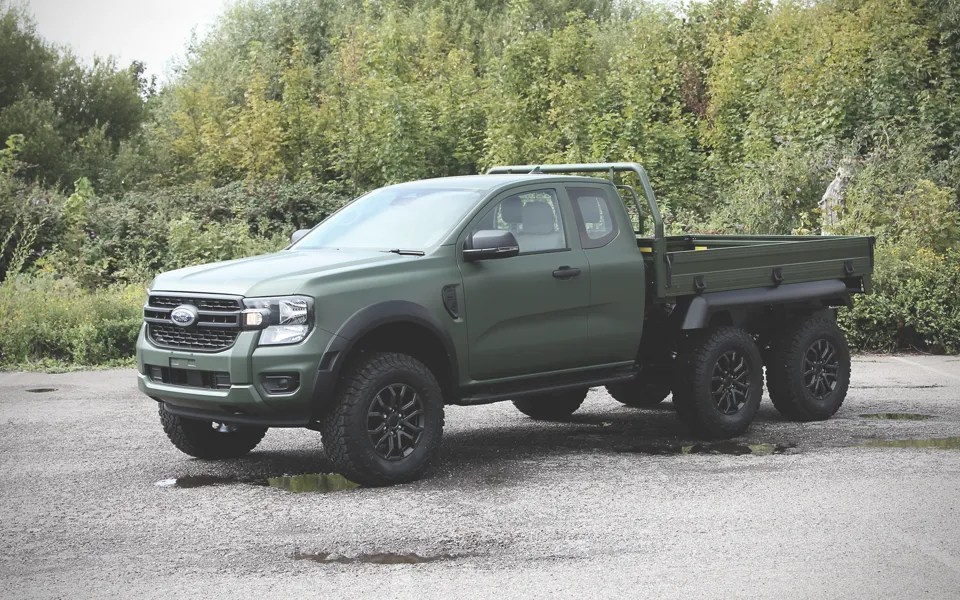
My first thought is that it looks the ultimate technical.
These two paragraphs introduce the vehicle.
Ricardo, a global strategic, environmental, and engineering consulting company, has developed the Ranger HEX, a 6×6 vehicle conversion designed to offer a significant improvement in payload of up to 3,800kg over the harshest of terrains. It comes with a hybrid drivetrain to maintain performance and improve fuel consumption.
This new conversion benefits from Ricardo’s expertise and experience in creating high quality, cost effective special vehicles for defence, security and utility applications. The vehicle will benefit from enhanced levels of capability, robustness and availability.
These three paragraphs describe the design.
The HEX solution differs from conventional conversions as it has been conceived as an overlay bolt-on system that does not require any alteration of the Ford Ranger base vehicle, which is Europe’s number one commercial pick-up platform. This ensures that the base vehicle retains all the robustness and quality of the standard vehicle and allows the system to be removed and re-installed on a different vehicle.
An electric rear drive system has been adopted that uses a production Ford drive unit to provide up to an additional 210kW of power, over and above the class leading 186kW of power from the existing 3.0L V6 diesel engine. The De Dion rear suspension design is not only weight efficient and robust but also provides better wheel control for improved traction and ride. In addition, the De Dion arrangement decouples the suspension and drive systems to allow a range of drive units to be used or deleted for a cost-effective 6×4 variant with maximum payload using an undriven ‘lazy’ axle.
The electric drive is designed as a self-contained through-the-road hybrid system. Braking energy is harvested under deceleration to charge the battery pack. This energy is then used to provide electric torque under acceleration to mitigate the usual drop in performance whist carrying a high payload. A selection of battery capacities are available, depending on customer requirements. All high voltage components are contained within a single integrated enclosure for safety and ease of maintenance and repair.
Note.
- The conversion would appear to bolt on to the standard Ford Ranger base vehicle.
- The vehicle has regenerative braking.
- It has a payload of 3.8 tonnes.
- It appears to have a very sophisticated rear suspension.
- Judging by the colour and the mention of the word defence in the article, I suspect this vehicle has been initially designed for a military application.
- Over 300,000 Rangers were sold worldwide in 2021.
- In the UK, it looks like a Ford Ranger will cost around £30,000 excluding VAT.
In addition I’ve read in this article on Autoweek that, the conversion itself has been designed as an overlay bolt-on modification that requires no alterations to the base vehicle, even preserving its existing warranty.
I have my thoughts.
Applications
The press release talks about high quality, cost effective special vehicles for defence, security and utility applications.
Use your imagination!
Perhaps.
- It is going to be used as the ultimate technical by the Ukrainians.
- A missile manufacturer has a system, that weighs around 3.5 tonnes and needs a launch vehicle.
- The RNLI needs an affordable vehicle to launch lifeboats from the beach.
- It is going to be used as rough terrain ambulance.
- It would make an excellent towing vehicle.
With all the problems in Morocco and Libya at the moment, it has been launched at the right time.
Zero-Carbon Operation
I believe that a zero-carbon version is essential. Especially, as the sub-heading mentions sustainable defence mobility.
The easiest way to achieve this would be to run on HVO or some form of biodiesel.
I suspect between them Ford and Ricardo have enough knowledge to create a hydrogen powered version.
Are There Autonomous Ford Rangers?
Google says, “Yes!”
This article on foresttech is entitled Ford Ranger Goes Fully-Autonomous, where this is said.
An Australian mining group has advanced the future of mobility (in mining at least) with the deployment of a fleet of fully-autonomous Ford Rangers at one of its mines.
Fortescue Metals Group has retrofitted four Rangers at its Christmas Creek mine in Western Australia with autonomous systems created by the company’s Technology and Automation team, to remove the need for fitters to make around 12,000 28-kilometre round trips each year to collect equipment and parts.
Of course, it’s not quite as ground-breaking as it sounds: mining operations don’t need to deal with road rules, pedestrians or many other vehicles, which hugely complicate the matter. Nevertheless, it’s still impressive.
Three applications suggest themselves.
- Delivering supplies in a disaster zone, after an earthquake, flooding,, landslide or volcanic eruption.
- Delivering supplies, including ammunition on a battlefield.
- Moving supplies along a long linear construction site, like a new railway or road.
Note.
In all three applications, six-wheel drive will be important, if ground conditions are bad.
- Could Fortescue Metals Group be behind this project?
- Disasters seem to be getting more common.
- Autonomous battlefield delivery must be safer for personnel.
I suspect there will be agricultural applications of an autonomous vehicle.
No comments yet.
 The Anonymous Widower
Leave a comment