Ten Spanish Companies Join Forces To Apply Hydrogen Propulsion To A High-Speed Train For The First Time
The title of this post, is the same as that of this press release from Talgo.
These are the three bullet points.
- The Hympulso project is part of the Strategic Projects for Economic Recovery and Transformation (PERTES)
- A new technical car with hydrogen and batteries to be developed for a Talgo 250 train, allowing it to run on clean energy on non-electrified lines.
- The main partners are Talgo, Golendus, Ingeteam, Repsol, Sener and Optimus3D.
These are the first four paragraphs.
Ten Spanish companies have joined forces to design, build and install, for the first time in the world, a propulsion system based on renewable hydrogen fuel cells on a high-speed train. Under the Hympulso project, the companies will develop a set of technologies that can be applied to the Talgo 250 ‘all-terrain’ train, making it possible to electrify the rail network with energy generated entirely from renewable sources, even on lines without overhead power lines.
Led by Talgo, Hympulso also includes Golendus, Ingeteam, Optimus3D, Repsol and Sener as partners. Universidad Pontificia Comillas and Tecnalia are collaborators, while Adif is an observer. The initiative has received a grant of €6.5 million and is part of the Incentive Programme for the Innovative Value Chain and Knowledge of Renewable Hydrogen, as part of the Recovery, Transformation and Resilience Plan.
Hympulso will be comprehensive in nature: it will activate the entire renewable hydrogen value chain in the railway system, from production to consumption. The project will also make it possible to analyse the impact of the future transition on the various railway infrastructure assets managed by Adif, such as maintenance facilities or the track.
Thus, the project will result in a joint output of hydrogen supply installations adapted to railways -both mobile and static- and a pioneering prototype of a hybrid bimodal train for passengers with automatic track-gauge change, which will be able to run both on conventional and high-speed networks, using catenary supply when available, or hydrogen and batteries in those corridors that are not electrified.
This picture shows a visualisation of the train.
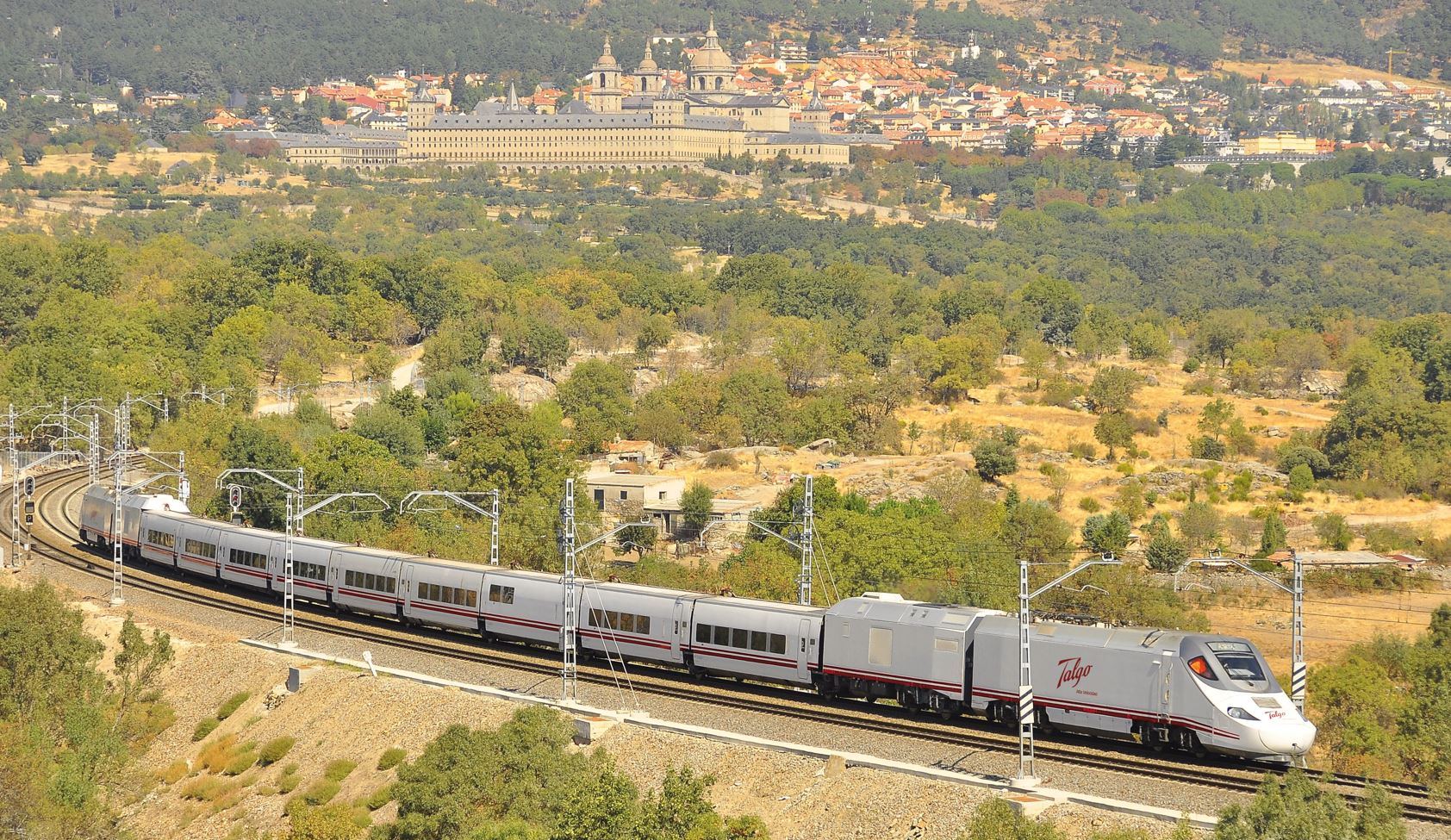
Note.
- There is a power car containing the hydrogen fuel cells and other gubbins behind the one or both locomotives.
- Hydrogen power is used, where there is no electrification.
- Talgo already make a high speed train with a diesel power pack, so engineering would only involve developing a new hydrogen power pack.
My only questions are.
- Do the trains come without gauge-changing?
- Could they be run on a typical UK rail line?
- Do they speak, Cornish, Gaelic and Welsh?
If the answer to all questions is yes, then this must be the ideal train for these routes.
- London Euston and Aberystwyth
- London Euston and Holyhead
- London King’s Cross and Aberdeen.
- London King’s Cross and Cleethorpes/Grimsby
- London King’s Cross and Inverness.
- London King’s Cross and Thurso/Wick.
- London Paddington and Carmarthen
- London Paddington and Penzance
Note.
- No more electrification on these routes would be needed.
- The trains could use High Speed Two to wherever it goes.
- The trains could do 140 mph on the Great Western Main Line, East Coast Main Line and West Coast Main Line.
Hympulso looks a very comprehensive, professional and practical plan, that could easily be adapted to the UK mainland.
 The Anonymous Widower
I’m sure Talgo will be able to come up with a standard guage bogie and meet the requirements of the British clearance
gauges.
Presumably this evolved out of Talgo’s Vittal technology programme that was announced in 2021/22. At that time they first proposed adding hydrogen traction for a train intended for commuter and regional services. I wonder how it’s progressing; it was due to be rolled out last year.
https://www.talgo.com/-/talgo-comienza-las-pruebas-din%C3%A1micas-del-primer-tren-dual-de-hidr%C3%B3geno-de-espa%C3%B1a
Comment by fammorris | January 25, 2024 |
The answer to your first question is ‘no’, at least not for use in Spain. All existing high-speed lines in Spain are electrified and standard gauge. The high-speed network is gradually expanding to link all the major cities, but until that’s complete the Alvia trains are dual-gauge and can run partly on the low-speed Spanish-gauge lines. Some of these are electrified, some aren’t (see OpenRailwayMap, which I think is uptodate). If those lines are electrified, you don’t need hydrogen. So these new trains are only for the routes which are dual gauge and partly unelectrified. These services are currently run by the Talgo 730 series, the bi-mode version of the 130 – there’s a list at https://es.wikipedia.org/wiki/Serie_730_de_Renfe but I’m not sure this is uptodate, as the line to Vigo is fully electrified now. The main one was this line to Galicia, but most of that is now fully electrified.
The FCH2Rail project has now run trials with CAF hydrogen trains on the local lines to Canfranc and Soria in the NE of Spain, so this project seems to be an extension of that to the high-speed services. Perhaps they reckon they can have a bi-mode train ready before the Madrid-Plasencia high-speed line is complete. I assume they reckon the distances on the local lines are too great for battery power alone.
Comment by Peter Robins | January 25, 2024 |
To see the 730 in action, https://www.youtube.com/@TrenEx730/videos includes a Merida-Madrid journey last month on the inaugural run after Merida-Plasencia electrification was switched on. The video labelled ‘inaugural’ is the electric bit to Caceres (don’t think ‘modo electrico’ needs translating), and the other one dated 10.12 is the remainder into Madrid. The train switches to diesel at Caceres, and then back to electric on the final suburban line into Madrid. There is no gauge change on this service, as the new electric track is dual-gauge, and the standard gauge track will only be used once the whole line is complete. Apparently, there is a speed restriction of 220kph on Iberian-gauge track, so these ducklings won’t be going at their full speed of 250kph in ‘modo electrico’.
The 2nd video gives a good idea of the work that’s going on for the high-speed line from Monfrague to the Extremadura border, and there’s some interesting written commentary superimposed on the video (Spanish only, of course). The scheduled completion for this section is 2026-8.
Does any other country have bi-mode high-speed trains? I’m not aware of any.
Comment by Peter Robins | January 25, 2024 |
There’s more on the CAF H2 train tests on the project’s LinkedIn page https://www.linkedin.com/posts/fch2rail_the-fch2rail-project-has-begun-tests-on-the-activity-7129781589269467137-9cKh If you search on Youtube, there are a few videos. Seems they finished the tests on the Canfranc line earlier this month, and started tests on the Soria line in November. Unlike the iLints, looks like they don’t have any qualms about using OLE as well as H2.
Comment by Peter Robins | January 25, 2024 |
Coaches would probably fit UK gauge put the power cars would need to be shrunk. Conceptually though its sound but in some ways just scaling up the hydroflex train.
Comment by nickrl | January 26, 2024 |
We should remember, that Talgo bid for the HS2 trains and had plans to build them in Scotland. So I suspect they have a classic-compatible UK power-car design.
Perhaps, HS2 should have gone for Talgo, rather than Hitachi/Bombardier?
I always felt that Talgo, who are very much engineering-led had a cunning plan to build high speed trains for all those broad gauge services in Eastern Europe at Longannet, as they could then put them on a train ferry at Rosyth, which would be much been easier logistically, than using a ferry from Spain, or dragging them by road and rail through standard gauge Europe.
I suspect Vlad the Genocider, is not popular amongst everybody at Talgo.
Comment by AnonW | January 26, 2024 |
Appa Nestle Waters have asked Alstom to produce a hydrogen powered generator car to couple to electric locos and expect to start its impplementation on freight trains in 2025. This supposedly will enable the trains to run on electrified and non-electrified routes.
Wabtec are also carrying out concept studies.
Comment by fammorris | January 26, 2024 |
AnonW reported on that at the time. I just did a quick search, and I can’t find any updates to this announcement, so we will see. Should it come to pass, it’ll be interesting to see how much power it can generate, and what the overall cost is.
Comment by Peter Robins | January 26, 2024
Just had a look at the height of the Talgo locos. While they’d need tailoring to
the British guage profile they’re not as big as they appear – the low floor passenger coaches tend to accentuate the impression. As far as I can see the Talgo locomotive is0 4 metres tall, while by comparison a Class 66 is 3.91 metres.
Comment by fammorris | January 26, 2024 |
https://en.wikipedia.org/wiki/Renfe_Class_730 gives the height (exactly 4m) and width (2.96m). The 102 class (without the dual gauge/bi-mode additions) is 3.36/2.94m respectively – which probably reflects the extra room needed for the diesel. The H version may have to be bigger, unless they put the H in a separate tender.
Comment by Peter Robins | January 26, 2024
So at >2.9m, the trains are probably too wide for British gauge, right? One thing I always notice on Iberian gauge trains is how wide they are compared to British ones.
Comment by Peter Robins | January 26, 2024
Spanish coaches from both Talgo and CAF seem to come in various widths for different gauges. As Talgo bid for HS2’s classic-compatible trains, they must be able to make them.
Comment by AnonW | January 26, 2024 |
If the question is: can Talgo or any other manufacturer make trains to fit on British tracks, the answer is ‘yes, of course’. But the answer to your 2nd question – Could they (the adapted 730s) be run on a typical UK rail line? – is ‘no’.
Comment by Peter Robins | January 26, 2024 |