Designing A Battery-Powered Mountain Goat
When I wrote Up To Ebbw Vale From Newport, this comment was posted.
I’m not surprised that the Class 150 train, had no difficulty in climbing up to Ebbw Vale Town. The max gradient is around 1 in 65. There are plenty of places in Britain where gradients are steeper and indeed part of the type test for all dmus was to climb the 2 mile, 1 in 37.7 Lickey Incline starting a couple of hundred metres before the beginning of the slope.
It certainly got me thinking.
Could a line like Newport and Ebbw Vale be decarbonised, by simply fitting batteries to an appropriately-sized electric train?
- The battery would be charged using the 25 KVAC overhead electrification in Newport station.
- The train would climb the hill to Ebbw Vale Town on battery power.
- Coming down the regenerative braking would charge the battery.
- Once in the platform at Newport station, the battery would be topped up, to the level needed to climb the hill, from the existing electrification.
The question is can the train carry enough juice in a battery?
I will work the example through with a three-car Class 331 train.
- I have chosen a Class 331 train, as CAF have a factory in Newport.
- The train weighs 30.48 tonnes.
- It has 213 seats.
- If I assume that each passenger is 80 Kg including baggage, bikes and buggies, that gives a mass of 17.04 tonnes or a total mass of 47.08 tonnes.
- The difference in altitude between Ebbw Vale Town and Newport is 764 feet.
Using Omni’s Potential Energy Calculator, that gives a value of 29.9 kWh.
This OpenRailwayMap shows the tracks from Newport to Pye Corner.
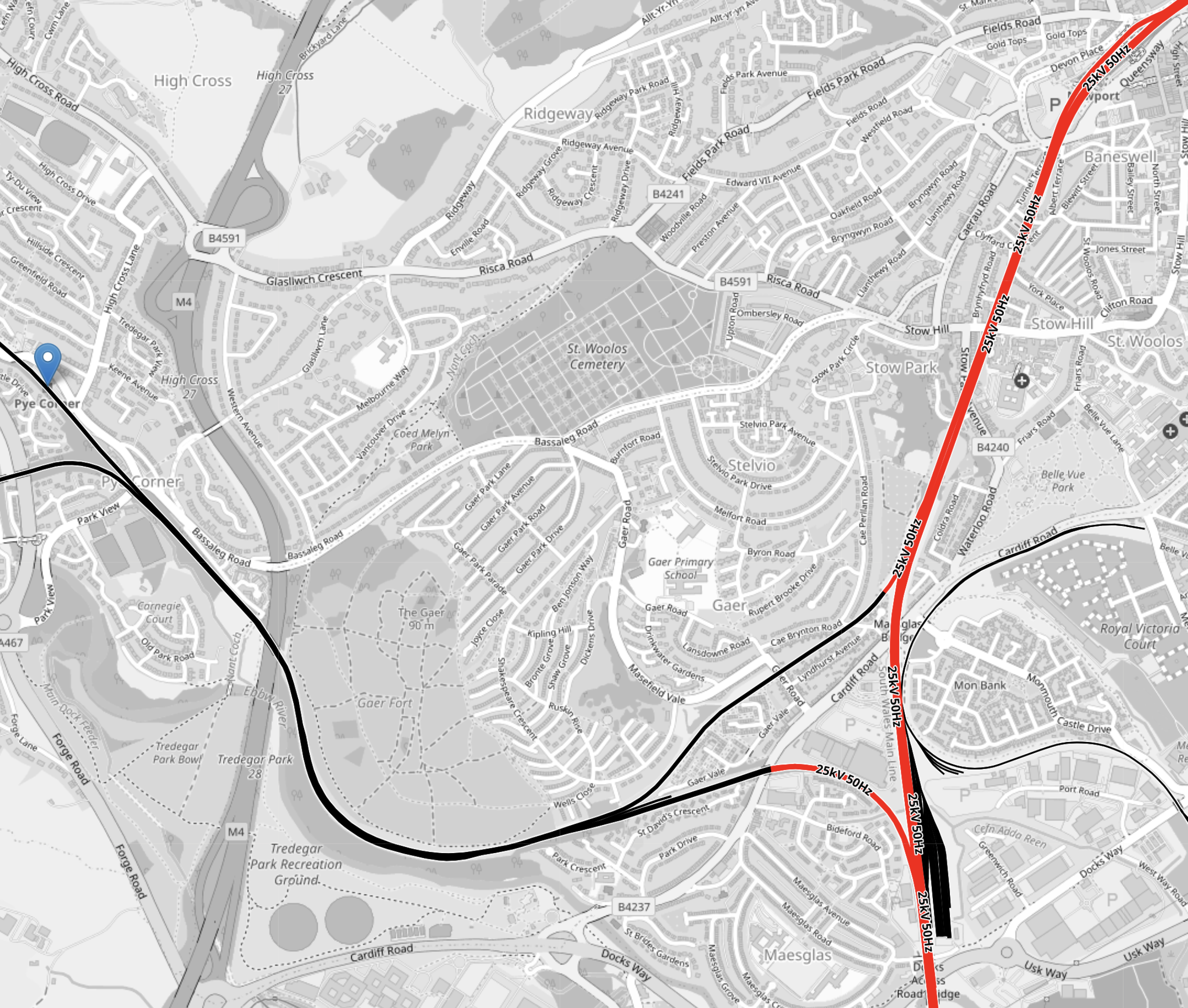
Note.
- Red tracks are electrified and black ones are not.
- Newport station is in the North-East corner of the map, with the South Wales Main Line running through.
- Pye Corner station is marked by the blue arrow and is the first station on the climb to Ebbw Vale.
- The unelectrified Ebbw Vale branch has a triangular junction with the electrified South Wales Main Line.
- The electrification continues for a short way towards Pye Corner and goes all the way to Newport and Cardiff.
- Trains take 24 minutes to turn round in Newport.
- Newport and Ebbw Vale Town is about twenty miles.
It can be safely said that trains will start their climb to Ebbw Vale with a full battery.
What Battery Size Will Be Needed?
I don’t think it will be that large and it will be the smallest battery, that could take a train up the hill.
As part of the climb is double track, the up track could be electrified to enable a smaller battery to be used, which would mean less power would be needed, due to the lower weight.
Conclusion
I believe that it will be possible to fit CAF’s Class 331 trains with a battery large enough to take a train up the hill to Ebbw Vale Town.
 The Anonymous Widower
[…] Designing A Battery-Powered Mountain Goat, I stated that I believe that a small fleet of CAF’S Class 331 trains fitted with batteries […]
Pingback by Ebbw Vale Town Station – 3rd February 2024 « The Anonymous Widower | February 5, 2024 |
You need an allowance for hotel load which is at least 15kw/coach to cater for coldest or hottest day plus auxiliaries then you need an allowance for dealing with operational events which has to be at least 30mins. All this drives up the size of the battery. So you probably need one per coach to keep the weight to a level that doesn’t need battleship engineer structural members to support it.
Comment by Nicholas Lewis | February 6, 2024 |
Stadler for the Class 777 IPEMU use a 160 kWh battery in both end cars.
Comment by AnonW | February 6, 2024 |