Could A Feeder Network Of Local Trains Be Developed For HS2 At Macclesfield Station?
Macclesfield station is one of the less important stations that will be served by High Speed Two.
I visited in July 2020 and afterwards wrote Macclesfield Station And High Speed Two.
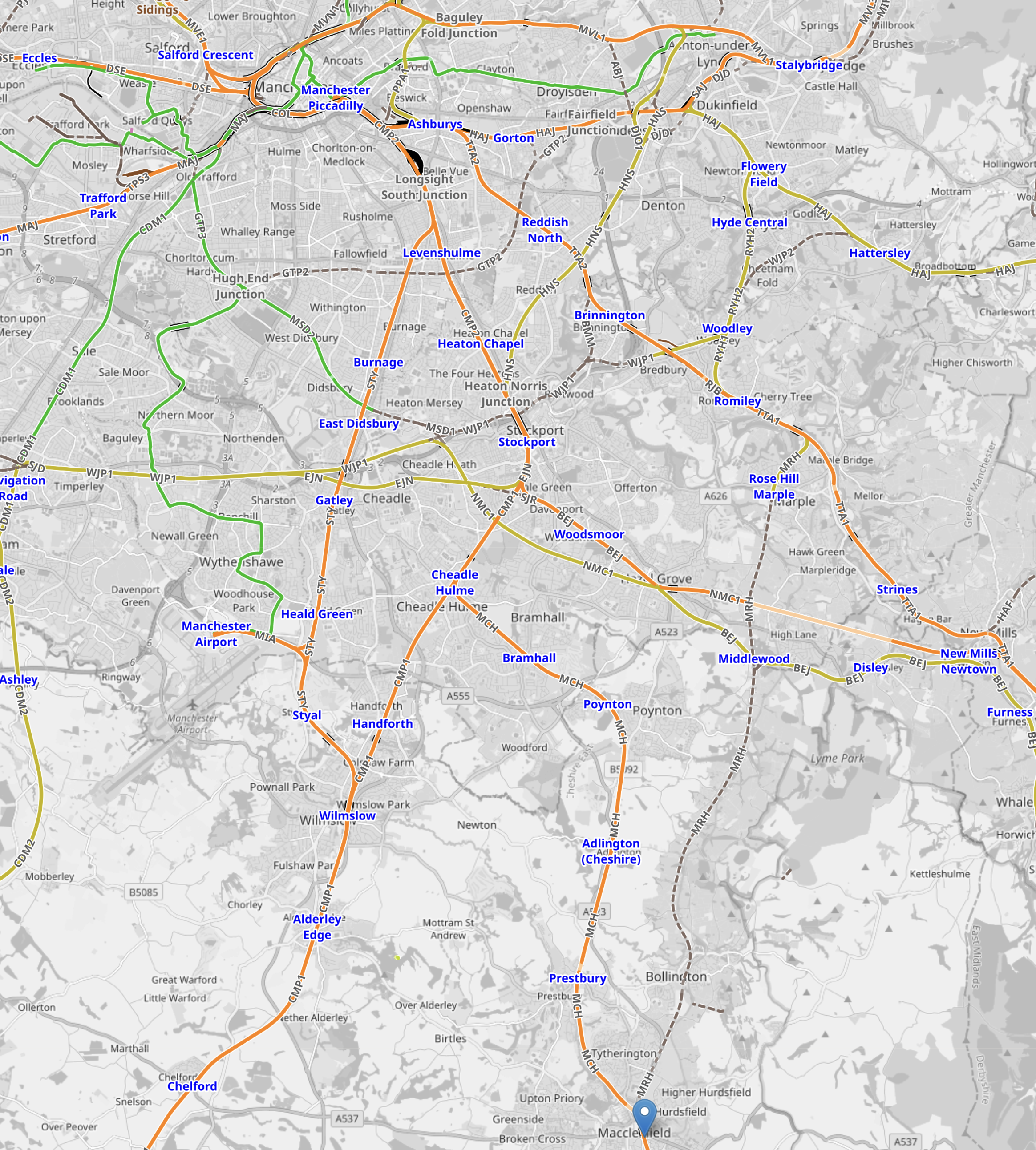
This OpenRailwayMap shows the railway network around Macclesfield.
Note.
- Manchester Piccadilly station is at the top of the map .
- The station is surrounded by the green tracks of the Manchester Metrolink.
- Macclesfield station is at the bottom of the map and indicated by a blue arrow.
The West Coast Main Line can be followed North as it threads through Prestbury, Adlington (Cheshire), Poynton, Bramhall, Cheadle Hulme, Stockport, Heaton Chapel, Levenshulme and Ashburys on its way to Manchester Piccadilly.
This summary from the Wikipedia entry for the station outlines the services at the station.
Macclesfield is served by three train operating companies: Avanti West Coast, CrossCountry and Northern Trains.
Northbound to Stockport and Manchester Piccadilly, Avanti West Coast and Northern operate hourly services, with some peak time extras, and CrossCountry runs two services an hour.
Southbound, there are also four trains per hour: one stopping service to Stoke-on-Trent, operated by Northern Trains; one inter-city service to London Euston, operated by Avanti West Coast; one to Bournemouth, via Birmingham New Street and Reading; and one to Bristol Temple Meads, both operated by CrossCountry.
Sunday services are similar, but the local stopping service operated by Northern Trains no longer runs on Sunday, with rail replacement bus services operating between Stockport and Stoke-on-Trent.
It is not as busy a station, as the map suggests it is.
Searching in detail, I found these local trains.
- CrossCountry – 1 – tph – Manchester Piccadilly and Bournemouth via Stockport, Macclesfield, Stoke-on-Trent and Stafford
- CrossCountry – 1 – tph – Manchester Piccadilly and Bristol Temple Meads via Stockport, Macclesfield, Stoke-on-Trent and Stafford
- Northern – 1 tph – Manchester Piccadilly and Stoke-on-Trent via Stockport, Cheadle Hulme, Bramhall, Poynton, Adlington, Prestbury, Macclesfield, Congleton and Kidsgrove
Three trains per hour is not many.
The train and bus network from Macclesfield station needs to be developed, so travellers can make full use of HS2.
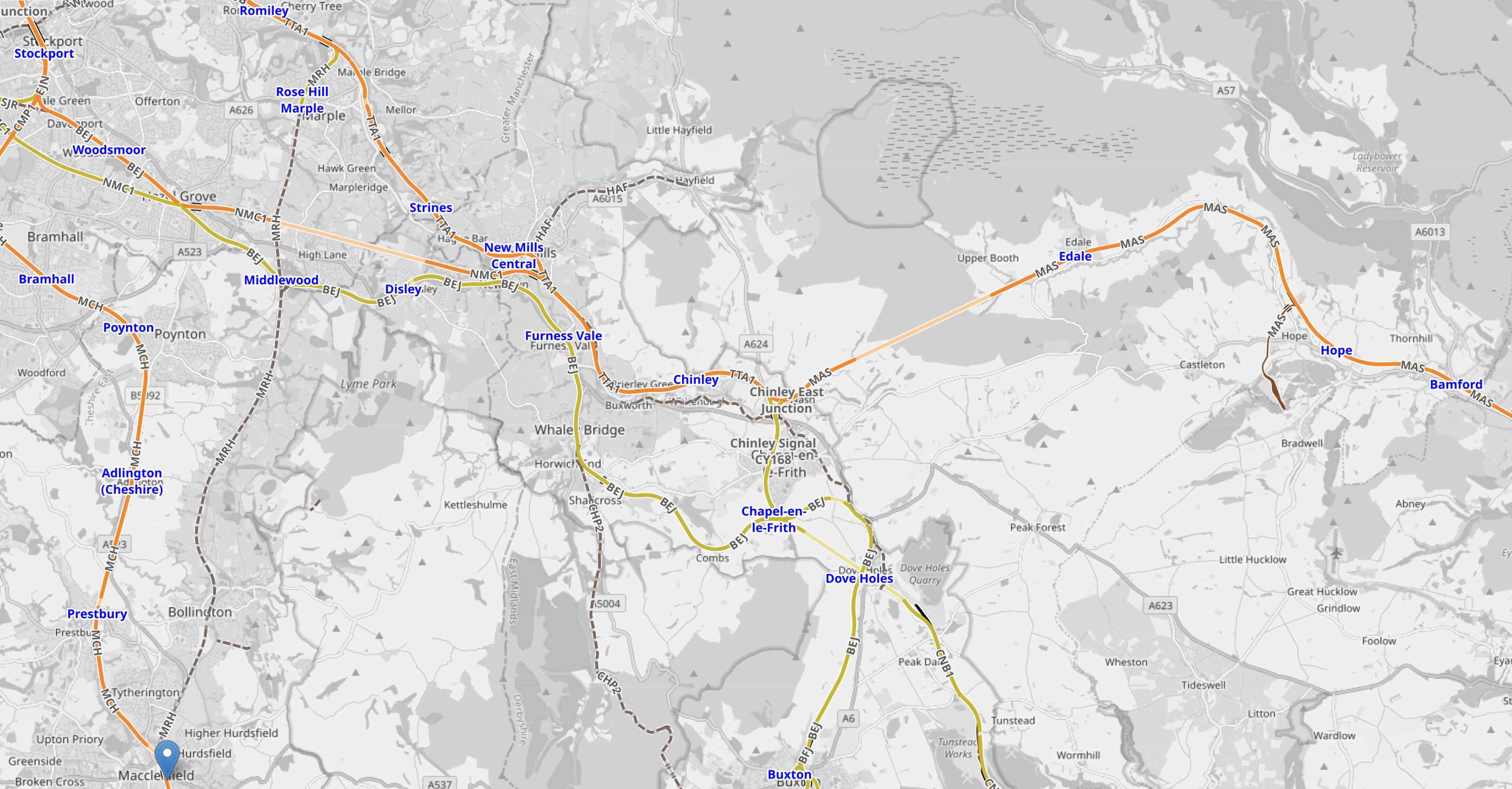
This second OpenRailwayMap shows the railway network to the East of Macclesfield.
Note.
- Macclesfield is in the South-West corner of the map.
- Stockport is in the North-West corner of the map.
- The orange track that stretches across the map is the busy Hope Valley Line, which is an important passenger route between Manchester and Sheffield and an important freight route for the quarry products of the Peak District to the South.
- The Buxton Line comes South from the Hope Valley Line to Chapel-en-le-Frith, Dove Holes and Buxton.
I believe a strong case can be made to link the area to the East of Macclesfield to HS2.
These points must be considered, when designing a road transport network to feed travellers from the East of Macclesfield.
Bakewell
Bakewell is the largest settlement and only town within the boundaries of the Peak District National Park.
I believe that travellers to Bakewell, would use a quality transport network to HS2 at Macclesfield.
Buxton
These are facts from Buxton’s Wikipedia entry.
- Buxton is a spa town of 20,000 people.
- It is England’s highest market town, sited at some 1,000 feet (300 m) above sea level.
- The University of Derby is a noted employer.
- Tourism is a major industry, with over a million visitors to Buxton each year.
- The Buxton Line connects Buxton to Stockport and Manchester Piccadilly.
I believe that travellers to Buxton, would use a quality transport network to HS2 at Macclesfield.
The Cat And Fiddle Inn
The road between Macclesfield and Buxton passes the famous Cat and Fiddle Inn.
This is the first paragraph of the Wikipedia entry for the public house.
The Cat and Fiddle Inn is a former public house in the English Peak District, close to the border between Cheshire and Derbyshire. It sits on the A537 road from Macclesfield to Buxton, which runs across a high and remote area of moorland. A section of the road is known as the “Cat and Fiddle Road” after the inn. The building is some 1,689 feet (515 m) above sea level, and it was the second-highest public house in Britain before it closed in 2015 (the Tan Hill Inn in Yorkshire is slightly higher). In 2020, it reopened as a distillery, shop and bar.
I visited it once in the 1960s with my future wife and two friends.
These roads in the Peak District will be challenging roads for modern electric buses.
Chatsworth House
I have never been to Chatsworth House and no very little about the house and its history.
So I asked Google AI,”Is Chatsworth House A Major Tourist Attraction?” and received this reply.
Yes, Chatsworth House is a major tourist attraction, frequently cited as one of the UK’s most popular country houses and a top destination in the Peak District. Located in Derbyshire, it draws hundreds of thousands of visitors annually to explore its historic house, 105-acre garden, farmyard, and massive parkland.
Key Reasons for Its Status:
Cultural Significance: As the home of the Cavendish family since 1549, it holds significant art collections (Old Masters, modern sculpture, Egyptian artifacts).
“Palace of the Peak”: Known for its grand interiors, including the Painted Hall and Sketch Galleries.
Famous Grounds: Features a 105-acre garden with a maze, cascading water features, and the impressive Emperor Fountain.
Media Appearance: Known as the real-life Pemberley from the 2005 Pride & Prejudice film.
Family Activities: The estate includes a popular farmyard and adventure playground.
Chatsworth is often ranked as a favorite stately home in Britain and is a key visitor attraction in the East Midlands region.
As with Buxton, I believe that travellers to Chatsworth House, would use a quality transport network to HS2 at Macclesfield.
Chesterfield Station
Chesterfield station is a major station on the Midland Main Line, close to the East side of the Peak District.
Chesterfield station is the following distances from these towns and attractions.
- Bakewell – 12-13 miles
- Buxton – 24-25 miles
- Chatsworth House – 12 miles
- Macclesfield – 35-40 miles
Chesterfield has no direct rail connection to any of these towns, but I think you can get to Buxton with changes at Sheffield and Hazel Grove.
The Wikipedia entry for Chesterfield station gives this description of services at the station.
Chesterfield is served by three train operating companies:
- East Midlands Railway operates regular inter-city services on the Midland Main Line between Sheffield and London St Pancras, via Derby and Leicester; this includes the 07:45 southbound departure, the Master Cutler. It also runs a route between Liverpool and Norwich, via Manchester Piccadilly and Nottingham.
- Northern Trains runs an hourly service between Nottingham and Leeds.
- CrossCountry operates a regular service between Sheffield and Derby; trains continue on to a variety of final destinations including Glasgow Central, Edinburgh Waverley, Plymouth, Reading, Southampton Central and Bristol Temple Meads.
There are typically 12 passenger trains per hour passing through the station on weekdays (six in each direction), with ten of those calling.
I believe that if a transport network is developed to the East of Macclesfield, it should call at Chesterfield station.
Dore & Totley Station
Dore &Totley station is the nearest station to Sheffield at the Sheffield end of the Hope Valley Line.
I wrote about the station in Dore & Totley Station – 1st April 2025 and after a sympathetic restoration, it is now a superb step-free station.
These pictures give a flavour of the station.


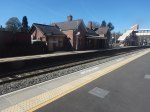
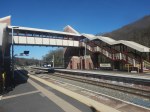
The second picture, appears to show a pair of bus stops on the main road.
If these aren’t considered adequate, I’m sure space could be found in the car park for a bus stop with level access to the station.
Hazel Grove Station
Hazel Grove station is the nearest station to Stockport at the Manchester end of the Hope Valley Line.
I wrote about the station in Hazel Grove Station and it is a rather ordinary station with car parking and step-free access.
Passengers can also change trains for the Buxton Line.
HS2 Day Trips
Toyota’s Trial Of Hydrogen Buses In The Peak District
To find out more of this, I typed the title of this section into Google AI, and received this answer.
Toyota conducted a two-week trial of hydrogen fuel cell buses in the Peak District National Park in September 2022 to promote sustainable tourism and reduce carbon emissions. Using CaetanoBus H2.City Gold vehicles, the trial aimed to connect key tourist sites without relying on private cars. This initiative supports a long-term goal of launching the “Peak Express” service by 2025.
Key Details of the Peak District Hydrogen Bus Trial
Purpose: The trial was designed to reduce the high reliance on cars (85% of visitors) in the national park, aiming to cut emissions by 3.6 million kg a year once fully operational.
Vehicles: The trial used hydrogen fuel cell electric buses manufactured by CaetanoBus, which is part of Toyota’s European partner network. These buses provide a range of up to 200 kilometers and can be refueled in 10-15 minutes.
Route: The hydrogen buses operated in and around the Peak District, connecting major spots including Chesterfield railway station and Chatsworth.
The “Peak Express” Initiative: Led by the Gateway at Peak development, this project plans a full service by 2025 to offer sustainable transport options.
Multi-technology Strategy: Toyota is testing both hydrogen fuel cell electric vehicles (FCEV) and battery electric vehicles (BEV) to determine which is most suitable for different types of journeys.
The trial was part of a larger push to test hydrogen infrastructure, with long-term plans to create multiple hubs around the Peak District National Park boundary.
The experience from my trip to Gatwick, that I described in Sutton Station To Gatwick Airport By Hydrogen-Powered Bus, has convinced me, that where bus and hills are involved, you need to have hydrogen buses, as they torque the torque.
Conclusion
I believe that the Peak District and Toyota are on the right track, but I strongly believe that any buses ferrying passengers around the Peak District, need the extra torque that hydrogen will provide.
The bus also must be large enough.
I also wonder, if as the service will be serving Chatsworth, that a hydrogen-powered coach might be a better choice of vehicle.
Hydrogen-Powered Coaches
The first hydrogen-powered coaches will becoming into service this year.
- Mercedes and Wrightbus have both said they will launch vehicles.
- Two and three-axle models have been talked about.
- Ranges of a thousand kilometres on a single tank of hydrogen seem to have been promised.
- Typical load will be about eighty passengers, which will include wheelchairs.
- Like the bus between Sutton station and Gatwick Airport, they will be mouse-quiet.
I believe they will become a valuable part of the public transport network.
- Running long distance coach services.
- Extending long-distance rail services.
- Running special services over long distances, like those for football supporters.
- Running rail replacement bus services for rail companies.
I can’t wait to have my first ride.
Designing A Battery-Powered Mountain Goat
When I wrote Up To Ebbw Vale From Newport, this comment was posted.
I’m not surprised that the Class 150 train, had no difficulty in climbing up to Ebbw Vale Town. The max gradient is around 1 in 65. There are plenty of places in Britain where gradients are steeper and indeed part of the type test for all dmus was to climb the 2 mile, 1 in 37.7 Lickey Incline starting a couple of hundred metres before the beginning of the slope.
It certainly got me thinking.
Could a line like Newport and Ebbw Vale be decarbonised, by simply fitting batteries to an appropriately-sized electric train?
- The battery would be charged using the 25 KVAC overhead electrification in Newport station.
- The train would climb the hill to Ebbw Vale Town on battery power.
- Coming down the regenerative braking would charge the battery.
- Once in the platform at Newport station, the battery would be topped up, to the level needed to climb the hill, from the existing electrification.
The question is can the train carry enough juice in a battery?
I will work the example through with a three-car Class 331 train.
- I have chosen a Class 331 train, as CAF have a factory in Newport.
- The train weighs 30.48 tonnes.
- It has 213 seats.
- If I assume that each passenger is 80 Kg including baggage, bikes and buggies, that gives a mass of 17.04 tonnes or a total mass of 47.08 tonnes.
- The difference in altitude between Ebbw Vale Town and Newport is 764 feet.
Using Omni’s Potential Energy Calculator, that gives a value of 29.9 kWh.
This OpenRailwayMap shows the tracks from Newport to Pye Corner.
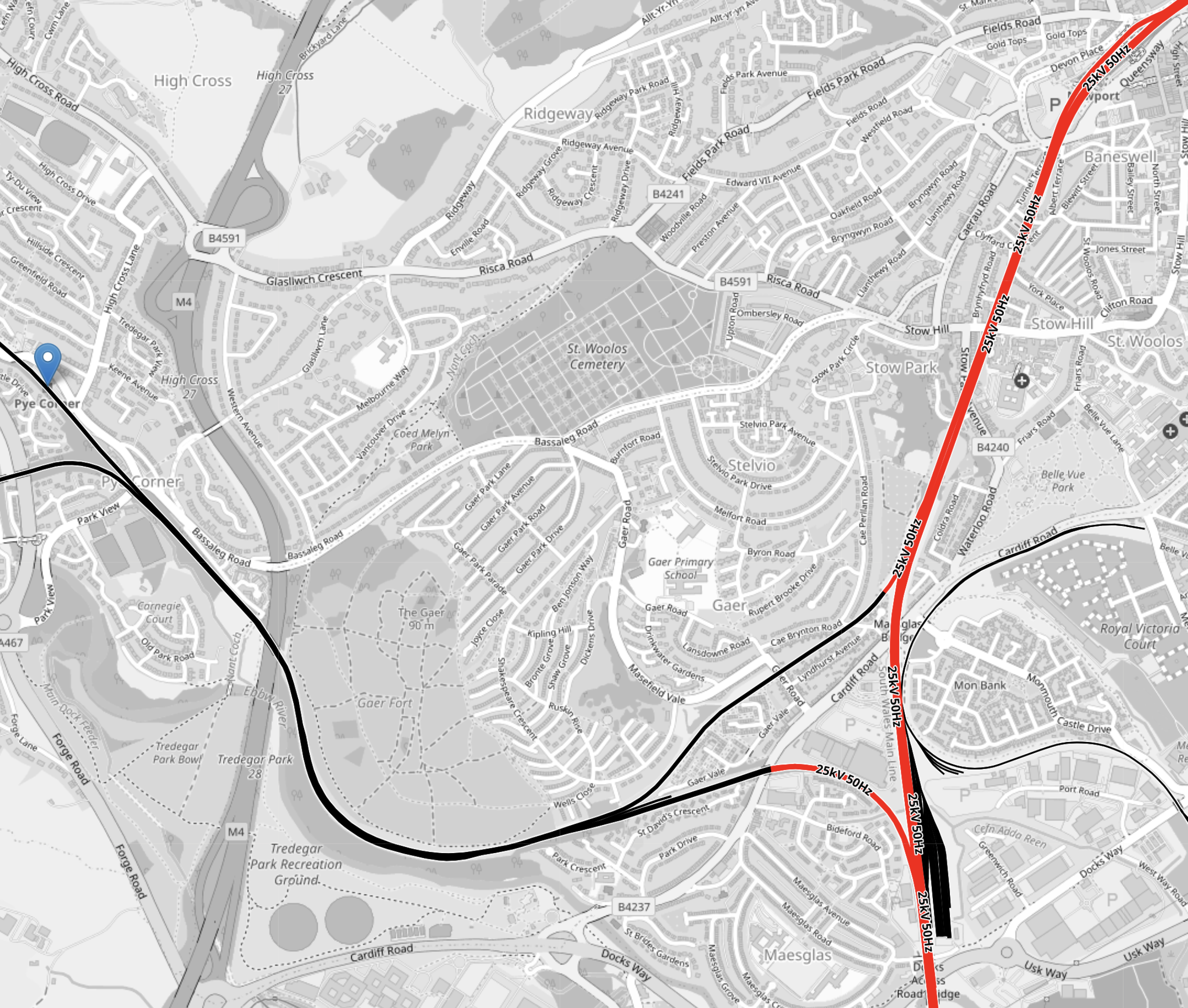
Note.
- Red tracks are electrified and black ones are not.
- Newport station is in the North-East corner of the map, with the South Wales Main Line running through.
- Pye Corner station is marked by the blue arrow and is the first station on the climb to Ebbw Vale.
- The unelectrified Ebbw Vale branch has a triangular junction with the electrified South Wales Main Line.
- The electrification continues for a short way towards Pye Corner and goes all the way to Newport and Cardiff.
- Trains take 24 minutes to turn round in Newport.
- Newport and Ebbw Vale Town is about twenty miles.
It can be safely said that trains will start their climb to Ebbw Vale with a full battery.
What Battery Size Will Be Needed?
I don’t think it will be that large and it will be the smallest battery, that could take a train up the hill.
As part of the climb is double track, the up track could be electrified to enable a smaller battery to be used, which would mean less power would be needed, due to the lower weight.
Conclusion
I believe that it will be possible to fit CAF’s Class 331 trains with a battery large enough to take a train up the hill to Ebbw Vale Town.

