GWR Trialling Transformative Ultra-Rapid Charging Train Battery
The title of this post is the same as that of this article on Rail Technology Magazine.
This is the sub-heading.
Great Western Railway (GWR) has begun trialling a potentially groundbreaking battery innovation called FastCharge. If the trial is successful, it is hoped that the technology could transform branch line services and accelerate the decarbonisation of the network.
This is the first paragraph.
This innovative system, which has been developed over three years, eliminates the need for diesel trains on branch lines by powering battery-operated units with ultra-rapid charging. The system boasts an impressive 2,000kW charging capacity, eight times more powerful than a Tesla Supercharger, allowing trains to fully recharge in just 3.5 minutes at West Ealing station, the trial’s first real-world location.
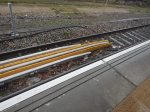
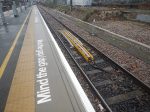
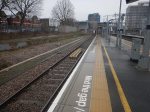
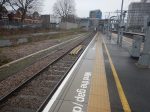
I took these pictures of the trial installation at West Ealing station, this morning.





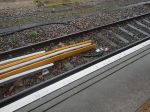
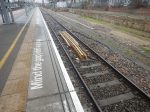
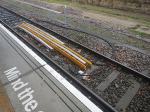
Note.
- Platform 5 is used by the trains to and from Greenford station.
- Two sets of charging rails have been installed between the rails, in Platform 5.
- The rails in the charging rails could be aluminium. This would not be surprising, as it is a good electrical conductor.
- The two shorter outside charging rails could be connected together.
- The yellow parts of the charging rails are plastic, so are probably for warning purposes.
- Two white containers have been installed alongside the track.
In Great Western Railway Updates EHRT On Its Upcoming Operational Trial Of Fast Charge Tech, I described the components of the Fast Charge system in this paragraph.
The Fast Charge system consists of three key components: retractable charging shoe gear, which is mounted to the underframe of the train; short (4m) charging rails mounted between the underframe of the train; and the Fast Charge Battery Bank (FCBB) installed beside the track, acting as an energy buffer between the train and the grid.
The charging rails are clearly visible in my images and the Fast Charge Battery Bank is probably in the white containers.
These are my thoughts.
The Engineering Is Of A High Quality
Or it certainly appears so from the platform and in the pictures, that I took.
How Much Energy Will Be Taken On Board at Each Charge At West Ealing?
According to the Rail Technology Magazine article, the Fast Charge Battery Bank will have to supply 2,000 KW for 3.5 minutes to fully-charge the train at West Ealing station.
This is 7,000 KW-minutes or 117 KWh.
In D-Train Order For Marston Vale Confirmed, this is said about the batteries on a Class 230 train.
- The train has four battery rafts, each with a capacity of 106 kWh
- Range is up to fifty miles with a ten minute charge at each end of the journey.
- Range will increase as battery technology improves.
I wonder if the Class 230 train, that will run between West Ealing and Greenford, will only have one 106 kWh battery.
- This will be less weight and therefor better acceleration.
- 117 kWh in the Fast Charge Battery Bank will be sufficient to fully-charge the single battery.
- The route is only five miles for a round trip.
I can see costs dropping.
What Batteries Will Be Used In The Fast Charge Battery Bank?
I think there are four main possibilities.
- New lithium-ion batteries
- Refurbished second-hand electric vehicle batteries
- New lead-acid batteries.
- It might be possible to use supercapacitors
Note.
- Lead-acid batteries can lose charge in cold weather.
- Supercapacitors don’t care about the weather.
- The weight of lead-acid batteries would not be a problem in a stationary application.
If there is only one battery on the train, I can see the supercapacitors handling it.
What Voltage Is Used In The Charging Rails?
Consider.
- The Vivarail Class 230 trains are built from redundant London Underground D78 Stock trains.
- The D78 Stock trains were built to run on London Underground lines, when that had voltages of 0 and 630 VDC.
- So I wouldn’t be surprised if the trains were designed around this voltage.
- If the charging rails worked at 630 VDC, then to have a 2,000kW charger, this would mean a charging current of 3175 Amps.
This would explain the fat cables connecting the charging rails to the Fast Charge Battery Bank.
An alternative voltage to use could be 3,000 VDC, as some trains are built to this voltage and therefor the electronics and transformers must be available. This would reduce the charging current to 667 Amps, which might be able to use smaller cables.
It may come down to what is convenient for the output voltage of the batteries.
Why Are There Two Sets Of Charging Rails?
They are both shown in this image.
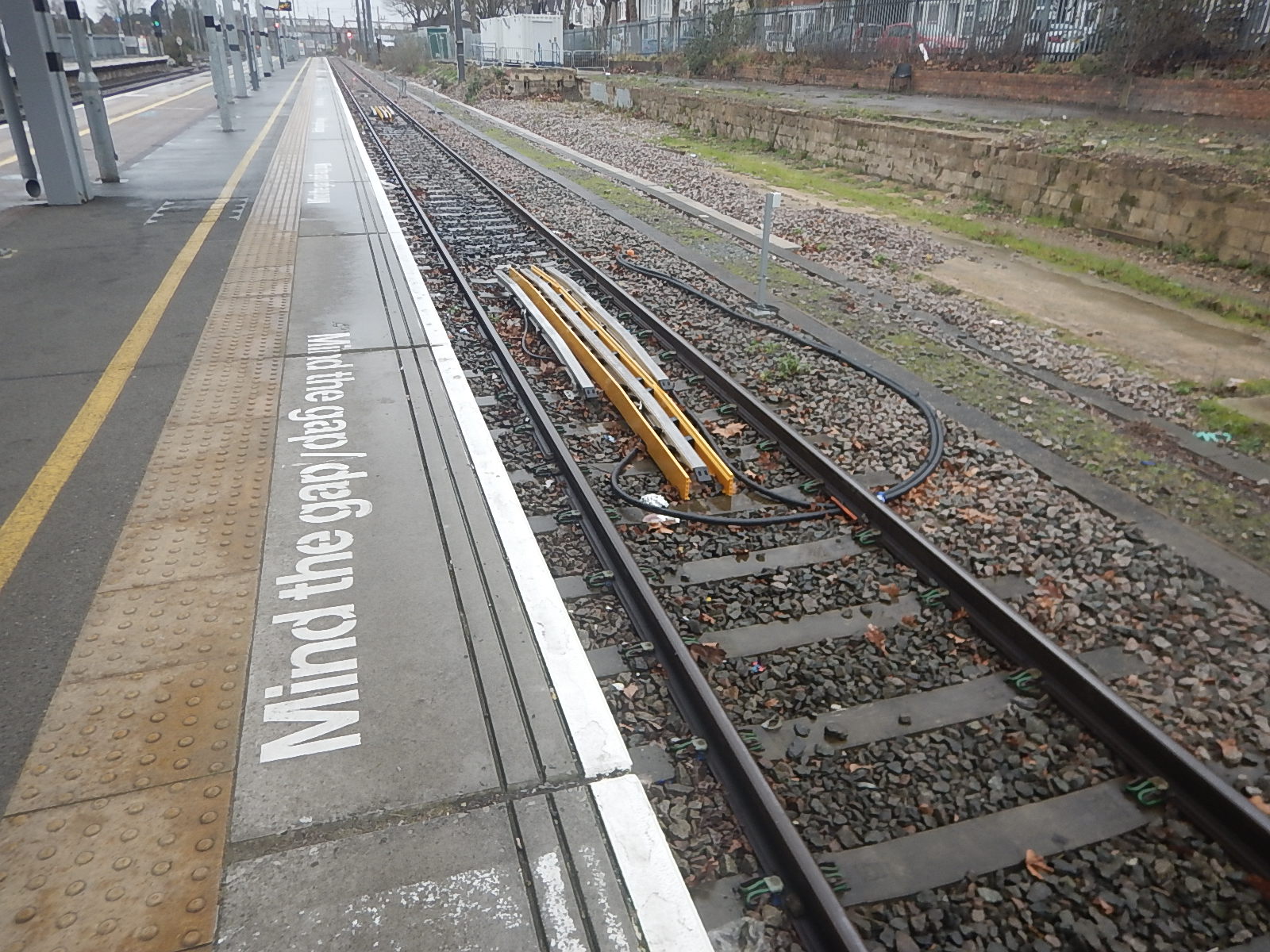
Note.
- The two sets of charging rails are about forty metres apart.
- The Fast Charge Battery Banks are another twenty metres further on.
It’s not the layout you’d expect for running a single two-car train running every half hour.
But could it be that two separate sets of charging rails can operate a more frequent service with this layout of charging rails?
 The Anonymous Widower
2MW seems a tad overkill for the battery packs on the 230 but at least its still progressing
Comment by Nicholas Lewis | February 13, 2024 |
If you want more detailed information about the fast charge system that GWR now own, you can do no better than read the latest patent, GB2574264A, which deals with the charging system as applied to the Class 230 for voltages between 500 – 750.
Hope it’s of use
Comment by fammorris | February 14, 2024 |
Thanks! One of the most detailed patents I’ve seen. It does seem that they’re still using the London Underground voltages. I thought they might use higher voltages, as they would be sufficiently guarded and would need thinner cables.
I suspect there could be an open-circuit detector, which would indicate the cable had been nicked.
Comment by AnonW | February 14, 2024 |
Two recharging railsets provides redundancy perhaps.
But how many cars in the class 230? Maybe you recharge 2 cars at once.
When this works, could the technology be sold/licensed to Stadler/Merseyrail? Put rails in Preston or Wrexham for extending the services.
Comment by chilterntrev | February 14, 2024 |
Class 230 trains can have two or three cars. The difference is a trailer in the middle. So a three-car train would fit the current setup if the batteries were in the two end cars.
They’d also fit something like a three-car Aventra. The system appears to be adaptable to any battery-electric train.
Comment by AnonW | February 14, 2024 |
AIUI, Vivarail deliberately designed the charger to be compatible with any battery train. It was reported that Vivarail demoed a 25kV EMU just before they went bust.
Comment by Peter Robins | February 17, 2024
Yes 630v nominal. I’d imagine LUL & NR and their suppliers have a lot of cable. The traction motors are new 56kW Traktionsysteme Austria motors. TSA was formerly an ABB company and is now a JV between Peter Spuhler, the guy who ran Stadler until it went public in 2019 and Voith Turbo.
Comment by fammorris | February 14, 2024 |
I wonder what the long term effects this fast charging has on the batteries? Ramming in 3,000 amps in 3 to 5 mins must cause the battery to heat up and potentially lead to buckling of plates. We’ve seen what happens to electric scooters left on charge unattended – a massive increase in house fires as the batteries explode in flames. Recently two buses in London went up in flames because the batteries caught fire. Nobody wants to see battery trains catching fire especially in the rush hour.
I just wonder if sufficient testing has been carried out on the batteries by fast charging and discharging in repeated cycles?
Comment by MauriceGReed | February 14, 2024 |
I don’t know if it’s the case with these Vivarail units, but it’s increasingly common for large batteries to be remotely monitored like jet engines, and then called in for maintenance to forestall an issue becoming a problem. GWR’s trial is scheduled to last a year, during which time they’ll be capturing large amounts of data and analysing it to see how it performs in different conditions (weather, etc). I’m sure if there’s any fear of anything overheating, they’ll stop the trial and see what can be improved.
Comment by Peter Robins | February 17, 2024 |
👍🏼
Comment by MauriceGReed | February 17, 2024
For more on fire safety, see https://www.evfiresafe.com/post/why-do-e-buses-catch-fire This Australian site (updated in Jan) finds only 27 bus fires out of 250,000 in operation. Of course, that’s 27 too many, but then other power sources can be dangerous. Overhead wires can fall down and short-circuit, people can and do get electrocuted from 3rd rail, and Hollywood action films frequently show exploding vehicles – fortunately, that’s not nearly as common in real life. The battery situation should improve once solid-state ones start being used, as the dreaded dendrites should be much less likely to occur.
Comment by Peter Robins | February 18, 2024
You need to look into sodium ion batteries. Massive investment into their manufacture.
https://www.youtube.com/watch?v=t3bS0I6p7RU
Comment by John Burns | March 8, 2024 |
I have been told by a train manufacturer, that they are on their way and are better.
I wouldn’t want to say more!
Comment by AnonW | March 8, 2024
If I had to bet on on Sodium ion and Solid State batteries over the next 5- 6 years I’d favour the latter. Toyota has made a breakthrough in its quest to improve the durability of this technology. Toyota solid-state lithium-ion batteries have a solid electrolyte that allows for faster movement of ions and a greater tolerance of high voltages and temperatures. This development has worried the world’s 3 largest battery developers, all Chinese so much that they’ve clubbed together to catch up.
Comment by fammorris | March 8, 2024
Horses for courses, I think. Solid-state will initially be expensive, and limited to high-end vehicles (Porsche and friends). I can’t see them being used in trains for the next few years. Sodium doesn’t have the range of lithium. So for immediate use, it has to be current Li-ion. Development is however moving fast, so I wouldn’t bet too much money on anything just now. I do have modest hopes that an incoming government might move things along faster. But at the current rate of progress, I’ll be long dead before there’s substantial progress on this front – or for that matter on track electrification.
Comment by Peter Robins | March 8, 2024
As you say for the foreseeable future Li-ion is going to be the solution, however to suggest that priority for solid state batteries is for likes of the prestige car market rather ignores the fact that the rail industry have long been in advance when it comes down to ac traction developments, have a technically challenging set of environmental and operating conditions and now will benefit from the road vehicle market’s focus on electric traction innovation.
Comment by fammorris | March 8, 2024
Well, with EVs we’ve so far seen the manufacturers concentrate on large SUVs and similar up-market cars where they can make good margins. Only the Chinese have been churning out small EVs and urban runabouts. The British firm Faradion was a pioneer in Na-ion batteries, but that was bought by the Indian giant Reliance a couple of years ago, and the Chinese now dominate that market. IRENA published a chart recently; they reckon that 95% of the current Na-ion production capacity is in China.
Rail can certainly benefit from the car industry’s battery development, but I’m afraid Britain is no longer any kind of pioneer in the tech. Vivarail was innovative, but that didn’t last very long!
Comment by Peter Robins | March 8, 2024
I do however see sodium and other technologies moving into static storage, grid-connected or residential/commercial use, pretty quickly. Size and weight aren’t important in static storage.
Comment by Peter Robins | March 8, 2024
Sodium is SAFER. That is the key to their mass production. You need more battery for sure however on trains that is less of an issue, if an issue at all, than with cars. Sodium batteries promise to be cheaper than lithium.
Even in cars, a car design to have the whole floor an underfloor pan of sodium batteries will still give a long range. Just means a larger battery set.
Solid state batteries is a good solution for sure, especially for smart phones (a bursting lithium battery ruined my expensive phone) but it is not in the stage that it can be manufactured en mass. …. Yet.
We will see different types of battery technology entering the market. Do not expect one to dominate as they are all good at various applications.
Comment by John Burns | March 9, 2024
Thanks!
Comment by AnonW | February 14, 2024 |
[…] Battery trains would be able to use a simple automatic charger, similar to the one, that I described in GWR Trialling Transformative Ultra-Rapid Charging Train Battery. […]
Pingback by Smart Train Lease Aims ‘To Make Renting Trains As Easy And Simple As Renting A Car’ « The Anonymous Widower | February 15, 2024 |
[…] GWR Trialling Transformative Ultra-Rapid Charging Train Battery, I talked about the installation of the Vivarail/GWR Fast Charge system at West Ealing […]
Pingback by Newquay Station – 9/10th February 2024 « The Anonymous Widower | February 17, 2024 |
GWR are reporting that the train travelled 86 miles on its batteries on Wed, and then yesterday 70 miles on less than half the battery capacity. They’re talking (rather excitedly) of 120 miles without a recharge. Here’s hoping this leads to more battery trains being ordered. https://news.gwr.com/news/great-western-railways-battery-train-sets-new-distance-record
Comment by Peter Robins | February 17, 2024 |
According to CESafety a company running training courses in the UK, a FOI survey they carried out found 14 incidents of fire on buses and coaches for the year 2022/23
Comment by fammorris | February 18, 2024 |
According to a CESafty FOI survey there were 14 ev fires on buses and coaches in the UK for the year 2022/23
Comment by fammorris | February 18, 2024 |
This tech should transfer over to Merseyrail with their new 777 trains.
Comment by John Burns | March 1, 2024 |
Looking closely at the charger, I have a feeling that it could be fitted to many trains.
It appears at West Ealing, there are actually two charging points. One for each car.
I do wonder, if the system could handle a five-car Class 800 train, with one charge point under each car with a battery.
Comment by AnonW | March 2, 2024 |
Overhead wires and their gantries are downright ugly. Third rail dangerous. Wires and 3rd rail can be ripped up. The GWR Vivarail Class 230 battery trains were tested at a range of 84 miles – and recharged in 3.5 minutes. On half battery charge they went 70 miles. NIce. The Merseyrail Class 777s were tested by Stadler reaching 84 miles in range. That is with current batteries with battery technology getting better.
The GWR 230s are charged at the stations using a charging rail between the rails at stations, or selected stations, with charging shoe under the train. This is ideal for urban railways and also regional railways. For example, they will do the Liverpool-Manchester line at 30 miles with a quick charge at each end.
The choice is a smaller and cheaper battery set charging at every 2nd or 3rd station, or one expensive big battery set that has over 80 miles range. The large train mounted battery set looks the cheaper option, as the chargers at the stations have a trackside battery set as well that transfers the charge to the trains batteries quickly. The trackside batteries charge from the grid slower. So, lots of battery sets needed. A combination of trackside super-capacitors and batteries would be the ideal setup.
These battery trains can also be hybrid running, on batteries, wires, or 3rd rail.
Comment by John Burns | March 3, 2024 |
I will be interested to see what the Heritage Taliban do, when Network Rail try to electrify the North Wales Main Line.
It looks to me, that the two chargers at West Ealing are arranged to each charge a coach.
Consider.
1. Hitachi have said that their battery packs weigh the same as a diesel engine.
2. Hitachi have indicated that they are looking at the next generation of batteries. But any big electrical company would be!
3. Longest battery range for a Hitachi Class 805 train would be for a train with three batteries in the three middle cars replacing the diesels.
4. There would be charging at Holyhead.
I reckon at least a hundred mile range would be possible.
The distance between Chester and Holyhead is just 84.4 miles.
There is an opportunity to create a unique electrification-free zero-carbon route between Crewe and Holyhead.
If necessary a triple Fast Charger could be built halfway at Llandudno Junction.
It would be a tourist attraction in its own right.
If it worked it would be replicated all over the world.
I have a feeling that Vivarail in their chargers use pre-owned lithium batteries. I suspect lead acid might also work.
Comment by AnonW | March 3, 2024 |
Crewe to Chester is unelectrified. So if a London-Holyhead train, Crewe to Holyhead can be on batteries, the rest on WCML or even HS2 track. It can charge batteries from the wires and a quick top up at Chester.
Comment by John Burns | March 3, 2024
Acceleration. The train can take energy directly from the rail under the train to initially move, rather than the batteries.
Comment by John Burns | March 3, 2024 |
The Class 230s are also used by TfW on the Wrexham to Bidston, Birkenhead service. Using batteries only, the trains can reach the underground station of Hamilton Sq then terminate in James St in Liverpool where it can recharge and with fast chargers at a few stations along the way. James St has an unused platform, so ideal for terminating then turning back. Merseyrail do not want the 230 trains to run around the Loop as they will accelerate track wear. They can terminate at James St though.
Comment by John Burns | March 3, 2024 |
I suspect they may be using supercapacitors on the trackside as they charge quickly and discharge quickly. So a quick one or two minute zap at each or every other station to trickle charge along the way.
Comment by John Burns | March 3, 2024 |
The use of supercapacitors rather depends on the amount of energy that you transfer from the charging station to the train, yes supercapacitors are great from the point of view of power density but they get rather big for larger amounts of energy. I can see them being used for tram and possibly light rail solutions but I’m not so sure about heavy rail applications.
Comment by fammorris | March 3, 2024 |
Super-caps take in ‘electrical’ energy QUICK and then discharge it Quick. Storage is poor, but getting better. There is no state change as in a chemical battery. A battery is chemical energy, so slow both ways. They have come a long way in the past 10 years. They are superb for starting cars where a large discharge is needed not putting strain on a battery. I believe there are hybrid chemical/supercap car batteries about.
A supercap charging off the grid is ideal to give a train a quick top up zap at a station. Ideal for high frequencies at a station.
Comment by John Burns | March 4, 2024
One point. To install, those battery container right in front of those house is totally contemptuous act. Out of order indeed.
Comment by John Burns | March 3, 2024 |
Responding to Peter Robins, in asserting that margins in the rail industry are higher than in the automotive sector I’m talking about the producers’ cost vs sales price that the vehicle builder pays rather than the sales margins between manufacturer and consumer of say a family car compared with an SUV. Not only are the Chinese preeminent in producing battery packs for what are often their own road vehicles but they also lead the way in providing cells and modules to larger, particularly large specialist low volume OEMs (mining, rail and perhaps defence) who are often involved in the module and battery pack integration. This is in contrast to smaller OEMs and start-ups who like smaller automotive manufacturers depend on battery cell suppliers to manage all of the production stages, i.e cell, module and battery pack, and then deliver a complete, ready-to-install pack to vehicles incorporating the battery management system (BMS) and thermal management system (TMS)
I have long thought that the notion that Britain is a pioneer in many technologies was illusiory, the trouble is that the country now has few corporations that can commit to finance the R&D, the manufacture and distribution of world leading products – the only one that immediately comes to mind is AstraZeneca, with perhaps an honourable mention for BAE, Rolls-Royce and Melrose the former aerospace wing of GKN. Companies like Vivarail may have displayed innovation, but it’s romantic to assume that without the capitalisation they have a future.
Comment by fammorris | March 9, 2024 |
Yes, that’s certainly true as regards finance. I know that Stadler and Vivarail both use Hoppecke batteries. I just looked up Siemens and CAF, but can’t find any reference to whose batteries they use. The first Siemens Mireo B was supposed to be coming into service on the Ortenau network at the end of last year, but was delayed due to ‘supply chain issues’.
The maintenance contracts so far (mainly in Germany) that I’ve seen are long-time, 30 years or more. So presumably include the ability to swap out the batteries if they need replacing or if a newer better option comes along. So I think it’s a fair bet that the range and performance of batteries will improve over the lifetime of the trains.
As our friend AnonW never ceases to point out, Britain was a pioneer in testing battery trains on the Manningtree line, but not a lot has happened since then. It’s falling way behind continental countries.
Comment by Peter Robins | March 9, 2024 |
Siemens could be using their own batteries, while CAF have recently used Enpower Greentech batteries produced in the good old USA on some tram projects.
As far as the IPEMU Manningtree tests went Bombardier did static testing (probably in Germany) on:
The vehicle trials were conducted using the LiFePh battery. Not much British input apart from the leasing company loaning a vehicle and Bombardier and RSSB running/the trial.
Comment by fammorris | March 9, 2024
Alstom use the MITRAC batteries they inherited from Bombardier’s Talent 3. https://www.alstom.com/solutions/components/mitrac-hydrogen-and-battery-solutions-sustainable-transport-non-electrified-lines has a photo of the complete unit, which presumably goes on the roof. Their trials with the SNCF should have completed by now, and they should be rolling out BEMUs from the end of the year IIRC. Unlike the 777s or the Vivarail, they can zip along at 160kph, in battery mode as well as under the wires.
CAF also have trams powered by supercapacitors https://www.vialibre-ffe.com/noticias.asp?not=2971 which date back to 2009. They built these in association with a technical institute and a company called Trainelec, firstly in Zaragoza and then a short stretch in Seville, which I have been on. Alstom also have supercaps on their trams in Nice, e.g. from the airport to the city centre. They’re pretty impressive – though of course they don’t nip along at 160kph. 🙂
Comment by Peter Robins | March 9, 2024
I particularly liked the Alstom link because unusually it is far mor informative than many publications they’ve produced over the years.
MITRAC was a Bombardier system which I came across in the 1990s and stands for Modular Integrated Traction System. It was originally launched to cover control electronics, traction converters and drives, so the term MITRAC really encompasses a whole range of components. MITRAC products consists of three elements including pantograph and shoe gears for power pickup, high voltage equipment, traction and auxiliary converters, drives, overall braking system and propulsion control, rather than defining a battery. A couple of years before Alstom acquired Bombardier, Bombardier agreed that the Swiss firm Leclanché would become its preferred global provider of battery systems for rail applications. Leclanché are Wrightbus’ battery supplier.
Yes I remember the Saville trams but never got to ride them while I was there. Trainelec were one of three CAF subsidiaries that are now known as CAF Power and Automation. There are some really good links based on CAF Power and Automation but the essence of the CAF ACR system is that it can be supplied either with a ‘simple’ supercapacitor solution using Maxwell devices or a hybrid battery , supercapacitor arrangement with the batteries from Enpower
Comment by fammorris | March 10, 2024
There’s a video of Alstom presenting their first BEMU at https://www.alstom.com/press-releases-news/2023/10/sncf-voyageurs-and-alstom-present-first-five-battery-powered-trains-ordered-french-regions-transport-authorities-charge-organising-regional-mobility with some footage of them taking out the diesel and installing the batteries. It’ll be interesting to see what kind of range these things can achieve.
I looked up supercap trams to see what kind of range they can achieve. CRRC installed one to Kunming Changshui airport in 2021. They say the caps store 80kWh of power, with a top speed of 70kph, and a range of 10km, which is pretty impressive. These trams are also driverless.
Comment by Peter Robins | March 10, 2024
RGI article on the initial test train before the latest units are being converted for revenue service https://www.railwaygazette.com/traction-and-rolling-stock/tri-mode-train-testing-completed/64318.article
Comment by fammorris | March 10, 2024
That’s a different train, known as https://en.wikipedia.org/wiki/R%C3%A9giolis in France.
In the beginning … Alstom produced the Coradias and Bombardier produced what’s widely known in France as the AGC, for autorail à grande capacité. When Alstom took over Bombardier, they had to divest the Coradia Polyvalent platform, along with the works at Reichshoffen in Alsace. CAF bought those, and has since received orders for Coradias. Alstom though apparently continues to provide numerous parts, including the motors (and the batteries?).
The Coradias you refer to are tri-modes which are adding batteries to the existing diesel-electric bi-modes.
According to the French wikipedia entry, there 699 AGCs in operation: 163 pure diesel (XGC), 185 diesel-electric bi-modes (BGC), 211 dual-current (ZGC: the non-TGV lines are mainly 1500V DC), and 141 which are both bimode and bivoltage (BiBi). I assume that, if the tests are ok, then they will gradually convert the remaining bi-modes, and then decide what to do with the pure diesels. As the man in the video says, they should have a good few years life in them yet.
Comment by Peter Robins | March 10, 2024
Its a bit tedious keeping up with the consolidation and resulting reorganisation of the European rail industry which has been going on in for the last thirty years, how Spain has ended up with two manufacturers don’t know. Yes I obviously wasn’t paying full attention to the machinations of Alstom’s takeover of Bombardier. What I have recognised is that the AGC’s MAN 2842 V12 and mtu 12V 1600 fitted to the UK’s Hitachi trains have very similar capacities, so the replacement battery packs for the two engines should be similar and should provide some interesting operating comparisons.
On an earlier point, so far as understanding what kind of range a tram can achieve, doesn’t it all come down to the amount of capacitance you instal on each vehicle set. The CRRC installed one, running on the Kunming Changshui airport line may have a range of 10km after which 2 minutes are required to recharge, however the route is 27 kms long and has seven intermediate stations. While it’s obvious that charging may not be needed at every stop, particularly those closely spaced, charging must take place at many of them. Trying to think about the CAF trams, differences in the duty load cycle apart which are determined by the kinematics of operation, suggest to me that the vehicle builders in Chanchung have probably installed a bigger capacitor than is optimally required.
I’m not always impressed by the research papers the RSSB however they produced a two part paper in 2009 under their reference T779 concerning ‘Energy Storage Systems for Rail Applications’ which is well worth reading even if some technology has moved on.
Comment by fammorris | March 10, 2024
I was going from CRRC’s press release at https://www.crrcgc.cc/en/g7389/s14333/t324625.aspx which gives more details on the capacitors. It sounds like these are much bigger than Alstom’s in Nice. Those are typical trams, stopping every few hundred metres. Every stop has one of Alstom’s charging rails which are set into the ground under the tram, and are only live when the tram is over them. They’re widely used in other cities which have battery-powered trams. Pedestrians can walk on them without fear of being electrocuted. Capacitors only take a few seconds to charge, so can be fully charged whilst passengers are getting on and off.
If such supercaps can have a range of kms rather than ms, I can see them replacing 3rd-rail metro and suburban systems. Much safer, and there’s no problem of charging times as with batteries.
Comment by Peter Robins | March 11, 2024
“how Spain has ended up with two manufacturers don’t know”
Maybe not for much longer. I see a Hungarian consortium has just put in a bid for Talgo, who are reported to be interested. Spanish government not keen, and is exploring whether CAF would like to take it over. CAF are certainly not short of ambition.
Comment by Peter Robins | March 11, 2024
I had a look at the background. It turns out that the company fronting the bid is essentially the Hungarian government, in a couple of guises and MOL, the Hungarian oil company. Spain’s concerns about Russian involvement are somewhat questionable. Ganz MaVag Europe zrt, who’ve made the offer was only established on Dec 1st 2023 and is based on what was until recently the DJJ carriage works that at one stage was owned by Bombardier (following the fall of the Eastern Bloc it was just one part of the old Ganz-mavag that was broken up and sold off to various rail business around Europe), sold on to the Hungarians and then a JV between them and the Russian TransMash Holdings, before finally TMH were bought out effectively leaving the Hungarians back in charge.
Talk about state intervention I’ll bet both the set up of Ganz MaVag Europe zrt and this bid break all sorts of EU rules
Comment by fammorris | March 11, 2024