National Grid Pioneers UK-First Trial Of 3D Printed Technology For Low-Carbon Substations
The title of this post, is the same as that of this press release from National Grid.
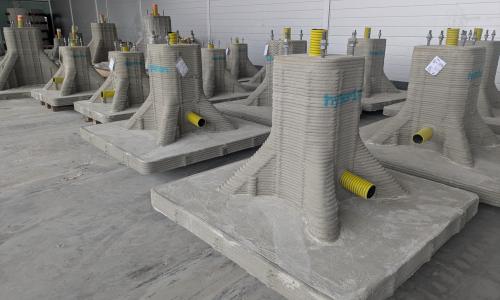
These three bullet points act as sub-headings.
- Collaboration with Hyperion Robotics and the University of Sheffield will trial low-carbon 3D-printed concrete foundations including at National Grid’s Deeside Centre for Innovation in North Wales
- Innovation could reduce waste, carbon emissions and costs to consumers of network construction
- If rolled out across National Grid substations the technology could save up to 705 tons of concrete and 323 tons of CO2 and deliver £1.7 million in consumer savings versus traditional methods over a 10-year period
These two paragraphs give more details.
National Grid is working with Hyperion Robotics and the University of Sheffield on a UK-first trial to manufacture, install and test 3D-printed substation foundations, which have the potential to reduce construction-driven carbon emissions and reduce costs to consumers of network construction. This is part of National Grid’s commitment to leverage innovation to future-proof the network.
If the project is successful and the technology is rolled out across all National Grid substations, it is estimated it could save up to 705 tons of concrete and 323 tons of CO2 over a 10-year period, and deliver £1.7 million in consumer savings versus traditional methods.
The foundation design will deliver significant savings across the entire value chain.
- 70% reduction in concrete usage
- 80% less soil displacement
- 65% decrease in embodied carbon emissions
- 70% weight reduction compared to typical foundations
- 50% reduction in site operative hours, streamlining production
The foundations will be designed and produced in Finland by Hyperion Robotics, and tested at full-scale by the University of Sheffield. Further field testing will then be carried out at National Grid’s state-of-the-art testing facility, the Deeside Centre for Innovation in North Wales, later in 2025.
Conclusion
I like this technology and I suspect there are many other applications of 3D Concrete Printing.
 The Anonymous Widower
So based on these photos, there appears to be no rebar.
So is this approach only suitable for simple low load bearing and low stress bearing structures?
Comment by chilterntrev | June 26, 2025 |