South West Freight Set For Resurgence
The title of this article is the same as that of a feature article in the November Edition of Modern Railways.
One of the topics, the article discusses is lithium mining in Cornwall and its transport from the South West.
I started by asking, Google AI, where lithium is mined in Europe, and received this answer.
Portugal is the only country in the EU currently mining lithium, with the Barroso project being the main focus of future production. However, there are multiple other European countries with significant lithium deposits that are expected to begin mining in the near future, including the Czech Republic, Finland, France, Germany, Spain, and Serbia.
So Cornish lithium will be one of several sources, but surely ideal for UK batteries.
The Modern Railways article has two paragraphs, which describe lithium mining in Cornwall.
But it’s the potential for lithium that may be the most exciting development for rail freight in the region. Cornish Lithium plans to extract it from an open pit at Trelavour, near St Austell, and it is adamant that rail will be vital for its plans to come to fruition. Trelavour is next to the Parkandillack china clay processing plant, and Cornish Lithium plans to use this to bring in essential materials. The volumes are significant – an estimated 180,000 tonnes per year of input are anticipated, most if not all brought in by rail, and the site’s output of around 8,000 tonnes per year could also go by rail. It is hoped the first traffic could run to the site before the end of Control Period 7 in March 2029 in a project that could run for 20 years.
It isn’t just Cornish Lithium seeking to extract this ‘white gold’ from Cornwall. Imerys British Lithium is extracting lithium and producing lithium carbonate, initially at a pilot site in Roche – with the aim of producing around 21,000 tonnes of the material every year for 30 years.
In total the two sites will produce 790,000 tonnes of lithium ores over thirty years, which when averaged is about 72 tonnes per day.
I then asked Google AI, where the lithium will be processed and refined and received this answer.
Lithium from Cornwall will be processed and refined at demonstration and full-scale plants located within the county. Specifically, Cornish Lithium has a demonstration plant in St Dennis and plans to build a full-scale plant there to produce refined lithium hydroxide. Similarly, the British Lithium project, a joint venture with Imerys, is developing a pilot plant and full-scale processing facility in the St Austell area to produce lithium carbonate from granite, says BBC News.
That seems a very comprehensive answer from a computer!
This Google Map shows the area of Cornwall between St. Dennis and St. Austell.
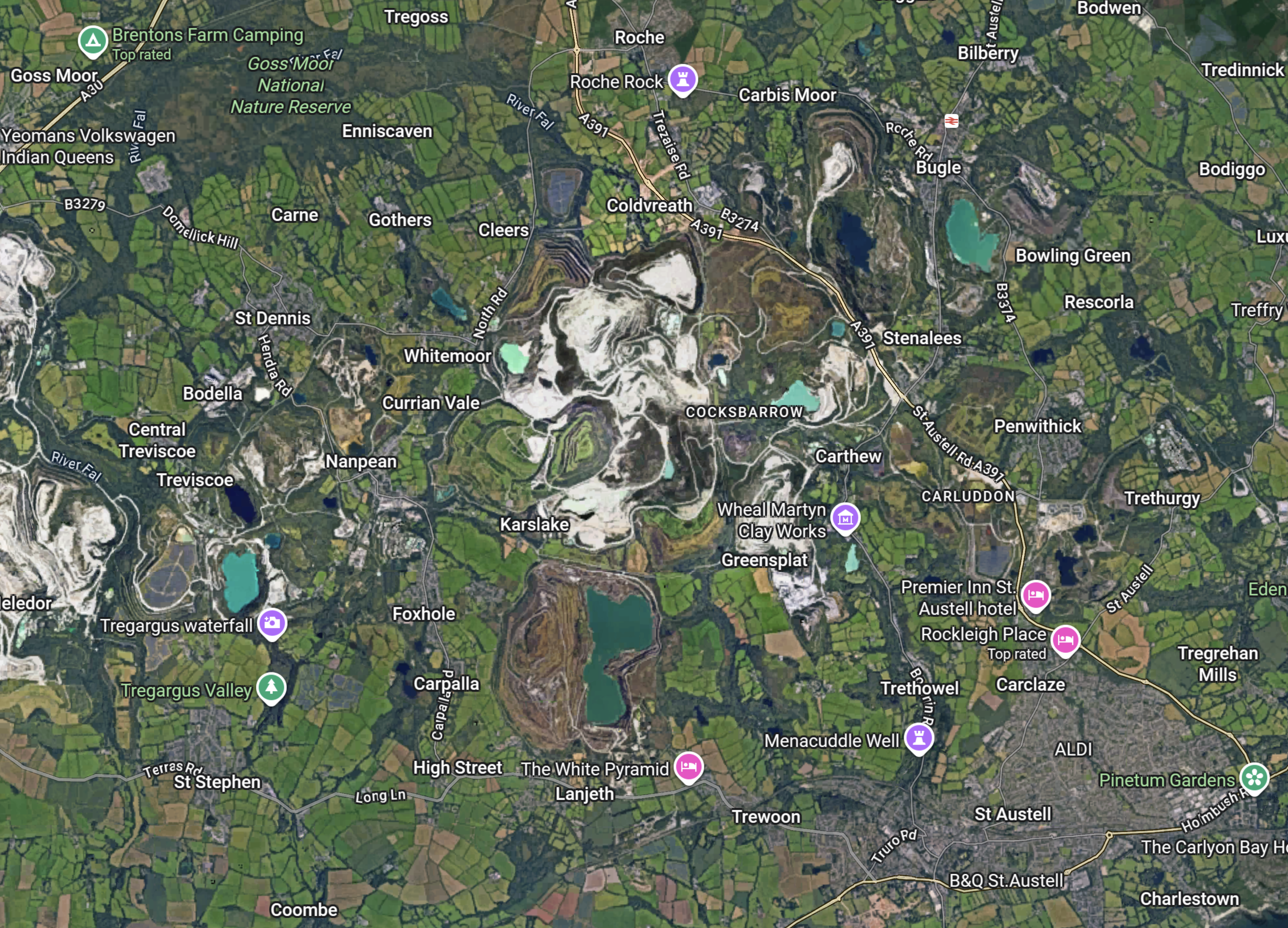
Note.
- St. Austell is in the South-East corner of the map.
- St. Dennis is in the North-West corner of the map.
- Trelavour appears to be just South of St. Dennis.
- In the middle of the map, are the china clay workings.
Although rail is mentioned, it looks like new tracks will have to be laid.
The Modern Railways article says this about using rail.
Should these plans come to fruition, it seems likely rail will play a part in the supply chain. It is not much of an exaggeration to suggest that Cornwall’s lithium deposits offer a generational opportunity for the Duchy, and by extension, for rail freight.
But, if I’m right about the daily amount being around 72 tonnes, then not many trains will be needed.
I have a few further thoughts.
How Much Will The Lithium Be Worth?
I asked Google AI, what is a tonne of lithium metal worth and got this answer.
A tonne of battery-grade lithium metal is worth approximately $77,962 to $80,398 USD, with an average of about $79,180 USD. The price fluctuates significantly based on market conditions, and the value can differ for industrial-grade lithium metal or other lithium compounds like carbonate or hydroxide.
Assuming a price of $80,000, then a day’s production is worth $5,760,000 and a year’s production is worth about $2 billion.
This could be a massive Magic Money Mine for Rachel from Accounts.
Will The Royal Albert Bridge Cope With The Extra Trains?
The Modern Railways article says this.
While there is excitement about the potential from Cornwall’s new and revived minerals industries, there are caveats. One is the train weight limit on the Royal Albert Bridge, Saltash.
Note.
- A five-car Class 802 train weighs 243 tonnes and I’ve seen pairs in Cornwall.
- Other trains may be heavier, but if the lithium refining is done in Cornwall, the lithium trains won’t be too heavy.
As lithium is the lightest metal, is it sensible to perform the processing and refining in Cornwall and leave the unwanted rocks in the Duchy?
No comments yet.
 The Anonymous Widower
Leave a comment