Zopa as a Borrower
I have no experience of Zopa as a borrower, but it is worth stating how a loan is charged.
- There is an arrangement fee of £100.
- You are fully credit checked using the methods any responsible lender would.
- You can chose your repayment date to suit.
- You can cancel the loan at any time without any charges.
If you think this can help you, then take advice and try it.
But don’t blame me, if anything is not as I say here, or it all goes wrong.
Zopa as a Lender
I have been asked by several of my friends how I feel about Zopa, and how do you get started.
I should say that I would never tell anybody to use the site, before they have researched it in full. There are many excellent articles by respected financial journalists on the Internet. Some have told me that they have even invested themselves.
I only invest what I can afford to lose on Zopa. Most of my intial investment actually came from the sale of my late wife’s Porsche Boxster and the site has certainly performed better than that car would have. I used to love my two 911’s but a Boxster is like a fat pig compared to the gazelle of my Lotus Elan.
I started with small amounts of under a £1,000 and made sure I got the workings of the site under control, before I upped my levels to what they are now. You must do this, as you need to do the following.
- Check rates every morning, so that you are tracking the rates in the way you want.
- Check returned money every night, so that you make sure you are offering money for lending and it’s not sitting in your holding account.
- Make sure you understand the rules on how money is lent. For instance, note how lending offers inter-relate and that you can lend from two offers to the same person.
Did I make any mistakes?
Yes!
As I said in an earlier post, I set my limits too high at first and ended up with a bad debt of £200. I now have a maximum limit set at a thousandth of my total money, but that is probably a bit low. Somewhere between £50 and £80 would be a safe limit for most people. But this would be too high if you were only lending a total of say £2,000.
I am trying to get my average lending per lender down to under £50.
I would also make sure that you construct your lending offers, so that you can’t lend from two offers to the same person. I didn’t do this at first and I ended up lending far too much to some individuals. So now, I have one lending offer to A* and A rated borrowers and another for Youth. The two lending offers can’t lend money to the same borrower.
But as with anything to do with money, be careful. I would have used prudent, but Gordon Brown has long since proved that his definition of that word, is not the same as mine.
Zopa Returns
I am trying to be as honest as I can here. I don’t want to be optimistic and I know that with any investment can go up as well as down, but so far the returns are much better than I get with my account at the Nationwide.
One point to note, is that all of the returns shown in the graph, are based on real returns. For instance, if I have any money that is unlent, then it is included in the total and thus it reduces the returns.
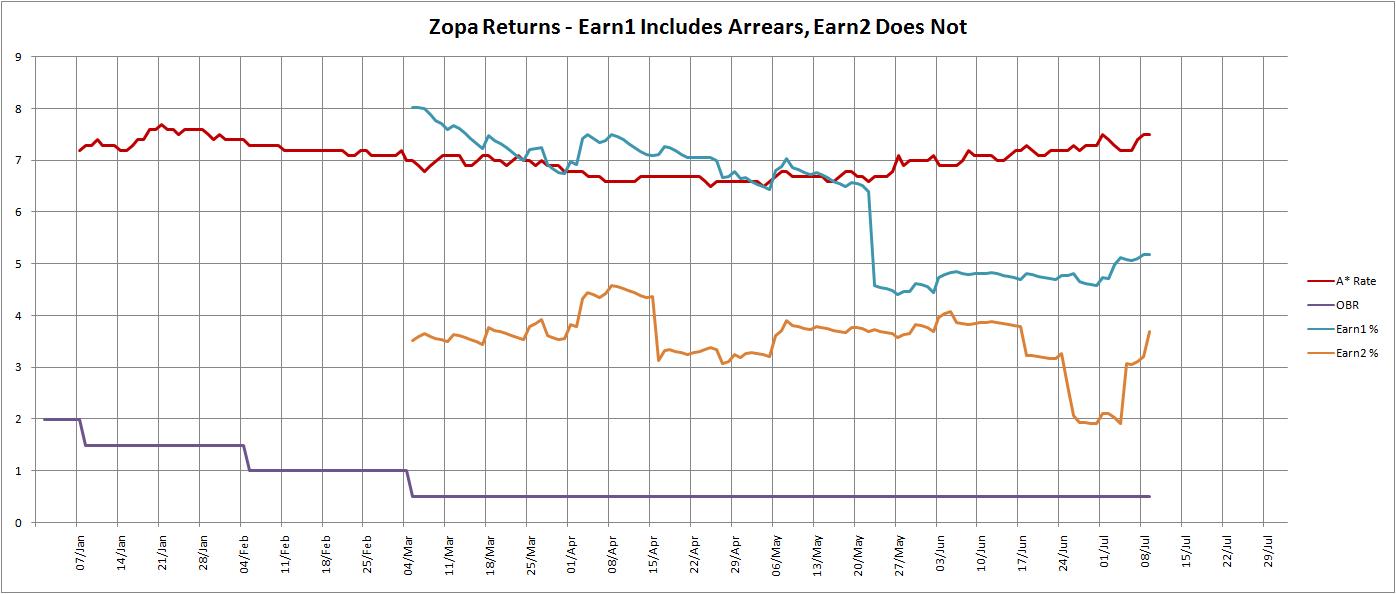
Zopa Returns Since January 2007
There are various lines shown on the graph.
- Red shows the A* lending rate
- Blue (Earn1) shows the returns discounting for any bad debt, but including accounts in arrears.
- Orange (Earn2) shows the returns discounting for any bad debt and arrears.
- Dark Blue at the bottom, is the OBR or Official Bank Rate
Notes.
- You will notice that Earn1, shows a large dip around the end of May. This was because I had a large default of £200 on a loan. I have now cut substantially the level I lend out in any individual tranch. It used to £200, but now it is just £30. The whole idea is to push the average level of loan to around £40 to £50, so that each deafult costs less. Admittedly, you will have more loans so it will be a case of swings and roundabouts.
- The dip and recovery in Earn2 was caused by payment difficulties at the start of some loans. So they went quickly from being in arrears to being up to date. You might blame computers and finger trouble, but I couldn’t possibly comment.
I’m happy with the returns and feel that by managing the lending properly, I can keep the Earn1 rate above five percent in these difficult times.
Zopa Interest Rates
Since the beginning of the year I have been tracking the rates that Zopa has been charging.
Rates obviously vary according to your credit rating and they are split into five bands; A*, A, B and C, with an additional Y or youth band. the A* rating is the highest and the C is the lowest, with Y being treated separately.
You can set your interest rates as you wish for the marketplace. I always set the rates so that money is let out quickly, by adjusting it to the lowest rate of their level of High.
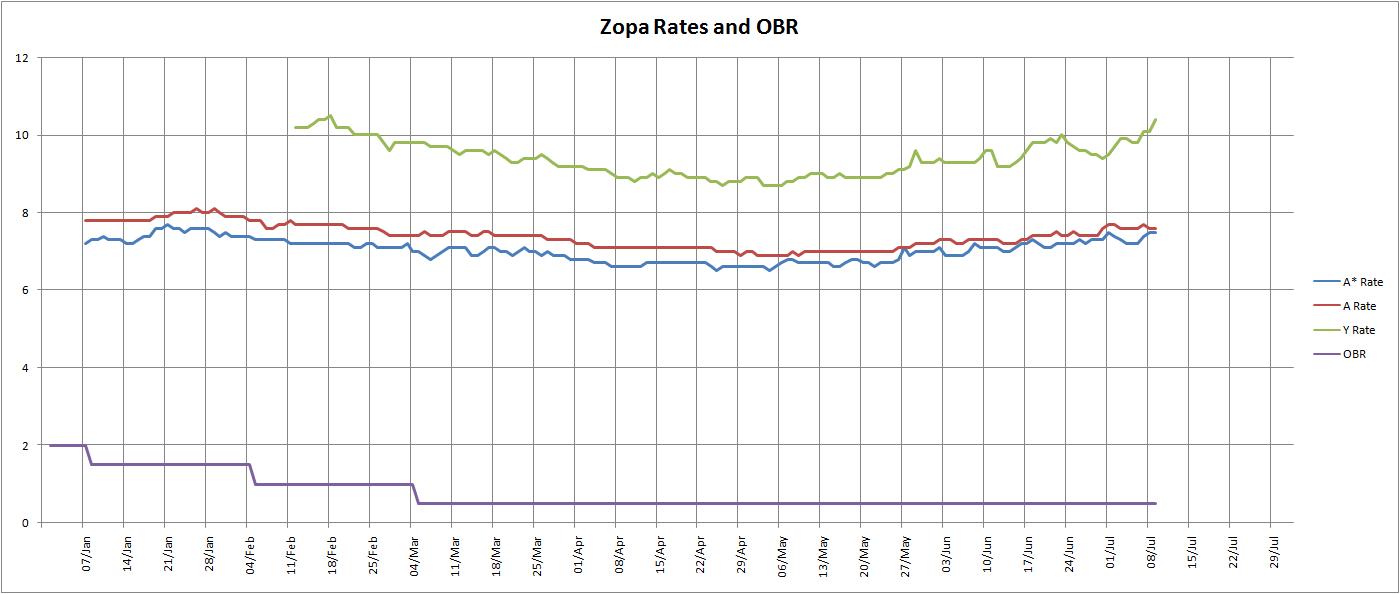
Zopa Rates Since January 2009
The line on the graph at the bottom is the OBR or Official Bank Rate and you can see it has really had no effect on the rate at which money is lent out by Zopa.
- Green is the Youth rate
- Red is the A rate
- Blue is the A* rate
As you can see rates have hardened since April and are probably now up by over a full point in the A rates and nearly double that in the Youth. Remember that Zopa is a closed system and that these rates will be set purely by the demand of the borrowers and the amount of money invested.
So much for the government trying to unlock lending with the banks.
As an aside here, I should say that I am a Control Engineer by training and know about these things and the various actions and reactions in systems. It is just a pity that these days those controlling the banking system still stick to the their tried and supposedly tested methods, rather than using some of the things I learned about in the 1960s.
I will return to this in another post.
Peer-to-Peer Lending – Zopa
The economy, and in particular the banking system, is suffering from two major problems.
- People like me, who have savings have no sensible place to put our money. You might just as well bury the cash in the garden. But what do you do if you have a flat?
- Others who want to borrow money, go through so many hoops with the banks, that they turn to dodgy sources of finance.
A quick point on borrowing is that I’ve had spam from the United States offering me loans at up to 180%. Not from suspicious operators, but supposedly reputable UK plcs. A quick letter to my MP and thankfully, he was able to push the rght buttons in government to get it all stopped.
There is a new system of lending called peer-to-peer lending.
A leading company and one of the first is Zopa, which was started by financial processionals in London. Their system is simple.
- Lenders club together to provide loans of up to £15,000 for others. This means that one loan may come from up to a couple of hundred lenders.
- Borrowers are properly credit checked and pay an arrangement fee of £100. One point for borrowers is that there is no fee for early repayment of the loan.
- Zopa does all the processing in the middle and charges one percent for this. So this means if I lend money out at 7%, then I effectively get 6%.
I signed up for Zopa in September 2008 and I now have over £30,000 invested.
From my experience, I now believe that peer-to-peer lending will become more and more commonplace, as we seek to replace the banks with something more akin to the twentieth century. And no I don’t mean the twenty-first century!
 The Anonymous Widower