Centrica To Invest In Fund Backing The Technologies Driving The Energy Transition
The title of this post, is the same as that of this press release from Centrica.
This is the sub-heading.
Centrica has made a $13.5 million anchor commitment to the first close of ERV Fund II, a new fund from London-based venture capital firm Energy Revolution. The fund is targeting US$50 million and invests at Seed and Series A in energy storage, grid technology and advanced materials.
These two paragraphs add more details.
The electrification of transport, heating and industry, alongside the rapid growth of data centres, is accelerating demand for electricity. That is putting greater pressure on the grids, storage systems, and materials needed to generate, move and deliver reliable power.
Founded in 2021, ERV Group backs early-stage energy technology companies through ERV Fund II and its venture builder, Prosemino. Its technical committee is led by three UK experts: Professor Paul Shearing, Director of the Zero Institute at Oxford University; Professor Chris Howard, Professor of Materials Physics at University College London; and Daniel Brett, CEO of Sention Technologies and formerly co-head of UCL’s Electrochemical Innovation Lab. The firm also has seven full-time PhDs across its technical team.
It looks to me, that this is a good long-term strategy from Centrica.
European Commission Greenlights France’s EUR 63 Billion Aid Scheme To Build 11 Offshore Wind Farms
The title of this post, is the same as that of this article on offshoreWIND.biz.
This is the sub-heading.
The European Commission has approved a EUR 63 billion French scheme to support the construction and operation of eleven offshore wind farms, in line with the objectives of the Clean Industrial Deal.
These three paragraphs add more detail.
The scheme was approved under the Clean Industrial Deal State Aid Framework (CISAF) adopted by the Commission on 25 June 2025.
France notified the Commission, under the CISAF, a scheme to support offshore wind energy to contribute to the objectives of the Clean Industrial Deal. The scheme will run for 25 years and has a maximum budget of EUR 63 billion.
The wind farms, located in the North Sea, the Atlantic and the Mediterranean, are expected to have a combined capacity of up to 11.1 GW and to generate up to 47.8 TWh of renewable electricity per year, or around 10.6 per cent of France’s annual electricity consumption.
I have highlighted this article, as it gives a lot of true figures about the cost of offshore wind farms in France.
The scheme costs in subsidy € 227027/GW/year.
Europe: New Fund To Upgrade Solar And Wind Assets With Battery Storage
The title of this post, is the same as that of this article on Review Energy.
This is the sub-heading.
The Aream Group has launched a new European investment vehicle targeting the renewable energy sector, with a strategy that combines power generation, storage and electricity marketing.
These three paragraphs add more details to the story.
The Clean Energy Future Fund II (CEFF II) will focus on integrating renewable generation assets with battery storage systems to improve the use of grid connections, which are increasingly scarce across European markets. According to Markus W. Voigt, Executive Chairman of aream Group, the hybrid model is designed to respond to growing volatility in electricity markets.
“With this hybrid approach, we are leveraging the changes and increased volatility in the European electricity markets for the benefit of our investors,” Voigt said.
The fund will primarily invest in Europe, with a particular focus on Germany, and will build on an existing portfolio of operational assets. A central element of the strategy is the addition of battery storage to solar and wind farms, allowing them to evolve from pure generation assets into providers of grid services.
I have a Google Alert which looks for “Energy Storage Fund” and this story was one of nine substantial stories.
This story talks about €400 million and two others talk about €300 million and AU $ 1.4 billion, respectively.
So hopefully, this money will help to mop up some of the energy wasted, when wind farms are curtailed.
Certainly, these funds don’t seem to have difficulty finding money to invest.
SSE And Centrica Lifted As UK Moves Wind And Solar Farms To Fixed-Price Contracts
The title of this post, is the same as that of this article on Proactive Investor.
These two paragraphs add more detail.
Shares in SSE PLC (LSE:SSE), Centrica and several renewable energy investment companies rose after the UK government confirmed plans to move older wind and solar farms onto fixed-price contracts, or else be hit with higher windfall taxes.
SSE, which owns windfarms and hydroelectric power plants, saw its share climb 3.3% to 2,610p on Tuesday, while fellow FTSE 100-listed energy producer Centrica PLC (LSE:CNA), which owns British Gas, and FTSE 250-listed biomass burner Drax Group (LSE:DRX) were up 2.3% and 1.8%.
In World’s Largest Wind Farm Attracts Huge Backing From Insurance Giant, I posted an article, about why insurance companies invest in renewables.
I suspect someone has come up with an idea to make wind farms more attractive for long term investors.
The new mechanism are called Wholsale Contracts for Different and have this aim.
The move is aimed at breaking the link between electricity prices and gas in the UK, as wholesale power prices are currently set based on the gas price, despite renewables generating a growing share of power.
The proposed wholesale CfDs would target legacy assets
This can only be good for the UK, as we have so many long term renewables.
I also wonder, whether they will make Highview Power’s liquid air batteries a worthwhile investment?
New Optimisation Agreement For 70 MW / 160 MWh BESS In Sweden
The title of this post is the same as that of this press release from Centrica.
This is the sub-heading.
Centrica Energy, the energy trading and optimisation arm of Centrica plc, has signed an optimisation agreement with Ånge Storage Solutions AB, a project company jointly established by Delta Capacity, a Swiss-based developer of utility-scale battery storage systems, and Wood & Co., a leading European investment bank and asset manager, for a 70 MW / 160 MWh battery project in Ånge, Sweden, scheduled to be commissioned in Q2 2026.
These three paragraphs add more detail.
Once operational, the Ånge project will be the largest BESS currently in operation in the Nordics, underlining the strong partnership between the companies and the project’s clear strategic significance and market impact. The project represents a major step forward for grid flexibility in Sweden, supporting the country’s rapidly growing renewable energy capacity while strengthening system stability in the SE2 bidding zone.
Under the agreement, Centrica Energy will act as optimiser for the project, providing 24/7 in-house trading and optimisation services. Leveraging advanced forecasting, real-time market benchmarking and AI-enhanced trading algorithms, Centrica Energy will optimise the battery across wholesale electricity markets and ancillary services, dynamically capturing value across multiple revenue streams.
The agreement on the Ånge project kicks off the partnership between Centrica Energy and Delta Capacity, underlining the companies’ shared ambition to accelerate flexible energy solutions across the Nordics.
It seems that Centrica are doing some serious programming, which mirrors the offbeat engineering, that was hinted at in Centrica Tackles Difficult Terrain To Deliver Sustainable Solar Solution For Derbyshire Manufacturer.
You can’t do anything but like Centrica’s robust attitude and their determination to get things done.
I also wonder, if Centrica are putting their expertise and technical excellence alongside the money and risk of others!
You can argue it was like that with Artemis in the last thirty years of the last century. One quarter million pound computer and software package would be planning and controlling the building of a multi-billion pound project.
I feel now, that I can say that now the Channel Tunnel is part of my history.
From the words of the press release, they seem to have developed a very-sophisticated hybrid-battery-control system, where types with expertise-honed on the trading floor or even the battlefield, could be intimately involved in the decisions.
As a check on my use of battlefield, I asked Google AI”if ex military weapons officers good operators on a city trading floor?” and received this reply.
Ex-military weapons officers—and military officers more broadly—can make excellent operators on a city trading floor, as their skill sets in leadership, pressure management, and risk assessment are highly transferable and increasingly sought after by financial institutions.
Key Reasons Military Officers Succeed as Traders
Decision-Making Under Extreme Pressure: Operational officers are accustomed to making critical, split-second decisions with limited information, which mirrors the environment of a volatile trading floor.
Risk Management & Discipline: The military teaches meticulous planning, risk mitigation, and strict adherence to procedures. In trading, this translates into managing margin, controlling losses, and following a strict, repeatable trading strategy.
High Mental Stamina and Resilience: The ability to stay calm and focused when others are losing their composure is a key trait that veterans bring, helping them survive high-stress trading scenarios.
Adaptability: The ability to respond to changing circumstances on the battlefield translates into managing portfolios in rapidly shifting market conditions.
Transferable Skills Checklist
Strategy & Logistics: Background in understanding supply chain imbalances (supply/demand).Communication: Ability to convey orders clearly and concisely.
Integrity: High level of discipline and accountability.
Potential Challenges and Considerations
While they possess strong psychological skills for trading, ex-military personnel often face a steep learning curve regarding technical financial knowledge and specific market terminology. Furthermore, the transition from a highly structured hierarchy to a meritocracy—where the only measure of success is profit/loss—requires a change in mindset.
Industry Adoption
Banks and trading firms in both the UK and US have recognized the value of these skills, with firms like Citibank and various prop firms establishing veteran-focused programs to hire and train former military personnel.
Conclusion
If ex-military weapons officers can adapt their ability to assess risks and manage operations to financial data, their natural inclination to stay calm under pressure and operate with discipline makes them top candidates for trading roles.
What Offshore Wind Turbine Components Can Be Transported By RORO Ferries?
I asked Google AI, the title of this post and received this answer.
Roll-on/Roll-off (RORO) ferries, specifically specialized vessels like the Rotra class (Rotra Vente, Rotra Mare, Rotra Futura), are used to transport major, oversized offshore wind turbine components. These vessels allow large parts to be rolled directly on and off the deck using hydraulic ramps, mitigating the need for heavy-lift cranes in some cases.
Wind Turbine Blades: Modern RORO vessels can transport massive rotor blades—sometimes over 100 meters long—stowed in tiers (up to 12 or more blades per trip).
Nacelles: RORO vessels can carry multiple complete nacelles for large-scale direct-drive wind turbines.
Tower Sections: These vessels can accommodate large tower sections, often transporting multiple sections at once.
Hubs: Hub components can be transported via RORO, especially when loaded onto specialized trucks.
Drivetrains and Transformers: Internal components and large drivetrain assemblies are transported in the holds.
Floating Substructures/Substructures: In addition to the turbine itself, specialized RORO systems can transport components of floating substructures, such as secondary steel, inverters, and mooring equipment.
Advantages of RORO for Wind Components
Reduced Handling: Eliminates the need for cranes to lift heavy items, reducing the risk of damage during transport.
High Efficiency: Allows rapid loading and unloading of numerous large items simultaneously.
Protection: Specialized RORO vessels often feature telescopic roofs to protect sensitive nacelles from saltwater spray.
Efficiency for Large Projects: Specifically designed for handling large-scale offshore wind projects, such as the North Sea developments.
Specialized vessels, such as the Rotra Futura and Rotra Horizon, are designed to handle even larger, heavier components for next-generation offshore wind farms, and they often include cranes to complement their RORO loading method.
This article on offshoreWIND.biz is entitled RoRo Offshore Vessel Rotra Futura Hits the Water, and gives a full description of the vessel and her sister; Rotra Horizon.
This is the sub-heading.
The first of two offshore wind Roll-on/Roll-off (RoRo) vessels, the Rotra Future, designed to transport wind turbine components, has been launched at Jiangsu Zhenjiang Shipyard in China.
These four paragraphs give details of the design, financing, construction and ownership of the two vessels.
Concordia Damen has collaborated with Amasus, deugro Denmark, Siemens Gamesa, and DEKC Maritime in the development and construction of two RoRo vessels, namely Rotra Futura and Rotra Horizon.
The vessels, of which the first one was launched recently at the shipyard in China, are designed for the transport of large, and ever growing, wind turbine components.
The design of the two RoRo vessels builds on the previous ships in the Rotra concept, the Rotra Mare and Rotra Vente, which were also developed by Concordia Damen and have been operating since 2016.
These vessels are designed with a RO/RO (Roll-On/Roll-Off) system and an innovative ramp, allowing for the safe and efficient transport of larger loads.
Ocasio-Cortez, Markey Ask Trump Admin To Explain Paying TotalEnergies USD 1 Billion ‘In Taxpayer Money’ To Drop Offshore Wind Projects
The title of this post, is the same as that of this article on offshoreWIND.biz.
This is the sub-heading.
US lawmakers Alexandria Ocasio-Cortez and Ed Markey have sent a letter to Secretary of the Interior Doug Burgum on the plan by the Trump administration to pay nearly USD 1 billion to TotalEnergies to cancel offshore wind projects off the US East Coast, calling on the administration to stop the payment and explain the legal basis and funding source for the proposed transfer.
These four paragraphs add detail to the story.
As reported recently, the US government’s agreement with TotalEnergies concerns the company’s exit from offshore wind development in the country by relinquishing leases for projects off New York/New Jersey and North Carolina, for which the administration intends to pay approximately USD 928 million.
The agreement also stipulates that TotalEnergies would redirect that money to oil & gas projects in the US. The company, in a press release issued after signing the agreement with the government, indicated that it would invest proceeds from the payment into a liquefied natural gas export facility in Texas and other oil and gas activities in the US that will support both domestic supply and the demand in Europe.
As reported recently, the US government’s agreement with TotalEnergies concerns the company’s exit from offshore wind development in the country by relinquishing leases for projects off New York/New Jersey and North Carolina, for which the administration intends to pay approximately USD 928 million.
The agreement also stipulates that TotalEnergies would redirect that money to oil & gas projects in the US. The company, in a press release issued after signing the agreement with the government, indicated that it would invest proceeds from the payment into a liquefied natural gas export facility in Texas and other oil and gas activities in the US that will support both domestic supply and the demand in Europe.
Trump may have got what he wanted and stopped development of wind farms, but at what cost to US taxpayers?
Out of curiosity, I asked Google AI, “Which LNG Terminal In Texas Have TotalEnergies Agreed To Develop”, And Received This Answer.
TotalEnergies has agreed to develop and invest in the Rio Grande LNG (RGLNG) project located in South Texas.
Key details regarding TotalEnergies’ involvement include:
Partnership: In June 2023, TotalEnergies signed a framework agreement with NextDecade Corporation to participate in the development of the Rio Grande LNG project.
Ownership and Phase 1: TotalEnergies holds a 16.67% stake in the first phase of the project, which includes three liquefaction trains with an annual capacity of 17.5 million tons per annum (Mtpa).
Offtake Agreement: TotalEnergies has agreed to purchase 5.4 million tons per annum (Mtpa) of LNG from Phase 1 for 20 years.
Expansion (Train 4): As of September 2025, TotalEnergies has reached a Final Investment Decision (FID) for a 10% stake in the joint venture developing Train 4 of the Rio Grande LNG facility.
NextDecade Stake: TotalEnergies also acquired a 17.5% stake in NextDecade Corporation, the developer of the project.
The Rio Grande LNG project is located in Brownsville, Texas, and is expected to contribute to TotalEnergies’ goal of expanding its U.S. LNG export capacity to 15 million tons annually by 2030.
I shall be watching this project. Especially, as several new techniques have come forward in the last few months.
EU, France Grant EUR 126 Million For BW Ideol’s Floating Foundation Factory
The title of this post, is the same as that of this article on offshoreWIND.biz.
This is the sub-heading.
BW Ideol has signed the final grant agreement for up to EUR 74 million from the EU Innovation Fund for a factory in Fos-sur-Mer, France, that will produce concrete floating wind foundations. The factory, dubbed Fos3F, has also secured up to EUR 52 million from the French State.
These three paragraphs add more detail.
The final agreement for the EU Innovation Fund grant was signed on 19 March, after BW Ideol revealed in November 2025 that the Fos3F was selected for up to EUR 74 million in funding by the European Commission.
The French government awarded support for the project at the end of 2025 through the C3IV tax credit scheme, dedicated to supporting leading French companies in the Green Industry. The funding from the French State will cover up to EUR 52 million to partially fund development and capital expenditures.
According to BW Ideol, if built, the Fos3F will be a first-of-its-kind factory dedicated to the serial production of concrete floating wind foundations based on the company’s patented Damping Pool.
The factory is stated to have a capacity of thirty foundations per year.
This Google Map shows the location of Fos-sur-Mer.
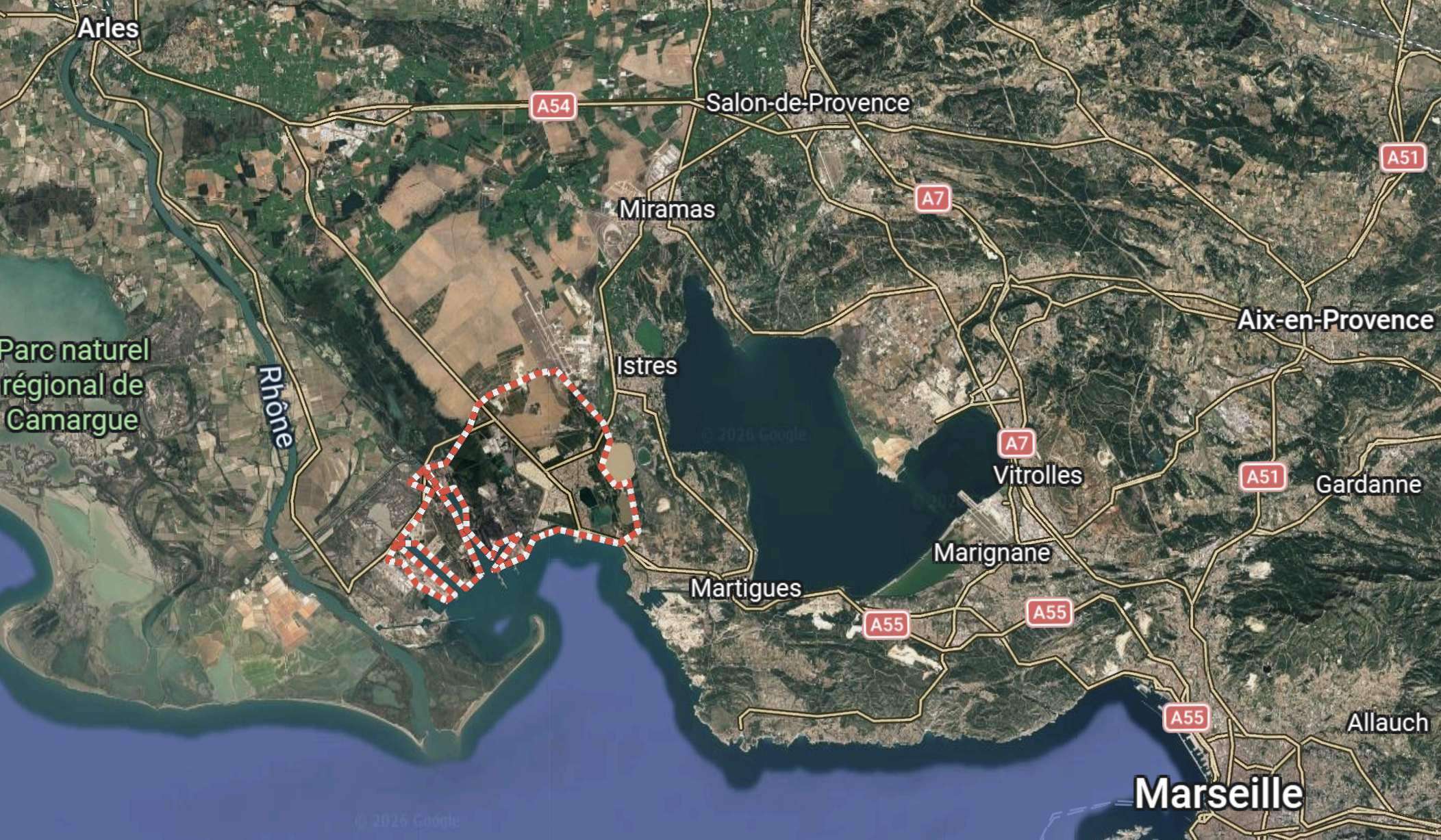
Note.
- Arles is in the North-West corner.
- Marseille is in the South-East corner.
- The mouth of the Rhône River is in between.
- Fos-sur-Mer is outlined by the red-and-white border.
Google AI says there is significant steel making at the mouth of the Rhône River.
I also asked Google AI, “What turbines will BW Ideol floating foundations support? and received this reply.
BW Ideol’s floating foundations are designed to be universal, supporting all major 15 MW+ offshore wind turbines currently on the market, with scalability to future 20 MW+ platforms. Their concrete barge-type technology—using the Damping Pool® design—is compatible with both existing and next-generation turbine manufacturers.
Key Compatibility Details:
15 MW+ and 20 MW+ Turbines: The foundations are engineered for current large-scale turbines (15 MW+) and are ready to accommodate upcoming 20 MW+ turbines, with designs already certified by DNV.
Proven Technology: The technology has been in operation since 2018 at the Floatgen site in France (using a Vestas V80 2 MW turbine) and in Japan, covering both shallow and deep-water applications.
Universal Application: The design is tailored for diverse metocean conditions and is designed to support the commercial deployment of large turbines in projects like the Buchan Offshore Wind project in Scotland.
Production Scalability: The concrete floating platforms are designed for mass production, capable of being manufactured quickly in a factory setting, such as the proposed Fos-sur-Mer site, to meet the schedules of major developers.
These foundations have received Design Certification from DNV, confirming their suitability for large-scale, commercial floating wind farms.
My Thoughts:
Concrete v. Steel: I used to work with someone, who was a big advocate of concrete yachts. Also check out the Wikipedia entry for the Troll A platform, which is a concrete Norwegian gas platform.
Zero-Carbon: I wouldn’t be surprised if concrete manufacture emits less carbon, than steel.
Port Talbot: Will BW Ideol build a similar factory at Port Talbot? I wrote about the Port Talbot factory in Port Talbot To Become Offshore Wind Hub For Celtic Sea. Both sites are next to a large bay, which would be ideal for parking completed floats and a world-class steelworks.
Buchan: Buchan’s web site says it will use seventy BW Ideol floats and generate I GW, 75 km. to the North-East of Fraserburgh. Google AI said the floats will be built at the Port of Ardersier.
Will A Mini-Steel Mill Be Built At The Port Of Ardersier?
I asked Google AI, the question in the title of this section and received this reply.
Yes, a £300 million green steel mill is planned for the Ardersier Port redevelopment as part of its transformation into a circular Energy Transition Facility. This facility aims to process scrap steel from decommissioned oil rigs into new materials to support offshore wind developments, alongside creating a concrete production plant.
Key details regarding the development:
Purpose: The mill is intended to process scrap from offshore decommissioning.
Technology: It is planned as a green steel plant.
Integration: It is aimed to be integrated into a new, fully circular “Energy Transition Facility”.
Context: While the facility aims for circular steel production, the port is primarily focused on becoming a hub for offshore wind and manufacturing.
Recent developments as of March 2026 suggest a focus on a “scaled back,” more achievable vision by new owners/managers, focusing on floating concrete wind turbine bases. Additionally, recent UK government intervention restricted a large Chinese-backed manufacturing plan at the site due to security concerns.
Vestas Unveils Plans For V236-15.0 MW Nacelle Factory In Scotland
The title of this post, is the same as that of this article on offshoreWIND.biz.
This is the sub-heading.
Vestas plans to build a nacelle and hub assembly facility in Scotland to support offshore wind projects in the UK and across Europe.
These four paragraphs give what looks to be a full outline of a more or less comprehensive plan.
The proposed factory would require a capital investment of more than EUR 250 million and is planned to manufacture nacelles and hubs for the company’s V236-15.0 MW offshore wind turbine. The new facility is expected to create up to 500 direct jobs, with additional employment across the supply chain.
According to Vestas, the plan to set up the factory follows the results of the Contracts for Difference Allocation Round 7 (AR7) in January 2026, the company’s growing offshore wind order book in the UK, and strategic discussions with the UK and Scottish governments on the next steps to develop and co-invest in the facility.
The plan also includes the potential co-location of suppliers producing other major turbine components, as part of a broader manufacturing setup.
The final investment decision (FID) on the new factory will depend on Vestas securing sufficient UK-based orders for the AR7 projects and those from the upcoming AR8. Subject to the timing of those results and the planning process, the facility could begin production by 2029 or 2030, Vestas said on 25 March.
- V236-15.0 turbines are 15 MW turbines, for which Vestas have 256 orders in the UK for Inchcape, Norfolk Vanguard East and Norfolk Vanguard West.
- In addition to new wind farms, will these large turbines be used for refitting to older wind farms?
- If other manufacturers or components could be involved, this would surely be sensible.
The picture in the original article shows the large size of these nacelles, which would suggest a site with good access to water might be good to ease transport.
Did The Help For Steel, Six Days Ago Help?
On the 19th March, I wrote UK Steel Industry Backed By Major New Trade Measure And Strategy. Did this help for steel to formulate Vestas’s plans? I wouldn’t be surprised, if the steel can be taken to the site Vesta chooses by rail or water.

